Mastering BPO: The Ultimate Guide to Workforce Management
A comprehensive guide to BPO workforce management covering forecasting, capacity planning, scheduling, real-time adherence, performance management, WFM software, employee engagement, and future trends for call center and contact center operations.
5 min read

Vik Chadha
Vik is a co-founder and investor in a number of high-tech companies.

On this page
Imagine trying to navigate a bustling city without a map, without traffic lights, or even a sense of direction. That’s what running a Business Process Outsourcing (BPO) operation—whether a call center, contact center, or back-office hub—without robust Workforce Management (WFM) can feel like. You’ve got agents, clients, and an endless stream of customer interactions, but without the right systems in place, chaos quickly ensues. This guide is your map, your compass, and your traffic control system, designed to equip you with the knowledge to not just survive, but to thrive in the complex world of BPO WFM.
The Pulse of Performance: Why Workforce Management is BPO's Secret Weapon
In the high-stakes environment of BPO call center operations, where razor-thin margins and demanding service level agreements (SLAs) are the norm, performance isn’t just a goal; it’s the very heartbeat of your operation. And at the core of that heartbeat lies Workforce Management. Think of WFM as the conductor of a magnificent orchestra. Each musician (agent) has a critical part to play, but without the conductor ensuring perfect timing, harmony, and rhythm, the performance falls flat.
For BPO, WFM isn’t merely an administrative function; it’s a strategic imperative. It’s the difference between meeting your client’s SLAs consistently and facing penalties. It’s the key to maintaining a high-quality customer experience (CX) and avoiding agent burnout. In an industry where efficiency and effectiveness are paramount, mastering effective workforce management isn’t just an advantage—it’s your secret weapon for sustained success.
Unpacking Workforce Management in BPO: What It Really Means
When we talk about Workforce Management in BPO, many immediately think of scheduling. While scheduling is undeniably a crucial component, it’s just one piece of a much larger, more intricate puzzle. Let’s dismantle this concept and understand its true scope.
It’s Not Just About Scheduling: The Four Pillars of WFM
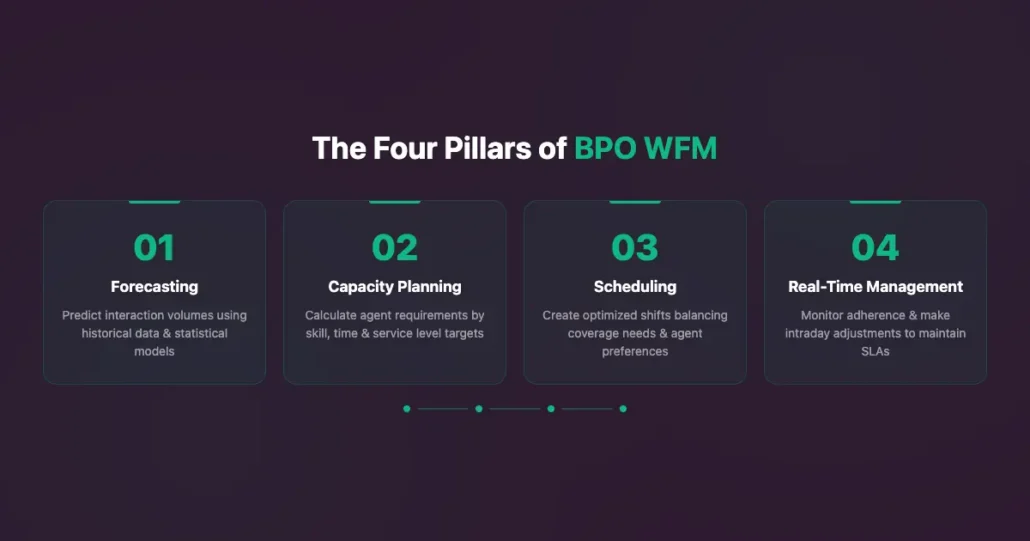
True WFM in BPO is built upon four interconnected pillars, each supporting the others to create a resilient and responsive operational framework.
First, there’s forecasting. This is where we look into the future, predicting the volume of customer support interactions (calls, chats, emails, etc.) your team will handle, when they’ll arrive, and how long they’ll take. Without accurate forecasting, all subsequent steps are built on shaky ground.
Next, we have capacity planning. Based on those forecasts, capacity planning determines how many agents you’ll need, with what skills, at specific times, to handle the predicted workload. It’s about ensuring you have the right number of people in the right place at the right time.
Then comes scheduling and rostering. This is where the rubber meets the road. It involves creating precise agent schedules that align with your capacity plan, assigning shifts, breaks, and training sessions to optimize workflows and coverage while meeting service targets—and also considering agent preferences and labor laws.
Finally, there’s intraday management, real-time adherence, and performance management. This pillar focuses on monitoring agents’ activities against their schedules in real-time, making adjustments as needed to handle demand fluctuations, and continuously analyzing performance data to identify areas for improvement, both for individual agents and the operation as a whole.
These four pillars don’t operate in isolation; they are in constant dialogue, feeding information back and forth to ensure the entire system remains agile and optimized.
Why the Stakes Are Higher in BPO
Why is call center workforce management so uniquely critical in BPO compared to an in-house contact center? The answer lies in the very nature of outsourcing. BPO companies operate under strict contractual obligations with their clients. These contracts often include stringent SLAs related to average speed of answer (ASA), abandonment rates, first call resolution (FCR), and customer satisfaction (CSAT) scores. Missing these targets doesn’t just mean unhappy customers; it can lead to financial penalties, damage to reputation, and ultimately, loss of client contracts.
Furthermore, BPO operations typically manage multiple clients, each with their own distinct service requirements, peak times, and customer demographics. This adds layers of complexity to forecasting and scheduling. You’re not just managing one queue; you’re often managing dozens, each with its own rhythm. The need for precise resource allocation and real-time adaptability becomes paramount. Without exceptional WFM, BPO providers risk a constant state of firefighting, leading to agent burnout, high attrition, and dissatisfied clients.
The Foundation: Forecasting and Capacity Planning
Every magnificent building starts with a solid foundation, and in WFM, that foundation is built on accurate forecasting and meticulous capacity planning. Get these wrong, and your entire operation will wobble.
Predicting the Future: The Art and Science of Forecasting
Forecasting is where you gaze into the crystal ball, not with magic, but with data. It’s the process of predicting future contact volumes and average handle times (AHT) with the greatest possible accuracy. This isn’t just guessing; it’s a blend of historical data analysis, statistical modeling, and understanding external factors.
Imagine a call center handling customer service for an e-commerce giant. Forecasting isn’t simply looking at last Tuesday’s call volume and assuming next Tuesday will be the same. You need to consider historical trends: weekly, monthly, seasonal (e.g., Black Friday, holiday shopping), and annual patterns. Was there a marketing campaign that spiked calls last month? Is a product recall imminent? What’s the impact of an upcoming system outage, unexpected disruptions, or a major product launch?
The “science” part involves using sophisticated algorithms and statistical methods (like time-series analysis, regression analysis, or exponential smoothing) to identify patterns and project future demand. The “art” comes in adjusting these statistical predictions with qualitative insights—those external factors that data alone might not capture. This could be a new client signing, a change in business processes, or even global events that might impact customer behavior. A skilled forecaster acts like a detective, unearthing every piece of relevant information to paint the most accurate picture of future demand.
The goal isn’t perfect prediction—that’s impossible—but to minimize the forecast error. A small percentage error in forecasting can lead to significant overstaffing (wasted costs) or understaffing (missed SLAs, frustrated customers, and burned-out agents).
Building the Blueprint: Capacity Planning for Success
Once you have your forecast, you move to capacity planning, which is essentially designing the blueprint for your workforce. This is where you translate those predicted interaction volumes into actual staffing requirements.
Think of it this way: your forecast tells you that next Tuesday, between 10 AM and 11 AM, you expect 500 calls, each taking an average of 5 minutes to handle. Capacity planning then asks: how many agents do I need to handle those 500 calls within an acceptable wait time (e.g., 20 seconds ASA), considering factors like agent occupancy, adherence, shrinkage, and desired service levels?
This often involves sophisticated calculations using Erlang C formulas, which are mathematical models specifically designed for queuing theory in call centers. These formulas help determine the number of agents required to achieve specific service levels given a certain call volume and AHT.
Beyond just the raw numbers, capacity planning also considers the skills matrix of your agents. Do you need agents fluent in specific languages? Agents trained on particular products or services? What about agents capable of handling email and chat, or those specifically trained for high-value customer segments? It’s not just about bodies; it’s about the right bodies with the right skills.
Capacity planning also accounts for “shrinkage”—the percentage of time agents are paid but not available to handle customer interactions. This includes breaks, lunches, training, team meetings, coaching sessions, sick leave, vacations, and even system downtime. Failing to factor in shrinkage means you’ll always be understaffed, no matter how good your initial agent count seems. Getting capacity planning right ensures you have the optimal number of agents, with the right skills, available precisely when they’re needed, creating the perfect balance between cost efficiency and service quality.
Orchestrating the Talent: Scheduling and Roster Management
With a solid foundation of forecasting and capacity planning, you’re ready to orchestrate your most valuable asset: your agents. This is where scheduling and roster management take center stage, translating the blueprint into a living, breathing operational plan.
The Dynamic Dance of Shift Planning
Shift planning in a BPO is a dynamic dance, a complex puzzle where you’re trying to fit irregular pieces together perfectly. Your capacity plan tells you precisely how many agents you need, by skill set, for every 15-minute or 30-minute interval throughout the day, week, and month. Shift planning then involves crafting individual agent schedules—their start and end times, their breaks, lunches, and even off-phone activities like training or coaching—to match that required coverage as closely as possible.
This isn’t about creating static 9-to-5 shifts. Modern BPO operations demand flexibility. You might have split shifts, part-time shifts, overnight shifts, or even “micro-shifts” designed to cover particularly tricky peak intervals. The challenge is balancing this operational need for coverage with agent preferences, labor laws, and fair work distribution. A good WFM scheduler understands that a happy agent is a productive agent, and strives to create schedules that minimize burnout while maximizing operational efficiency. Well-designed workflows streamline the entire shift planning process, reducing manual effort and improving accuracy.
Imagine trying to cover the peaks and valleys of customer demand for a global client operating across multiple time zones. You might need a surge of agents in the morning for North American customers, another peak for European business hours, and a smaller, specialized team for overnight support. Manually managing this intricate web of requirements for hundreds or even thousands of agents quickly becomes impossible without specialized tools.
Beyond the Schedule: Real-time Adherence and Optimization
Once schedules are published, the work of WFM is far from over. In fact, it’s just beginning. This leads us to real-time adherence and optimization. Think of it as the air traffic control tower for your contact center.
Real-time adherence monitors whether agents are actually following their assigned schedules. Is an agent scheduled to be on a call but is instead on an unscheduled break? Is someone supposed to be in training but is still logged into the queue? WFM tools provide real-time alerts for these deviations, allowing supervisors and WFM analysts to intervene immediately.
Why is this so crucial? Because even small deviations, when multiplied across many agents, can quickly lead to service level failures. If 10 agents are 5 minutes late returning from break during a peak interval, that’s 50 agent-minutes of lost capacity when you needed it most. Real-time monitoring allows for immediate correction, preventing a small ripple from becoming a tidal wave.
Beyond adherence, real-time optimization involves making tactical adjustments on the fly. A sudden, unexpected surge in calls? WFM might recommend temporarily pulling agents from non-essential tasks, postponing training, or initiating overtime. A sudden drop in volume? Agents might be sent to training, given early breaks, or tasked with offline work to maintain efficiency. This constant, agile adjustment ensures that your BPO contact center operation remains responsive and resilient, no matter what the day throws at it.
Cultivating Growth: Performance Management and Coaching
Workforce Management isn’t just about moving pieces on a chessboard; it’s about nurturing the players. Performance management and coaching are integral parts of WFM, transforming raw data into actionable insights that drive individual and team growth.
Measuring What Matters: Key Performance Indicators (KPIs) in BPO WFM
In the world of BPO, data is king. WFM provides a wealth of information, but it’s crucial to measure the right things. KPIs act as your scorecard, telling you how well your WFM strategies are translating into operational success and client satisfaction.
Some core KPIs you’ll obsess over include:
- Service Level (SL): The percentage of contacts answered within a specified time frame (e.g., 80% of calls answered within 20 seconds). This is often a critical contractual SLA.
- Average Speed of Answer (ASA): The average time a customer waits before their call is answered.
- Abandonment Rate: The percentage of callers who hang up before reaching an agent. High abandonment rates signal understaffing or long wait times.
- Average Handle Time (AHT): The average time an agent spends on a customer interaction, from start to finish. This impacts capacity planning.
- Occupancy Rate: The percentage of time an agent spends actively handling customer interactions (calls, chats, emails) versus waiting for interactions. High occupancy can lead to burnout; low occupancy signals inefficiency.
- Adherence to Schedule: The percentage of time agents are logged in and available according to their schedule.
- Forecast Accuracy: How close your forecasted volumes and AHT were to actuals. This directly impacts staffing efficiency.
- Shrinkage: The percentage of paid time agents are not available to handle contacts due to breaks, training, meetings, etc.
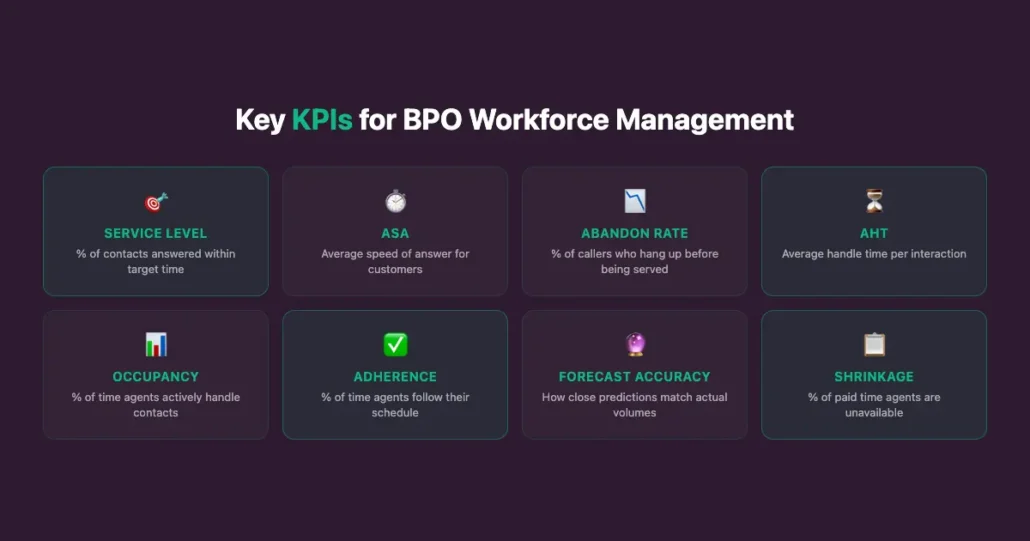
These KPIs are not just numbers; they tell a story. A sudden dip in service level might point to a forecasting error, a spike in AHT could indicate a training gap, or a consistent low adherence rate might signal issues with agent engagement or scheduling practices. WFM uses these metrics to diagnose problems and prescribe solutions.
Empowering Your Team: The Role of Coaching and Development
The most sophisticated WFM systems are only as effective as the people operating within them. This is where coaching and development become critical. WFM data isn’t just for management; it’s a powerful tool for empowering agents.
Imagine an agent struggling with a high AHT. Instead of simply penalizing them, WFM data allows supervisors to pinpoint why. Is it a lack of product knowledge? Difficulty navigating systems? Inefficient call closing? By leveraging call recordings and performance metrics alongside schedule adherence, coaches can provide targeted feedback. “I see you’re struggling with the new billing system. Let’s schedule a 30-minute refresher training during your planned offline time tomorrow morning, as per your WFM schedule.”
WFM can also identify top performers, allowing for “best practice” sharing and peer coaching. It can highlight skill gaps across the team, informing training needs and development programs. By integrating performance data from WFM with quality assurance (QA) scores, BPO operations can create a holistic view of agent effectiveness, fostering a culture of continuous improvement. When agents understand how their individual performance contributes to overall client SLAs, and see a clear path for growth, they become more engaged and productive.
The Human Element: Employee Engagement and Retention
In an industry notorious for high turnover, the human element of WFM cannot be overstated. Beyond the algorithms and schedules, WFM directly impacts the daily lives of your agents, profoundly influencing their engagement and your ability to retain them.
More Than Just a Number: Fostering a Positive Work Environment
For an agent, their schedule is their lifeblood. It dictates when they can pick up their kids, attend appointments, or simply have downtime. A WFM system that prioritizes efficiency above all else, without considering agent well-being, is a recipe for disaster. Agents who constantly feel like cogs in a machine, with unpredictable schedules or unfair shift assignments, quickly become disengaged.
Effective WFM, however, can be a powerful tool for fostering a positive work environment. Transparent scheduling practices, allowing agents input into their preferences (e.g., bidding for shifts, requesting specific days off), and providing stable, consistent schedules where possible, demonstrate that the organization values its employees. When agents feel heard and respected, and their work-life balance is considered, their morale and productivity soar.
WFM also plays a role in workload management. Overworked agents who are constantly slammed with calls and rarely get a moment to breathe will burn out quickly. Underworked agents, on the other hand, can become bored and disengaged. WFM, through its precise forecasting and capacity planning, aims to create an optimal workload—challenging but not overwhelming—ensuring agents feel productive without feeling perpetually stressed. It’s about finding that sweet spot where agents are busy and engaged, but also have sufficient breaks and support.
The Ripple Effect: How WFM Impacts Attrition
High attrition rates are a silent killer in BPO. The cost of recruiting, hiring, and training new agents is substantial, and a constant churn severely impacts operational consistency, service quality, and overall profitability. WFM directly influences attrition in several critical ways.
Firstly, scheduling fairness and predictability. Agents often leave jobs due to unpredictable schedules, lack of work-life balance, or feeling unfairly treated in shift assignments. A well-implemented WFM system promotes equity, providing mechanisms for fair shift distribution and clear communication about schedule changes.
Secondly, workload management. As mentioned, consistently high occupancy and intense call volumes without adequate breaks or support lead to burnout. WFM’s ability to accurately staff and reallocate resources in real-time can mitigate these pressures, ensuring agents aren’t constantly pushed to their breaking point.
Thirdly, career development. By identifying performance gaps and strengths, WFM data supports targeted coaching and development. Agents who see opportunities for growth and feel their skills are being honed are more likely to stay. They feel invested in, rather than just utilized.
Finally, employee voice. Modern WFM solutions often integrate with agent self-service portals, allowing them to view schedules, request time off, and even swap shifts with colleagues. This level of autonomy and control over their work lives significantly boosts satisfaction and reduces the feeling of being “managed.” When WFM empowers agents, rather than simply dictates to them, it creates a more stable, committed workforce, directly impacting retention rates and saving the BPO significant operational costs.
Technology as Your Co-Pilot: WFM Tools and Solutions
Trying to run a sophisticated BPO WFM operation with spreadsheets is like trying to cross an ocean in a rowboat. While possible, it’s inefficient, prone to error, and ultimately limits your potential. Technology is not just an aid; it’s your indispensable co-pilot.
Beyond Spreadsheets: The Power of Dedicated WFM Software
Dedicated Workforce Management software transforms the entire call center workforce management lifecycle, moving it from reactive firefighting to proactive strategic management. These platforms integrate the four pillars of WFM—forecasting, capacity planning, scheduling, and real-time adherence—into a cohesive, automated system.
Imagine the sheer complexity of manually forecasting call volumes for multiple clients, each with different SLAs and historical trends, across various channels. A WFM software suite uses advanced algorithms to analyze vast datasets, identifying patterns and generating highly accurate forecasts in minutes, a task that would take days or weeks manually.
Then, taking those forecasts, it automatically calculates optimal staffing levels using sophisticated Erlang C models, accounting for shrinkage, desired service levels, and agent skills. This frees up WFM analysts from tedious calculations, allowing them to focus on strategic insights.
The scheduling engine then takes these capacity plans and intelligently builds schedules, balancing operational needs with agent preferences, labor laws, and collective bargaining agreements. It can even automate shift bids or allow agents to swap shifts, significantly reducing administrative overhead.
In real-time, these systems provide dashboards that offer a bird’s-eye view of your operation. You can see agent adherence, current service levels, queue depths, and incoming volumes, all updated instantaneously. Automated alerts notify WFM teams of potential service level breaches, allowing for immediate interventions. This real-time visibility is impossible with manual methods and is the cornerstone of agile BPO operations.
Furthermore, WFM software often includes robust reporting and analytics capabilities. You can track KPI trends, analyze schedule efficiency, measure forecast accuracy, and identify performance bottlenecks with unprecedented detail, driving continuous improvement across the entire contact center operation.
Choosing the Right Tools for Your BPO Operation
Selecting the right call center workforce management software is a critical decision, as it will impact your operational efficiency, client satisfaction, and agent morale for years to come. Here are key considerations:
- Scalability: Can the software grow with your BPO? Will it handle thousands of agents and dozens of clients without performance degradation?
- Integration Capabilities: Does it integrate seamlessly with your existing ACD (Automatic Call Distributor), CRM, HR systems, and payroll software? Data silos are efficiency killers.
- Forecasting Accuracy: Look for solutions with robust, configurable forecasting models that can handle various data patterns and adjust for external factors.
- Scheduling Flexibility: Does it support complex scheduling rules, multi-skill routing, agent preferences, and automated shift bidding?
- Real-time Management: Evaluate the real-time adherence monitoring, alerting capabilities, and dynamic adjustment tools.
- Reporting and Analytics: Look for customizable dashboards, insightful reports, and the ability to drill down into specific metrics.
- User Interface (UI) / User Experience (UX): Is it intuitive for WFM analysts, supervisors, and agents? A clunky interface will hinder adoption and efficiency.
- Vendor Support and Training: What kind of support does the vendor offer during implementation and ongoing use?
- Pricing and Cost vs. ROI: Evaluate pricing models carefully and calculate the potential return on investment through improved efficiency, cost savings from reduced attrition, and enhanced client satisfaction.
Don’t rush this decision. Conduct thorough demos, speak to references, and ideally, run a pilot program to ensure the chosen solution truly meets the unique demands of your BPO environment.
The Road Ahead: Future Trends in BPO Workforce Management
The BPO landscape is constantly evolving, driven by technological advancements and shifting customer expectations. Workforce Management, far from being static, is at the forefront of these changes, adapting and innovating to meet new challenges. Industry case studies consistently show that organizations investing in next-generation WFM technology see measurable improvements in service levels and agent satisfaction.
AI and Machine Learning: Smarter Decisions, Faster
Artificial intelligence (AI) and machine learning (ML) are not just buzzwords; they are poised to revolutionize WFM. Imagine forecasts that automatically learn from past errors and adapt to real-time events with uncanny accuracy. ML algorithms can analyze not just historical call volumes, but also sentiment from past interactions, social media trends, and even weather patterns to predict micro-spikes in demand more precisely.
AI can also optimize scheduling beyond human capabilities. AI-powered WFM systems can generate optimal schedules in seconds, considering hundreds of variables simultaneously—agent skills, preferences, training needs, regulatory compliance, and multiple client SLAs—creating hyper-efficient rosters that minimize costs and maximize service levels.
Furthermore, AI-driven WFM can proactively identify potential issues. For instance, ML can flag agents at risk of burnout based on their schedule patterns, performance trends, and adherence data, prompting early intervention. It can even suggest dynamic real-time adjustments, recommending precisely which agents to re-skill, cross-train, or move between queues based on live data and predicted future needs, all without human intervention, ensuring smoother operations and superior customer experiences.
Remote and Hybrid Workforces: New Paradigms for WFM
The pandemic irrevocably altered how BPO operations function, ushering in an era of widespread remote and hybrid workforces. This new paradigm presents both opportunities and challenges for WFM.
WFM now needs to account for geographical distribution of agents, varying internet connectivity, and ensuring secure access to systems. Scheduling becomes more flexible, allowing for agents to work from different locations and time zones. Real-time adherence needs to adapt to monitoring agents who aren’t physically present in a central facility, often relying on desktop monitoring and virtual check-ins.
Moreover, managing engagement and performance for a distributed team requires new WFM strategies. How do you facilitate coaching sessions virtually? How do you maintain team cohesion and a positive work environment when agents are physically isolated? Future WFM solutions will integrate more robust collaboration tools, virtual performance management, and even gamification to keep remote teams connected and motivated. It’s about extending the reach and control of WFM beyond the four walls of a traditional call center or contact center.
The Evolving Customer Journey: Adapting WFM to Omnichannel
Customers today interact with businesses across a multitude of channels: phone, email, chat, social media, messaging apps, and self-service portals. The customer journey is no longer linear, and WFM must adapt to this omnichannel reality.
Traditional WFM focused primarily on voice calls. Now, it needs to forecast and staff for a blended environment. How do you predict the volume of simultaneous chats versus emails? How do you cross-train agents to handle multiple channels efficiently? How do you ensure consistent service levels across all interaction types?
Future WFM solutions will offer integrated omnichannel forecasting and scheduling, allowing BPOs to optimize resources across all channels from a single platform. This will include sophisticated skill-based routing that ensures customers are connected to the most appropriate agent, regardless of the channel they choose. It will also involve measuring agent performance not just by AHT on calls, but by average resolution time on chat, email backlog clearance, and overall customer journey satisfaction, providing a truly holistic view of agent effectiveness in an interconnected world.
Your Blueprint for BPO WFM Mastery
You now hold the blueprint for BPO WFM mastery. We’ve journeyed from understanding its fundamental importance to dissecting its core pillars, from the foundational science of forecasting to the art of human orchestration, and finally, to the transformative power of technology and future trends.
Remember, Workforce Management isn’t a static tool; it’s a dynamic, living system that requires constant attention, adaptation, and refinement. It’s the engine that drives efficiency, the compass that guides client satisfaction, and the heart that keeps your agents engaged.
By embracing these principles, investing wisely in technology, and consistently putting your people at the center of your WFM strategy, you won’t just manage your BPO operation—you will master it, unlocking unparalleled levels of performance, profitability, and lasting success. Go forth, build your WFM fortress, and let it propel your BPO to new heights.
Start your outsourcing company’s transformation today!
Say hello to productivity, accuracy, and profitable growth. Streamline your operations and project management with HiveDesk.