Child Labor Laws in the US — Federal & State Rules for 2026

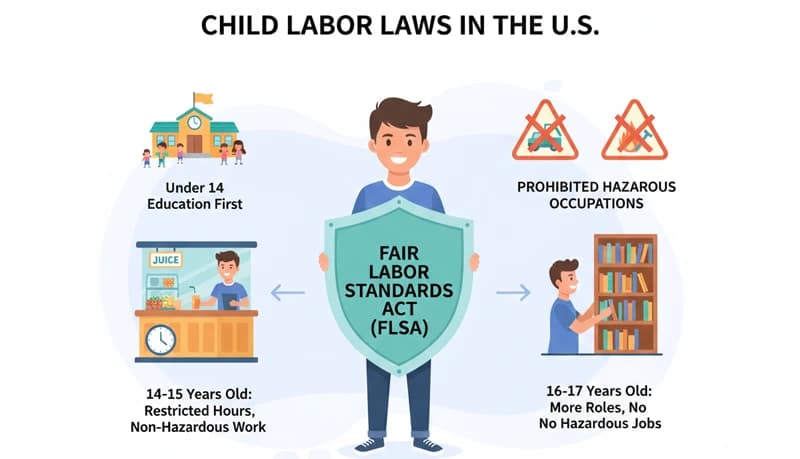
Federal child labor laws set the baseline for employing minors in the United States — minimum ages, hour limits, and prohibited occupations. Many states have additional requirements that are stricter than the federal standard: shorter work hours, earlier curfews, work permit requirements, or additional prohibited jobs. When federal and state laws differ, employers must follow whichever law is more protective of the minor.
This guide covers the federal rules in detail, highlights every state with requirements that exceed the federal standard, and addresses the practical compliance questions employers face.
Federal child labor rules (FLSA)
The Fair Labor Standards Act regulates child labor through three mechanisms: minimum age requirements, work hour restrictions, and hazardous occupation prohibitions. Employee time tracking software helps employers verify that minor employees stay within the legally permitted hours.
Minimum age by job type
| Age | What they can do |
|---|---|
| 18+ | No restrictions — any job, any hours |
| 16–17 | Any non-hazardous job, unlimited hours (but cannot work in occupations declared hazardous by the Department of Labor) |
| 14–15 | Limited non-manufacturing, non-mining, non-hazardous jobs. Primarily retail, food service, office work, and similar occupations |
| Under 14 | Generally cannot be employed. Exceptions: acting/performing, newspaper delivery, working for a parent's non-hazardous business, and certain agricultural work |
Work hour limits for 14- and 15-year-olds
The FLSA restricts when and how much 14- and 15-year-olds can work:
During the school year:
- Maximum 3 hours on a school day
- Maximum 18 hours in a school week
- Work only between 7:00 AM and 7:00 PM
During summer (June 1 – Labor Day):
- Maximum 8 hours on a non-school day
- Maximum 40 hours in a non-school week
- Work permitted between 7:00 AM and 9:00 PM
There are no federal hour limits for 16- and 17-year-olds — they can work any number of hours. However, many states impose limits on 16- and 17-year-olds that federal law does not.
Hazardous occupations
The Department of Labor has designated 17 "Hazardous Occupations Orders" (HOs) that prohibit minors under 18 from performing certain types of work:
- Operating power-driven machinery (woodworking, metalworking, bakery equipment, paper products machines)
- Operating motor vehicles or serving as outside helpers on motor vehicles
- Mining and quarrying
- Logging and sawmill work
- Roofing and excavation work
- Slaughtering and meatpacking
- Wrecking, demolition, and shipbreaking
- Manufacturing or storing explosives
- Work involving exposure to radioactive substances
Some of these prohibitions have limited exemptions for student-learner programs and apprenticeships under specific conditions.
Agricultural employment
Agricultural child labor rules are significantly different from non-agricultural rules:
- Age 16+ — Any agricultural job, including hazardous
- Age 14–15 — Any non-hazardous agricultural job, with parental consent or outside school hours
- Age 12–13 — Non-hazardous agricultural work with parental consent, or on a farm where a parent is employed
- Under 12 — May work on a farm owned or operated by a parent, or on small farms with parental consent (exempt from most FLSA provisions)
Work permits and age certificates
Federal law does not require work permits, but it allows employers to request age certificates to verify a minor's age as protection against unintentional violations. Most states, however, require work permits (also called "employment certificates") — see the state-by-state section below.
Federal penalties
- Civil penalty: Up to $15,138 per minor employed in violation of child labor provisions
- Enhanced penalty: Up to $68,801 if the violation causes serious injury or death to a minor
- Criminal penalty: Willful violations can result in fines up to $10,000 and imprisonment for repeat offenders
- Hot goods provision: Goods produced in violation of child labor laws may be barred from interstate commerce
States with stricter requirements
Most states follow the federal FLSA standards for minimum age (14) and basic hour limits. The states below have requirements that exceed the federal baseline in one or more areas. If your state is not listed here, federal FLSA rules apply as the standard.
Alaska
- Hours for 14–15: Maximum 4 hours on school days (stricter: federal allows weekday limits), 23 hours in school weeks
- Hours for 16–17: Maximum 6 hours on school days
- Night work for 14–15: Cannot work past 9:00 PM (federal: 7 PM during school year)
California
- Work permit required for all minors under 18
- Hours for 16–17 during school: Maximum 4 hours on school days, 48 hours per week when school is not in session
- Night work for 16–17: Cannot work past 10:00 PM on nights preceding a school day (12:30 AM on non-school nights)
- Entertainment industry has specific permit requirements and on-set education rules
Connecticut
- Work permit required for minors under 16
- Hours for 16–17: Maximum 6 hours on school days
- Night work: 16–17-year-olds cannot work past 10:00 PM on nights before school days (11:00 PM on non-school nights)
Florida
- Hours for 14–15: Maximum 15 hours in school weeks (federal: 18 hours) and 8 hours on non-school days
- Hours for 16–17: Maximum 30 hours in school weeks, 8 hours on school days
- Night work for 16–17: Cannot work past 11:00 PM on nights before school days
Illinois
- Work permit required for minors under 16
- Hours for 14–15: Maximum 3 hours on school days, 24 hours in school weeks (federal: 18)
- Hours for 16–17: Maximum 8 hours per day when school is not in session
- Night work: 14–15-year-olds cannot work past 7:00 PM; 16–17-year-olds cannot work past midnight (10:00 PM on school nights)
Maryland
- Work permit required for minors under 18
- Hours for 14–15: Follow federal limits
- Hours for 16–17: Maximum 5 hours on school days during the school year
- Night work for 16–17: Cannot work past 11:00 PM on school nights
Massachusetts
- Work permit required for all minors under 18
- Hours for 14–15: Maximum 3 hours on school days, 18 hours in school weeks
- Hours for 16–17: Maximum 9 hours per day, 48 hours per week
- Night work: 14–15-year-olds cannot work past 7:00 PM (9:00 PM during summer); 16–17-year-olds cannot work past 10:00 PM on school nights (11:15 PM on non-school nights)
- 30-minute break required for shifts over 6 hours (applies to minors specifically)
New York
- Work permit required for all minors under 18
- Hours for 14–15: Maximum 3 hours on school days, 18 hours in school weeks
- Hours for 16–17: Maximum 4 hours on school days, 28 hours in school weeks, 8 hours on non-school days, 48 hours in non-school weeks
- Night work for 16–17: Cannot work past 10:00 PM (midnight with written parental and school consent in certain circumstances)
- Minors under 18 are prohibited from working in factories in New York
Ohio
- Work permit required for minors under 18 (called "age and schooling certificate")
- Hours for 14–15: Maximum 3 hours on school days, 18 hours in school weeks
- Hours for 16–17: Maximum 8 hours per day, cannot work before 6:00 AM or after 11:00 PM on school nights
Oregon
- Work permit required for minors under 18 (annual employer authorization)
- Hours for 14–15: Follow federal limits
- Hours for 16–17: Maximum 44 hours per week, no daily maximum
- Night work for 16–17: Cannot work past 10:00 PM on school nights
Pennsylvania
- Work permit required for minors under 18 (transferable work permit)
- Hours for 14–15: Maximum 3 hours on school days, 18 hours in school weeks
- Hours for 16–17: Maximum 8 hours per day, 28 hours in school weeks, 44 hours in non-school weeks
- Night work: 14–15-year-olds cannot work past 7:00 PM (except during summer); 16–17-year-olds cannot work past midnight on school nights
Washington
- Work permit required for minors under 18 (parent/school authorization)
- Hours for 14–15: Maximum 3 hours on school days, 16 hours in school weeks
- Hours for 16–17: Maximum 4 hours on school days, 20 hours in school weeks
- Night work for 16–17: Cannot work past 10:00 PM on school nights (midnight on non-school nights)
- Washington's school-week limits for 16–17-year-olds are among the strictest in the country
States that follow federal standards
The following states do not impose child labor requirements stricter than the federal FLSA for most non-agricultural employment. Federal hour limits, age minimums, and hazardous occupation rules apply. Some may still require work permits — check your state's labor department.
Alabama, Arizona, Arkansas, Colorado, Delaware, Georgia, Hawaii, Idaho, Indiana, Iowa, Kansas, Kentucky, Louisiana, Maine, Michigan, Minnesota, Mississippi, Missouri, Montana, Nebraska, Nevada, New Hampshire, New Jersey, New Mexico, North Carolina, North Dakota, Oklahoma, Rhode Island, South Carolina, South Dakota, Tennessee, Texas, Utah, Vermont, Virginia, West Virginia, Wisconsin, Wyoming
Work permit requirements
Many states require minors to obtain a work permit (also called an employment certificate) before starting a job. The process typically requires:
- The minor obtains the permit application from their school
- The employer completes the section describing the job duties and hours
- A parent or guardian signs, giving consent
- The school issues the permit after verifying the minor's age, enrollment status, and academic standing
Employer responsibilities:
- Do not allow a minor to start work until the permit is on file
- Keep the permit accessible for inspection
- Return the permit to the issuing school when the minor's employment ends
- Some states require a new permit for each employer; others allow transferable permits
Employer compliance basics
Verify age before hiring
Request proof of age for any applicant who appears to be under 18. Acceptable documents include a birth certificate, driver's license, passport, or state-issued age certificate. Document what you verified and when — "I didn't know they were a minor" is not a defense against child labor violations.
Post required notices
Federal law requires posting the FLSA minimum wage poster, which includes child labor provisions, in a conspicuous location. Many states require additional postings specific to minor employment.
Schedule within legal limits
Configure your scheduling software to enforce hour and curfew restrictions for minor employees. A system that allows you to flag employees by age group and apply different scheduling rules prevents accidental violations that could occur when a manager manually builds schedules.
Track hours accurately
Track hours worked by minor employees separately and review them weekly. The most common violation is exceeding daily or weekly hour limits — often unintentionally when a minor picks up extra shifts or stays late.
Maintain records
Keep the following records for every minor employee:
- Full name, date of birth, and home address
- Work permit (if required by state)
- Daily and weekly hours worked
- Time of day worked (to verify curfew compliance)
- Occupation performed
Retain records for at least 3 years. For more on state-specific labor law requirements, see our labor law compliance center.