How to Reduce Overtime and Labor Costs in BPO

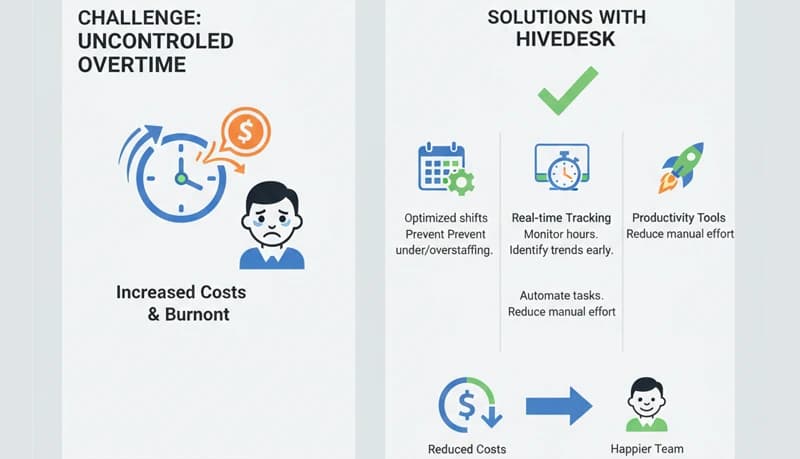
BPO labor cost management is harder than in a single-purpose operation because you are managing multiple clients, contracts, and service types simultaneously. An agent might work on Client A's inbound queue in the morning and Client B's back-office processing in the afternoon — and the overtime generated by one account gets absorbed by the other.
This multi-client complexity means that standard overtime advice ("schedule better") is insufficient. BPO overtime problems often stem from contract structures that do not match staffing realities, account-level inefficiencies that are invisible in aggregate data, and cross-account scheduling conflicts. Fixing them requires understanding where costs are generated at the account level, not just the center level. A BPO workforce management solution with account-level time tracking makes this visibility possible.
Understand your cost structure by account
The most important thing a BPO can do for labor cost control is know the actual cost of serving each client. Aggregate labor cost numbers hide the accounts that are profitable and the ones that are quietly losing money.
Calculate loaded cost per agent-hour
Your loaded cost includes everything you pay for an hour of agent time:
Loaded hourly cost = (base wage + benefits + training + overhead) ÷ productive hours
A typical calculation: agent earns $15/hour, benefits add 30% ($4.50/hour), training and overhead add $2/hour. That is $21.50/hour in total cost. If the agent is productively utilized 78% of paid time, the loaded cost per productive hour is $21.50 ÷ 0.78 = $27.56.
When overtime is involved, the cost jumps: the wage component goes to $22.50/hour (1.5x), making the total $29/hour loaded, or $37.18 per productive hour. Every overtime hour costs 35% more than a regular hour.
Track overtime by account
BPO overtime is often caused by a single account but distributed across the payroll. If Client A's volume spikes on Tuesdays and agents working that account accumulate overtime, the cost shows up as general overtime — not as a Client A problem.
Track time at the account level and attribute overtime to the account that generated it. This tells you:
- Which accounts are consistently generating overtime (and whether the contract covers it)
- Whether an account's revenue justifies its actual labor cost including overtime
- Where to focus scheduling fixes for the greatest impact
Measure account profitability
Account profit = account revenue − (regular hours × loaded regular cost) − (overtime hours × loaded overtime cost)
Run this calculation monthly for every account. An account that looks profitable on paper may be unprofitable once you attribute the overtime it generates. This data gives you leverage in contract renegotiations and helps you make informed decisions about which accounts to grow and which to restructure.
Align contracts with staffing realities
Many BPO overtime problems originate in the contract, not on the floor. Contracts that guarantee specific headcounts, fixed coverage windows, or rigid staffing ratios can force overtime when a more flexible arrangement would serve both parties.
Common contract-driven overtime traps
Fixed headcount requirements. A contract requiring 20 dedicated agents during all operating hours forces you to staff 20 agents even during periods when volume only requires 12. When volume peaks require 25, you either pull agents from other accounts (disrupting those) or run overtime.
Extended coverage windows. A contract requiring 16-hour coverage (6 AM–10 PM) with a team sized for 8-hour shifts creates scheduling math that almost always produces overtime. Covering 16 hours with 8-hour shifts and accounting for breaks, absences, and shrinkage requires more agents than the contract may be priced for.
Inflexible SLA targets. SLAs that require 95% of calls answered within 15 seconds demand higher staffing levels than 80/20 targets. If the contract pricing does not account for the staffing required to meet the SLA, the resulting overtime erodes your margin.
What to negotiate
When renewing or renegotiating contracts:
- Volume-based staffing instead of fixed headcounts — staff to demand rather than a fixed number
- Overtime pass-through clauses that allow you to bill overtime when client-driven volume exceeds forecasts
- Shared accountability for forecasting — if the client's forecast is consistently low, the resulting overtime should be reflected in billing
- Seasonal staffing adjustments built into the contract for accounts with predictable volume fluctuations
Optimize cross-account scheduling
BPO scheduling is more complex than single-client scheduling because you are juggling multiple accounts with different volume patterns, skill requirements, and coverage windows.
Cross-train agents across accounts
Agents who can work on multiple accounts give you scheduling flexibility that single-account agents cannot. When Client A's volume drops in the afternoon while Client B peaks, cross-trained agents can shift between accounts instead of sitting idle on one and generating overtime on the other.
How to implement:
- Identify accounts with complementary volume patterns (one peaks when the other is slow)
- Select agents to cross-train — start with your most experienced and adaptable staff
- Train in batches, not all at once, so you do not disrupt current operations
- Track proficiency on each account separately so you know which agents can handle which work
The investment in cross-training pays for itself quickly. If 20% of your agents can flex across two or three accounts, your scheduling efficiency improves significantly.
Build shared agent pools
Instead of dedicating all agents to specific accounts, maintain a shared pool of cross-trained agents who can be deployed where demand is highest on any given day. The dedicated agents provide baseline coverage; the shared pool absorbs peaks.
| Staffing layer | Purpose | Sizing |
|---|---|---|
| Dedicated agents | Baseline coverage per account | Sized for average volume |
| Shared pool | Peak coverage and absence backfill | 15–20% of total headcount |
| Part-time agents | Scheduled peak coverage | Sized for predictable daily peaks |
This structure reduces overtime because peaks on one account can be absorbed by the shared pool rather than extending shifts for dedicated agents.
Coordinate schedules across accounts
When accounts are scheduled independently, you get conflicts: Agent X is scheduled for Client A from 8–4 and Client B from 3–11, creating an overlap that either goes to overtime or leaves one account short. Central scheduling that considers all account assignments for each agent prevents these conflicts.
Reduce shrinkage
Shrinkage — the percentage of paid time when agents are unavailable for client work — is a major driver of BPO labor costs because every percentage point of shrinkage means you need proportionally more agents (and more overtime to cover gaps).
Target the controllable categories
| Category | Typical % | Controllable? | How to reduce |
|---|---|---|---|
| Scheduled breaks | 5–8% | Partially | Optimize break timing to minimize coverage impact |
| Training | 3–6% | Yes | Consolidate training; use e-learning during slow periods |
| Team meetings | 2–4% | Yes | Reduce frequency; keep to 15 minutes; stagger across teams |
| Unplanned absence | 4–8% | Partially | Address root causes (burnout, morale, scheduling fairness) |
| System downtime | 1–3% | Yes | IT infrastructure investment |
| Account transitions | 1–2% | Yes | Streamline account-switching tools and processes |
BPOs have an additional shrinkage category that single-client operations do not: account transitions. The time agents spend switching between accounts — logging into different systems, reviewing different scripts, mental context-switching — adds up. If your agents switch accounts 4 times per shift and each transition takes 3 minutes, that is 12 minutes per agent per day lost to transitions.
Fix: Make account switching faster (single sign-on, unified desktop, pre-loaded scripts) and minimize unnecessary switches. Schedule longer blocks on each account rather than frequent rotation.
Control overtime at the shift level
Set overtime thresholds and alerts
Configure your time tracking system to flag agents approaching overtime thresholds:
- Alert at 36 hours — gives supervisors time to adjust the remaining schedule
- Alert at 38 hours — last chance to prevent overtime by releasing agents early
- Hard stop at 40 hours — any work beyond this point must be explicitly approved by a manager who understands the cost
Use voluntary overtime (VOT) instead of mandatory
When overtime is genuinely needed, offer it voluntarily first. Agents who choose overtime are more productive during those hours and less likely to burn out than agents who are forced to stay. Track who volunteers and rotate opportunities to prevent the same agents from always working extra.
Offer voluntary time off (VTO) during slow periods
When volume is below forecast, offer agents the option to leave early. This recovers hours that would otherwise be idle — and prevents agents from accumulating unnecessary hours that push them toward overtime later in the week.
Measure results
Track these metrics monthly to assess whether your cost reduction efforts are working:
| Metric | Formula | Target |
|---|---|---|
| Overtime % of total hours | OT hours ÷ total hours | Under 5% |
| Overtime by account | OT hours attributed to each client | Identify top contributors |
| Productive utilization | Client work hours ÷ total paid hours | 75–85% |
| Shrinkage rate | Non-productive hours ÷ total paid hours | Under 30% |
| Cost per productive hour | Total labor cost ÷ productive hours | Track trend |
| Account profitability | Revenue − loaded labor cost per account | Positive for all accounts |
| Turnover rate (annualized) | Departures ÷ avg headcount × 100 | Under 35% |
Review at the account level, not just the center level. A center-wide overtime rate of 4% can mask one account at 12% and another at 0%. The account at 12% is the problem to solve — and it might be a contract problem, not a scheduling problem.
For more on BPO-specific time tracking and billing, see our guide on time tracking best practices for BPO companies. For labor law compliance across multi-site operations, see our labor law compliance center.