Paid Sick Leave Laws in the US — State-by-State Guide

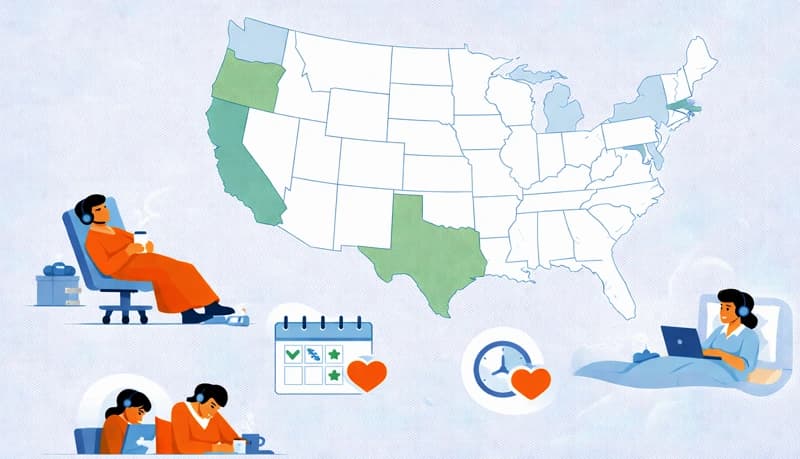
There is no federal law requiring private employers to provide paid sick leave. The decision is left to individual states — and the result is a patchwork of different requirements, accrual rates, caps, and employer thresholds that varies significantly depending on where your employees work.
As of early 2026, roughly half of US states plus Washington D.C. have enacted some form of paid sick leave or paid leave mandate. The rest have no state requirement, though some have cities or counties with local ordinances.
This guide covers federal requirements, every state with a mandate (with specifics on accrual and caps), and which states have no requirement. Using employee time tracking software with built-in leave management helps you track accruals and usage accurately across jurisdictions.
Federal requirements
There is no general federal paid sick leave mandate for private employers. Two federal provisions are relevant:
Family and Medical Leave Act (FMLA) — Provides up to 12 weeks of unpaid, job-protected leave for serious health conditions, caring for a family member, or bonding with a new child. Applies to employers with 50 or more employees within a 75-mile radius. FMLA does not require paid leave — it only protects the employee's job while they are on leave.
Executive Order 13706 — Requires federal contractors and subcontractors to provide up to 56 hours (7 days) of paid sick leave per year. Employees accrue 1 hour for every 30 hours worked. Unused leave carries over. This applies only to employees working on or in connection with covered federal contracts.
States with paid sick leave mandates
The following states require employers to provide paid sick leave (or paid leave that can be used for sick time). Details vary by state — pay attention to employer size thresholds, accrual rates, and annual caps.
Arizona
- Applies to: All employers
- Accrual: 1 hour per 30 hours worked
- Annual cap: 24 hours (fewer than 15 employees) / 40 hours (15+ employees)
California
- Applies to: All employers
- Accrual: 1 hour per 30 hours worked
- Annual cap: 40 hours (fewer than 25 employees) / 80 hours (25+ employees), or employers may front-load 40/80 hours at start of year
Colorado
- Applies to: All employers
- Accrual: 1 hour per 30 hours worked
- Annual cap: 48 hours
Connecticut
- Applies to: Employers with 25 or more employees (expanding to all employers by 2027)
- Accrual: 1 hour per 30 hours worked
- Annual cap: 40 hours
Illinois
- Applies to: All employers (statewide Paid Leave for All Workers Act, effective January 2024)
- Accrual: 1 hour per 40 hours worked
- Annual cap: 40 hours
- Note: This is paid leave usable for any reason, not limited to sick time. Chicago has a separate ordinance with additional sick leave requirements.
Maine
- Applies to: Employers with more than 10 employees
- Accrual: 1 hour per 40 hours worked
- Annual cap: 40 hours
- Note: This is earned paid leave usable for any reason, not limited to sick time.
Maryland
- Applies to: Employers with 15 or more employees (smaller employers must provide unpaid sick leave)
- Accrual: 1 hour per 30 hours worked
- Annual cap: 40 hours
Massachusetts
- Applies to: All employers (employers with fewer than 11 employees must provide unpaid sick leave)
- Accrual: 1 hour per 30 hours worked
- Annual cap: 40 hours
Michigan
- Applies to: All employers
- Accrual: 1 hour per 30 hours worked
- Annual cap: 72 hours
Minnesota
- Applies to: All employers (statewide Earned Sick and Safe Time law, effective January 2024)
- Accrual: 1 hour per 30 hours worked
- Annual cap: 48 hours
Missouri
- Applies to: All employers (Proposition A, effective May 2025)
- Accrual: 1 hour per 30 hours worked
- Annual cap: 40 hours (fewer than 15 employees) / 56 hours (15+ employees)
Nebraska
- Applies to: All employers (Initiative 436, effective October 2025)
- Accrual: 1 hour per 30 hours worked
- Annual cap: 40 hours (fewer than 20 employees) / 56 hours (20+ employees)
Nevada
- Applies to: Employers with 50 or more employees
- Accrual: 0.01923 hours per hour worked (approximately 1 hour per 52 hours worked)
- Note: This is paid leave usable for any reason, not limited to sick time.
New Jersey
- Applies to: All employers
- Accrual: 1 hour per 30 hours worked
- Annual cap: 40 hours
New Mexico
- Applies to: All employers
- Accrual: 1 hour per 30 hours worked
- Annual cap: 64 hours
New York
- Applies to: All employers
- Accrual: 1 hour per 30 hours worked
- Annual cap: 40 hours (1–4 employees, net income over $1M) / 40 hours (5–99 employees) / 56 hours (100+ employees)
- Note: Employers with 1–4 employees and net income under $1M must provide unpaid sick leave.
Oregon
- Applies to: All employers (employers with fewer than 10 employees must provide unpaid sick leave; 6+ in Portland)
- Accrual: 1 hour per 30 hours worked
- Annual cap: 40 hours
Rhode Island
- Applies to: Employers with 18 or more employees (smaller employers must provide unpaid sick leave)
- Accrual: 1 hour per 35 hours worked
- Annual cap: 40 hours
Vermont
- Applies to: All employers
- Accrual: 1 hour per 52 hours worked
- Annual cap: 40 hours
Virginia
- Applies to: Home health workers only (not a general mandate)
- Accrual: 1 hour per 30 hours worked
- Annual cap: 40 hours
Washington
- Applies to: All employers
- Accrual: 1 hour per 40 hours worked
- No annual accrual cap (employers may cap use)
Washington D.C.
- Applies to: All employers
- Accrual: 1 hour per 37 hours worked (1–24 employees) / 1 hour per 37 hours worked with higher cap (25–99 employees) / 1 hour per 37 hours worked (100+ employees)
- Annual cap: 3 days (1–24 employees) / 5 days (25–99 employees) / 7 days (100+ employees)
States with local ordinances only
These states have no statewide paid sick leave mandate, but one or more cities or counties within the state require it:
- Pennsylvania — Philadelphia and Pittsburgh have paid sick leave ordinances. Philadelphia: 1 hour per 40 hours worked, up to 40 hours per year, applies to employers with 10+ employees (unpaid for smaller employers). Pittsburgh's ordinance has faced legal challenges.
States with no paid sick leave mandate
The following states have no state-level requirement for employers to provide paid sick leave. Employers in these states may still be subject to federal requirements (Executive Order 13706 for federal contractors) or local ordinances.
Alabama, Alaska, Arkansas, Delaware, Florida, Georgia, Hawaii, Idaho, Indiana, Iowa, Kansas, Kentucky, Louisiana, Mississippi, Montana, New Hampshire, North Carolina, North Dakota, Ohio, Oklahoma, South Carolina, South Dakota, Tennessee, Texas, Utah, West Virginia, Wisconsin, Wyoming
Common permitted uses for paid sick leave
Most state laws allow employees to use accrued sick leave for:
- Personal illness or injury — Physical or mental health conditions, medical diagnosis, preventive care, or treatment
- Family member care — Caring for a sick child, spouse, parent, or other family member (definition of "family member" varies by state)
- Domestic violence, sexual assault, or stalking — Time off for medical care, legal proceedings, counseling, or relocation related to these situations
- Public health emergencies — When a workplace, school, or childcare facility is closed due to a public health emergency
Employer compliance basics
Regardless of which state mandate applies, most paid sick leave laws share common compliance requirements:
Accrual tracking — Employers must track hours worked and sick leave accrued for each employee. Most states require that accrual begins on the first day of employment, though use may be restricted until after a waiting period (commonly 90 days).
Notice and posting — Most states require employers to notify employees of their sick leave rights, either at hire, via posted workplace notices, or both.
Record keeping — Employers must maintain records of hours worked, sick leave accrued, sick leave used, and balances. Retention periods vary but are typically 3 years.
Anti-retaliation — All state sick leave laws prohibit retaliation against employees who use or request sick leave. This includes termination, demotion, reduction in hours, or any other adverse action.
Carryover vs. front-loading — Most states require that unused sick leave carries over to the next year (though employers may cap the total balance). As an alternative, many states allow employers to front-load the full annual allotment at the start of the year, which eliminates the need to track accrual and carryover.
What employers should do
If you have employees in multiple states — which is common for businesses with remote teams — compliance gets complicated quickly. The law that applies is typically based on where the employee works, not where the employer is headquartered.
Audit your obligations. Identify every state and locality where your employees work. Check whether a paid sick leave mandate applies, and if so, what the specific requirements are for accrual, caps, permitted uses, and record keeping.
Choose a single policy that meets the strictest standard. If you operate in multiple states, it's often simpler to adopt a single paid sick leave policy that meets or exceeds the most generous state requirement. This avoids managing different accrual rates and caps for different employees.
Configure your time tracking and payroll systems. Your systems need to track accrual, usage, and balances per employee. If you use different policies by state, your system must apply the correct rules based on each employee's work location.
Document your policy. Put your sick leave policy in writing and distribute it to all employees. Include accrual rates, caps, permitted uses, notice requirements, and the process for requesting leave.
Paid sick leave laws are actively evolving — several states and cities pass new requirements each year. Review your obligations annually and whenever you hire employees in a new state. For the most current information, check our labor law compliance center or consult an employment attorney.