Work Opportunity Tax Credit (WOTC) — Who Qualifies and How

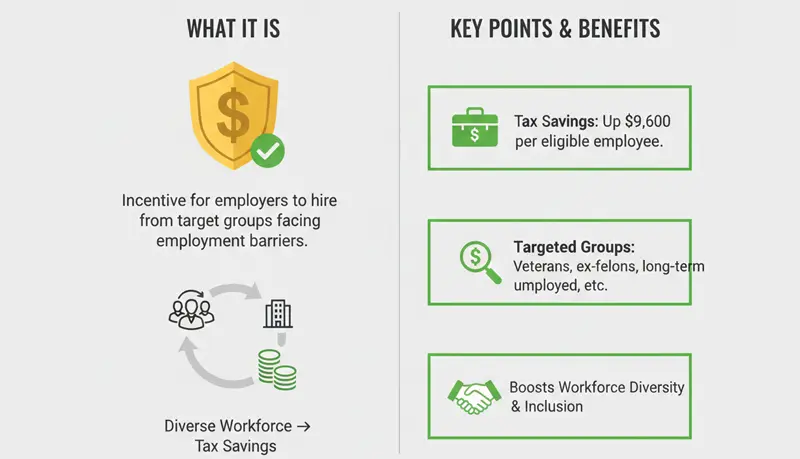
The Work Opportunity Tax Credit (WOTC) is a federal tax credit for employers who hire individuals from groups that face significant barriers to employment — veterans, long-term unemployed individuals, people receiving government assistance, and others.
For businesses with high hiring volume — call centers, BPO operations, staffing agencies, retail — WOTC can meaningfully reduce tax liability. The credit ranges from $1,200 to $9,600 per eligible employee, depending on the target group and hours worked. For certain veteran categories, it can reach up to $24,000.
The catch is that claiming the credit requires specific paperwork filed within strict deadlines. Miss the 28-day filing window and you lose the credit entirely, regardless of eligibility.
Who qualifies
The employee must belong to one of the target groups defined by the IRS and the Department of Labor. The main categories:
Veterans
Several veteran subcategories qualify, with different credit amounts:
- Veterans who received SNAP benefits for at least 3 months during the 15 months before hire
- Disabled veterans entitled to VA disability compensation
- Veterans unemployed for at least 4 weeks (or 6 months) in the year before hire
- Veterans receiving SNAP benefits and unemployed for at least 6 months
The maximum credit for veterans ranges from $2,400 to $24,000 depending on disability status and length of unemployment.
Long-term unemployed
Individuals who have been unemployed for 27 or more consecutive weeks and received unemployment compensation during part or all of that period.
Government assistance recipients
- TANF recipients — Individuals receiving Temporary Assistance for Needy Families at the time of hire or during the 18 months before
- SNAP recipients — Individuals aged 18–39 who received Supplemental Nutrition Assistance Program benefits within the 6 months before hire
- SSI recipients — Individuals receiving Supplemental Security Income for any month within the 60 days before hire
- Long-term family assistance recipients — Individuals who received TANF for at least 18 consecutive months, or who stopped receiving TANF within the past 2 years after reaching the time limit
Other qualifying groups
- Ex-felons — Hired within one year of conviction or release from prison
- Designated community residents — Individuals aged 18–39 living in Empowerment Zones or Rural Renewal Counties
- Vocational rehabilitation referrals — Individuals with disabilities referred by a state vocational rehabilitation agency, the Department of Veterans Affairs, or an Employment Network under the Ticket to Work program
- Summer youth employees — Individuals aged 16–17 living in Empowerment Zones, hired for summer employment
How much is the credit worth
The credit amount depends on the target group, qualified wages, and hours worked during the first year (or two years for long-term family assistance recipients).
Standard calculation
For most target groups:
- 400+ hours worked — Credit equals 40% of qualified first-year wages, up to $6,000 in wages. Maximum credit: $2,400
- 120–399 hours worked — Credit equals 25% of qualified first-year wages, up to $6,000. Maximum credit: $1,500
- Under 120 hours — No credit
Special categories
| Target group | Maximum qualified wages | Maximum credit |
|---|---|---|
| Most target groups | $6,000 (year 1) | $2,400 |
| Long-term family assistance recipients | $10,000/year (years 1–2) | $9,000 |
| Disabled veterans (unemployed 6+ months) | $24,000 | $9,600 |
| Other qualifying veterans | $6,000–$14,000 | $2,400–$5,600 |
| Summer youth employees | $3,000 | $1,200 |
"Qualified wages" means wages paid to the employee during the first year of employment (or first two years for long-term family assistance recipients). The credit applies only to wages that were actually paid — not to benefits, bonuses, or other compensation.
How to claim the credit
Step 1: Screen applicants before or on the day of hire
Complete IRS Form 8850 (Pre-Screening Notice and Certification Request) on or before the day you make a job offer. This form captures the information needed to determine whether the applicant belongs to a target group.
The timing matters — the form must be completed no later than the date the job offer is made. You cannot retroactively screen employees who were hired weeks or months ago.
Step 2: Submit certification request to your state workforce agency
Submit the completed IRS Form 8850 along with ETA Form 9061 (Individual Characteristics Form) or ETA Form 9062 (Conditional Certification) to your state workforce agency (SWA). This must be done within 28 calendar days of the employee's start date.
This is the deadline that most employers miss. If you submit on day 29, the credit is lost for that employee. Build the submission into your hiring workflow so it happens automatically.
Step 3: Receive certification from the state agency
The state workforce agency reviews the submission and determines whether the employee meets the criteria for a target group. If approved, they issue a certification.
Processing times vary by state — some respond within a few weeks, others take months. You can proceed with employment regardless; you don't need to wait for certification before the employee starts working.
Step 4: Claim the credit on your tax return
Once you receive certification and the employee has worked the minimum qualifying hours (at least 120), claim the credit using IRS Form 5884 (Work Opportunity Credit) as part of your annual federal income tax return.
For tax-exempt organizations hiring qualified veterans, use IRS Form 5884-C to claim the credit against payroll taxes instead of income taxes.
Key deadlines and forms
| Form | Purpose | Deadline |
|---|---|---|
| IRS Form 8850 | Pre-screening applicants | On or before the job offer date |
| ETA Form 9061 or 9062 | Employee characteristics documentation | Within 28 days of start date (submitted with Form 8850) |
| IRS Form 5884 | Claiming the credit | Filed with annual tax return |
| IRS Form 5884-C | Credit against payroll taxes (tax-exempt employers) | Filed with annual tax return |
Practical considerations
Build WOTC screening into your hiring process
The 28-day deadline means WOTC screening can't be an afterthought. The most effective approach is to include Form 8850 as part of your standard new-hire paperwork — every applicant completes it alongside their W-4 and I-9. This ensures no eligible hires are missed.
Not every eligible hire will generate a credit
An employee must work at least 120 hours to generate any credit, and at least 400 hours for the full credit amount. For positions with high early turnover — which is common in call centers and entry-level roles — some eligible hires will leave before reaching the minimum hours threshold.
Track hours worked for WOTC-eligible employees so you know which ones qualify when it's time to file.
Consider a WOTC service provider
For businesses with high hiring volume, managing WOTC paperwork in-house can be resource-intensive. Third-party WOTC service providers handle screening, form submission, state agency follow-up, and credit calculation for a fee (typically a percentage of credits claimed). For large operations, the administrative savings often justify the cost.
The program requires periodic reauthorization
WOTC is not a permanent part of the tax code — Congress must periodically reauthorize it. The program has been extended multiple times since its creation in 1996. Check the IRS WOTC page or consult your tax advisor for the current authorization status before building it into long-term financial projections.
WOTC applies to new hires only
The credit is available only for new employees. You cannot claim it for rehires (with limited exceptions) or for employees who are related to the business owner. The employee must not have previously worked for you.
Consult a tax professional
WOTC interacts with other tax credits and deductions. A tax professional can help you understand how WOTC fits into your overall tax strategy, ensure you're claiming the maximum allowable credit, and handle the filing correctly.