Project Management Techniques to Improve Team Productivity

Introduction
Project management techniques have evolved rapidly in the last two decades. The dominant project management technique in the last century was the Waterfall method, combined with PERT/CPM. Newer techniques like Agile, Scrum, and Lean came up in the last twenty years. These changes are driven primarily by a need to adapt to the faster pace of innovation and change brought about by technology.
As a business owner or manager, you need to make sure your team keeps performing at its best. One of the ways to get the best out of your team is to organize and manage their work using the right project management technique. Using the right techniques can help your team ensure timely delivery, stay productive, and manage cost. Pairing these techniques with employee time tracking software gives you the data to measure which approach works best for your team.
Work Breakdown Structure
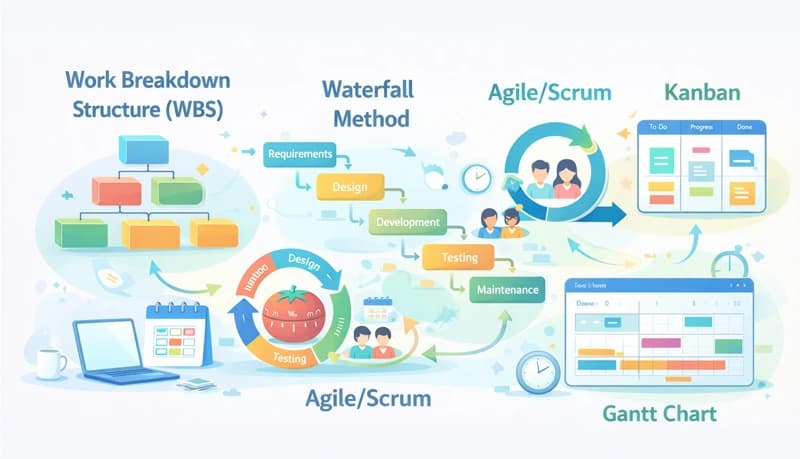
Managing a project requires us to identify all activities we need to complete in order to finish the project. But before you can apply any project management technique, you need to break down each activity into smaller tasks. This helps team members easily understand the tasks, estimate time needed to complete them, and execute them. This is called the Work Breakdown Structure or WBS.
A WBS transforms big, complex project activities into smaller, manageable blocks of tasks. If you're planning to run a marketing campaign for a new product, you can break it down into smaller "packages" of work such as researching the target audience, selecting channels, and developing marketing collaterals. You can further break down each of these packages into tasks that you assign to a team member.
In this post, we discuss five of the most popular project management techniques, looking at strengths, limitations, and suitability to different types of work.
Waterfall
The Waterfall technique is one of the oldest project management techniques. It has been in use for over half a century and is still used in many projects.
The Waterfall technique deals with project tasks in a sequential manner. You organize the tasks in stages or phases that occur sequentially. Each phase of the project can start only after the previous phase is complete. For example, a software development project is typically organized in four stages:
- Requirements
- Design
- Development
- Testing / Verification
- Maintenance
How it works
In the Waterfall method, you collect all functional, technical, and security requirements upfront. The idea is to make sure that the design and architecture will be able to take care of all current and future needs. An underlying assumption is that the requirements will either not change during development or can wait until the next round of development.
Collecting requirements upfront makes it easier to estimate effort and cost and create a more robust design. This technique worked well during the mainframe era when both business and technology were changing at a much slower pace.
Limitations
In today's fast-changing world, Waterfall's insistence on collecting every requirement upfront does not work well. It's an inflexible project management technique that does not lend itself well to the internet era of software development. If your project will evolve over time with frequent iterations and changes in design, then Waterfall is not the right technique.
But it still works well for projects with distinct phases that require very few iterations throughout the project life cycle, such as launching a satellite or building houses.
When to use: The Waterfall technique is best suited for complex, long-term projects that do not need iterations or changes after the project starts.
PERT
In the 1950s, the US Navy needed a sophisticated project management technique to manage its weapons development programs. The Program Evaluation Review Technique (PERT) was developed to give project managers a visual tool for managing and adjusting task schedules without compromising on the final completion date.
PERT helps realistically estimate the amount of time it will take to finish a project using three different time estimates:
- Optimistic — the least amount of time needed to complete a task
- Pessimistic — the most amount of time a task might take if something were to go wrong
- Most likely — the best estimate to complete a task
You calculate the expected time for completing each task and the project, understanding that things don't always go according to plan.
Scheduling with PERT
The first step in PERT is to decide which tasks need to be completed in order to accomplish the project's goal. Then you need to decide the order in which the tasks need to be completed. Some tasks cannot be done unless another task is completed. These are called Successor and Predecessor tasks.
Once the project starts, the team continuously evaluates project performance and adjusts tasks based on the three time estimates. The goal is to finish the project on schedule, even if some tasks do not go as planned.
PERT is best suited for unique and uncertain projects such as R&D activities for developing a new product or technique. Since there is no historical data on different tasks for such a project, PERT is an effective technique for estimating time and scheduling tasks.
When to use: PERT is best suited for managing one-of-a-kind, R&D, and projects with non-routine tasks.
Critical Path Method (CPM)
While the Navy was developing PERT, the private sector was working on a similar method called Critical Path. Both techniques visualize the project timeline and alternative paths for completing the project. CPM is often used along with PERT.
CPM is a powerful yet simple technique for analyzing, planning, scheduling, and managing complex projects. It focuses on:
- Identifying which tasks in the project are "critical" for completing the project on time. If there is a delay in completing any of these tasks, the entire project will be delayed.
- Scheduling all tasks in a way that enables you to complete the project on time and at minimum cost.
How it works
The first step in CPM is to list all tasks required to complete the project with time required to complete them and their immediate prerequisite tasks. Modern project management tools like MS Project depict tasks on a horizontal time axis in the form of a Gantt chart.
All tasks that do not have a predecessor are scheduled to begin simultaneously at the start of the project. All tasks that do not have a successor are deemed the last tasks to be completed and mark the completion of the project. The rest of the tasks are arranged in between with each task preceded by its predecessors and followed by its successors.
Finding the critical path
Once all the tasks are arranged on the timeline, you can see multiple paths from start to completion. These paths show different orders in which you can complete tasks and finish the project. The total time needed to complete all tasks along a path is the time you need to complete the project. The critical path is the one that takes the longest from start to finish. This is the minimum time necessary to complete the entire project. If a task on this path is delayed, it will delay the entire project.
One benefit of this technique is that you know where to focus your efforts if you want to finish the project faster. If you can finish one or more tasks on the critical path faster, you may be able to reduce the total project duration. You can, for example, assign more resources to a task to finish it faster.
When to use: CPM should be used in complex, large projects where delivery times are critical such as construction, developing new products, military, and critical infrastructure.
Kanban
Kanban is probably the simplest project management technique. It's well suited for simple projects and new project managers. At its core, Kanban is a way to manage your to-do lists.
Board, cards, and columns
Kanban has three elements — Board, Card, and Columns. The board is where you draw columns for arranging the cards.
You create a card for each task. The card includes details such as the person the task is assigned to and the due date. Then you arrange these cards in columns such as To-do, Doing, and Done. Initially, all tasks will be in the first column. When you start a task, you move its card to the Doing column. Once the task is complete, you move it to Done.
Origins
An industrial engineer at Toyota, Taiichi Ohno, developed Kanban as part of Toyota's lean manufacturing system. Others adopted and further developed the technique for use in the services and technology industry. Kanban's popularity has increased with the adoption of Agile project management, as it is a common framework used to implement agile software development.
When to use: Kanban is best suited for knowledge work and dynamic projects where work arrives unpredictably. It's also great for individuals managing their own work — an ideal tool for freelancers and gig workers.
Scrum
Like Kanban, Scrum is a technique for implementing the Agile methodology.
Agile was developed to address the need for a faster, dynamic, and adaptable way to develop software. Older techniques such as Waterfall were falling short of what was needed to develop software in the internet era.
How Agile organizes work
The Agile process begins with the customer (internal or external) describing how the software will be used and what problem it will solve. This establishes clear objectives for the project team. In Agile, work is organized in three levels:
- Stories — short requirements written from the perspective of an end user
- Epics — large blocks of work that you break down into Stories
- Initiatives — collections of Epics with an underlying common goal
How Scrum works
Scrum is one of the most popular techniques for implementing Agile in software development projects. Work is organized around Sprints. During each sprint, the team works on one deliverable or feature. A Sprint is usually less than 2 weeks and can be as short as a day.
Project teams in Scrum are small but empowered to make all decisions about the work. They are cross-functional teams with all the skills necessary to complete their tasks. They self-organize while working on a problem and share experiences with each other to continuously improve. After the sprint, the team holds a review meeting to evaluate the work and make improvements for the next sprint.
The small team size and short cycles of work enable the team to make quick decisions, develop software faster, and adapt to changing customer needs.
When to use: Scrum is best suited for software development projects that require fast product development with uncertain features or user needs. Most modern commercial software development teams use Scrum or a variant. Project teams outside software can also use Scrum by adapting it to their specific needs.
Conclusion
There are many techniques you can use for managing your projects. Older ones like Waterfall are suited for large, monolithic projects where the project objectives and outcomes are pre-determined. PERT and CPM are well suited for research and development work that involves tasks with uncertainties.
The newer ones like Kanban and Scrum are well suited for implementing Agile project management methodology. These techniques are popular for managing software development projects but can be adapted for other types of work as well.