Is Employee Monitoring Ethical? A Framework

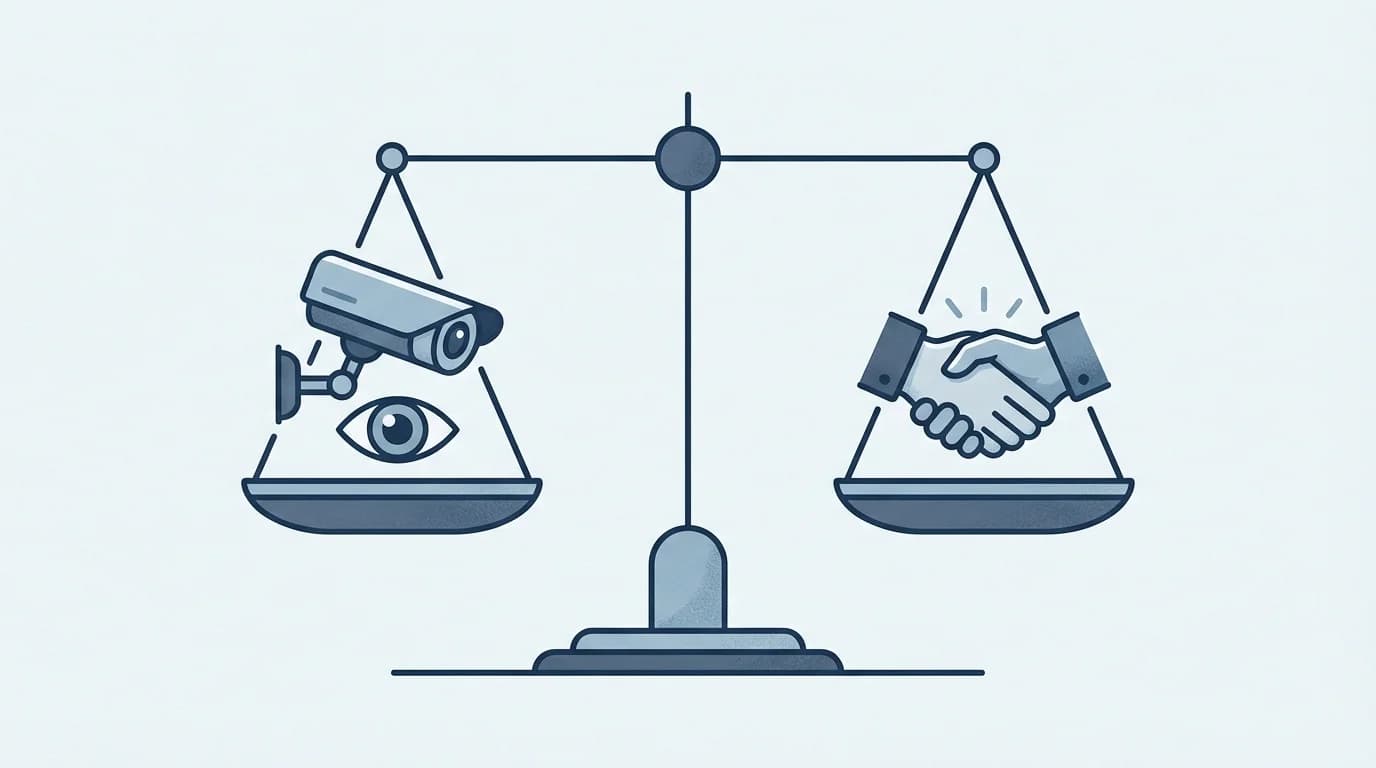
Employee monitoring has expanded far beyond the call center floor. What was once limited to recording phone calls for quality assurance now includes screenshot capture, application tracking, keystroke logging, GPS location, email monitoring, and more. The shift to remote work accelerated adoption across industries, and the global employee monitoring software market continues to grow.
But the expansion of monitoring has outpaced the conversation about whether — and how — it should be done. The question is not just "can we monitor employees?" (legally, the answer is usually yes) but "should we, and if so, how?"
This guide examines the evidence, the legal boundaries, and a practical framework for implementing monitoring ethically.
- Monitoring effectiveness depends heavily on work type — it improves throughput for routine tasks but can undermine intrinsic motivation for creative work
- The ethical framework centers on five principles: transparency, proportionality, purpose limitation, employee agency, and data minimization
- Legal boundaries vary widely — the US is relatively permissive while the EU requires proportionality assessments and data protection impact assessments
- Employees accept monitoring that addresses legitimate business needs but resist surveillance that feels disproportionate or covert
- The key question is not "can we monitor?" but "what is the least invasive method that achieves our goal?"
Why employee monitoring is growing
The remote work shift
Before 2020, monitoring was standard practice in contact centers, financial services, and security-sensitive roles. It was the exception for knowledge workers. The shift to remote work changed the calculus: managers who could previously see their teams working suddenly could not. Monitoring software offered a replacement for physical visibility.
Gartner reported that the share of large employers using monitoring tools roughly doubled between 2019 and 2022. The trend has continued as hybrid work became permanent for many organizations.
What employers are monitoring
Not all monitoring is equal. The range of tools spans a wide spectrum of invasiveness:
| Level | What is tracked | Invasiveness |
|---|---|---|
| Time tracking | Hours worked, clock-in/out | Low |
| Project tracking | Time allocated to tasks/projects | Low |
| Periodic screenshots | Desktop capture at intervals (e.g., every 10 min) | Medium |
| Application/URL tracking | Which apps and websites are used during work | Medium |
| Continuous screen recording | Full video of the desktop throughout the day | High |
| Keystroke logging | Every key pressed, including passwords | Very high |
| Email/chat monitoring | Reading employee communications | Very high |
| GPS location tracking | Continuous physical location monitoring | Very high |
The ethical implications differ dramatically across this spectrum. Time tracking is broadly accepted; keystroke logging raises serious concerns. Treating all monitoring as equivalent obscures the real debate.
The "bossware" backlash
Media coverage of invasive monitoring tools has been overwhelmingly negative. The term "bossware" — coined to describe particularly intrusive monitoring software — captures the public perception problem. Companies that implemented aggressive surveillance during the pandemic and then publicized it faced employee backlash, negative press, and in some cases, increased turnover.
The backlash is not against monitoring per se. It is against monitoring that feels disproportionate, covert, or punitive.
Key Takeaway
The "bossware" backlash is not against monitoring itself — it is against monitoring that feels disproportionate, covert, or punitive. The level of invasiveness matters far more than whether monitoring exists at all.
Does monitoring actually improve productivity?
The Hawthorne Effect
The Hawthorne studies of the 1920s and 1930s at Western Electric's factory found that workers' productivity increased when they knew they were being observed — regardless of what was being changed in their environment. The effect was attributed to the observation itself, not the experimental conditions.
In a monitoring context, the Hawthorne Effect predicts an initial productivity spike when monitoring is introduced. Employees who know they are being watched tend to work more visibly. But the effect raises two questions:
- Is the productivity gain real or performative? Workers may shift from genuinely productive work to visibly busy work. Typing faster is not the same as thinking better.
- Does the effect persist? Research suggests the Hawthorne Effect fades over time, or worse, workers learn to game the metrics being monitored while neglecting unmeasured aspects of their work.
What research says
The evidence on monitoring and productivity is mixed, and the answer depends heavily on the type of work:
For routine, measurable tasks (data entry, call handling, order processing), monitoring tends to improve throughput. When the work is well-defined and the metrics are clear, knowing that performance is tracked encourages consistent output. This is why monitoring has been standard in contact centers for decades.
For creative and knowledge work, the evidence is weaker and sometimes negative. Studies on intrinsic motivation — the internal drive to do good work — consistently find that external surveillance can undermine it. Workers shift from "I want to do this well" to "I want to look productive," which are different things.
A 2023 study published in the Harvard Business Review found that monitored employees were more likely to take unauthorized breaks, work at a slower pace when not being observed, and engage in minor rule-breaking — the opposite of the intended effect. The researchers attributed this to a feeling of reduced autonomy and fairness.
The privacy paradox
Here is the tension at the heart of the debate: employees simultaneously want privacy and accountability.
Most workers do not want their employer reading their emails or recording their keystrokes. But most workers also want to be recognized for their effort and want assurance that their colleagues are pulling their weight. The paradox is that these desires pull in opposite directions.
The resolution is proportionality. Employees are more likely to accept monitoring that addresses a legitimate business need (billing accuracy, project tracking, attendance verification) than monitoring that feels like surveillance for its own sake (continuous screen recording, keystroke logging).
Monitoring That Respects Your Team
HiveDesk provides time tracking with periodic screenshots — not continuous surveillance. Activity data is visible to employees, not just managers. Proportionate accountability without the cultural cost.
Legal boundaries of employee monitoring
United States
U.S. law is relatively permissive toward employer monitoring:
- The Electronic Communications Privacy Act (ECPA) broadly permits monitoring of employee communications on company-owned systems, especially with prior notice.
- State laws vary. Connecticut and Delaware require written notice before electronic monitoring. New York's WARN Act requires notice of telephone and email monitoring. California's constitution provides a right to privacy that courts have applied to some workplace contexts.
- The general rule: monitoring with notice on company-owned devices is legal in most states. Covert monitoring is riskier legally and ethically.
European Union
The EU takes a significantly stricter approach under the GDPR:
- Monitoring must have a legitimate interest that outweighs employee privacy rights
- The principle of proportionality requires using the least invasive method that achieves the business objective
- Data minimization limits what data can be collected and how long it is retained
- Employers must conduct a Data Protection Impact Assessment for high-risk monitoring
- Employee consent is problematic because the power imbalance in employment relationships means consent is rarely freely given
Several EU court decisions have limited employer monitoring. The European Court of Human Rights has ruled that blanket monitoring of employee communications violates Article 8 (right to private life) when it is not proportionate to the business need.
Other jurisdictions
- Canada (PIPEDA): Requires that monitoring be reasonable and proportionate, with clear notice to employees
- Australia: State-level workplace surveillance laws require notice and registration of monitoring systems
- Global trend: Most jurisdictions are moving toward stronger employee privacy protections, not weaker ones
An ethical framework for employee monitoring
Legal permission is the floor, not the ceiling. Here is a framework for monitoring that is both effective and ethical.
Principle 1: Transparency over surveillance
Employees should always know what is being monitored, why, how the data is used, and who has access. Covert monitoring destroys trust — even when it is legal.
In practice: Publish a clear, plain-language monitoring policy before implementation. Do not bury it in the employee handbook. Discuss it openly during onboarding and in team meetings.
Principle 2: Proportionality
The level of monitoring should be proportional to the legitimate business need. Time tracking for billing accuracy is different from keystroke logging for performance management. The question to ask: "Is this the least invasive way to achieve our goal?"
In practice: If the business need is accurate project billing, time tracking with project allocation is sufficient. You do not need continuous screen recording to achieve that goal. A proportionate remote employee monitoring approach — such as periodic screenshots rather than continuous recording — achieves accountability without crossing ethical lines.
Principle 3: Purpose limitation
Monitoring data should be used only for its stated purpose. Time tracking data collected for project billing should not be repurposed for performance reviews without notice. Activity data captured for attendance verification should not be mined for behavioral patterns.
In practice: Define the purpose of each monitoring tool in your policy and stick to it. Scope creep — gradually expanding how monitoring data is used — is the most common ethical failure.
Important
Scope creep is the most common ethical failure in employee monitoring. Time tracking data collected for billing should not be silently repurposed for performance reviews. Define each tool's purpose in your policy and stick to it.
Principle 4: Employee agency
Employees should have input into monitoring policies, be able to see their own monitoring data, and have a channel to raise concerns without fear of retaliation.
In practice: Let employees view their own screenshots, activity data, and time records. Share dashboards rather than hiding them. Create a process for employees to flag concerns about monitoring practices.
Principle 5: Data minimization and retention
Collect only what is needed. Retain it only as long as necessary. Screenshots taken every 10 minutes and stored indefinitely are harder to justify than periodic screenshots retained for 30 days.
In practice: Set automatic data retention policies. Delete screenshots and activity logs after a reasonable period (30-90 days). Do not store data "just in case."
How to implement monitoring the right way
Start with the problem, not the tool
Define the business problem first. Is it billing accuracy? Project estimation? Accountability for remote teams? Compliance? The problem determines the appropriate level of monitoring.
If the problem is "we do not know how much time projects actually take," the answer is time tracking — not screenshot monitoring. If the problem is "we cannot verify that remote employees are actually working during their tracked hours," periodic screenshots may be warranted.
Involve employees in the process
Announce monitoring before implementation. Explain the business rationale. Solicit feedback. Address concerns. This process itself builds the trust that monitoring can erode.
Employees who participate in designing monitoring policies are more likely to accept the outcome than employees who have monitoring imposed on them.
Choose proportionate tools
Lightweight time tracking with periodic screenshots is fundamentally different from continuous screen recording with keystroke logging. Choose the minimum effective tool for your specific need.
Focus on outcomes, not activity
The best monitoring systems track outputs (tasks completed, projects delivered, goals met) alongside inputs (hours worked). Hours worked is a means, not an end. Activity metrics without outcome context incentivize looking busy over being productive.
Review and adjust regularly
Monitor the monitoring. Is it achieving the business goal? Has it affected morale or retention? Are managers using the data appropriately? Be willing to scale back if the costs outweigh the benefits.
How HiveDesk approaches employee monitoring
HiveDesk is designed around time tracking and periodic screenshots — not continuous surveillance. The design philosophy reflects the ethical framework described above:
- Transparency: Activity data is visible to employees, not just managers
- Proportionality: Screenshot frequency is configurable — teams set the level that matches their needs
- Purpose limitation: The data serves time tracking, project management, and accountability — not behavioral profiling
- Simplicity: One plan at $5/user/month with all features. No tiered pricing that pushes organizations toward more monitoring than they need
We acknowledge the tension honestly: any monitoring tool can be misused by a manager with bad intentions. The tool provides the capability; the organization provides the culture. HiveDesk is designed to answer a simple question — where does the time go? — not to watch every move.
Frequently asked questions
Is employee monitoring legal?
In most U.S. jurisdictions, yes — especially on company-owned devices with notice. Some states require written disclosure. EU/GDPR requirements are stricter, requiring proportionality and data protection impact assessments. Check your jurisdiction's specific rules.
Can employees refuse to be monitored?
Generally, no — if monitoring is a condition of employment and is properly disclosed. However, employees can push back through internal channels, and excessive monitoring can contribute to turnover. The practical question is not whether you can force monitoring but whether the resulting culture is one people want to work in.
Does monitoring improve productivity?
For routine, measurable work, evidence suggests modest improvements. For creative and knowledge work, the effect is mixed — monitoring can reduce intrinsic motivation and shift effort toward gaming metrics rather than producing quality output. The type of monitoring matters more than whether monitoring exists.
What is the least invasive way to monitor remote employees?
Time tracking (clock-in/out or automatic) is the least invasive form of monitoring and is widely accepted by employees. Adding periodic screenshots (every 10-15 minutes) provides verification without continuous surveillance. This combination covers most legitimate monitoring needs without the ethical and cultural costs of more invasive approaches.
Should monitoring data be used in performance reviews?
With caution. If employees were told monitoring data would be used for billing accuracy, using it to evaluate performance is a scope change that should be disclosed. If you intend to use monitoring data in reviews, say so upfront and make sure the metrics measured actually correlate with performance — hours tracked and screenshots captured are inputs, not outputs.