

Labor Law Compliance Guide for Chile
Chile labor law guide covering minimum wage, overtime, severance, social security, and compliance for hiring employees and contractors.
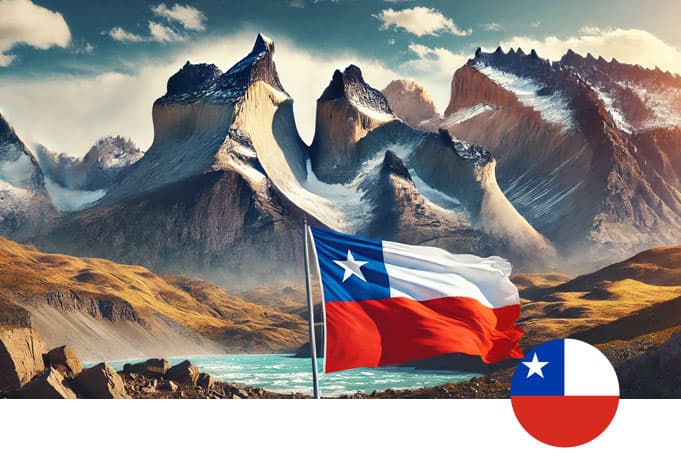
Chile's economy remains one of the most stable and prosperous in Latin America, with a 2025 nominal GDP of approximately $347 billion USD (IMF estimate) and projected 2026 growth of 2.0-2.2% (IMF/OECD).
| Category | Details |
|---|---|
| Minimum Wage | CLP 539,000 per month (as of January 2026) |
| Overtime Wage | 150% of the regular hourly rate |
| Meal Breaks | 30 minutes to 1 hour |
| Rest Breaks | 15 minutes |
| Working hours | 8 hours per day, 42 hours per week (from April 2026; currently 44 hours) |
| Salary Payment Cycle | Monthly |
| Payroll Taxes | AFP pension (10% employee), health insurance (7% employee), unemployment insurance (0.6% employee / 2.4% employer), work accident insurance (0.95% employer), SIS (1.5% employer), new employer pension contribution (1% employer, rising to 8.5% by 2033) |
| Paid Vacation | 15 working days after 1 year of service |
| Overtime Hours | More than 42 hours per week (from April 2026) |
| Night Shift Hours | No specific rate mandated by law |
| Holidays | 16 |
| No Work Days | Sunday |
| Minimum Wage | Chile has a national minimum wage law. As of January 2026, the minimum wage is CLP 539,000 per month (approx. USD 560-575). The minimum wage is reviewed annually and adjusted by the government. |
The country's economy is strongly supported by the mining sector, particularly copper, which accounts for a significant portion of its exports. Other important sectors include agriculture, fishing, forestry, and services, especially in finance and telecommunications. Additionally, Chile is known for its growing technology sector and renewable energy initiatives.
The official currency of Chile is the Chilean Peso (CLP).
Hiring Laws
Pro Tip
Hiring in Chile without a local entity? See our Employer of Record guide for Chile for a complete breakdown of EOR costs, providers, and compliance.
In Chile, businesses must establish a legal entity to hire employees. The process to incorporate a business can take 4 to 6 weeks and typically costs between CLP 1,000,000 and CLP 2,000,000, depending on the type of entity and legal services required. Employers must sign written employment contracts with their employees, which should specify the terms of employment, including job duties, salary, working hours, and termination conditions. These contracts must comply with the Chilean Labor Code, which governs employment relationships. Contractors and employees are treated differently under Chilean law, with employees being entitled to more protections. There are no regional variations in the minimum wage, but certain industries or roles may have different wage agreements. Additionally, Chilean law requires employers to pay holiday bonuses, typically known as “Aguinaldo,” which are additional payments made during national holidays like Independence Day and Christmas.
Working Hours
Chile is progressively reducing the standard workweek from 45 to 40 hours under Ley 21.561 (published April 2023). The current schedule is:
- April 2024: Maximum reduced to 44 hours/week
- April 2026: Maximum reduces to 42 hours/week
- April 2028: Final target of 40 hours/week
Employers cannot reduce salaries when reducing hours. The daily limit remains 8 hours per day for a standard schedule. Overtime is allowed but must be compensated at 150% of the regular hourly rate, with a maximum of 2 hours of overtime per day and 12 hours per week. Overtime agreements must be in writing and are valid for a maximum of 3 months (renewable). As of 2026, overtime may also be compensated with up to 5 additional paid holiday days per year (at a rate of 1.5 hours of holiday per 1 overtime hour), if agreed between employer and employee.
Night shifts do not have a specific pay rate mandated by law; instead, compensation for night work is typically agreed upon in the employment contract. The minimum legal working age in Chile is 15 years, with strict regulations governing the employment of minors, including limitations on working hours and types of work.
Payroll and Taxes
Employers in Chile must make several payroll deductions. Contributions are split between employee and employer:
Employee Contributions (deducted from gross salary):
| Contribution | Rate |
|---|---|
| AFP pension (individual account) | 10% of taxable income |
| Health insurance (FONASA/ISAPRE) | 7% of taxable income |
| Unemployment insurance (Seguro de Cesantia) | 0.6% of taxable income |
Employer Contributions:
| Contribution | Rate | Notes |
|---|---|---|
| Unemployment insurance (Seguro de Cesantia) | 2.4% | Of taxable income |
| Work accident insurance (Seguro de Accidentes) | 0.95% (base) | Can increase based on industry risk |
| SIS (Disability & Survivor Insurance) | 1.5% | Until July 2026 (then absorbed into FAPP) |
| New employer pension contribution | 1% (from Aug 2025) | Rising gradually to 8.5% by 2033-2035 |
2026 Contribution Caps: AFP, health, and accident insurance are capped at 89.9 UF/month. Unemployment insurance is capped at 135.1 UF/month.
Pension Reform (effective August 2025): Chile's pension reform (Ley de Pensiones, approved January 2025) introduces a new 7% additional employer contribution phased in over 9 years, starting at 1% in August 2025. Of this, a portion goes to individual AFP accounts and the remainder to the new FAPP (Autonomous Pension Protection Fund). The existing employee 10% AFP contribution remains unchanged.
The current income tax regime in Chile is progressive, with 8 brackets expressed in UTM (Unidad Tributaria Mensual, approximately CLP 66,362 in 2026):
| Monthly Income (UTM) | Tax Rate |
|---|---|
| 0 - 13.5 | Exempt |
| 13.5 - 30 | 4% |
| 30 - 50 | 8% |
| 50 - 70 | 13.5% |
| 70 - 90 | 23% |
| 90 - 120 | 30.4% |
| 120 - 310 | 35% |
| Over 310 | 40% |
The exempt threshold of 13.5 UTM is approximately CLP 896,000/month. Taxable income is calculated after deducting AFP, health, and unemployment insurance contributions from gross salary.
Statutory Leave Policies
Chilean labor laws mandate several types of leave:
-
Paid Vacation: Employees are entitled to 15 working days of paid vacation after completing 1 year of service.
-
Maternity Leave: 18 weeks of paid maternity leave (6 weeks before and 12 weeks after childbirth).
-
Paternity Leave: 5 days of paid paternity leave.
-
Sick Leave: Paid sick leave is covered through the Chilean social security system, with the first 3 days typically covered by the employer.
The following table lists the 16 mandated public holidays in Chile for 2026:
| Holiday | 2026 Date |
|---|---|
| New Year’s Day (Ano Nuevo) | January 1 (Thu) |
| Good Friday (Viernes Santo) | April 3 (Fri) |
| Holy Saturday (Sabado Santo) | April 4 (Sat) |
| Labour Day (Dia del Trabajo) | May 1 (Fri) |
| Navy Day (Dia de las Glorias Navales) | May 21 (Thu) |
| National Day of Indigenous Peoples | June 20 (Sat) |
| Saints Peter and Paul (San Pedro y San Pablo) | June 29 (Mon) |
| Our Lady of Mount Carmel (Virgen del Carmen) | July 16 (Thu) |
| Assumption of Mary (Asuncion de la Virgen) | August 15 (Sat) |
| Independence Day (Fiestas Patrias) | September 18 (Fri) |
| Army Day (Dia de las Glorias del Ejercito) | September 19 (Sat) |
| Columbus Day / Day of Two Cultures | October 12 (Mon) |
| Reformation Day (Dia de las Iglesias Evangelicas) | October 31 (Sat) |
| All Saints’ Day (Dia de Todos los Santos) | November 1 (Sun) |
| Immaculate Conception (Inmaculada Concepcion) | December 8 (Tue) |
| Christmas Day (Navidad) | December 25 (Fri) |
Note: Some holidays are "irrenunciable" (non-waivable), meaning most businesses must close. These include New Year’s Day, Labour Day, Independence Day (Sep 18), and Christmas Day.
Employee Benefits
Employers in Chile are required to provide several benefits:
-
Social Security: Covers pensions, healthcare, and unemployment insurance.
-
Aguinaldo: A mandatory bonus paid during the national holidays of Independence Day and Christmas.
-
Gratuity: Not mandatory by law, but often included in collective bargaining agreements or employment contracts.
-
Healthcare: Medical coverage provided through Isapre or Fonasa, funded by employer and employee contributions.
Employee Termination
Chile does not follow At-Will Employment laws. Termination must be justified under the Labor Code, and employers must follow specific procedures, including providing written notice and severance pay if applicable.
-
Notice Period: Typically, 30 days’ notice is required for termination without cause. If notice is not provided, the employer must pay an additional month’s salary as compensation.
-
Termination Benefits: Employees terminated without just cause are entitled to severance pay, which includes one month’s salary for each year of service, up to a maximum of 11 months.
-
Legal Challenges: Employees can challenge their termination in labor courts. If the court rules in favor of the employee, they may be awarded reinstatement or additional compensation.
Employers can legally terminate employees for just cause, including misconduct, poor performance, or redundancy. However, the reasons must be well-documented, and the employer must adhere to the legal termination process.
This guide provides a comprehensive overview of the labor laws in Chile, helping businesses navigate the complexities of hiring and managing employees in the country.
Stay Compliant with Labor Laws
Track time, attendance, time-off, and schedules with HiveDesk — workforce management software built for compliance. $5/user/month, all features included.