

Labor Law Compliance Guide for Singapore
Singapore labor law guide covering wages, working hours, CPF contributions, and compliance requirements for hiring employees and contractors.
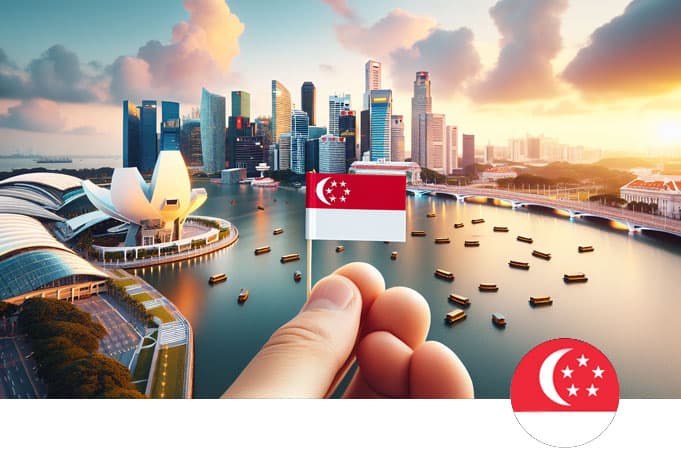
This labor law guide for Singapore has important information for businesses looking to hire employees or contractors in the country. Singapore is a country in Southeast Asia.
| Category | Details |
|---|---|
| Minimum Wage | No universal minimum wage; Progressive Wage Model (PWM) sets sector-specific minimums across 9 sectors |
| Overtime Wage | 1.5 times the hourly basic rate |
| Meal Breaks | 45 minutes after 6 hours of work |
| Rest Breaks | Not mandated |
| Working hours | 8 hours/day; 44 hours/week (max 9 hrs/day for 5-day week) |
| Salary Payment Cycle | Typically monthly |
| Payroll Taxes | CPF contributions (37% total for employees 55 and below: 17% employer + 20% employee) |
| Paid Vacation | Minimum of 7 days increasing with years of service |
| Overtime Hours | Over 44 hours per week (capped at 72 hours/month) |
| Night Shift Hours | Not mandated |
| Holidays | 11 gazetted public holidays |
| No Work Days | Saturday and Sunday |
Singapore, often heralded as one of the most dynamic economies, reported robust economic performance with full-year 2025 GDP growth of 4.8% and a nominal GDP of approximately S$574 billion. The Ministry of Trade and Industry forecasts 2.0% to 4.0% growth for 2026. The city-state's GDP continues to thrive, bolstered by its pivotal sectors including finance, manufacturing, electronics, biotechnology, and logistics.
As one of the world's leading financial hubs, it attracts investments from across the globe. Additionally, Singapore's strategic location and open trade policies make it an essential player in the global supply chain. With its highly skilled workforce and business-friendly environment, hiring in Singapore provides numerous opportunities.
The official currency is the Singapore Dollar (SGD).
Hiring Laws in Singapore
Pro Tip
Hiring in Singapore without a local entity? See our Employer of Record guide for Singapore for a complete breakdown of EOR costs, providers, and compliance.
When hiring employees in Singapore, businesses need to adhere to several regulations and requirements. Companies must be registered locally to employ workers. The cost and time taken to set up a business entity in Singapore is relatively low, with incorporation often completed within a day.
Employment agreements in Singapore must be in writing and include the following clauses: job title and descriptions, salary details, working hours, benefits, leave entitlement, termination grounds, and notice periods.
Contracts must clearly distinguish between employees and contractors, as labor laws treat them differently. Employees are entitled to statutory benefits, while contractors are not.
Minimum Wage in Singapore
Singapore does not have a universal minimum wage. Instead, it uses the Progressive Wage Model (PWM), which sets sector-specific minimum wages tied to skills and career progression. PWM now covers 9 sectors and occupations -- cleaning, security, landscape, lift and escalator, retail, food services, waste management, administrators, and drivers -- affecting over 155,000 local workers.
Sample PWM rates:
| Sector | Role | 2025 | 2026 |
|---|---|---|---|
| Cleaning | Entry-level cleaner | S$1,910/mo (Jul 2025) | S$2,080/mo (Jul 2026) |
| Retail | Entry-level (full-time) | ~S$2,635/mo | Rising toward S$3,100 by 2027 |
| Retail | Part-time (hourly) | S$12.09/hr | Rising toward S$13.45/hr by 2027 |
The Local Qualifying Salary (LQS) is S$1,600/month -- the minimum that local employees must earn for the employer to count them toward work pass quotas.
Singapore does not mandate holiday pay through federal law, though many companies voluntarily offer it as part of their compensation package.
Working Hours in Singapore
Standard working hours in Singapore are capped at 8 hours a day and 44 hours a week (or 9 hours a day for a 5-day work week). Overtime hours are those exceeding the standard 44-hour workweek and are paid at 1.5 times the employee's regular hourly rate.
Overtime provisions apply to workmen earning up to S$4,500/month and non-workmen earning up to S$2,600/month. Managers and executives are exempt from statutory overtime provisions. Monthly overtime is capped at 72 hours unless the Ministry of Manpower grants an exemption. Overtime wages must be paid within 14 days after the salary period closes.
Night shift regulations do not mandate additional pay, but companies often provide allowances as a policy.
The minimum legal age for employment in Singapore is 13 years, and there are stringent laws against child labor, ensuring that children are not employed in hazardous jobs.
Payroll and Taxes in Singapore
Employers in Singapore must make contributions to the Central Provident Fund (CPF) for Singaporean and Permanent Resident employees. The CPF contributions are shared between employer and employee and serve as retirement savings and health insurance.
The income tax regime in Singapore is progressive, with rates based on income levels. Below is the income tax table for YA 2026 (income earned in 2025):
| Chargeable Income (S$) | Tax Rate |
|---|---|
| First 20,000 | 0% |
| 20,001 -- 30,000 | 2% |
| 30,001 -- 40,000 | 3.5% |
| 40,001 -- 80,000 | 7% |
| 80,001 -- 120,000 | 11.5% |
| 120,001 -- 160,000 | 15% |
| 160,001 -- 200,000 | 18% |
| 200,001 -- 240,000 | 19% |
| 240,001 -- 280,000 | 19.5% |
| 280,001 -- 320,000 | 20% |
| 320,001 -- 500,000 | 22% |
| 500,001 -- 1,000,000 | 23% |
| Above 1,000,000 | 24% |
For YA 2026, a tax rebate of 60% of tax payable (capped at S$200) is applied automatically by IRAS. Non-residents are taxed at 15% on employment income or progressive rates, whichever is higher; other income is taxed at a flat 24%.
CPF Contribution Rates (From 1 January 2026)
The Ordinary Wage (OW) ceiling was raised to S$8,000/month (from S$7,400 in 2025). The annual salary ceiling remains at S$102,000.
| Age Group | Employer | Employee | Total |
|---|---|---|---|
| 55 and below | 17% | 20% | 37% |
| Above 55 to 60 | 16% | 18% | 34% |
| Above 60 to 65 | 12.5% | 12.5% | 25% |
| Above 65 to 70 | 9% | 7.5% | 16.5% |
| Above 70 | 7.5% | 5% | 12.5% |
The 2026 increases for the 55--65 age groups are part of a planned schedule to strengthen retirement adequacy for senior workers.
Statutory Leave Policies in Singapore
Employers in Singapore are mandated to provide various leaves. An employee qualifies for annual leave after three months of employment, starting at 7 days and increasing with service length.
Types of Leaves:
- Paid/Unpaid Vacation Leave: Starts at 7 days.
- Maternity Leave: 16 weeks, applicable after 3 months of employment.
- Paternity Leave: 4 weeks (increased from 2 weeks, effective April 2025).
- Shared Parental Leave: 6 weeks from April 2025, increasing to 10 weeks from April 2026.
- Sick Leave: 14 days with a medical certificate.
- Adoption Leave: 12 weeks.
Public Holidays in Singapore (2026)
When a public holiday falls on a Sunday, the following Monday is a gazetted replacement holiday.
| Holiday | 2026 Date | Notes |
|---|---|---|
| New Year’s Day | Thu 1 Jan | |
| Chinese New Year (Day 1) | Tue 17 Feb | |
| Chinese New Year (Day 2) | Wed 18 Feb | |
| Hari Raya Puasa | Sat 21 Mar | Subject to moon sighting |
| Good Friday | Fri 3 Apr | |
| Labour Day | Fri 1 May | |
| Hari Raya Haji | Wed 27 May | Subject to moon sighting |
| Vesak Day | Sun 31 May | Mon 1 Jun is substitute holiday |
| National Day | Sun 9 Aug | Mon 10 Aug is substitute holiday |
| Deepavali | Sun 8 Nov | Mon 9 Nov is substitute holiday |
| Christmas Day | Fri 25 Dec |
Employee Benefits in Singapore
Employers must offer various social security and employee benefits programs including:
- Retirement Benefits: CPF contributions.
- Healthcare Benefits: MediSave account under CPF for medical expenses.
- Annual Bonuses: Commonly a 13th-month bonus (Annual Wage Supplement).
- Gratuity: Not mandated but given at employer’s discretion.
Employee Termination in Singapore
Singapore does not follow At-Will Employment laws. Termination must follow statutory requirements as outlined by the Employment Act.
-
Notice Period: Typically ranges from 1 day to 4 weeks based on the length of service.- Termination Benefits: Severance pay is not mandated but is common in redundant roles.- Legal Challenges: Employees can challenge wrongful dismissal through the Ministry of Manpower or the Employment Claims Tribunals. Employees can be terminated on the following grounds:
-
Employee misconduct.- Performance issues.- Company redundancy/restructuring.
Employers must ensure fair practice during the termination process to avoid potential legal disputes.
Recent Employment Law Changes (2025--2026)
Workplace Fairness Legislation (passed January 2025, expected in force 2026/2027): Prohibits adverse employment decisions based on protected characteristics including age, nationality, sex, marital/pregnancy status, caregiving responsibilities, race, religion, language, disability, and mental health. Employers must establish formal discrimination complaint procedures.
Platform Workers Act (effective 1 January 2025): Introduces work injury compensation, CPF contributions, and representation rights for platform workers such as ride-hailing and delivery workers.
Work Injury Compensation Act (WICA) amendments (November 2025): Maximum death compensation raised from S$225,000 to S$269,000.
Employment Act Review: A Task Working Group is consulting stakeholders, with recommendations expected in H2 2026.
By understanding and adhering to Singapore’s labor laws, businesses can ensure smooth operations and maintain positive employer-employee relationships.
Stay Compliant with Labor Laws
Track time, attendance, time-off, and schedules with HiveDesk — workforce management software built for compliance. $5/user/month, all features included.