

Free Call Center SOP Template
A comprehensive Standard Operating Procedure template to document your call center's processes, train new agents, and maintain consistent service quality. Covers 12 sections from call handling to compliance.
Download SOP Template (Google Docs) →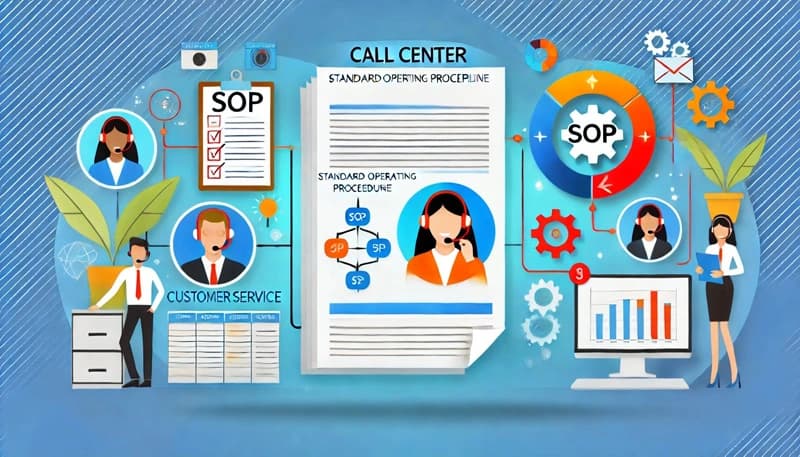
What This Template Covers
| Section | Description |
|---|---|
| Introduction | Document title, version, effective date, and approval |
| Purpose | Objectives the SOP aims to achieve |
| Scope | Departments, roles, and channels covered |
| Responsibilities | Role-based accountability matrix |
| Call Handling Procedures | Inbound and outbound call flows with step-by-step instructions |
| Escalation Procedures | Escalation levels, criteria, and target resolution times |
| Quality Assurance | Call scoring criteria, weights, and feedback process |
| Training Requirements | Training types, audience, frequency, and duration |
| Reporting and Metrics | KPI targets and reporting frequency |
| Compliance and Security | Data protection, call recording, and prohibited activities |
| Continuous Improvement | Monthly reviews, agent feedback, and root cause analysis |
| Review and Updates | Review schedule and ownership |
SOP Template Sections
1. Introduction
Document Title: __________ Call Center Standard Operating Procedures
Version: _____ | Effective Date: __________ | Last Reviewed: __________
Approved By: __________ (Name, Title)
This document outlines the standard operating procedures for __________ (call center name). It serves as the primary reference for all agents, team leads, supervisors, and managers.
2. Purpose
The purpose of this SOP is to ensure consistent, high-quality service delivery across all customer interactions. It defines the processes, responsibilities, and standards that all team members must follow.
3. Scope
- Departments covered: __________
- Roles covered: Agents, Team Leads, Supervisors, QA Analysts, Managers
- Channels covered: Phone, Chat, Email (specify which apply)
- Exceptions: __________
4. Responsibilities
| Role | Key Responsibilities |
|---|---|
| Agent | Follow call handling procedures, meet KPI targets, escalate as needed |
| Team Lead | Monitor team performance, conduct coaching, handle escalations |
| Supervisor | Manage schedules, review reports, enforce compliance |
| QA Analyst | Score calls, provide feedback, track quality trends |
| Operations Manager | Oversee staffing, set targets, review SOP effectiveness |
5. Call Handling Procedures
5.1 Inbound Call Flow
- Greeting: Answer within ___ rings. Use the standard greeting: "Thank you for calling __________, my name is _____. How can I help you today?"
- Identification: Verify the caller's identity using __________ (account number, security question, etc.)
- Issue Identification: Listen actively, ask clarifying questions, and confirm the issue before proceeding.
- Resolution: Follow the relevant knowledge base article or procedure to resolve the issue.
- Wrap-Up: Summarize the resolution, confirm the customer is satisfied, and ask if there is anything else.
- After-Call Work (ACW): Complete notes, update the CRM, and categorize the interaction within ___ minutes.
5.2 Outbound Call Flow
- Preparation: Review the customer record and call purpose before dialing.
- Introduction: Identify yourself and state the purpose of the call clearly.
- Engagement: Follow the relevant script or guideline for the campaign.
- Documentation: Log the outcome and schedule follow-up if needed.
For detailed inbound and outbound SOPs, see our specialized templates: SOP for Inbound Calls and SOP for Outbound Calls.
6. Escalation Procedures
| Level | When to Escalate | Escalated To | Target Time |
|---|---|---|---|
| Level 1 | Agent cannot resolve within SOP | Team Lead | _____ minutes |
| Level 2 | Team Lead cannot resolve | Supervisor | _____ hours |
| Level 3 | Requires management decision | Operations Manager | _____ hours |
| Emergency | Legal, safety, or PR risk | _____ | Immediately |
Escalation Rules:
- Always inform the customer that you are escalating and provide an expected timeline.
- Document the issue and all steps taken before transferring.
- Never leave a customer on hold for more than ___ minutes without an update.
7. Quality Assurance
All agents will have a minimum of ___ calls scored per month using the QA Scorecard.
| Category | Weight | Description |
|---|---|---|
| Greeting and opening | _____% | Professional greeting, proper identification |
| Active listening | _____% | Understanding customer needs, asking clarifying questions |
| Problem resolution | _____% | Accuracy, completeness, use of knowledge base |
| Communication | _____% | Clarity, tone, professionalism |
| Compliance | _____% | Following required scripts, disclosures, procedures |
| Wrap-up | _____% | Summary, CRM updates, after-call work |
Feedback Process:
- QA scores are shared with agents within ___ business days.
- Agents scoring below ___% receive additional coaching.
- Agents consistently scoring above ___% are eligible for recognition.
8. Training Requirements
| Type | Audience | Frequency | Duration |
|---|---|---|---|
| New hire onboarding | All new agents | At hire | _____ weeks |
| Product/system updates | All agents | As needed | _____ hours |
| Compliance training | All staff | Annually | _____ hours |
| QA calibration | QA team + leads | Monthly | _____ hours |
| Soft skills refresher | Agents below target | Quarterly | _____ hours |
9. Reporting and Metrics
| KPI | Target | Frequency |
|---|---|---|
| Service Level (% answered within __ sec) | _____% | Daily |
| Average Handle Time (AHT) | _____ minutes | Daily |
| First Call Resolution (FCR) | _____% | Weekly |
| Customer Satisfaction (CSAT) | _____% | Weekly |
| Abandon Rate | Below _____% | Daily |
| Agent Occupancy Rate | _____-_____% | Weekly |
| Shrinkage Rate | Below _____% | Monthly |
| Schedule Adherence | _____% | Daily |
For detailed KPI calculations, see our Call Center KPI Calculation Guide.
10. Compliance and Security
- Data Protection: All agents must follow __________ (GDPR, CCPA, PCI DSS, etc.) requirements when handling customer data.
- Call Recording: Customers must be informed that calls may be recorded for quality and training purposes.
- Password Policy: Agents must not share login credentials and must change passwords every ___ days.
- Clean Desk Policy: No customer information may be written on paper or left visible on screens when unattended.
- Prohibited Activities: __________ (personal calls, unauthorized software, sharing customer data, etc.)
11. Continuous Improvement
- Monthly SOP Review: Team leads review procedures monthly and flag any that are outdated or unclear.
- Agent Feedback: Agents can submit SOP improvement suggestions through __________.
- Root Cause Analysis: When recurring issues are identified through QA or customer complaints, conduct root cause analysis and update the SOP.
- Change Log: Maintain a version history for all SOP updates.
12. Review and Updates
- This SOP must be reviewed at least every 6 months or whenever there is a significant change in tools, processes, or regulations.
- Review Owner: __________ (Name, Title)
- Next Scheduled Review: __________
Frequently Asked Questions
Common questions about call center standard operating procedures.
An SOP (Standard Operating Procedure) is a documented set of instructions that defines how agents should handle calls, escalate issues, follow compliance rules, and complete administrative tasks. It serves as the single reference point for how your call center operates.
The essential components are: call handling procedures, escalation paths, quality assurance standards, training requirements, and compliance and security protocols. A complete SOP also includes reporting metrics, continuous improvement processes, and a review schedule.
Review your SOP at least every 6 months. Update it immediately when there are changes to tools, client requirements, regulations, or processes. Assign a specific person to own the review process so it does not get missed.
Length depends on your operation. A small team may need 10 to 15 pages. A multi-client BPO may have 50 or more pages with client-specific appendices. Focus on being comprehensive but scannable -- use tables, numbered steps, and clear headers.
Start with a single master SOP covering your core procedures. As your operation grows, you can break out specialized SOPs for specific campaigns, clients, or channels. Cross-reference between documents to avoid duplication.
Manage Your Call Center Operations
Track agent time, manage schedules, and monitor attendance with HiveDesk -- workforce management software built for contact centers and BPOs. $5/user/month, all features included.