How to Calculate Labor Costs in BPO

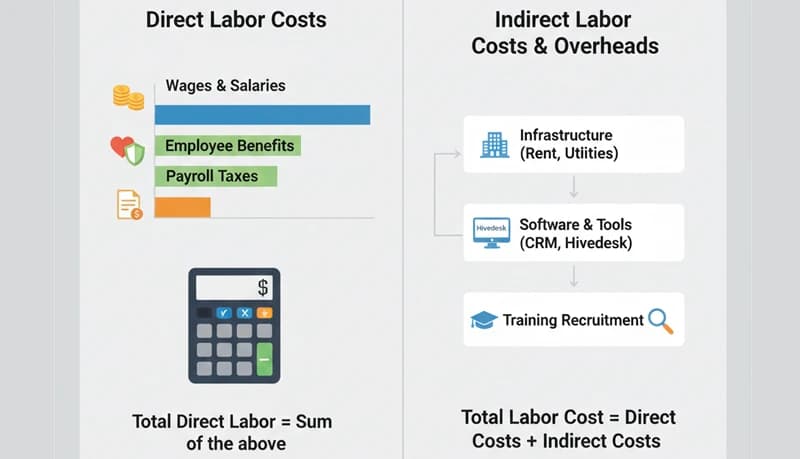
Labor costs in BPO operations typically account for 60–70% of total operating expenses. Getting this number wrong — even slightly — cascades through your pricing, profitability analysis, and staffing decisions. If you underestimate labor costs by 10%, an account that looks profitable on paper may actually be losing money every month.
The challenge in BPO is that labor cost is not just "what you pay agents." It includes benefits, taxes, training, turnover, idle time, and overhead — and these indirect costs can add 40–60% on top of base wages. This guide walks through every component, the formulas to combine them, and how to use the results for pricing and account management.
Components of BPO labor cost
Base wages
The hourly or salaried pay for agents and support staff. This is the starting point, but it is never the full cost.
For hourly agents, base wage cost is straightforward: hours worked x hourly rate. Accurate time tracking for BPO operations is essential — even small inaccuracies in hours recorded multiply across hundreds of agents. For salaried employees, convert to an hourly equivalent: annual salary ÷ 2,080 (standard work hours per year).
If you operate in multiple countries or regions with different wage levels, calculate base wages separately for each location. A blended average across locations masks the true cost of serving each client.
Benefits
Employer-provided benefits include:
- Health insurance — Often the largest benefit cost, typically $5,000–$15,000/year per employee depending on the plan and location
- Retirement contributions — 401(k) matching, pension contributions, or local equivalents
- Paid time off — Vacation, sick leave, holidays. These are hours you pay for but receive no productive work in return
- Other benefits — Life insurance, disability insurance, wellness programs, transportation subsidies
Benefits load factor = total annual benefits cost ÷ annual base wages
A typical benefits load in the US is 25–40% of base wages. In countries with mandatory social contributions (much of Europe, Latin America), the load can reach 40–60%.
Payroll taxes
Employer-side payroll taxes vary by jurisdiction:
- US: Social Security (6.2%), Medicare (1.45%), federal unemployment (FUTA, ~0.6%), state unemployment (varies, 1–6%)
- Other countries: Social contributions, national insurance, local employment taxes
Payroll tax rate for US employers is typically 8–12% of gross wages, depending on state.
Training costs
BPO training costs are higher than most industries because of the combination of high turnover and the need for account-specific knowledge.
- New hire training — Classroom and nesting time before an agent handles work independently. Typically 2–6 weeks for call center agents, longer for complex accounts.
- Ongoing training — Product updates, process changes, compliance refreshers, quality coaching
- Training labor cost — Trainer salaries and the wages paid to trainees during non-productive training time
Annual training cost per agent = (new hire training cost × turnover rate) + ongoing training cost
If new hire training costs $3,000 per agent and your annual turnover is 40%, the amortized new hire training cost is $1,200 per agent per year. Add $500 for ongoing training, and total training cost is $1,700/year per agent position.
Recruitment and turnover costs
Every departure triggers costs:
- Recruiting — Job posting, screening, interviewing, background checks
- Onboarding — Administrative setup, equipment, system access
- Productivity ramp — New agents are less productive for 4–12 weeks after training
Turnover cost per agent = recruiting cost + training cost + (ramp-up weeks × productivity deficit × loaded hourly cost)
For a BPO agent earning $15/hour with a 6-week training period, 4-week ramp at 70% productivity, and $1,500 in recruiting costs:
- Recruiting: $1,500
- Training wages (6 weeks × 40 hours × $15): $3,600
- Ramp-up productivity loss (4 weeks × 40 hours × 30% deficit × $15): $720
- Total turnover cost: $5,820 per agent
At 40% annual turnover with 200 agents, that is 80 departures × $5,820 = $465,600/year in turnover-related costs.
Shrinkage
Shrinkage is the percentage of paid time when agents are not available for productive work. It includes breaks, training, meetings, system downtime, and unplanned absences.
Shrinkage does not add a direct dollar cost on top of wages — instead, it reduces the number of productive hours you get from each paid hour. This is critical for calculating the loaded cost per productive hour.
Productive hours = paid hours × (1 − shrinkage rate)
If shrinkage is 30%, an agent paid for 2,080 hours per year delivers 1,456 productive hours.
Calculating the loaded hourly cost
The loaded hourly cost is the single most important number in BPO labor cost management. It represents the true cost of one hour of productive agent time.
The formula
Loaded hourly cost = (base wages + benefits + payroll taxes + training + turnover) ÷ productive hours
Worked example
For a US-based BPO agent:
| Component | Annual cost |
|---|---|
| Base wages ($15/hour × 2,080 hours) | $31,200 |
| Benefits (32% of base) | $9,984 |
| Payroll taxes (10% of base) | $3,120 |
| Training (amortized) | $1,700 |
| Turnover (amortized: $5,820 × 40% rate) | $2,328 |
| Total annual cost | $48,332 |
| Paid hours per year | 2,080 |
| Shrinkage rate | 30% |
| Productive hours per year | 1,456 |
Loaded hourly cost = $48,332 ÷ 1,456 = $33.19/hour
The $15/hour agent actually costs $33.19 for every productive hour. This is the number you should use for:
- Pricing — Your billing rate must exceed this number to generate a margin
- Account profitability — Compare loaded cost against revenue per agent-hour per account
- Overtime decisions — Overtime loaded cost is even higher (base wage at 1.5x pushes the loaded cost to ~$40/hour)
Cost per transaction
For BPOs that bill per transaction (per call, per ticket, per processed claim), you need to convert the loaded hourly cost into a per-unit cost.
Cost per transaction = loaded hourly cost ÷ transactions per agent per hour
If your loaded cost is $33.19/hour and agents handle an average of 8 calls per hour:
Cost per call = $33.19 ÷ 8 = $4.15
Track this by account and call type. Technical support calls with 12-minute average handle time cost more per call than billing inquiries at 4 minutes. If you charge the same per-call rate for both, the complex calls are subsidized by the simple ones.
Account-level profitability
The ultimate purpose of accurate labor cost calculation is knowing whether each client account is profitable.
The calculation
Account profit = account revenue − (agent hours on account × loaded hourly cost) − account-specific overhead
Account-specific overhead includes:
- Dedicated team leads or supervisors
- Account-specific software licenses
- Travel for client visits or on-site work
- QA and compliance costs specific to the account
Example
| Monthly | |
|---|---|
| Account revenue | $85,000 |
| Agent hours (12 agents × 173 hours) | 2,076 hours |
| Loaded labor cost (2,076 × $33.19) | $68,883 |
| Account overhead (team lead, software) | $7,500 |
| Account profit | $8,617 |
| Account margin | 10.1% |
Run this calculation monthly for every account. Accounts with margins below 10% need investigation — are you underpriced, overstaffed, or absorbing overtime that should be billed to the client?
Calculating costs for multi-site operations
BPOs often operate across multiple locations with different wage levels, benefit structures, and tax regimes. A blended loaded cost across all sites is useful for high-level reporting but misleading for account pricing.
Calculate loaded cost per site
Run the full loaded cost calculation separately for each site:
| Site | Base wage | Benefits load | Tax rate | Shrinkage | Loaded hourly cost |
|---|---|---|---|---|---|
| US onshore | $15.00/hr | 32% | 10% | 30% | $33.19 |
| Nearshore (Latin America) | $6.50/hr | 45% | 15% | 28% | $16.22 |
| Offshore (Philippines) | $4.00/hr | 50% | 12% | 28% | $10.78 |
These site-specific costs determine which accounts are profitable at each location and inform decisions about where to place new work.
Account-level site allocation
When an account uses agents across multiple sites, calculate the blended cost for that specific account:
Account blended cost = Σ (hours at site × site loaded cost) ÷ total account hours
If an account uses 1,000 hours onshore ($33.19) and 2,000 hours offshore ($10.78):
Account blended cost = (1,000 × $33.19 + 2,000 × $10.78) ÷ 3,000 = $18.25/hour
Review cadence
Monthly
- Loaded hourly cost per site — is it trending up or down?
- Account profitability — which accounts are above/below target margin?
- Overtime as a percentage of total hours — is it driving costs up?
- Productive utilization — are you getting enough productive hours from paid hours?
Quarterly
- Full cost component review — have benefits, taxes, or training costs changed?
- Turnover cost recalculation — has turnover improved or worsened?
- Pricing review — do your billing rates still generate adequate margin at current loaded costs?
- Site comparison — are cost differences between sites changing?
Annually
- Complete recalculation of loaded costs with updated wage rates, benefit costs, and tax rates
- Contract renegotiation preparation — use current cost data to inform pricing discussions
- Staffing model validation — does your mix of onshore, nearshore, and offshore still optimize cost and quality?
Accurate labor cost calculation is not a one-time exercise. Wages change, benefits costs shift, turnover rates fluctuate, and shrinkage evolves. Recalculate regularly, and use the results to make pricing, staffing, and account management decisions based on data rather than assumptions. For more on managing BPO labor costs and tracking time across accounts, see our related guides.