Jury Duty Laws in the US — What Employers Must Know

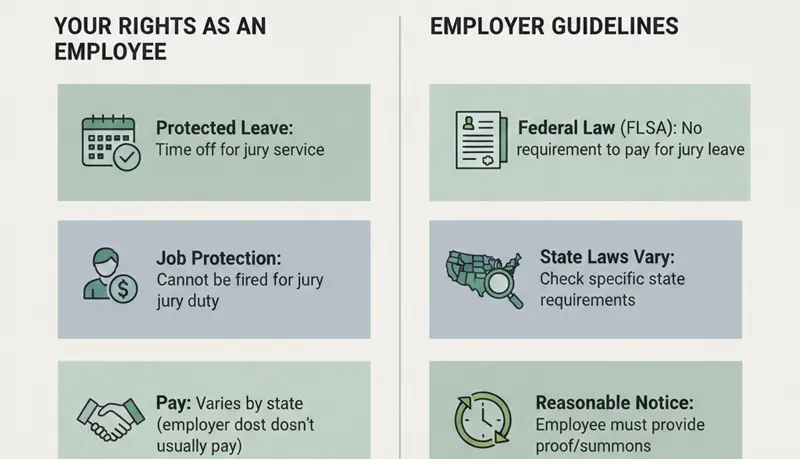
Every state and the federal government require employers to let employees attend jury duty. No employer can fire or retaliate against an employee for serving. That much is universal.
Where states differ — and where employers get into trouble — is on three questions. Accurate employee time tracking helps you document jury duty leave and maintain compliance with state-specific pay requirements:
- Must the employer pay the employee during jury duty? Most states say no. A handful require full or partial pay for some portion of the service.
- Can the employer require employees to use PTO? Most states prohibit this, but the specifics vary.
- What are the penalties for violations? These range from civil fines to criminal charges, depending on the state.
This guide covers the federal baseline, highlights every state with requirements that go beyond it, and addresses the practical staffing and compliance questions that come up.
Federal requirements
Federal law (28 U.S.C. § 1875) establishes the baseline:
- Time off is required. Employers must allow employees to attend jury duty in any court — federal, state, or local.
- No pay required. Federal law does not require employers to pay employees during jury duty.
- Anti-retaliation. Employers cannot fire, threaten, intimidate, or coerce an employee because of jury service. This includes demotion, reduction in hours, disciplinary action, or any other adverse employment action.
- No forced PTO. Federal law does not explicitly address whether employers can require PTO use, but many states prohibit it.
Federal juror compensation: The court pays jurors directly — $50/day for federal jury service, plus a travel allowance. This is separate from any employer-paid wages.
Penalties: An employer who violates federal jury duty protections may face a civil action by the employee, with the court awarding lost wages, reinstatement, and attorneys' fees. Willful violations can result in criminal contempt charges.
States that require paid jury duty leave
Most states do not require employers to pay employees during jury duty. The states below are the exceptions — they require some form of employer-paid leave for jury service.
Alabama
- Employers must pay employees their usual compensation for jury duty
- Applies to full-time employees
- Employers cannot require employees to use PTO
Colorado
- Employers must pay employees their regular wages for the first 3 days of jury service (up to $50/day)
- After 3 days, leave is unpaid unless the employer's policy provides otherwise
Connecticut
- Employers with 5 or more employees must pay full-time employees their regular wages for the first 5 days of jury service
- After 5 days, the state compensates jurors directly ($50/day)
Louisiana
- Employers must pay employees their regular wages for 1 day of jury service
- After the first day, leave is unpaid
Massachusetts
- Employers must pay employees their regular wages for the first 3 days of jury service
- After 3 days, the state compensates jurors directly ($50/day)
Nebraska
- Employers must pay employees their regular wages for jury duty
- Employees must turn over any jury fees received from the court to the employer (since the employer is already paying full wages)
New York
- Employers with 10 or more employees must pay employees their regular wages for the first 3 days of jury service (minimum $40/day)
- Smaller employers are not required to pay
- Employees may also keep court-paid jury fees
Tennessee
- Employers must pay employees their usual compensation during jury service
- Employers are entitled to a credit for any jury fees the employee receives from the court
District of Columbia
- Employers must pay employees their regular wages for the entire duration of jury service
- This is the most employee-favorable requirement in the country
States with unpaid leave only
All remaining states require employers to provide unpaid leave for jury duty. In every state:
- The employer cannot fire or retaliate against the employee for attending jury duty
- The employer cannot require the employee to use vacation, sick, or personal leave in most states (a few states are silent on this point, but it is considered best practice to not require PTO)
- The employee must provide reasonable notice to the employer upon receiving a jury summons
These states follow the standard unpaid-leave-plus-anti-retaliation framework:
Alaska, Arizona, Arkansas, California, Delaware, Florida, Georgia, Hawaii, Idaho, Illinois, Indiana, Iowa, Kansas, Kentucky, Maine, Maryland, Michigan, Minnesota, Mississippi, Missouri, Montana, Nevada, New Hampshire, New Jersey, New Mexico, North Carolina, North Dakota, Ohio, Oklahoma, Oregon, Pennsylvania, Rhode Island, South Carolina, South Dakota, Texas, Utah, Vermont, Virginia, Washington, West Virginia, Wisconsin, Wyoming
How long jury duty lasts
The duration of jury duty varies widely and is largely unpredictable, which makes it a staffing challenge:
- Jury selection (voir dire) — Most potential jurors are called for a single day of selection. If not chosen, they are released. This accounts for the majority of jury service.
- Short trials — Civil and criminal trials at the state level typically last 2–5 days.
- Longer trials — Complex civil cases or serious criminal cases can last weeks or, rarely, months.
- Grand jury — Federal and some state grand juries can require service for 12–18 months, though jurors typically serve only 1–2 days per week during that period.
Employers cannot ask employees to postpone or avoid jury duty. However, courts generally allow jurors to request a postponement if the timing creates genuine hardship — and many courts have a "one-day/one-trial" system where jurors serve for a single day unless selected for a trial.
Employer compliance requirements
What you must do
1. Grant the leave. When an employee presents a jury summons, you must allow them time off. You cannot schedule them for shifts during their service, pressure them to find a replacement, or penalize them for being unavailable.
2. Maintain benefits. In most states, employees on jury duty continue to accrue benefits (health insurance, retirement contributions, seniority) as if they were working. Do not suspend or modify benefits during jury service.
3. Allow return to work. Employees must be allowed to return to the same or an equivalent position after jury duty ends. This applies regardless of how long the service lasted.
4. Avoid retaliation. This goes beyond not firing the employee. Any negative action connected to jury service — reduced hours, unfavorable schedule changes, negative performance reviews timed around jury duty, hostile comments — can constitute retaliation.
What you should not do
- Do not ask the employee to "try to get out of it." Courts take this seriously, and it can be viewed as obstruction of justice.
- Do not dock exempt employees' pay for partial-week absences due to jury duty. Under FLSA, deducting pay from exempt employees for less than a full week of absence (when they performed some work that week) can jeopardize the salary basis for their exemption. You may offset jury fees against their salary, but you cannot reduce their weekly salary below the exempt threshold.
- Do not require proof of service on a daily basis. You may ask for a copy of the jury summons and a certificate of service when jury duty is complete, but requiring daily proof is unreasonable and may be viewed as harassment.
Practical staffing considerations
Jury duty creates unpredictable absences — you know when an employee reports for selection, but you often do not know how long they will be gone. For businesses that depend on scheduling — call centers, BPO operations, retail, healthcare — this requires planning.
Build jury duty into your shrinkage calculations. If you have 100 employees and the average jury service rate in your area is 1–2 employees per month, account for that in your staffing model.
Cross-train employees so that when someone is called for jury duty, their responsibilities can be absorbed without overtime or service disruption.
Have a notification policy. Require employees to notify their manager as soon as they receive a summons — not the day before they report. This gives you time to adjust schedules.
Know your state's rules on partial-day service. Some states require that if an employee is released from jury duty before their shift ends, they must report to work for the remainder of the day. Others do not. Clarify this in your employee handbook.
Track jury duty leave in your time tracking and leave management systems as a separate leave category. This keeps your attendance records accurate and prevents jury duty absences from being counted against employees in performance reviews. For more on state-specific labor law requirements, see our labor law compliance center.