Time Off Rules for Hourly Employees in US States

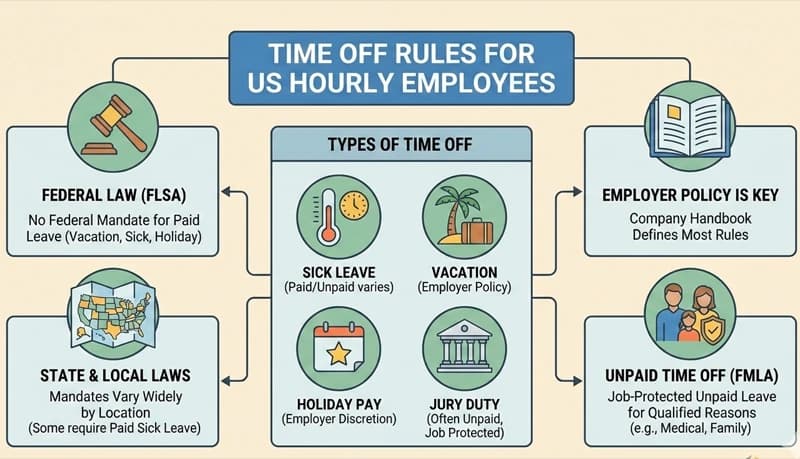
There is no federal law requiring employers to provide paid vacation, paid sick leave, or paid personal time to hourly employees. The federal requirements that do exist — FMLA, USERRA, and the PUMP Act — provide unpaid, job-protected leave for specific circumstances. Everything beyond that is determined by state law and employer policy. Using employee time tracking software with integrated leave management helps you stay compliant across states while keeping accurate records of accruals, usage, and payouts.
The complexity for employers — especially those operating in multiple states — is that state requirements vary dramatically. Some states mandate paid sick leave with specific accrual rates. Others mandate general paid leave that can be used for any reason. Several states require paid family and medical leave funded through payroll taxes. And a growing number of states restrict how employers can manage vacation payout at separation.
This guide covers the federal baseline, then details every state that goes beyond it.
Federal time off laws
These apply to all US employers regardless of state. None require paid time off for hourly workers, but they establish job-protected leave rights.
Family and Medical Leave Act (FMLA)
- What it provides: Up to 12 weeks of unpaid, job-protected leave per year
- Qualifying reasons: Birth or adoption of a child, serious health condition of the employee, caring for a spouse/child/parent with a serious health condition, qualifying military exigency
- Eligibility: Employee must have worked for the employer for 12+ months, logged 1,250+ hours in the past 12 months, and work at a location with 50+ employees within 75 miles
- Key rule: Employer must maintain group health benefits during leave and restore the employee to the same or equivalent position upon return
- Military caregiver leave: Up to 26 weeks in a single 12-month period to care for a covered servicemember with a serious injury or illness
PUMP Act (break time for nursing)
- What it provides: Reasonable break time and a private space (not a bathroom) for expressing breast milk for up to one year after a child's birth
- Coverage: All employees covered by the FLSA, including hourly workers (expanded from the previous law which only covered non-exempt employees)
- Compensation: Breaks for expressing milk are unpaid unless the employee is not completely relieved from duty
Uniformed Services Employment and Reemployment Rights Act (USERRA)
- What it provides: Job protection and reemployment rights for employees who leave civilian employment for military service
- Duration: Cumulative military leave of up to 5 years with the same employer
- Key rule: Returning employees must be restored to the position they would have attained had they remained continuously employed (escalator principle)
What federal law does NOT require
- Paid vacation
- Paid sick leave
- Paid personal days
- Paid holidays
- Paid bereavement leave
- PTO payout at separation
All of these are governed by state law or employer policy.
States that mandate paid sick leave
The following states require employers to provide paid sick leave to hourly employees. Accrual rates, caps, and employer size thresholds vary.
| State | Accrual rate | Annual cap | Employer size threshold | Key details |
|---|---|---|---|---|
| Arizona | 1 hr per 30 hrs worked | 40 hrs (fewer than 15 employees); 56 hrs (15+) | All employers | Includes temp and part-time workers |
| California | 1 hr per 30 hrs worked | 40 hrs accrual or 24 hrs frontloaded (employer choice); usage cap 40 hrs | All employers | SB 616 (2024) increased caps from previous 24/48 structure |
| Colorado | 1 hr per 30 hrs worked | 48 hrs | All employers | Additional public health emergency leave provisions |
| Connecticut | 1 hr per 40 hrs worked | 40 hrs | 50+ employees (service workers); all employers for general paid sick leave effective 2025 | Expanded from service workers only |
| Illinois | 1 hr per 40 hrs worked | 40 hrs | All employers | Paid Leave for All Workers Act (2024) — can be used for any purpose, not just sick leave |
| Maine | 1 hr per 40 hrs worked | 40 hrs | 10+ employees | Earned paid leave — usable for any reason, not limited to illness |
| Maryland | 1 hr per 30 hrs worked | 40 hrs (paid for 15+ employees; unpaid for smaller) | All employers (paid leave for 15+) | Employers with fewer than 15 employees must provide unpaid sick leave |
| Massachusetts | 1 hr per 30 hrs worked | 40 hrs | All employers (paid for 11+; unpaid for smaller) | Employers with fewer than 11 employees must provide unpaid sick leave |
| Michigan | 1 hr per 30 hrs worked | 72 hrs | All employers | Restored Earned Sick Time Act (2025) — expanded from previous 40-hour cap |
| Minnesota | 1 hr per 30 hrs worked | 48 hrs | All employers | Statewide sick and safe time law effective 2024 |
| Missouri | 1 hr per 30 hrs worked | 56 hrs (15+ employees); 40 hrs (fewer than 15) | All employers | Proposition A (2025) |
| Nebraska | 1 hr per 30 hrs worked | 56 hrs (20+ employees); 40 hrs (fewer than 20) | All employers | Initiative 436 (2025) |
| Nevada | 0.01923 hrs per hr worked (~1 hr per 52 hrs) | 40 hrs | 50+ employees | Paid leave for any reason (not limited to illness) |
| New Jersey | 1 hr per 30 hrs worked | 40 hrs | All employers | |
| New Mexico | 1 hr per 30 hrs worked | 64 hrs | All employers | One of the highest caps in the country |
| New York | Varies by employer size | 40–56 hrs depending on employer size and location | All employers | NYC employers have additional requirements |
| Oregon | 1 hr per 30 hrs worked | 40 hrs | All employers (paid for 10+ employees; 6+ in Portland) | Smaller employers provide unpaid sick leave |
| Rhode Island | 1 hr per 35 hrs worked | 40 hrs | All employers (paid for 18+) | Smaller employers provide unpaid sick leave |
| Vermont | 1 hr per 52 hrs worked | 40 hrs | All employers | Slowest accrual rate among mandate states |
| Washington | 1 hr per 40 hrs worked | No cap on accrual | All employers | No cap — one of the most generous requirements |
| Washington, D.C. | 1 hr per 37 hrs worked | 56 hrs (100+ employees); 40 hrs (25–99); 24 hrs (fewer than 25) | All employers | Tiered by employer size |
Permitted uses
Most state paid sick leave laws allow employees to use sick leave for:
- The employee's own illness, injury, or medical appointment
- Caring for a family member with an illness or medical appointment
- Reasons related to domestic violence, sexual assault, or stalking (safe time)
- Public health emergency closures (school, workplace, childcare)
The definition of "family member" varies by state — some include only spouses and children, while others include siblings, grandparents, in-laws, or anyone the employee considers family.
States that mandate paid family and medical leave
These states have enacted paid family and medical leave insurance programs, typically funded through payroll tax contributions from employees, employers, or both.
| State | Duration | Wage replacement | Funding |
|---|---|---|---|
| California | Up to 8 weeks family leave; up to 52 weeks disability | 60–70% of wages (capped) | Employee payroll tax (SDI) |
| Colorado | Up to 12 weeks (16 for pregnancy complications) | Up to 90% of wages (capped) | Shared employer/employee payroll tax |
| Connecticut | Up to 12 weeks (14 for pregnancy complications) | Up to 95% of wages (capped) | Employee payroll tax |
| Delaware | Up to 12 weeks (effective 2026) | 80% of wages (capped) | Shared employer/employee payroll tax |
| Massachusetts | Up to 20 weeks medical; 12 weeks family; 26 weeks combined max | Up to 80% of wages (capped) | Shared employer/employee payroll tax |
| Maryland | Up to 12 weeks (effective 2026) | Up to 90% of wages (capped) | Shared employer/employee payroll tax |
| Minnesota | Up to 12 weeks family; 12 weeks medical (20 combined max, effective 2026) | Up to 90% of wages (capped) | Shared employer/employee payroll tax |
| New Jersey | Up to 12 weeks family; 26 weeks disability | Up to 85% of wages (capped) | Employee payroll tax |
| New York | Up to 12 weeks family leave; 26 weeks disability | 67% of wages (capped at state AWW) | Employee payroll tax (PFL); employer-funded (DBL) |
| Oregon | Up to 12 weeks (14 for pregnancy complications) | Up to 100% of wages (capped) | Shared employer/employee payroll tax |
| Rhode Island | Up to 6 weeks family (TCI); 30 weeks disability (TDI) | Up to 72% of wages (capped) | Employee payroll tax |
| Washington | Up to 12 weeks family; 12 weeks medical (16 combined max; 18 for pregnancy complications) | Up to 90% of wages (capped) | Shared employer/employee payroll tax |
Employer obligations
Even in states where the benefit is funded by employee payroll tax, employers have obligations:
- Correctly withhold and remit contributions
- Provide required notices to employees about the program
- Maintain job protection during leave (most programs require it)
- Continue health benefits during leave
- Not retaliate against employees who use the benefit
Vacation payout at separation
Federal law does not require vacation payout. State rules vary:
States that require payout of accrued, unused vacation
If an employer offers vacation, these states require that accrued, unused vacation be paid out at separation (whether the employee quits or is terminated):
California, Colorado, Illinois, Louisiana, Massachusetts, Montana, Nebraska, North Dakota
States that allow "use it or lose it" with conditions
Most remaining states allow employers to establish "use it or lose it" policies — where unused vacation does not pay out at separation — but only if the policy is clearly communicated to employees in writing. If the employer has no written policy addressing payout, courts in many states treat accrued vacation as wages owed.
Key rules
- California: Vacation is treated as wages. Cannot be forfeited. Must be paid out at separation. "Use it or lose it" policies are prohibited, though reasonable accrual caps are permitted.
- Illinois: Accrued vacation must be paid out at separation. Employers can set accrual caps and waiting periods.
- Colorado: Vacation is wages. Must be paid out at separation regardless of employer policy.
- Montana: Accrued vacation must be paid out unless the employee is terminated for cause within the first year.
States that follow federal standards only
The following states do not mandate paid sick leave, paid family leave, or vacation payout beyond what federal law requires. Employers in these states must comply with FMLA, USERRA, and the PUMP Act, but are not required to provide any paid time off to hourly employees:
Alabama, Alaska, Arkansas, Florida, Georgia, Idaho, Indiana, Iowa, Kansas, Kentucky, Mississippi, New Hampshire, North Carolina, North Dakota, Ohio, Oklahoma, Pennsylvania, South Carolina, South Dakota, Tennessee, Texas, Utah, Virginia, West Virginia, Wisconsin, Wyoming
Note: Some of these states have other leave requirements (voting leave, jury duty leave, military leave) that are not paid time off in the traditional sense. Several also have local (city or county) ordinances that mandate paid sick leave even though the state does not — Austin, Dallas, San Antonio, Pittsburgh, Philadelphia, and others have enacted or attempted local mandates. Check local requirements in addition to state law.
Compliance for multi-state employers
Employers with hourly employees in multiple states — common in BPO and remote-first operations — face the most complex compliance landscape.
Which state's law applies
Generally, the law of the state where the employee performs the work governs, not the state where the employer is headquartered. A call center based in Texas with remote agents in California, Colorado, and New York must comply with each of those states' paid sick leave, paid family leave, and vacation payout requirements for the agents located there.
Practical compliance steps
Identify all states where employees work. For remote workers, this is their home state — even if they were originally hired to work in a different location.
Map requirements by state. Build a matrix of which states require paid sick leave, paid family leave, and vacation payout, and configure your payroll and time tracking systems to enforce the applicable rules per employee.
Use the strictest standard as a baseline. Some employers simplify compliance by applying the most generous state requirement to all employees nationwide. For example, offering 1 hour of paid sick leave per 30 hours worked (up to 56 hours per year) to all employees meets or exceeds every current state mandate. This simplifies administration at a modest cost.
Track law changes. State paid leave laws are expanding rapidly — multiple states have enacted or expanded mandates in the past two years alone. Review requirements annually and update policies accordingly. For a broader overview of labor law requirements, see our labor law compliance center.