HR Policies for BPOs — What Differs from Call Centers

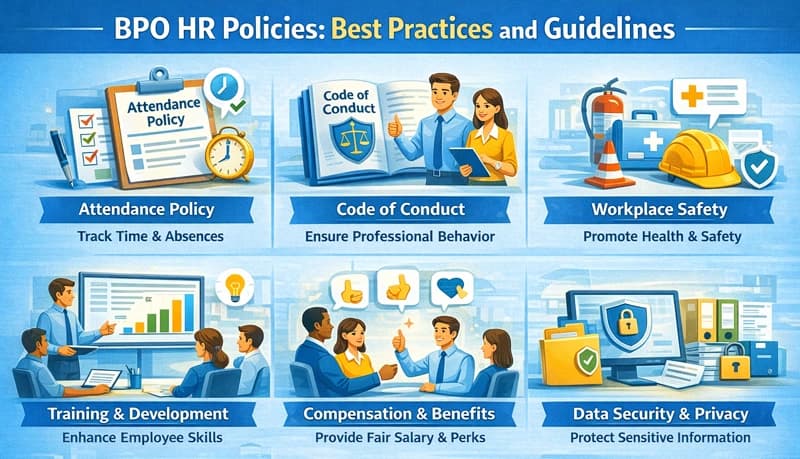
BPOs share most HR policy needs with in-house call centers — attendance, scheduling, performance management, conduct, and separation all apply. But BPOs operate under conditions that create additional policy requirements: multiple clients with different contractual obligations, agents who move between accounts, operations spanning multiple countries with different labor laws, and client-imposed requirements that may conflict with internal policy.
This guide focuses on the HR policy areas where BPOs differ from single-client call centers — the policies that address multi-client complexity, cross-border operations, and the contractual dynamics unique to outsourcing. A purpose-built BPO management solution helps enforce these policies consistently across accounts and sites.
Multi-client workforce management
Account assignment and mobility
In a single-client call center, every agent does essentially the same job. In a BPO, agents may be assigned to one client account or cross-trained on several, and they may move between accounts based on demand, client requirements, or agent development.
What the policy should cover:
Assignment process. How agents are assigned to accounts — by skill match, language proficiency, shift availability, seniority, or client request. Document the criteria so agents understand why they are placed where they are and how reassignment decisions are made.
Cross-training expectations. Whether agents are expected to learn multiple accounts, how cross-training is compensated (same rate or skill-based differential), and how cross-trained agents are scheduled across accounts. Cross-training creates scheduling flexibility and reduces overtime costs, but agents need clarity on what is expected.
Account transitions. When an agent is moved from one account to another — whether due to client volume changes, account loss, or performance issues — the policy should define:
- Notice period (how much advance warning the agent receives)
- Whether the agent's pay rate changes with the new account
- Retraining period and whether reduced performance targets apply during transition
- Whether the agent can request to return to their previous account
Client-requested removals. Clients sometimes request that specific agents be removed from their account — for quality issues, compliance concerns, or personality conflicts. The policy should specify how these requests are handled internally. A client can request removal from their account; they should not be able to dictate that the BPO terminates the agent. The BPO's obligation is to reassign, not terminate, unless the agent's behavior also violates internal policy.
Client-specific rules
Different clients impose different requirements on how their work is performed, and these requirements often go beyond standard operating procedures into areas that feel like HR policy:
| Client requirement | Policy implication |
|---|---|
| Background check or security clearance | Only qualified agents can be assigned; policy must define who pays for checks and how long certification takes |
| Dress code (for video-enabled accounts) | May differ from BPO's general dress code; agents need clarity on which standard applies |
| Mandatory overtime during peak seasons | Must comply with labor law regardless of client contract terms |
| Non-disclosure agreements | Agents may need to sign client-specific NDAs; policy should address what happens if an agent refuses |
| Screen recording or keystroke monitoring | Must comply with local privacy laws and be disclosed to agents |
The critical principle: Client contracts cannot override labor law. If a client's contract requires mandatory 12-hour shifts but local law caps daily work hours at 10, the BPO must comply with the law and renegotiate the contract. HR policy should explicitly state this hierarchy: law > BPO policy > client requirements.
Cross-jurisdictional compliance
BPOs operating across multiple countries — or even multiple US states — face compliance complexity that single-site operations do not.
Multi-country labor law
Each country where the BPO employs agents has its own labor law framework governing wages, hours, termination, benefits, leave, and employee rights. A policy that works in the US may violate labor law in the Philippines, India, or Colombia.
What the policy should cover:
Country-specific policy addenda. Rather than trying to write one global policy, create a core policy that establishes principles and standards, with country-specific addenda that address local legal requirements. For example:
| Policy area | US | Philippines | India |
|---|---|---|---|
| Minimum notice for termination | At-will (none required in most states) | 30 days for regular employees | Varies by state; typically 30 days |
| Mandatory benefits | Health insurance (50+ employees), FMLA | SSS, PhilHealth, Pag-IBIG, 13th month pay | PF, ESI, gratuity |
| Overtime threshold | 40 hours/week (federal); daily in some states | 8 hours/day | 9 hours/day |
| Paid leave minimums | No federal requirement; state laws vary | 5 days service incentive leave after 1 year | 15 days earned leave (varies by state) |
Local HR representation. Each country site should have HR staff or legal counsel familiar with local labor law. Relying on headquarters HR to interpret foreign labor law is a compliance risk.
Termination procedures by jurisdiction. The termination process that is routine in an at-will US employment context — same-day termination with final paycheck — may be illegal in countries that require notice periods, severance payments, or labor authority approval. Document the correct procedure for each jurisdiction.
Multi-state US compliance
Even within the US, BPOs with agents in multiple states must navigate varying requirements for overtime, breaks, paid sick leave, and scheduling. Remote agents working from home in different states compound this — an agent hired in Texas who moves to California triggers California labor law compliance, including daily overtime and mandatory meal breaks.
What the policy should cover:
- How the BPO determines which state's law applies (generally the state where the agent performs work, not where the BPO is headquartered)
- Process for agents to report changes in their work location
- How payroll and scheduling systems are configured to apply state-specific rules
Compensation structures
BPO compensation is more complex than in-house call center pay because rates often vary by account, shift, skill level, and location.
What the policy should cover
Account-based pay rates. If different accounts pay different rates — for example, a technical support account paying $16/hour and a general customer service account paying $14/hour — document how rates are determined and what happens when an agent works on multiple accounts in the same week. For overtime calculation, the blended rate (weighted average of all rates worked that week) must be used as the regular rate for overtime premium calculation, per FLSA requirements.
Shift differentials. Night shift, weekend, and holiday premium rates, specified by amount (flat dollar amount or percentage). Document whether differentials apply to overtime hours and how they interact with account-based rates.
Billable vs. non-billable time. BPOs track whether agent time is billable to a client. Training, meetings, system downtime, and bench time (when an agent is between account assignments) are typically non-billable. The policy should be clear that all hours worked are paid regardless of billability — non-billable time is a cost management issue for the BPO, not a compensation issue for the agent.
Bench policy. What happens when an account ends or reduces volume and agents have no immediate assignment. Options include:
- Reassignment to another account (with retraining)
- Temporary reduced hours
- Bench period with full pay for a defined duration (e.g., 2 weeks) followed by reduced hours or separation if no assignment is found
Document the bench process so agents know what to expect and the BPO has a consistent, defensible approach.
Data security and client confidentiality
BPOs handle data belonging to their clients' customers, creating a chain of data custody that requires more rigorous policies than an in-house operation.
What the policy should cover
Information barriers between accounts. Agents working on competing clients (two financial services companies, two telecom providers) must not be able to access each other's data or share competitive information. Policy should define how information barriers are enforced — separate systems, separate teams, separate physical spaces, or technical access controls.
Client data classification. Not all data is equally sensitive. Define classification levels and the handling requirements for each:
| Classification | Examples | Handling requirements |
|---|---|---|
| Restricted | Payment card data, SSN, health records | Encrypted, no local storage, clean desk mandatory, PCI/HIPAA compliance |
| Confidential | Customer account details, contact information | Access limited to assigned agents, no screenshots, no personal devices |
| Internal | Client processes, SOPs, quality standards | Not shared outside the account team, NDA-protected |
Remote agent data security. For agents working from home, additional requirements:
- Dedicated workspace in a private room (no shared screens visible to household members)
- VPN required for all work activity
- No personal devices connected to work systems
- Prohibition on printing customer data at home
- Periodic compliance audits (remote workspace checks)
Breach notification. The process for reporting and escalating a potential data breach, including notification timelines mandated by client contracts and applicable regulations (GDPR requires notification within 72 hours). Agents must know how to report suspected breaches and understand that prompt reporting is protected — not punished.
Remote and hybrid work
BPOs have adopted remote and hybrid models at scale, which creates policy needs beyond what a standard work-from-home arrangement requires.
What the policy should cover
Eligibility criteria. Which accounts, tenure levels, and performance levels qualify for remote work. Some clients contractually require on-site work; others permit remote with security requirements. The policy should specify which accounts are remote-eligible and which are not.
Equipment and connectivity. What the BPO provides (laptop, headset, monitor) vs. what the agent must provide (internet connection meeting minimum speed requirements, backup power in areas with unreliable electricity). Document minimum internet speed (typically 25+ Mbps download, 5+ Mbps upload) and whether the BPO provides a stipend for internet costs.
Time tracking and activity monitoring. How remote agents' work hours and activity are tracked — time tracking software, screenshot monitoring, login/logout records, or a combination. The policy must disclose what is monitored and how the data is used.
Return-to-office provisions. Under what circumstances a remote agent can be required to return to an office — client mandate, performance issues, security concerns, or organizational restructuring. Define the notice period for a return-to-office requirement.
Employee development and career paths
BPOs have a unique advantage in career development — the multi-client, multi-function environment creates more career path options than a single-client operation. But these paths only drive retention if they are documented and accessible.
What the policy should cover
Defined progression tiers. Map out the career path from entry-level agent through senior agent, team lead, supervisor, operations manager, and account manager. For each tier, define:
- Minimum tenure and performance requirements to be eligible
- Skills or certifications required
- Pay range for the tier
- How advancement opportunities are posted and filled (internal posting, manager nomination, application process)
Account mobility as development. Moving to a more complex account — from general customer service to technical support, from domestic to multilingual, from a small account to a strategic client — is a development opportunity. Frame it that way in policy, with corresponding pay adjustments and recognition.
Support roles. BPOs have non-agent roles that agents can grow into: QA analyst, trainer, workforce management analyst, reporting analyst, client services coordinator. Document these paths and the skills development available to reach them. Agents who can see a future beyond the phone are significantly more likely to stay.
Policy governance
Review and update cadence
| Trigger | Action |
|---|---|
| Annual | Full review of all policies against current law and operational practice |
| New client onboarded | Review whether client requirements create policy gaps or conflicts |
| New country/state entered | Create or update jurisdiction-specific addenda |
| Labor law change | Update affected policies within 30 days of effective date |
| Significant incident | Post-incident review to determine if policy gaps contributed |
Version control
Maintain version history for every policy document. When a policy changes, agents should acknowledge the new version in writing. In multi-jurisdiction operations, track which version applies in which location to avoid applying outdated rules.
Supervisor calibration
Policies are only as consistent as the supervisors who apply them. Train supervisors on policy interpretation at least annually, and when any policy changes. Run calibration scenarios — "Agent X did Y; what action does the policy require?" — to ensure supervisors across shifts, sites, and countries are applying the same standards. Inconsistent application creates legal exposure and erodes agent trust in the fairness of the system.