The 2-2-3 Schedule Explained — Rotation, Pros, and Cons

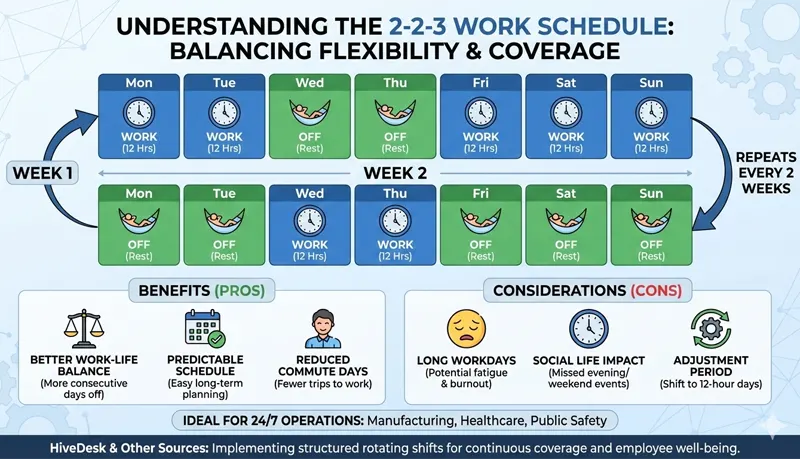
The 2-2-3 schedule (also called the Panama schedule) is a rotating shift pattern designed for operations that need 24/7 coverage. It uses 12-hour shifts and requires 4 teams to cover all hours. Each team works a repeating 14-day cycle: 2 days on, 2 days off, 3 days on, 2 days off, 2 days on, 3 days off.
The result is that every employee works 7 out of 14 days — an average of 42 hours per week — and gets a 3-day weekend every other week. Two teams are always working any given 12-hour shift (day or night), providing consistent coverage without overtime. Workforce scheduling software simplifies managing these rotations and ensures the right teams are assigned to each shift.
The rotation pattern
The 2-2-3 schedule runs on a 14-day cycle with 4 teams (A, B, C, D). Two teams work days (e.g., 6 AM–6 PM) and two work nights (6 PM–6 AM), then they swap.
Week 1:
| Mon | Tue | Wed | Thu | Fri | Sat | Sun | |
|---|---|---|---|---|---|---|---|
| Team A (days) | ON | ON | off | off | ON | ON | ON |
| Team B (days) | off | off | ON | ON | off | off | off |
| Team C (nights) | off | off | ON | ON | off | off | off |
| Team D (nights) | ON | ON | off | off | ON | ON | ON |
Week 2:
| Mon | Tue | Wed | Thu | Fri | Sat | Sun | |
|---|---|---|---|---|---|---|---|
| Team A (days) | off | off | ON | ON | off | off | off |
| Team B (days) | ON | ON | off | off | ON | ON | ON |
| Team C (nights) | ON | ON | off | off | ON | ON | ON |
| Team D (nights) | off | off | ON | ON | off | off | off |
After the 14-day cycle, day and night teams swap: Teams A and B move to nights, Teams C and D move to days. Use our free shift schedule generator to build and customize this rotation for your team.
Key numbers:
| Metric | Value |
|---|---|
| Shift length | 12 hours |
| Days worked per 14-day cycle | 7 |
| Average hours per week | 42 |
| Teams required | 4 |
| Teams on any given shift (day or night) | 2 |
| Days off per 14-day cycle | 7 |
| 3-day weekends per cycle | 1 |
The coverage math
For a call center that needs N agents on the phones at all times (24/7), here is how many total agents the 2-2-3 schedule requires.
At any given time, 2 of 4 teams are working (50% of the workforce). But you also need to account for shrinkage — breaks, absences, training, and other non-productive time.
| Component | Calculation | Example (need 20 agents on phones) |
|---|---|---|
| Agents needed on phones | N | 20 |
| Agents needed per shift (accounting for shrinkage at 30%) | N / (1 − 0.30) | 20 / 0.70 = 29 agents per shift |
| Agents per team (2 teams per shift) | Agents per shift / 2 | 29 / 2 = 15 per team (round up) |
| Total agents across 4 teams | Agents per team × 4 | 15 × 4 = 60 total agents |
60 agents to keep 20 on the phones at all times. This 3:1 ratio (total headcount to concurrent requirement) accounts for the fact that only 50% of the workforce is on shift at any time, plus 30% shrinkage on the working shift.
When the 2-2-3 schedule fits
The 2-2-3 schedule is not right for every call center. It solves specific problems and creates others.
Operations where it works well
| Characteristic | Why 2-2-3 fits |
|---|---|
| True 24/7 operation | The schedule is designed for round-the-clock coverage. If your operation runs 24/7 with similar volume day and night, it provides even staffing |
| Consistent volume across all hours | The schedule puts the same number of agents on every shift. This works when volume is relatively flat across the day |
| Difficulty filling night shifts | Because all agents rotate between days and nights, no one is permanently on nights. This can reduce the attrition problem of dedicated night-shift workers |
| High overtime costs from irregular coverage | The 2-2-3 eliminates most overtime because the rotation provides built-in coverage. Each agent works approximately 42 hours per week — close to 40, with minimal overtime exposure |
Operations where it does not work
| Characteristic | Why 2-2-3 does not fit |
|---|---|
| Volume varies significantly by time of day | Most call centers have 2–3x more volume during business hours than overnight. The 2-2-3 schedule puts equal agents on every shift, which means overstaffing at night and understaffing during the day. A volume-matched schedule is better |
| Operation runs fewer than 18 hours per day | If your call center runs 12–16 hours per day (e.g., 7 AM–9 PM), 12-hour shifts with 4 teams is overkill. Standard 8-hour shifts with 2–3 overlapping shift patterns provide better coverage |
| Agents cannot work 12-hour shifts | Some agents — especially those with caregiving responsibilities — cannot work 12-hour days. If a significant portion of your workforce cannot accommodate 12-hour shifts, the schedule reduces your available labor pool |
| Labor law restrictions | Some states and jurisdictions have predictive scheduling laws or daily overtime requirements that make 12-hour shifts costly. In California, hours beyond 8 in a day trigger daily overtime — a 12-hour shift means 4 hours of overtime every working day |
How 2-2-3 compares to other 24/7 schedules
| Schedule | Shift length | Teams | Hours/week | Key difference from 2-2-3 |
|---|---|---|---|---|
| 2-2-3 (Panama) | 12 hours | 4 | ~42 | Balanced rotation with 3-day weekends every other week |
| 4 on / 4 off | 12 hours | 4 | ~42 | Simpler pattern (4 days on, 4 off). Easier to remember but no guaranteed weekends off |
| DuPont | 12 hours | 4 | ~42 | Includes a 7-day off stretch every 28 days. More complex rotation but longer recovery periods |
| 5-2 / 5-3 (standard rotating) | 8 hours | 3–5 | 40 | Uses 8-hour shifts. More teams needed but avoids 12-hour fatigue. Better for operations where daily overtime laws apply |
| Fixed shifts | 8 hours | 3 | 40 | No rotation — each agent always works the same shift. Simplest to manage but night shift has chronic staffing and attrition problems |
Implementing the 2-2-3 schedule in a call center
Step 1: Validate that it fits your volume pattern
Before committing to the 2-2-3, check whether your volume supports equal staffing on all shifts.
| Check | How to check | Go / no-go |
|---|---|---|
| Night volume vs. day volume | Pull volume by interval for the last 4 weeks. Compare total contacts during day shifts (6 AM–6 PM) to night shifts (6 PM–6 AM) | If night volume is fewer than 40% of day volume, the 2-2-3 will significantly overstaff nights. Consider a hybrid approach or a different schedule |
| Weekend volume vs. weekday volume | Compare Saturday/Sunday volume to weekday average | If weekend volume is fewer than 50% of weekday volume, equal weekend staffing wastes labor cost |
| AHT consistency across shifts | Compare AHT during day vs. night | If AHT differs significantly (e.g., night calls are longer), the staffing requirement per shift is different even at the same volume |
Step 2: Size your teams
Use the coverage math above to determine how many agents per team. Then validate:
| Validation check | What to verify |
|---|---|
| Minimum coverage during peak | Are 2 teams sufficient for peak volume, or do you need overlap during the busiest 4–6 hours? If peak requires more agents than 2 teams provide, you need a supplemental shift during peak hours |
| Absence buffer | Add 5–8% to each team size to account for unplanned absences. If a team has 15 agents and 2 are absent, coverage drops to 13 — check if that still meets the requirement |
| Supervisor coverage | Each working shift needs a supervisor. With 2 teams per shift, you may need 2 supervisors or 1 supervisor and 1 team lead per shift |
Step 3: Handle the day/night swap
The day-to-night rotation is the most disruptive element of the 2-2-3 schedule. Agents switching from day shifts to night shifts (or vice versa) need time to adjust.
| Approach | How it works | Trade-off |
|---|---|---|
| Swap every 2 weeks (standard) | After the 14-day cycle, day teams move to nights and vice versa | Frequent adjustment. Some agents struggle with biweekly circadian disruption |
| Swap every 4 weeks | Teams stay on days or nights for a full 28-day cycle before swapping | Less frequent disruption but longer stretches on nights, which can increase fatigue and absenteeism |
| Swap every quarter | Teams rotate day/night every 3 months | Minimal disruption but night-shift agents may experience the same retention problems as fixed-night workers during their quarter |
| Fixed day/night (no rotation) | Two teams are permanently on days, two permanently on nights. Night teams receive a shift differential | Eliminates rotation disruption but creates a two-tier workforce. Night teams will have higher attrition unless compensated significantly |
Step 4: Address the overtime question
The 2-2-3 schedule produces approximately 42 hours per week (seven 12-hour shifts per 14-day cycle = 84 hours biweekly = 42 hours/week average). Depending on your jurisdiction and overtime rules:
| Overtime rule | Impact on 2-2-3 |
|---|---|
| Federal FLSA (overtime after 40 hours/week) | Agents average 42 hours/week. In the 3-day work week, they work 36 hours. In the 4-day work week (includes the 3-day block + the 2-day start of the next pattern), they may work 48 hours. Overtime applies to hours above 40 in that week |
| Daily overtime (some states, e.g., California) | Every 12-hour shift triggers 4 hours of daily overtime. This makes the 2-2-3 significantly more expensive — 28–33% of all hours are overtime |
| Biweekly pay period | If your pay period is biweekly (14 days), each period contains exactly 84 hours, averaging 42 hours/week. Overtime calculation depends on whether your jurisdiction uses weekly or biweekly overtime thresholds |
Check your state and local labor laws before implementing. In states with daily overtime, the 2-2-3 schedule may cost 15–20% more in labor than an 8-hour shift schedule that avoids daily overtime triggers.
Step 5: Communicate and transition
| Action | Timeline | Detail |
|---|---|---|
| Announce the change | 6–8 weeks before go-live | Explain the schedule, share the rotation calendar for the first 3 months, address questions |
| Post the full rotation calendar | 4 weeks before go-live | Every agent should know their exact days and shifts for at least 8 weeks out. Publish the full annual rotation if possible |
| Pilot with 1–2 teams first | 4 weeks before full rollout | Run the schedule with a subset to identify operational issues (coverage gaps, overtime calculation problems, break scheduling within 12-hour shifts) |
| Go live | After pilot validation | Full transition to 2-2-3 across all teams |
| Review | 30 and 90 days after go-live | Check service level, overtime, absence rates, attrition, and employee feedback |
Managing breaks within 12-hour shifts
A 12-hour shift requires more break time than an 8-hour shift. Typical break structure:
| Break | Timing | Duration |
|---|---|---|
| First break | 2–2.5 hours into shift | 15 minutes |
| Meal break | 4–5 hours into shift | 30–60 minutes (check state meal break requirements) |
| Second break | 7–8 hours into shift | 15 minutes |
| Third break | 10–10.5 hours into shift | 15 minutes |
Total break time: 75–105 minutes per 12-hour shift. This is a higher percentage of the shift than breaks in an 8-hour day (45–60 minutes), which increases shrinkage. Factor this into the staffing calculation.
Stagger breaks so no more than 10–15% of agents on the shift are on break at the same time. With a 15-agent team and 4 break periods, staggering is essential — if all 15 take their first break in the same 30-minute window, coverage drops to zero.
What to monitor after implementation
| Metric | Compare to | Concern if |
|---|---|---|
| Service level by shift | Pre-implementation baseline and target | Night shift or weekend service level is significantly above target (overstaffed) while day shift is below (understaffed) |
| Overtime hours | Pre-implementation baseline | Overtime increased — may indicate the 42-hour average is triggering more weekly overtime than the previous schedule |
| Absence rate by shift | Pre-implementation baseline | Night shift absences significantly higher — indicates the rotation is not providing adequate recovery |
| Attrition | Pre-implementation 3-month trailing rate | If attrition increases within 90 days of implementation, agents may not be adapting to 12-hour shifts or the rotation pattern |
| Agent productivity in hours 10–12 | Same agent's productivity in hours 1–4 | Significant decline in the last 2 hours of a 12-hour shift indicates fatigue affecting performance. Track AHT and QA scores by hour of shift |