Managing Attrition in BPOs — What Actually Reduces Turnover

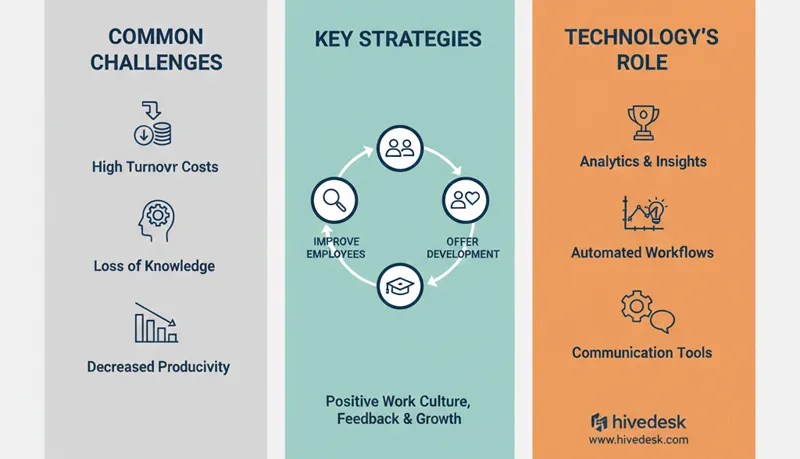
BPO attrition is not a single problem with a single cause. It is the aggregate result of dozens of operational decisions — how you schedule, how you pay, how you promote, how you manage workload, and how you treat the gap between what agents experience and what they were told to expect during hiring.
The BPO industry typically operates at 30-45% annual turnover, with some segments (outbound sales, collections) running considerably higher. A BPO management platform that tracks attendance, scheduling, and performance helps you identify at-risk agents before they leave. This is not inevitable. Some BPOs sustain turnover below 20%. The difference is not pizza parties or engagement surveys — it is structural: how the operation is designed, how agents are compensated relative to alternatives, and whether the management layer between the agent and the organization actually functions.
This post focuses on the interventions that measurably reduce BPO attrition, distinguished from the ones that feel productive but do not move the number. For the mechanics of calculating and segmenting retention rates, see our retention rate guide. For the relationship between agent satisfaction and customer outcomes, see why agent satisfaction drives customer satisfaction.
Why BPO attrition is structurally different
A BPO has attrition drivers that do not exist in a single-client call center or in most other industries:
Multi-client complexity. Agents may be moved between accounts based on business needs, not their own preferences. An agent trained on a healthcare account who gets reassigned to a telecom account has to restart their learning curve — and may not like the new work. Account transitions are a significant attrition trigger that in-house call centers do not face.
Contract-driven instability. When a client contract ends or reduces volume, agents face reassignment or separation. Even agents who are not directly affected see colleagues lose their positions, which undermines the sense of stability. In a BPO with high client concentration, a single contract loss can trigger a wave of departures — both forced and voluntary.
Wage compression across accounts. A BPO may pay the same rate for agents handling a simple order-status queue and agents handling complex technical support — because the billing model does not differentiate. The technical support agents, who could earn more elsewhere, leave first. Meanwhile, the BPO's account profitability on the technical account deteriorates as experienced agents are replaced by trainees.
The "stepping stone" perception. In many markets, BPO work is seen as a temporary job rather than a career. Agents take the position intending to leave once something better comes along. This is partly a reputation problem and partly a structural one — if the BPO does not offer meaningful career progression, the perception is accurate.
Where agents actually go
Before designing retention interventions, understand where your departing agents are going. Exit data should capture this, and the answer determines which levers matter:
| Destination | What it tells you | Which lever matters |
|---|---|---|
| Another BPO (same role) | Your compensation or working conditions are below market | Pay, scheduling, management quality |
| Another BPO (higher role) | You are not promoting fast enough | Career path, internal mobility |
| Different industry (same pay level) | Agents are leaving the work itself, not just your company | Workload, occupancy, schedule flexibility |
| Different industry (higher pay) | Your wages cannot compete with alternatives | Pay structure, or accept higher turnover and optimize for it |
| Education / personal reasons | Not retention-preventable in most cases | Minimize friction — offer return paths |
| Involuntary (terminated for performance or attendance) | Your hiring or training process is not filtering correctly | Hiring criteria, onboarding |
If 40% of your attrition is agents leaving for other BPOs at higher pay, no amount of team-building will fix it. If 40% is agents leaving the industry entirely because the work is unsustainable, raising pay will not fix it either.
Interventions that reduce attrition
Compensation — the floor, not the ceiling
Pay is the most common reason agents cite for leaving, but the relationship between pay and retention is not linear. Paying below market guarantees high attrition. Paying at market gets you to a baseline. Paying above market helps — but with diminishing returns, and only if other factors are not pushing agents out.
What works:
- Pay at or above the 50th percentile for your market and role type. Check this annually — minimum wage increases and local labor market shifts can erode your position without any change on your end.
- Account-based rate differentials. Pay agents on complex or high-skill accounts more than agents on simple accounts. This retains your most valuable agents and creates a financial incentive for skill development.
- Attendance and performance bonuses tied to metrics that are within the agent's control — quality scores, schedule adherence, tenure milestones. Keep the criteria clear and the payout reliable.
- Shift differentials for evening, overnight, and weekend shifts. A $1.50–$2.00/hour differential for undesirable shifts reduces the resentment that drives attrition on those shifts.
What does not work:
- Across-the-board raises without addressing the structural problems. A $0.50/hour raise costs a 500-agent operation $520,000 per year. If attrition does not actually drop, that money is wasted.
- Annual raises that do not keep pace with market movement. A 2% annual increase when the local market is moving at 4% means you are falling further behind every year.
Scheduling — the most underrated retention lever
For hourly workers, schedule quality is often more important than pay. An agent who earns $15/hour but has a predictable schedule they can plan their life around will stay longer than one earning $16/hour with erratic, last-minute schedule changes.
What works:
- Post schedules at least 2 weeks in advance. Employee scheduling software makes it practical to build and publish schedules well ahead of time. Last-minute schedule changes are one of the top drivers of attrition in hourly workforces.
- Consistent shift patterns. Rotating shifts (mornings one week, evenings the next) are harder on agents than fixed shifts — even if the fixed shift is an undesirable one.
- Schedule swap systems that let agents trade shifts with each other without requiring management approval for every swap.
- Limit mandatory overtime. Occasional mandatory overtime is accepted. Chronic mandatory overtime — especially on weekends — is a primary attrition driver.
- Accommodate life events. Agents with childcare, school schedules, or second jobs need some flexibility. Rigid scheduling that ignores this loses agents who would otherwise stay.
The first 90 days — where most attrition happens
In most BPOs, 40–60% of all attrition occurs within the first 90 days. An agent who makes it past 90 days is dramatically more likely to stay for a year or more. This means the highest-leverage retention interventions are concentrated in the early employment period.
Why agents leave early:
| Timing | Common reason |
|---|---|
| During training (weeks 1–4) | Job is not what they expected; training pace too fast or too slow; personal circumstances |
| Nesting / early production (weeks 5–8) | Overwhelmed by live calls; insufficient support; quality of the supervisor relationship |
| First 90 days of full production (weeks 9–12) | Metrics pressure before proficiency; schedule assigned does not work; better opportunity materialized |
What works:
- Realistic job previews during hiring. If the job description promises "a dynamic team environment" and the reality is back-to-back calls at 88% occupancy with a 6-minute AHT target, the agent feels deceived. Describe the actual work.
- Structured nesting periods with dedicated support. New agents handling live calls for the first time need a floor walker or buddy — not just a supervisor managing 15 other agents.
- Graduated metric expectations. Do not hold a week-5 agent to the same quality and efficiency standards as a tenured agent. Ramp targets over 60–90 days.
- Check-ins at days 7, 30, and 60 — not just with the supervisor but with someone outside the direct reporting chain (HR, a senior agent, a training team member). Agents who are struggling will tell a neutral party things they will not tell their boss.
- Address the onboarding experience as a retention program, not just a training program. The goal is not only to teach skills but to build the agent's confidence and connection to the team.
Supervisor quality — the single biggest variable
The direct supervisor is the most influential factor in whether an agent stays or leaves. An agent with a good supervisor will tolerate below-market pay, a bad schedule, and a difficult account longer than an agent with a bad supervisor who has all three of those things right.
What "good" means in this context:
- Provides regular, specific coaching focused on improvement — not just score delivery
- Handles escalated calls and difficult situations rather than disappearing
- Advocates for the team when policies or workload are unreasonable
- Communicates changes honestly, including bad news
- Treats agents as individuals — knows their goals, challenges, and circumstances
What to do about it:
- Track attrition by supervisor. If one supervisor's team has 50% annual turnover and another's has 20%, the problem is not "BPO attrition" — it is that specific supervisor. Real-time dashboards help surface these patterns before they become entrenched. This is the most diagnostic analysis you can run.
- Invest in supervisor development. Most call center supervisors were promoted because they were good agents, not because they demonstrated management ability. Being good at taking calls does not make someone good at coaching, scheduling, or having difficult performance conversations.
- Control span of control. Supervisors managing more than 15 agents cannot provide meaningful individual attention. If your supervisors manage 20–25 agents, they are administrators, not coaches — and their teams will attrit faster.
Career progression — making "stepping stone" untrue
If agents see BPO work as temporary, it is partly because the BPO does not offer a visible path to something better. Creating a real career ladder — with meaningful skill development, title changes, and pay increases — converts some percentage of "passing through" agents into long-term employees.
A realistic BPO career path:
| Level | Typical tenure to reach | Role | Pay increase |
|---|---|---|---|
| Agent (entry) | Hire | Handles standard calls on assigned account | Base rate |
| Senior agent | 6–12 months | Handles complex calls, mentors new agents, may handle escalations | +10–15% |
| Subject matter expert / trainer | 12–18 months | Trains new agents, develops knowledge base, QA support | +15–25% |
| Team lead | 18–24 months | Supervises 8–12 agents, handles scheduling, delivers coaching | +25–35% |
| Supervisor / operations | 24–36 months | Manages team leads, owns account-level metrics, client interaction | +40–60% |
Not every agent wants to be a supervisor — some want to stay on the phones but in a more specialized, better-paid role. The senior agent and SME levels serve this population. The key is that the path exists, is visible, and is actually used — not a theoretical ladder that no one climbs.
Cross-account mobility also matters. An agent who is bored on their current account but could move to a more interesting or challenging account has a reason to stay. BPOs that lock agents into accounts and only move them involuntarily miss this retention lever.
Interventions that do not reduce attrition
Not everything that feels like a retention initiative actually reduces turnover. These are common in BPOs and rarely move the number:
Engagement surveys without follow-through. Asking agents what is wrong and then not fixing anything is worse than not asking. It demonstrates that management either does not care or cannot act. If you run an engagement survey, commit to addressing at least the top 2–3 issues within 90 days — and communicate what you are doing and why.
Recognition programs that reward the wrong things. "Agent of the month" based on volume or AHT encourages the wrong behaviors and is often seen as arbitrary by the team. Recognition works when it is specific, timely, tied to behaviors that actually matter (quality, customer outcomes, helping teammates), and not limited to a single winner.
One-time retention bonuses. A $500 stay bonus paid at the 6-month mark delays attrition by a few weeks — agents leave after the payout. Retention bonuses only work as part of a compensation structure that is already competitive, not as a substitute for it.
Team-building events disconnected from work. A quarterly outing does not compensate for daily frustration with scheduling, tools, or management. Social connection matters — but it develops through daily work interactions (team huddles, peer mentoring, collaborative problem-solving), not forced fun.
Exit interviews as the primary data source. By the time you are conducting an exit interview, the agent has already decided to leave and often gives polished, non-specific reasons ("better opportunity") rather than the actual grievances. Stay interviews — conversations with current agents about what keeps them and what might cause them to leave — are more useful for prevention.
Measuring whether retention efforts work
Track these metrics monthly to determine whether your interventions are having an effect:
| Metric | What it measures | Target |
|---|---|---|
| 90-day retention rate | Whether early attrition is improving | 70%+ (aim for 80%) |
| Annual retention rate by account | Whether specific accounts have retention problems | 75%+ |
| Retention by supervisor | Whether specific supervisors are driving attrition | Within 10 points of site average |
| Retention by tenure band | Where in the employee lifecycle attrition concentrates | Improving at each band over time |
| Voluntary vs. involuntary split | Whether you are losing people you want to keep, or shedding poor performers | Voluntary should be declining |
| Regrettable attrition rate | Attrition of agents rated "meets expectations" or above | Track separately from overall rate |
| Cost of attrition | Financial impact: recruiting + training + productivity loss per departure | Declining as retention improves |
Regrettable attrition is the most important metric. Losing low performers is a natural and healthy part of operations — it is the loss of solid and strong performers that damages the business. If your overall attrition rate is 30% but your regrettable attrition rate is 10%, you have a different (and less urgent) problem than a BPO with 30% overall attrition where 25% is regrettable.
The cost math that justifies retention investment
Every agent departure costs the BPO money — recruiting, training, the productivity gap during ramp-up, and the impact on the remaining team's workload and morale.
For a typical BPO agent earning $14/hour:
| Cost component | Estimate |
|---|---|
| Recruiting (advertising, screening, interviewing) | $500–$1,000 |
| Training (4 weeks at full pay, trainer cost, materials) | $2,200–$3,000 |
| Productivity loss during ramp (weeks 5–12 at reduced efficiency) | $1,500–$2,500 |
| Overtime / service level impact on remaining team | $500–$1,000 |
| Total cost per departure | $4,700–$7,500 |
At 35% annual attrition in a 300-agent operation, that is 105 departures per year — costing $494,000–$788,000. Reducing attrition from 35% to 25% eliminates 30 departures and saves $141,000–$225,000 per year.
That savings funds a meaningful compensation increase, additional supervisors to reduce span of control, or schedule flexibility investments — any of which can sustain the lower attrition rate going forward. Retention investment is one of the few operational spending categories that pays for itself.