US Holidays 2026: Complete List

US Holidays 2026 — Quick Answer
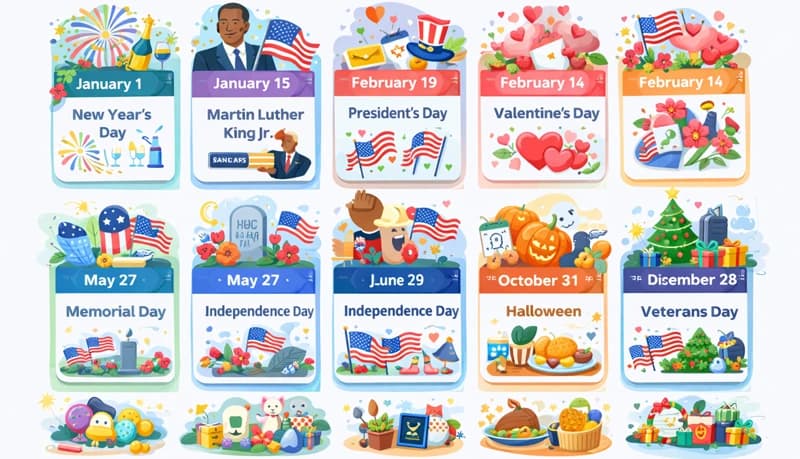
The United States observes 11 federal holidays in 2026: New Year's Day (Jan 1), Martin Luther King Jr. Day (Jan 19), Presidents' Day (Feb 16), Memorial Day (May 25), Juneteenth (Jun 19), Independence Day (Jul 4, observed Jul 3), Labor Day (Sep 7), Columbus Day (Oct 12), Veterans Day (Nov 11), Thanksgiving (Nov 26), and Christmas Day (Dec 25). Federal offices, banks, and the postal service close on these days. Private employers are not required by federal law to provide time off for holidays, though most offer at least some paid holidays.
The United States observes 11 federal holidays, plus dozens of cultural, religious, and informal holidays throughout the year. This guide covers all of them — with 2026 dates, holiday pay rules, and what employers need to know about managing time off.
For state-specific labor law requirements, see our US labor law compliance guide.
Federal holidays in 2026
Federal holidays are established by Congress. Federal government offices, banks, and the postal service are closed on these days. Private employers are not required by federal law to give employees time off, but most do for at least some of these holidays.
| Holiday | 2026 date |
|---|---|
| New Year's Day | January 1 (Thursday) |
| Martin Luther King Jr. Day | January 19 (Monday) |
| Washington's Birthday (Presidents' Day) | February 16 (Monday) |
| Memorial Day | May 25 (Monday) |
| Juneteenth National Independence Day | June 19 (Friday) |
| Independence Day | July 4 (Saturday); observed July 3 (Friday) |
| Labor Day | September 7 (Monday) |
| Columbus Day | October 12 (Monday) |
| Veterans Day | November 11 (Wednesday) |
| Thanksgiving Day | November 26 (Thursday) |
| Christmas Day | December 25 (Friday) |
When a federal holiday falls on a Saturday, it's typically observed on the preceding Friday. When it falls on a Sunday, it's observed on the following Monday.
Cultural and religious holidays in 2026
These holidays are not federal holidays, but many employers recognize some of them — particularly Good Friday, Easter Monday, and the day after Thanksgiving. Employers with diverse teams should be aware of these dates for scheduling and time-off planning.
| Holiday | 2026 date |
|---|---|
| Groundhog Day | February 2 (Monday) |
| Valentine's Day | February 14 (Saturday) |
| St. Patrick's Day | March 17 (Tuesday) |
| April Fool's Day | April 1 (Wednesday) |
| Good Friday | April 3 (Friday) |
| Easter Sunday | April 5 (Sunday) |
| Easter Monday | April 6 (Monday) |
| Earth Day | April 22 (Wednesday) |
| Cinco de Mayo | May 5 (Tuesday) |
| Mother's Day | May 10 (Sunday) |
| Flag Day | June 14 (Sunday) |
| Father's Day | June 21 (Sunday) |
| Halloween | October 31 (Saturday) |
| Hanukkah | Starts at sundown December 4 (Friday) |
| Kwanzaa | December 26 (Saturday) – January 1 (Friday) |
Informal and commercial holidays
These aren't official holidays, but they're widely observed and can affect workplace attendance and scheduling.
- Super Bowl Sunday (first Sunday in February) — Unofficial national event; expect lower productivity the following Monday
- Mardi Gras (date varies, February or March) — Regional holiday, especially in Louisiana; some employers in affected areas close
- Pi Day (March 14) — Lighthearted observance of the mathematical constant
- National Ice Cream Day (third Sunday in July) — Commercial observance
- Grandparents Day (first Sunday after Labor Day) — Minor observance
- Black Friday (day after Thanksgiving) — Many employers give this day off; effectively a four-day weekend for most office workers
- Cyber Monday (Monday after Thanksgiving) — Online shopping day; not a day off but affects productivity
Presidential proclamation holidays
The President can declare special days of observance through presidential proclamations. These don't create permanent federal holidays (that requires Congress), but they carry national significance.
Days of national remembrance
- Patriot Day (September 11) — Remembers the victims of the 2001 terrorist attacks
- National Pearl Harbor Remembrance Day (December 7) — Commemorates the 1941 attack on Pearl Harbor
- National POW/MIA Recognition Day (third Friday in September) — Honors prisoners of war and those missing in action
National days of mourning
Declared following the death of a significant national figure, typically a former president. Federal offices may close, and flags are flown at half-staff.
Heritage and awareness months
- National African American History Month — February
- National Women's History Month — March
- National Hispanic Heritage Month — September 15 to October 15
- National Volunteer Week — typically in April
Holiday pay rules
No federal requirement for holiday pay
There is no federal law requiring private employers to provide paid time off for holidays — or extra pay for employees who work on holidays. Holiday pay policies are set by employers through company policy or employment contracts. Businesses that need to track holiday hours, schedule shifts around holidays, and manage leave requests use workforce management software to keep everything organized — see our comparison of the best workforce management software for current options.
However, if working on a holiday causes an employee to exceed 40 hours in a workweek, standard overtime rules under the Fair Labor Standards Act (FLSA) apply.
Full-time employees
Most employers offer paid time off for at least some federal holidays as part of their benefits package. The number of paid holidays varies — typically between 6 and 10 per year. Some employers offer "floating holidays" that employees can use on dates of their choosing. A leave management system helps track both fixed holidays and floating days without spreadsheets.
Part-time employees
Holiday pay for part-time employees depends entirely on company policy. Some employers provide pro-rated holiday pay for part-time workers, while others do not. Part-time employees should check their employment agreement or employee handbook for specifics.
Holiday premium pay
Some employers offer premium pay (often 1.5x or 2x the regular rate) as an incentive for employees who work on holidays. This is a company policy decision, not a legal requirement. It's most common in industries that operate on holidays — healthcare, retail, hospitality, and emergency services. Automatic time tracking ensures premium hours are recorded accurately for payroll.
Frequently asked questions
Is the post office closed on federal holidays?
Yes. The US Postal Service does not deliver mail or provide counter services on federal holidays.
When did Juneteenth become a federal holiday?
Juneteenth became a federal holiday on June 17, 2021, when the Juneteenth National Independence Day Act was signed into law.
Is Inauguration Day a federal holiday?
Not for the entire country. Federal employees in the Washington, D.C. area are granted a day off on Inauguration Day (January 20 following a presidential election). It does not apply nationwide.
Is it a holiday when a president dies?
Not automatically. The sitting president typically issues a proclamation declaring a national day of mourning, which may include closure of government offices and flags flown at half-staff.
Does overtime apply on holidays?
Working on a holiday does not automatically trigger overtime pay under federal law. Overtime applies when an employee exceeds 40 hours in a workweek, regardless of whether any of those hours fall on a holiday. Some states have different rules — check your state's labor laws.