Mandatory Overtime in Call Centers — Rules and Solutions

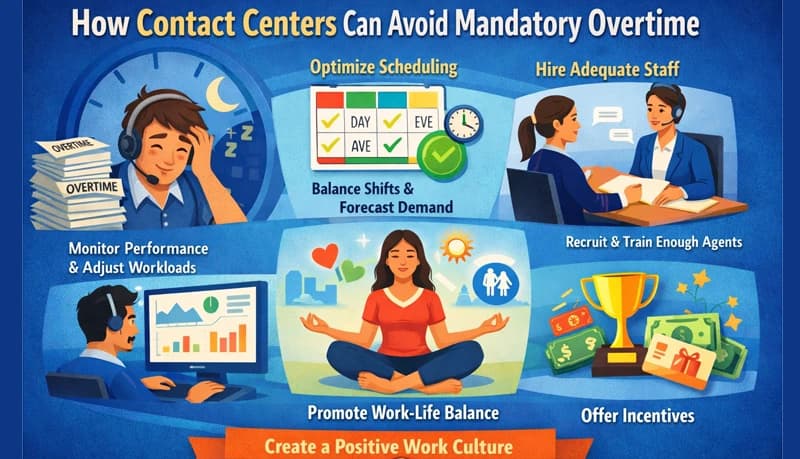
Mandatory overtime in a call center means requiring agents to work beyond their scheduled shift — not asking for volunteers, but telling agents they must stay. It is legal in most circumstances, but it is almost always a sign that the operation has a staffing or scheduling problem that overtime is masking rather than solving.
A call center that relies on mandatory overtime every week is paying 1.5x for hours that should be covered at the regular rate. It is also creating the conditions for higher absenteeism (agents call in sick to recover from extended hours), higher attrition (agents leave for employers who do not mandate overtime), and declining quality (fatigued agents handle calls worse). The "solution" of mandatory overtime creates problems that generate more mandatory overtime — a cycle that only breaks when the underlying staffing gap is fixed.
Is mandatory overtime legal?
Federal law
Under the Fair Labor Standards Act (FLSA), mandatory overtime is legal for non-exempt employees (which includes nearly all hourly call center agents). There is no federal limit on how many hours an employer can require an employee to work in a week.
The FLSA requires:
- Overtime pay at 1.5x the regular rate for all hours over 40 in a workweek
- The employee must be paid for all hours worked, including mandatory overtime
- The employer can discipline or terminate an employee who refuses to work mandatory overtime (in most states)
State-specific rules
Some states impose additional requirements that affect how mandatory overtime works in practice:
| State | Additional overtime rule | Impact on mandatory OT |
|---|---|---|
| California | Daily overtime: 1.5x after 8 hours/day, 2x after 12 hours/day. Seventh consecutive day: 1.5x for first 8 hours, 2x after | Mandatory shifts extending beyond 8 hours trigger daily OT even if weekly hours are under 40. Seventh-day work triggers premium pay |
| Alaska | Daily overtime: 1.5x after 8 hours/day | Same daily trigger as California |
| Colorado | Daily overtime: 1.5x after 12 hours/day | Shifts extended past 12 hours trigger additional premium |
| Nevada | Daily overtime: 1.5x after 8 hours/day if employee makes less than 1.5x minimum wage | Applies to most hourly call center agents |
| Oregon | Predictive scheduling law — employers with 500+ employees must pay premium for schedule changes within 14 days | Adding mandatory OT shifts within 14 days of the schedule triggers premium pay beyond the 1.5x OT rate |
| Several cities | NYC, Chicago, Seattle, SF, Philadelphia, LA have predictive scheduling requirements | Same premium pay implications for last-minute mandatory OT |
When mandatory overtime may be restricted
| Situation | Restriction |
|---|---|
| Union contract (CBA) | Many collective bargaining agreements limit mandatory overtime to a specific number of hours per week or require overtime to be offered by seniority before mandating |
| ADA accommodation | An employee with a disability whose accommodation limits their work hours may not be subject to mandatory overtime |
| FMLA | An employee on intermittent FMLA leave cannot be disciplined for refusing overtime that conflicts with their FMLA-protected condition |
| State break laws | Extending a shift may trigger additional mandatory break requirements — California requires a second meal break for shifts over 10 hours |
| Child labor laws | Employees under 18 have strict limits on daily and weekly hours — mandatory OT may violate these |
What mandatory overtime actually costs
Mandatory overtime appears to solve a staffing problem at 1.5x the regular rate. But the true cost includes the downstream effects that mandatory overtime creates.
Direct cost
Example — 100-agent operation, 10% of labor hours as mandatory overtime:
| Component | Calculation | Annual cost |
|---|---|---|
| Regular agent wage | $15/hour | — |
| Overtime rate | $22.50/hour (1.5x) | — |
| Total scheduled hours/year (100 agents) | 100 × 2,080 = 208,000 hours | — |
| Overtime hours (10% of total) | 20,800 hours | — |
| Overtime premium (the extra 0.5x over regular rate) | 20,800 × $7.50 | $156,000/year |
That $156,000 is the premium paid above regular rate — the amount that could be saved by covering those hours with regular-rate staff instead of overtime.
Indirect costs
| Indirect cost | Mechanism | Estimated impact |
|---|---|---|
| Higher absenteeism | Agents use sick calls to recover from mandatory extended hours | 1–3 percentage point increase in absence rate |
| Higher attrition | Mandatory OT is a top-3 reason agents leave in exit interviews | 5–10 percentage point increase in annual attrition |
| Attrition replacement cost | Each departure costs 3–4 months of fully loaded salary to replace | $4,000–$7,500 per departure |
| Quality degradation | Agents in hours 9–10 of a shift handle calls worse than in hours 1–8 | AHT increases, FCR decreases, QA scores drop |
| Supervisor time | Managing mandatory OT — who stays, who is exempt, handling complaints | 3–5 hours/week of supervisor time |
Total cost comparison:
| Approach | Annual cost for 20,800 hours |
|---|---|
| Mandatory overtime at 1.5x | $468,000 (wages) + indirect costs (attrition, absenteeism, quality) |
| Hiring 10 additional agents at regular rate | $312,000 (wages) + $15,000–$25,000 recruiting/training |
Hiring is almost always cheaper than sustained mandatory overtime. The only reason not to hire is if the overtime need is genuinely temporary (seasonal spike, short-term volume increase). If mandatory overtime has been happening every week for 3+ months, it is not temporary — it is a staffing gap that should be filled with regular headcount.
Diagnosing why mandatory overtime is happening
Mandatory overtime has a root cause. Identifying the cause determines the fix.
| Pattern | Root cause | Fix |
|---|---|---|
| OT on the same shift every week | That shift is structurally understaffed — not enough agents assigned | Move agents from overstaffed shifts or hire specifically for the understaffed shift |
| OT across all shifts every week | Total headcount is insufficient for current volume | Hire more agents — the math is clear |
| OT spikes on specific days (Monday, Friday) | Absence rate on those days exceeds the schedule buffer | Increase the absence buffer on high-absence days |
| OT following specific events (billing cycle, promotions) | Forecastable volume spikes are not in the staffing plan | Build known events into the forecast — schedule additional staff for those periods |
| OT concentrated on a few agents | Same agents are asked/forced to stay every time — fairness issue | Rotate overtime assignments equitably, or convert to voluntary OT with enough lead time to fill the need |
| OT during training weeks | Agents pulled off phones for training are not backfilled | Schedule training during low-volume periods, or plan coverage for training days |
| OT following attrition | Departed agents have not been replaced | Speed up the hiring pipeline — if attrition is predictable, hire continuously rather than waiting for departures |
How to eliminate mandatory overtime
Step 1: Quantify the gap
Calculate the difference between required staff hours and scheduled staff hours by shift and interval. This tells you exactly where the overtime need exists.
Example:
| Shift | Required staff hours/week | Scheduled staff hours/week | Gap | Current coverage |
|---|---|---|---|---|
| Early (7 AM–3 PM) | 560 | 520 | 40 hours short | Covered by mandatory OT |
| Mid (11 AM–7 PM) | 480 | 480 | None | Adequate |
| Late (3 PM–11 PM) | 400 | 360 | 40 hours short | Covered by mandatory OT |
| Total gap | 80 hours/week | = 2 FTEs |
This operation needs 2 additional full-time agents — one for the early shift, one for the late shift — to eliminate mandatory overtime entirely. The cost of hiring 2 agents ($62,400/year at $15/hour) is far less than the overtime premium ($62,400 × 0.5 = $31,200) plus the indirect costs of attrition, absenteeism, and quality degradation.
Step 2: Fix the schedule
Even without hiring, scheduling changes can reduce or eliminate mandatory overtime:
- Redistribute agents across shifts. If the mid shift is adequately staffed while early and late shifts are short, move 1–2 agents from mid to the understaffed shifts. This may require a shift bidding process or shift differential to incentivize moves.
- Stagger start times. Instead of three fixed shifts, use staggered starts that overlap during peak periods and reduce coverage during low-volume periods.
- Increase the absence buffer. If overtime is covering absences, the schedule did not account for enough shrinkage. Recalculate shrinkage from actual data and rebuild the schedule with the correct buffer.
- Improve forecast accuracy. If overtime covers volume spikes that were not predicted, the forecast is wrong. Compare forecast vs. actual weekly and recalibrate.
Step 3: Replace mandatory with voluntary
If some overtime remains necessary after scheduling and hiring adjustments, convert it from mandatory to voluntary:
| Approach | How it works | Advantage |
|---|---|---|
| Voluntary overtime sign-up | Post available OT shifts in advance — agents choose to pick them up | Agents who want extra income get it; agents who do not are not forced |
| On-call pool | Designate agents willing to be called in, with on-call pay (smaller flat rate) even if not called | Provides coverage without mandating — on-call agents are compensated for availability |
| Split overtime | Instead of one agent staying 4 extra hours, two agents each stay 2 | Shorter extensions are less disruptive and easier to fill voluntarily |
| Shift differential | Pay a premium rate for shifts that are hard to staff, attracting agents who want the higher pay | Fills shifts through incentive rather than mandate |
Step 4: Track and report
Track overtime as a percentage of total labor hours weekly. The target is fewer than 5%. If overtime creeps back above this level, revisit the diagnosis — something changed (volume increased, attrition spiked, forecast drifted) and the staffing plan needs to be updated.
Report overtime cost alongside the cost of alternatives (hiring, shift differential, voluntary OT pool) so that decision-makers can see the comparison every month. When the overtime premium exceeds the cost of an additional hire, the business case for hiring is clear.