How to Fire an Employee in a Call Center or BPO

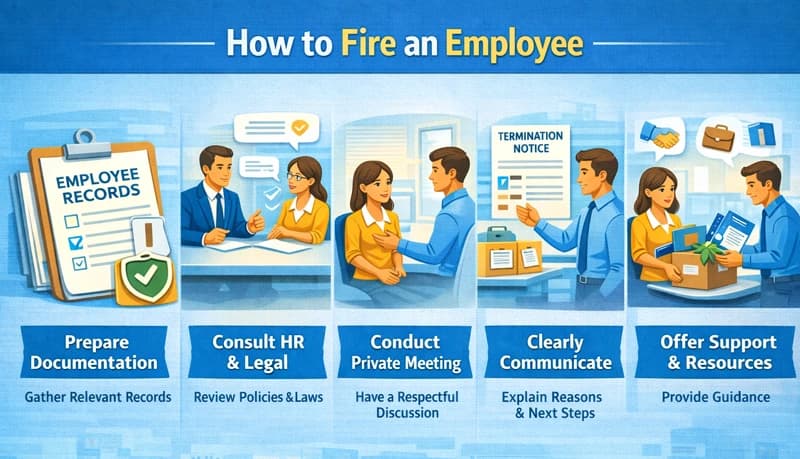
Terminating an employee is the most consequential management action in a call center. Done well, it protects the organization legally, treats the departing agent with dignity, and maintains team stability. Done poorly, it creates legal exposure, damages morale among remaining agents, and can disrupt service levels for days or weeks.
The biggest mistakes happen before the termination meeting — insufficient documentation, inconsistent application of progressive discipline, or failing to consult HR before acting. Having a call center management platform that records attendance, time, and performance data gives you the documentation trail you need. By the time you sit down with the agent, the outcome should be a conclusion supported by a documented trail, not a surprise decision based on a recent incident.
Before the decision: documentation
No termination for performance or conduct reasons should happen without a documented history. In at-will employment states, you technically can terminate without cause — but practically, you should always have a documented record that demonstrates the termination was based on legitimate, non-discriminatory business reasons. This is your protection against wrongful termination claims, unemployment disputes, and EEOC complaints.
What should already exist
| Document | Purpose | Timing |
|---|---|---|
| Written warnings | Documents specific policy violations or performance deficiencies, including date, details, and expected improvement | At each occurrence |
| Performance improvement plan (PIP) | Defines specific, measurable improvement targets, the timeline (typically 30–60 days), and the consequence of not meeting them | After coaching and warnings have not produced improvement |
| PIP follow-up documentation | Records whether PIP targets were met, partially met, or not met, with supporting data | At PIP milestones and conclusion |
| Coaching notes | Records coaching conversations, what was discussed, and what was agreed upon | After each coaching session |
| Attendance records | Documents tardiness, absences, and no-call no-shows against the attendance policy | Ongoing |
| QA evaluations | Provides objective performance data from quality reviews | Monthly |
The progressive discipline trail
For performance-based terminations, the typical progression is:
- Verbal coaching — documented in supervisor notes
- Written warning — signed by the agent acknowledging receipt (not agreement)
- Final written warning or PIP — clearly stating that failure to improve will result in termination
- Termination — after the PIP period ends without sufficient improvement
Skipping steps weakens your legal position and creates the perception of unfairness among remaining agents. If an agent's colleagues see someone terminated without the coaching and warnings they would expect, they lose trust in the process — and start worrying about their own job security.
Exceptions: immediate termination
Some behaviors warrant immediate termination without progressive discipline:
- Gross misconduct — theft, fraud, violence, threats of violence, or intoxication on the job
- Data breach or security violation — intentionally accessing or sharing customer data outside authorized channels
- Harassment or discrimination — behavior that creates a hostile work environment
- Job abandonment — typically defined as 2–3 consecutive no-call no-shows
- Falsification of records — time theft (clocking in when not working), falsifying quality or performance data
Even in these cases, document the investigation and findings before acting. "We fired them for cause" needs to be supported by specific, documented evidence — not a supervisor's verbal account.
Legal framework
At-will employment
Most US states are at-will, meaning the employer or employee can end the relationship at any time for any reason that is not illegal. However, "at-will" does not mean "without risk." Terminations can still be challenged on several grounds:
Discrimination. Federal law (Title VII, ADA, ADEA) prohibits termination based on race, color, religion, sex, national origin, age (40+), disability, or genetic information. State and local laws may add additional protected classes (sexual orientation, gender identity, marital status). If the terminated agent is a member of a protected class, you need clear documentation showing the termination was based on legitimate performance or conduct reasons.
Retaliation. Terminating an employee who recently filed a complaint (harassment, safety, wage), participated in an investigation, or exercised a legal right (FMLA leave, workers' compensation) creates a presumption of retaliation. Even if the termination is genuinely performance-based, the timing creates legal risk. Consult HR and legal before proceeding.
Implied contract. Statements in employee handbooks, offer letters, or verbal promises ("you'll always have a job here as long as you perform") can create an implied employment contract that limits at-will termination rights. Review what was communicated to the agent during hiring and onboarding.
International considerations
For BPOs with international operations, the legal framework differs significantly:
| Jurisdiction | Key differences |
|---|---|
| Philippines | Requires "just cause" (serious misconduct, willful disobedience, gross neglect, fraud) or "authorized cause" (redundancy, retrenchment). 30-day notice to employee and DOLE required. Separation pay may be mandatory. |
| India | Varies by state. Shops and Establishments Acts often require 30 days' notice or pay in lieu. Gratuity payment required after 5 years of service. Industrial Disputes Act applies to certain categories. |
| Colombia | Just cause termination requires specific grounds. Without just cause, severance payment is mandatory based on tenure and salary. |
| South Africa | Labour Relations Act requires fair reason and fair procedure. CCMA can order reinstatement if termination is found to be unfair. |
Never apply US termination practices in international locations without local legal review.
The termination meeting
Who should be present
- The direct supervisor or manager who made the recommendation
- An HR representative as witness and to handle administrative details
- No one else — this is not a group discussion
Timing and logistics
When: Early in the week (not Friday — the agent has the weekend to ruminate without access to support resources) and at the end of the agent's shift (not the beginning — walking someone out at 8 AM while their colleagues watch is unnecessarily humiliating).
Where: A private office or conference room. Never on the call floor, never in a shared space.
Duration: 15–20 minutes. This is not a negotiation or a counseling session. The decision has been made.
What to say
Be direct, brief, and specific. The agent should understand within the first 30 seconds that this is a termination, not a coaching session.
Opening: "We're meeting today because we have decided to end your employment, effective today."
Reason: State the specific, documented reason. "Over the past 90 days, your quality scores have remained below the minimum threshold of 75 despite the coaching sessions on [dates] and the performance improvement plan that began on [date]. We've been unable to achieve the improvement needed."
What not to say:
- Do not apologize ("I'm sorry, but...") — it undermines the legitimacy of the decision
- Do not make it personal ("You're not a good fit") — state the objective facts
- Do not compare them to other agents
- Do not offer false hope ("Maybe in the future...")
- Do not argue or debate — if the agent disagrees, acknowledge their perspective and move on
Next steps: Cover the logistics — final paycheck timing (varies by state — some require immediate payment), benefits continuation (COBRA notification), return of equipment, and any severance being offered.
Let the agent respond. They may be angry, upset, or silent. Give them space. Do not rush them out of the room, but also do not extend the conversation into a debate about the decision.
Documentation from the meeting
Complete a termination checklist during or immediately after the meeting:
- Termination letter provided to employee (reason, effective date, final pay details)
- Company property collected (badge, headset, laptop, parking pass)
- System access deactivated (phone system, CRM, email, VPN, building access)
- Final paycheck scheduled per state law requirements
- COBRA notification initiated
- Forwarding address confirmed for W-2 and final correspondence
- Employee file updated with termination documentation
System access and data security
In a call center, system access deactivation must happen immediately — not "by end of day" or "when IT gets to it." An agent who has just been terminated should not have access to customer data, phone systems, CRM records, or internal communications.
Coordinate with IT before the meeting. Have access deactivation queued and ready to execute the moment the meeting concludes. This includes:
- ACD/phone system login
- CRM and ticketing systems
- Email and chat platforms
- VPN and remote access
- Physical building access (badge deactivation)
- Any client-specific systems
For remote agents, coordinate the return of equipment — provide a prepaid shipping label and a clear deadline for returning the laptop, headset, and any other company property.
Communicating with the team
What to say
Inform the team the same day, briefly: "As of today, [name] is no longer with the company. We wish them well. [Name's] responsibilities will be covered by [plan] while we determine next steps."
What not to say
- Do not share the reason for the termination — it is confidential
- Do not criticize the departed agent
- Do not say "it was a mutual decision" if it was not
- Do not provide excessive detail about the documentation or PIP process
What to expect
The team will have reactions ranging from relief (if the agent was clearly underperforming and everyone knew it) to anxiety (if they did not see it coming). Supervisors should be available for individual conversations in the days following a termination. Agents who are worried about their own standing may need reassurance — "Your performance is solid, and this is not related to anything broader."
Operational impact
In a call center, every termination removes an agent from the schedule and creates immediate operational consequences.
Staffing adjustment
Calculate the impact on service levels and adjust:
- Redistribute the terminated agent's scheduled shifts among remaining agents or offer voluntary overtime
- Accelerate any pending hiring to fill the vacancy
- If the agent was on a specialized account, ensure sufficient coverage from other trained agents
Knowledge transfer
If the terminated agent had specialized knowledge (specific client processes, escalation contacts, system workarounds), ensure that knowledge is captured. In most cases, this should already be documented — if it is not, identify the gaps and fill them before institutional knowledge walks out the door.
Backfill timeline
A realistic backfill timeline in a call center:
| Phase | Duration |
|---|---|
| Recruiting and hiring | 1–3 weeks |
| Training | 2–6 weeks (account-dependent) |
| Nesting | 1–2 weeks |
| Ramp to full productivity | 4–8 weeks |
| Total time to full replacement | 8–19 weeks |
This timeline is why termination should never be a surprise reaction to a single incident. If you know an agent is likely to be terminated at the end of a PIP period, start recruiting before the PIP concludes — so the vacancy window is as short as possible.
After the termination
File retention
Keep the terminated agent's complete employment file — application, offer letter, performance reviews, warnings, PIP documentation, termination letter, and any signed acknowledgments — for a minimum of 3 years after the termination date. Some jurisdictions and client contracts require longer retention. EEOC charges can be filed up to 300 days after termination; some state claims have longer windows.
Unemployment claims
Expect a potential unemployment claim. Respond to the state unemployment office promptly with the documented evidence for the termination. Terminations for documented performance failure (after coaching and PIP) are generally not considered "misconduct" for unemployment purposes — the agent may still be eligible. Terminations for gross misconduct (theft, fraud, policy violation) are typically disqualifying.
Post-mortem
After any termination, ask: Could this have been prevented?
- Was the agent set up for success during onboarding?
- Were the performance expectations clear and the metrics fair?
- Did the agent receive adequate coaching before reaching the PIP stage?
- Was there a management or scheduling factor contributing to the failure?
Not every termination is preventable — some agents are genuinely not suited for the role. But a pattern of terminations from the same team, shift, or account suggests a systemic issue that individual terminations will not fix. Track termination data alongside your retention metrics to identify whether the problem is with the agents being hired or the environment they are placed in.