How to Reduce No-Call No-Shows in BPOs

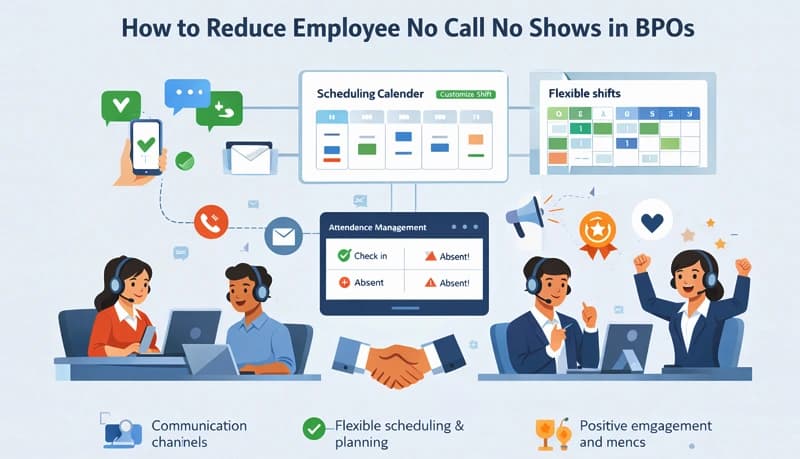
A no-call no-show — when an employee fails to appear for a scheduled shift without any advance notice — is one of the most disruptive events in a BPO operation. Unlike a called-in absence, which gives supervisors time to adjust, a no-show is discovered only when the shift starts and a seat is empty.
The downstream effects hit immediately: the queue backs up, remaining agents absorb extra calls, service levels drop, and if the absence triggers overtime to cover the gap, it inflates labor costs. In a BPO with tight SLA commitments, a single no-show on a thinly staffed shift can put you in breach of contract.
Most BPOs treat no-shows as a disciplinary problem — issue warnings, then terminate. That addresses the symptom but not the cause. Reducing no-shows requires understanding why they happen and fixing the conditions that produce them. A BPO operations platform with attendance tracking and scheduling helps you spot patterns and intervene before no-shows become chronic.
Why employees no-show
No-call no-shows are rarely random. They cluster around specific causes, and the distribution tells you where to intervene.
Schedule-related causes
- Short notice schedules — When employees learn their schedule only a few days in advance, conflicts arise that cannot be resolved in time. The employee has a childcare problem, a medical appointment, or a second job conflict — and with no time to arrange coverage, they simply do not show up.
- Clopens — Closing one shift and opening the next (e.g., working until 11 PM then starting at 7 AM) leaves insufficient recovery time. Agents oversleep or decide the shift is not worth the exhaustion.
- Unfair shift distribution — When the same agents consistently get the worst shifts (overnight, weekends, holidays), resentment builds and attendance deteriorates. The no-show becomes a passive form of protest.
- Inflexible policies — If the only way to handle a conflict is to request time off through a slow approval process, employees with urgent needs may default to not showing up rather than navigating bureaucracy.
Management-related causes
- Punitive culture — Paradoxically, excessively punitive attendance policies can increase no-shows. If calling in sick results in the same consequence as a no-show (a "point" or write-up either way), there is no incentive to call. Make sure the penalty for a no-show is meaningfully worse than the penalty for calling in.
- Poor supervisor relationships — Agents who feel their supervisor does not care about them or is hostile are less likely to feel obligated to communicate.
- No consequences for no-shows — The opposite problem: if no-shows carry no real consequences, some employees learn that the behavior is tolerated.
Personal causes
- Burnout — Agents working excessive hours or handling high-stress queues without adequate recovery time eventually hit a wall. The no-show is the result of physical or mental exhaustion.
- Transportation issues — Particularly relevant for BPOs with early morning or late night shifts in locations with limited public transit.
- Disengagement — An employee who has mentally quit but has not formally resigned often signals through attendance decline before they leave entirely.
What no-shows actually cost
Most BPO managers know no-shows are expensive but have not calculated the actual cost. Quantifying the impact makes the business case for prevention.
Direct costs per no-show event
| Cost component | How to calculate |
|---|---|
| Overtime to cover the gap | Hours of coverage × overtime rate (1.5x loaded cost) |
| Lost productivity during gap | Time before coverage arrives × calls not handled |
| SLA penalties (if applicable) | Contractual penalties for missed service levels |
| Supervisor time managing the event | 30–60 minutes of supervisor time per incident |
Indirect costs
- Morale impact on remaining agents — The agents who absorb the extra work resent it, especially if no-shows are chronic and the same reliable agents always cover. Over time, this drives your best agents toward burnout and turnover.
- Client relationship damage — If no-shows cause visible service degradation, client confidence erodes — particularly if you are unable to staff to the contracted levels.
- Turnover acceleration — Chronic no-shows from specific agents often end in termination, which triggers the full cost of turnover — recruiting, hiring, training a replacement.
For a mid-size BPO, even a modest no-show rate of 2–3% translates to hundreds of thousands of dollars per year in combined direct and indirect costs.
Scheduling practices that reduce no-shows
Scheduling is the single biggest lever. Most no-shows can be traced to a scheduling problem — either the employee had a conflict they could not resolve, or the schedule itself was unreasonable.
Publish schedules early
Post schedules at least two weeks in advance — three weeks is better. When agents know their schedule far enough ahead, they can arrange childcare, coordinate with second jobs, and plan personal commitments. Short-notice schedules make conflicts inevitable and no-shows predictable.
Eliminate clopens
Enforce a minimum 11-hour gap between the end of one shift and the start of the next. Clopens are a leading cause of both no-shows (oversleeping, exhaustion) and early turnover. See our guide on scheduling strategies to reduce stress for more detail.
Allow shift swaps
Let agents trade shifts with each other (with manager approval) rather than requiring them to request time off or accept a schedule they cannot work. A shift swap system gives agents a way to resolve conflicts without calling in or no-showing — and the shift stays covered.
How to implement: Designate a channel (a shared board, a scheduling tool, or a team chat) where agents can post shifts they need covered and claim shifts from others. Require manager approval to ensure skill and account coverage requirements are met.
Collect availability before scheduling
Survey agents for their availability and preferences before building the schedule, not after. You will not accommodate everyone, but knowing that an agent cannot work Tuesdays before scheduling them on Tuesday prevents a predictable no-show.
Build absence buffers
If your historical no-show rate is 3%, scheduling exactly the number of agents you need guarantees that 3% of shifts will be short-staffed. Schedule 5–8% above the minimum to absorb both no-shows and called-in absences without triggering overtime or SLA breaches.
Policy and consequences
Create a clear attendance policy
Your policy should distinguish between different types of absences and assign proportionate consequences:
| Absence type | Definition | Consequence progression |
|---|---|---|
| Planned absence | Requested and approved in advance | No penalty |
| Called-in absence | Employee notifies before shift start | Tracked; excessive frequency triggers conversation |
| Late arrival | Employee arrives after shift start | Tracked; repeated lateness triggers conversation |
| No-call no-show | No contact before or during the shift | Written warning → final warning → termination |
The key principle: calling in must always be better than not calling. If both carry the same penalty, you are incentivizing no-shows over communicated absences. An agent who calls in sick gives you time to find coverage. An agent who no-shows gives you nothing.
Make the call-in process easy
If calling in requires navigating a phone tree, leaving a voicemail that may not be checked, or reaching a specific person who may not be available, agents will default to not calling. Provide a simple, always-available channel — a dedicated phone line, a text number, or an app notification that goes directly to the supervisor on duty.
Enforce consequences consistently
A policy that is applied inconsistently is worse than no policy at all. If some agents receive warnings for no-shows while others are quietly excused, the agents who face consequences resent it, and the agents who are excused learn the behavior is tolerated.
Document every no-show, follow the progressive discipline process, and apply it equally regardless of tenure or performance.
Early warning signs
No-shows rarely come without warning. Track these leading indicators to identify at-risk agents before they stop showing up:
- Increasing late arrivals — An agent who starts arriving 5, then 10, then 15 minutes late is signaling disengagement or an unresolved scheduling conflict.
- Rising called-in absences — A sudden increase in sick calls from an agent who previously had good attendance often precedes a no-show or resignation.
- Declining schedule adherence — Agents logging off early, taking extended breaks, or going unavailable during scheduled time are behaviorally checking out.
- Withdrawal from team interactions — Stopping participation in team chats, skipping optional meetings, or becoming notably less communicative.
When you spot these patterns, have a one-on-one conversation. Not a disciplinary meeting — a genuine check-in. "I've noticed you've been coming in late the last couple of weeks. Is something going on that we can help with?" Often, the underlying issue is fixable: a schedule conflict, a supervisor problem, or personal stress that can be accommodated.
Tracking and measurement
Track these metrics monthly to measure whether your no-show reduction efforts are working:
| Metric | Formula | Target |
|---|---|---|
| No-show rate | No-show events ÷ total scheduled shifts | Under 2% |
| Unplanned absence rate | (No-shows + called-in absences) ÷ total scheduled shifts | Under 6% |
| Coverage fill rate | Shifts successfully covered after a no-show ÷ total no-show shifts | Above 90% |
| Time to coverage | Average time to fill a gap after a no-show is identified | Under 30 minutes |
Segment by shift, team, account, and supervisor. If one supervisor's team has a 5% no-show rate while the center average is 2%, the problem may be that supervisor's management style, not the agents. If the overnight shift has 4x the no-show rate of the day shift, the scheduling or compensation for that shift needs attention.
Reducing no-shows is not about cracking down harder — it is about making it easy and worthwhile for agents to show up, and removing the conditions that make them not want to. For more on managing BPO attendance and scheduling, see our guides on BPO time tracking and employee attendance tracking.