Effective Communication in Call Centers and BPOs

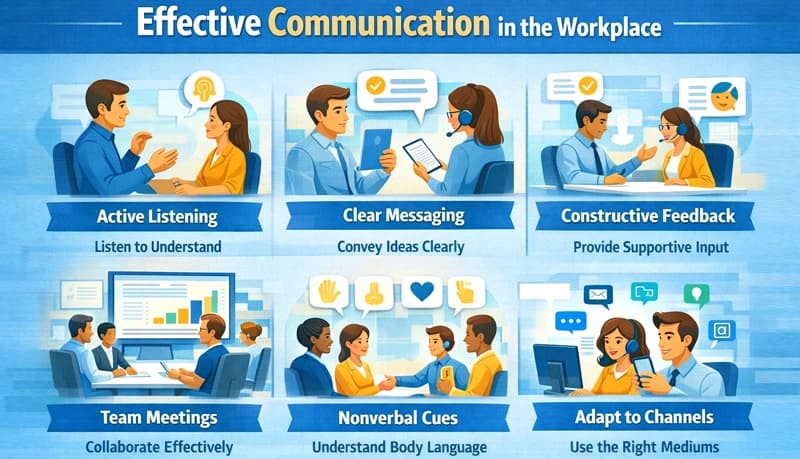
Communication problems in call centers rarely look like communication problems. They look like quality failures, repeated errors, agent confusion after a process change, or an escalation that should have been resolved on the first call. The root cause is traced back, and it turns out that a policy update was announced in a team meeting that half the agents missed because they were on a different shift, or a process change was documented in an email that was buried under 40 others.
In a call center or BPO, communication is not a soft skill — it is infrastructure. The right call center management tools formalize information flow so that critical updates reach every shift and every site. Information must flow accurately between specific points: from clients to operations, from operations to agents, between shifts, between sites, and from agents back to management. When any of these channels breaks down, the failure shows up in the metrics within days.
Where communication breaks down
Shift handoffs
Call centers that operate across multiple shifts have a structural communication gap at every shift change. What happened during the day shift — a system outage, a client escalation, a process change, a spike in a particular call type — needs to reach the evening and night shifts. Without a defined handoff process, each shift starts blind.
What goes wrong:
- The day shift supervisor mentions the issue verbally to the evening supervisor, who forgets to relay it to agents
- An email is sent, but the night shift does not check email before logging into the phones
- The information reaches team leads but not frontline agents
What works:
A written shift handoff log — a shared document or system that each shift's supervisor updates before leaving and each incoming shift's supervisor reviews with their team during the first 5 minutes. The log should cover:
- Active issues (system problems, client escalations, unusual call patterns)
- Process changes effective that day
- Staffing notes (who called out, who is covering what)
- Anything the incoming shift needs to handle differently than normal
The handoff log is not optional and not informal. It is a defined operational process with accountability — if the incoming shift was not informed about an active issue, the question is "why wasn't this in the handoff log?" not "why didn't you know?"
Process and policy changes
The most common communication failure in call centers is announcing a change without ensuring it reaches every agent who needs to act on it. This is especially damaging in environments where agents handle calls based on documented procedures — a process change that reaches 80% of agents means that 20% are giving customers incorrect information.
What goes wrong:
- Changes are announced in team meetings, missing agents on PTO, different shifts, or different sites
- Changes are sent via email with no confirmation of receipt or understanding
- The knowledge base is updated, but agents are not told what changed — they find out mid-call when their usual process does not work
- Changes are communicated with effective dates that conflict with when agents actually receive the information
What works:
| Change type | Communication method | Confirmation required |
|---|---|---|
| Minor update (wording change, contact number update) | Knowledge base update + brief team message noting the change | Agents acknowledge in team chat or huddle |
| Process change (new steps, different routing, new escalation path) | Written communication + supervisor walkthrough in next huddle + knowledge base update | Quiz or verbal check during next coaching session |
| Policy change (new rule, compliance requirement, new client mandate) | Formal written notice + dedicated briefing per shift + updated SOPs + read-and-sign acknowledgment | Signed acknowledgment on file |
| Emergency change (system issue, immediate process swap) | Real-time broadcast to all active agents via supervisor announcement + follow-up written documentation | Supervisor confirms delivery to each active agent |
The critical principle: the person communicating the change is responsible for confirming it was received, not the person who needs to receive it. If an agent gives a customer wrong information because they were not told about a process change, that is a communication failure — not an agent performance failure.
Client-to-operations communication
In BPO operations, the client communicates requirements, changes, and feedback to the BPO's operations team, who then translates and distributes to agents. This translation layer is where information degrades.
What goes wrong:
- The client sends a request to the account manager, who paraphrases it to the operations manager, who paraphrases it to supervisors, who paraphrase it to agents. By the time it reaches the floor, the original intent is distorted.
- Client feedback is received but not acted on because there is no process to convert client input into operational changes
- The client changes a requirement verbally in a call, and no written documentation follows
What works:
- Client communications that affect agent behavior should be documented in writing and distributed in their original form (or as close to it as possible) — not filtered through multiple layers of interpretation
- Designate a single point of contact on the operations side who is responsible for translating client requirements into agent-facing documentation
- Require written confirmation of any verbal client requests before implementing changes
Agent-to-management communication
Communication is not just top-down. Agents observe patterns that management cannot see from dashboards — a product defect generating repeat calls, a knowledge base article that is wrong, a process that creates unnecessary customer friction, or a caller type that the current scripts do not handle well.
What goes wrong:
- Agents report issues to their supervisor, who is too busy with escalations to act on them
- There is no formal mechanism for agents to flag process problems — they mention it informally and nothing happens
- Agents stop reporting problems because previous reports were ignored
What works:
- A structured process for agents to report process issues, knowledge base errors, and improvement suggestions — with tracking and visible follow-through
- Regular review of agent-reported issues by operations leadership (weekly or bi-weekly)
- Closing the loop: when an agent's report leads to a change, tell them. When it does not, explain why. Agents who see their input acted upon continue providing it; agents who see it ignored stop.
Communication across sites and time zones
For distributed operations, every communication challenge above is amplified by distance, time zones, and sometimes language.
Written communication as the default
In a single-site operation, important information can spread through hallway conversations, floor announcements, and in-person huddles. In a multi-site operation, anything not written down is invisible to every other site.
The practice: default to writing. Decisions, process changes, client updates, and operational issues should be documented in a shared, searchable location accessible to all sites. Verbal communication is supplementary — never primary — for anything that affects how agents handle calls.
Language clarity
If your operation spans language barriers — even when the working language is English — communication standards need to account for varying fluency levels:
- Use direct, simple language. Avoid idioms ("let's circle back," "low-hanging fruit," "move the needle") that do not translate well
- In written communications, use numbered steps rather than narrative paragraphs for procedural instructions
- For critical communications (compliance changes, client requirements), have someone at the receiving site review for clarity before distribution
- Confirm understanding through action, not acknowledgment. An agent saying "I understand" does not mean they do. A quiz, a role-play, or a monitored call confirms actual understanding.
Meeting discipline
Meetings across time zones are expensive — they pull people from productive work during someone's off-hours. Make them count:
- Have an agenda — shared in advance, with specific items requiring input from each site
- Document decisions — not just in someone's notes, but in a shared location accessible to anyone who was not present
- Rotate inconvenient times — if the weekly sync is always at 9 AM headquarters time (9:30 PM in India), rotate so no single site always bears the burden
- Default to asynchronous — most information exchange does not require a meeting. Written updates, recorded briefings, and shared dashboards cover 80% of what meetings are used for
Supervisor communication skills
Frontline supervisors are the communication bottleneck in most call centers. Every piece of information — from management, from clients, from other shifts — passes through them to reach agents. And every piece of agent feedback — problems, suggestions, escalations — passes through them to reach management.
What supervisors need to communicate well
Coaching conversations. The difference between effective and ineffective coaching is communication skill. "Your quality score is 72" is data delivery. "On this call, you moved to troubleshooting before the customer finished explaining the problem — and they had to repeat themselves, which extended the call by 2 minutes and left them frustrated. Let's listen to it together and talk about where to pause" is coaching. The supervisor who can do the latter improves quality; the one who can only do the former generates anxiety.
Difficult conversations. Performance warnings, PIP discussions, termination meetings — these require clear, direct communication without ambiguity or hedging. Supervisors who are uncomfortable with direct communication soften the message until the agent does not understand the severity, then escalate to termination without the agent having received a clear warning.
Upward communication. Supervisors who can clearly articulate operational problems to senior management — with data, specifics, and proposed solutions rather than vague complaints — are more likely to get those problems addressed. This is a trainable skill, and it is worth training.
Common supervisor communication failures
| Failure | Impact | Fix |
|---|---|---|
| Filtering bad news upward ("everything's fine") | Management does not learn about problems until they become crises | Create a culture where surfacing problems is expected, not punished |
| Inconsistent messaging across supervisors | Agents on different teams get different information about the same policy | Written communications for anything that affects agent behavior; supervisor alignment meetings before announcements |
| Coaching that is vague or score-focused | Agents do not know what to change | Train supervisors on behavior-specific feedback using call examples |
| Avoiding difficult conversations | Performance problems persist until they require termination rather than correction | Role-play difficult conversations in supervisor training; provide scripts and frameworks |
Measuring communication effectiveness
You cannot directly measure "communication" — but you can measure the outcomes that deteriorate when communication fails.
| Signal | What it suggests | Where to investigate |
|---|---|---|
| Spike in errors after a process change | Change was not communicated effectively to all agents | Review how the change was distributed and confirmed |
| Different agents giving different answers to the same question | Knowledge base gap or inconsistent supervisor messaging | Audit knowledge base accuracy and supervisor communication |
| Repeat contacts where the first agent gave incorrect information | Agent did not have current, accurate information | Check when the knowledge base was last updated and whether the agent was trained on the correct process |
| Low engagement survey scores on "I am informed about changes that affect my work" | Systemic communication gap | Review communication channels and confirmation processes |
| Agent-reported issues that were never addressed | Upward communication channel is broken | Audit the process for handling agent-reported problems |
Track these signals regularly. When a quality failure or operational problem is traced to a communication breakdown, fix the communication process — not just the immediate error. A single miscommunication is a mistake; repeated miscommunication on the same type of information is a broken process.