How to Build Company Culture in a Global, Distributed Team

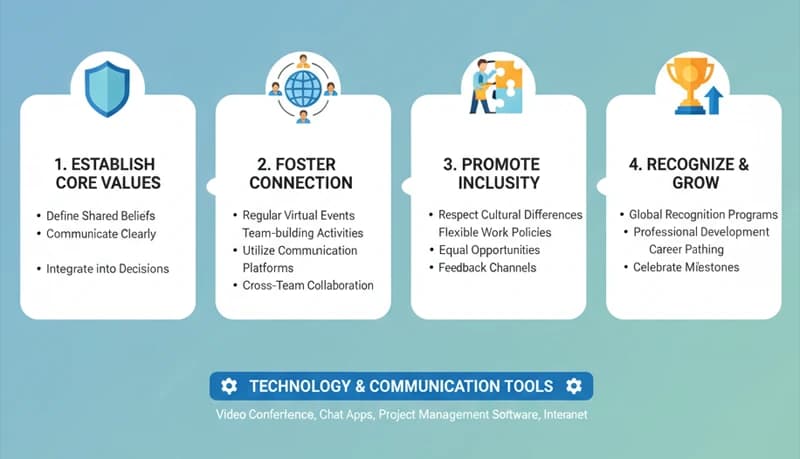
Company culture in a distributed team is not built through mission statements, virtual happy hours, or "culture decks." It is built through the daily operational decisions that tell people how work actually gets done — how information flows, how decisions are made, how conflicts are resolved, and how performance is recognized.
In a single-site call center, culture develops organically. People observe how their colleagues and managers behave, absorb norms from the break room and the floor, and calibrate their behavior accordingly. In a global team spread across multiple sites, time zones, and sometimes languages, none of that organic transmission works. Culture has to be built deliberately through systems and practices — or it fragments into separate site cultures that barely recognize each other. A unified BPO operations platform that all sites share for time tracking, scheduling, and reporting creates a common operational language that reinforces consistency.
This is especially acute in call centers and BPOs, where operations run across shifts and geographies, agents at different sites may serve the same clients, and the quality of the customer experience depends on consistent standards regardless of which site handles the interaction.
What "culture" actually means in operations
Culture is not how people feel about their employer — it is the set of shared expectations about how work is done. In a call center or BPO context, culture shows up in concrete behaviors:
- How agents handle ambiguity. When an agent encounters a situation not covered by the knowledge base, do they escalate, improvise, or ignore it? The answer is cultural, not procedural.
- How supervisors respond to mistakes. Do they coach, document, or punish? The pattern agents observe determines whether they report problems or hide them.
- How sites treat each other. Do agents at the offshore site feel like full members of the team, or like a cheaper labor pool that headquarters tolerates? This dynamic shapes quality, retention, and collaboration.
- How performance pressure is applied. Is the emphasis on hitting metrics at any cost, or on doing the work correctly and sustainably? Agents learn which one management actually values by watching what gets rewarded and what gets ignored.
If these behaviors are inconsistent across your sites, you do not have one culture — you have several. And the customer experience will reflect whichever culture happens to answer the phone.
Communication across time zones
The default meeting problem
The most common failure in global team communication is scheduling meetings that work for headquarters and are painful for everyone else. A 9 AM Eastern standup is a 9:30 PM call for an agent in India. When the same people consistently take calls outside their working hours, you have communicated — through your scheduling — whose time matters and whose does not.
What to do instead:
- Rotate meeting times for recurring calls so the inconvenience is shared. If a weekly sync rotates through three time slots, no single site is always the one calling in at night.
- Make synchronous meetings the exception, not the default. Most information exchange does not require real-time conversation. Use written updates, recorded briefings, and shared documents for anything that does not need immediate discussion.
- Identify the overlap windows. For any pair of sites, there is typically a 2–4 hour window where both are in reasonable working hours. Protect those windows for the interactions that genuinely require real-time collaboration — calibration sessions, escalation discussions, joint planning.
Written communication as the backbone
In a single-site operation, important decisions get communicated verbally — in huddles, hallway conversations, or team meetings. In a distributed operation, anything communicated only verbally is invisible to every other site.
The practice that fixes this: write it down. Process changes, policy decisions, client updates, and performance expectations should be documented and distributed in a way that every site can access at any time, regardless of when their shift starts.
This means:
- A shared, searchable knowledge base that all sites update and reference — not separate documents maintained independently by each location
- Decision logs that capture not just what was decided, but why, so sites that were not in the room can understand the reasoning
- Shift handoff notes that transfer context between sites handling the same account across time zones
Language and clarity
If your team operates in multiple languages, the working language for cross-site communication needs to be explicitly defined and consistently used. More importantly, communication standards should account for the fact that not everyone has the same fluency level:
- Use simple, direct language in written communications — avoid idioms, slang, and cultural references that do not translate
- In meetings, slow down, check for understanding, and use the chat function to confirm key points in writing
- Provide critical communications (policy changes, process updates) in translation when a significant portion of your team operates in a different primary language
Consistent standards across sites
Culture fragments when different sites develop different interpretations of the same standards. This is common in multi-site call center operations: the onshore team scores quality one way, the offshore team scores it differently, and neither realizes they have diverged.
Cross-site calibration
Run calibration sessions that include evaluators from all sites — not just within each location. When a QA analyst in Manila and a QA analyst in Louisville listen to the same call and score it, their scores should be within 5 points of each other. If they are not, the scorecard criteria need clearer definitions, or one site has drifted from the standard.
Frequency: Monthly cross-site calibration at minimum, plus additional sessions whenever processes change or new evaluators are added.
Shared metrics, shared visibility
All sites should see the same dashboards with the same metrics. When one site can see its own performance but not how it compares to other sites, it develops an insular view. When all sites can see each other's numbers, it creates a shared context for improvement.
| Practice | Why it matters |
|---|---|
| Same KPI definitions across sites | Prevents "we define AHT differently" disagreements |
| Single dashboard accessible to all sites | Creates shared context and healthy comparison |
| Cross-site performance reviews | Identifies best practices that can transfer between locations |
| Unified QA scorecard | Ensures consistent quality standards regardless of site |
Process consistency vs. local adaptation
Not everything should be identical across sites. Compliance requirements differ by country. Local labor laws affect scheduling, breaks, and overtime. Cultural norms affect what works in team meetings, coaching conversations, and recognition.
The distinction: what gets done should be consistent (quality standards, process steps, customer experience). How it gets done can be adapted locally (meeting formats, recognition styles, management cadence).
Building cross-site relationships
Site visits
There is no substitute for people from different sites spending time together in person. When a team lead from the Philippine site spends a week with the US team, or vice versa, they build the kind of understanding that video calls cannot replicate. They see how the other site works, what their challenges are, and who the people behind the screen names are.
This is an investment, not a perk. Budget for regular cross-site visits — at minimum, site leaders should visit each other's locations annually. If budget allows, rotating individual contributors through other sites (even for a few days) accelerates cross-site trust.
Cross-site projects
Assign projects that require collaboration across sites — process improvement initiatives, knowledge base updates, training material development. When people from different sites work together toward a shared goal, they build relationships that persist beyond the project.
Shared recognition
Recognition programs should span sites, not be siloed within them. When an agent in the offshore site handles an exceptionally difficult interaction, that recognition should be visible to the entire organization — not just their local team. Cross-site recognition reinforces that all sites are part of the same operation and held to the same standard of excellence.
Management practices that build or destroy culture
Headquarters bias
The most common culture problem in global operations is headquarters bias — the assumption that the "home" site's way of doing things is the default, and other sites should adapt. This shows up in subtle ways:
- Decisions made during headquarters business hours without input from other sites
- Promotions and career development opportunities concentrated at the home site
- "We" language that implicitly means the headquarters team, not the global organization
- Other sites learning about changes after they have been decided
Fixing this requires deliberate effort from leadership. Include site leaders from all locations in planning and decision-making. Rotate who leads cross-site meetings. Make career paths visible and accessible regardless of location.
Local leadership quality
Culture at each site is ultimately shaped by local leaders. A strong site manager in Manila can build an excellent local culture even within a flawed global structure — and a weak one can undermine the best-designed global practices.
Invest in site leadership:
- Hire site managers who can operate independently while maintaining alignment with the broader organization
- Give them decision-making authority over local operations (scheduling, recognition, team structure) within defined guardrails
- Include them in strategic conversations about the accounts and clients their teams serve
- Evaluate them on retention and quality outcomes, not just cost metrics
Feedback mechanisms
Agents at remote sites — particularly offshore locations — often feel that their feedback disappears into a void. They raise issues, and nothing visibly changes. Over time, they stop raising issues.
Build feedback mechanisms with visible follow-through:
- Regular pulse surveys with results shared back to all sites (not just collected and filed)
- Site-specific action plans that address the issues raised, with timelines and accountability
- Direct channels between site-level agents and organizational leadership — not just through multiple layers of management
What does not work
A few approaches that distributed teams commonly try but that do not build culture in any meaningful way:
Mandatory fun. Virtual happy hours, online team-building games, and forced social activities feel obligatory rather than connecting, especially across time zones and cultures. If people want to socialize, they will — create the spaces (chat channels, informal calls), but do not mandate participation.
Values posters without values practice. Writing "respect" on the wall means nothing if agents observe their supervisor dismissing feedback from the offshore team. Culture is what people see rewarded and tolerated, not what is written on a poster.
One-size-fits-all engagement programs. A recognition program designed for American cultural norms (public praise, individual awards) may not work in cultures where being singled out is uncomfortable and collective achievement is valued. Adapt programs to work across cultural contexts.
Assuming digital tools solve communication problems. Adding another Slack channel, another project management tool, or another video platform does not fix communication problems that are rooted in unclear expectations, time zone neglect, or language barriers. Tools support good communication practices — they do not create them.
Culture in a global team is not a thing you build once — it is a set of practices you maintain continuously. Every process change, every leadership hire, every scheduling decision, and every cross-site interaction either reinforces a shared culture or fragments it. The organizations that get this right treat culture as an operational discipline with the same rigor they apply to quality, staffing, and client delivery.