Overtime in BPOs — Why It Happens and How to Eliminate It

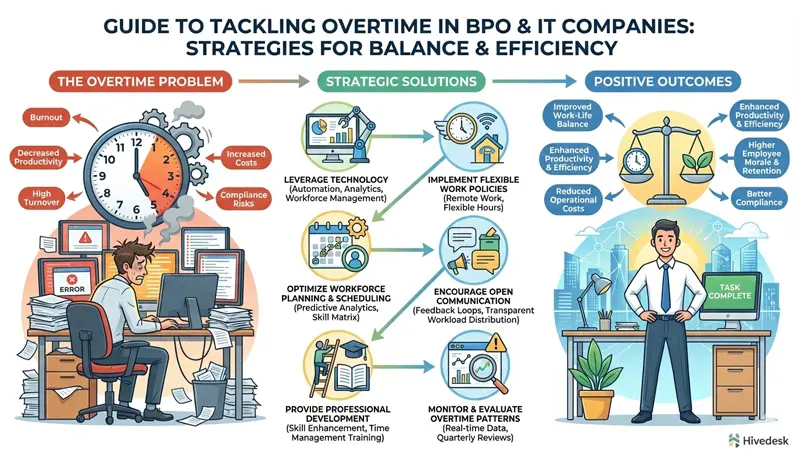
Overtime in a BPO is a symptom, not a problem. The problem is whatever is causing the operation to need more agent hours than the schedule provides — understaffing, forecast inaccuracy, shrinkage underestimation, attrition outpacing hiring, or client volume exceeding contractual commitments. Treating overtime as the problem leads to solutions like capping hours or denying overtime requests — which reduce the overtime line item but cause service level misses, SLA penalties, and agent burnout from absorbing the same workload in fewer hours.
The post on avoiding mandatory overtime covers the general overtime framework for any call center — FLSA rules, cost calculations, and the 4-step elimination process. This post focuses on the BPO-specific factors: client-driven overtime, multi-account complexity, contract economics, and how to manage overtime across accounts with different SLA requirements.
Occasional overtime vs. structural overtime
The first diagnostic step is determining whether overtime is occasional or structural. They have different causes and different fixes.
| Type | Pattern | Cause | Fix |
|---|---|---|---|
| Occasional | Overtime spikes 1–2 times per month, triggered by specific events | Unplanned absences beyond buffer, short-term volume spike, client-side event not captured in forecast | Intraday management — the system is working correctly, occasional overtime is the designed response to unplanned deviations |
| Structural | Overtime every week, 5%+ of total hours, same teams or shifts affected repeatedly | The operation does not have enough agents to cover the workload at regular hours. The schedule is structurally short | Cannot be fixed by better intraday management. Requires hiring, forecast correction, or schedule redesign |
How to tell the difference: Pull overtime hours by week for the last 8 weeks using your BPO workforce management tools. If overtime exceeds 5% of total hours in 6 or more of those weeks, it is structural.
What causes structural overtime in BPOs
BPOs have all the same overtime causes as single-client call centers — plus additional complexity from managing multiple clients, contracts, and staffing models.
Cause 1: Client volume exceeds contracted assumptions
| What happens | How to identify | Fix |
|---|---|---|
| The client committed to sending X calls per month. Actual volume is consistently 15–30% above X. The BPO staffed for X | Compare actual monthly volume to the volume band in the SLA/contract for each client | Present the data to the client: "Volume has exceeded the contracted band of X–Y for 3 consecutive months, averaging Z. We need to discuss either additional headcount approval or adjusted SLA targets for the higher volume" |
Why this is BPO-specific: In a single-client call center, the operations team controls both the volume forecast and the staffing plan. In a BPO, the client controls (or influences) the volume, and the BPO controls the staffing. When the client's volume exceeds what was planned, the BPO covers the gap with overtime — and absorbs the cost.
Contract protection: The SLA should include a volume band (e.g., "targets apply for monthly volume between 40,000 and 50,000 contacts"). Volume above the band triggers a renegotiation of staffing and targets — not an expectation that the BPO will cover unlimited volume at the contracted price.
Cause 2: Attrition outpacing the hiring pipeline
| What happens | How to identify | Fix |
|---|---|---|
| Agents leave faster than replacements can be hired and trained. The gap between headcount plan and actual headcount grows each month. Overtime fills the gap | Track actual headcount vs. planned headcount by month. If the gap is widening, the hiring pipeline is not keeping up with attrition | Increase the hiring pipeline to cover both replacements (attrition rate × headcount) and the accumulated deficit. Account for 7–10 week recruiting + training lead time |
The math: If a 100-agent BPO account has 5% monthly attrition (5 departures/month) and the hiring pipeline delivers 3 new agents per month, the headcount drops by 2 agents per month. After 6 months, the account is 12 agents short — covered entirely by overtime.
| Month | Departures | Hires | Net change | Headcount | Overtime to cover gap |
|---|---|---|---|---|---|
| 1 | 5 | 3 | −2 | 98 | 2 agents × 40 hrs = 80 hrs OT |
| 2 | 5 | 3 | −2 | 96 | 160 hrs cumulative |
| 3 | 5 | 3 | −2 | 94 | 240 hrs cumulative |
| 6 | 5 | 3 | −2 | 88 | 480 hrs/month |
At month 6, the operation needs 480 overtime hours per month — 12 agents × 40 hours. At 1.5x rate with a $15/hour base wage, that is $10,800/month in overtime premium alone ($7.50 premium × 480 hours × 3 OT-eligible hours average per agent per week... simplified: 480 hours × $7.50 = $3,600/month premium, growing each month).
Cause 3: Shrinkage underestimated in the staffing plan
| What happens | How to identify | Fix |
|---|---|---|
| The staffing calculation assumes 25% shrinkage. Actual shrinkage is 32%. Every shift has fewer agents on phones than planned | Calculate actual shrinkage from time tracking data over 4 weeks. Compare to the assumption in the staffing model | Update the shrinkage assumption. Recalculate required staff. The increase in scheduled agents eliminates the gap currently covered by overtime |
Impact example: For an account needing 30 agents on phones:
- At 25% shrinkage: schedule 30 / 0.75 = 40 agents
- At 32% shrinkage: schedule 30 / 0.68 = 44 agents
- Gap: 4 agents. Covered by overtime: 4 × 40 hours = 160 hours/week of overtime
Cause 4: Multi-account scheduling inefficiency
| What happens | How to identify | Fix |
|---|---|---|
| The BPO manages multiple client accounts with different volume patterns. Agents are dedicated to single accounts. One account is overstaffed while another needs overtime | Compare occupancy across accounts. If Account A has 68% occupancy and Account B has 92% occupancy with overtime, there is a rebalancing opportunity | Cross-train agents to handle multiple accounts. Move agents from overstaffed accounts to understaffed accounts during intraday management |
Cross-training ROI for overtime reduction: If 10 agents are cross-trained on both Account A and Account B, and Account B's overtime need is 40 hours/week, moving 1 cross-trained agent per shift from Account A (during low volume) to Account B (during high volume) can eliminate 20–30 hours of weekly overtime.
Cause 5: Forecast does not capture client-specific events
| What happens | How to identify | Fix |
|---|---|---|
| The client runs a marketing campaign, system migration, billing cycle, or product launch that increases contact volume. The BPO was not notified or did not adjust the forecast | Review overtime occurrences against client event calendars. If overtime consistently follows client events, the forecast is missing known volume drivers | Establish a formal process: client provides a monthly event calendar by the 15th of the prior month. The BPO adjusts the forecast and staffing plan for each event |
The cost comparison: overtime vs. hiring
This calculation is the foundation of every overtime reduction business case. If overtime is structural, hiring is almost always cheaper.
For a BPO account needing 5 additional agents:
| Cost component | Overtime approach (annual) | Hiring approach (annual) |
|---|---|---|
| Base hours needed | 5 agents × 40 hrs/week × 52 weeks = 10,400 hours | Same: 10,400 hours |
| Hourly cost | $15/hr × 1.5 (OT rate) = $22.50/hr | $15/hr × 1.0 (regular rate) = $15/hr |
| Annual labor cost | 10,400 × $22.50 = $234,000 | 10,400 × $15 = $156,000 |
| Benefits and overhead (30%) | Minimal (existing employees) | $156,000 × 0.30 = $46,800 |
| Recruiting and training | $0 | 5 × $4,000 = $20,000 (one-time) |
| Year 1 total | $234,000 | $222,800 |
| Year 2+ total | $234,000/year | $202,800/year |
Hiring saves $11,200 in year 1 and $31,200 in every subsequent year — plus it eliminates the attrition, burnout, and quality risks of sustained overtime.
BPO margin impact: If the client pays $20/hour per agent in a dedicated model and the BPO is paying $22.50/hour in overtime, the BPO loses $2.50/hour on every overtime hour. Overtime directly erodes margin. Hiring at $15/hour (+ $4.50 benefits = $19.50 fully loaded) preserves the margin.
Managing overtime across multiple accounts
BPOs must manage overtime at the account level, not just the aggregate level. A BPO reporting 4% total overtime may have 0% on Account A and 12% on Account B — and Account B's margin is being destroyed.
Per-account overtime tracking
| Metric | Track per account | Why |
|---|---|---|
| Overtime hours as % of total hours | Weekly | Identifies which accounts are driving overtime. Target: fewer than 5% per account |
| Overtime cost as % of account revenue | Monthly | Shows the margin impact. If overtime cost exceeds 3% of account revenue, the account's profitability is at risk |
| Root cause of overtime | Weekly | Categorize each overtime event: volume above forecast, absences, attrition gap, client event. Identifies whether the cause is BPO-controllable or client-controllable |
| Cross-trained agent utilization | Weekly | How often are cross-trained agents moved between accounts to prevent overtime? If rarely, cross-training investment is underutilized |
The client conversation about overtime
When overtime is driven by client-side factors (volume above contract, unannounced events, scope changes), the BPO must initiate the conversation — with data.
| Situation | Data to present | Request |
|---|---|---|
| Volume consistently above contracted band | 3+ months of actual vs. contracted volume, with the overtime hours and cost generated | Additional headcount approval at the contracted rate, or volume commitment adjustment |
| Client events not communicated | Correlation between client events and overtime spikes, with the cost of each | Monthly event calendar requirement. Advance notice allows staffing adjustment without overtime |
| Scope change increased AHT | AHT by call type before and after the scope change, showing the increase in agent hours required | AHT adjustment in the staffing model and corresponding headcount or rate adjustment |
| SLA targets require higher staffing than contracted headcount | Staffing calculation showing agents required for the SLA target at actual volume vs. agents approved | Either relax the SLA target, approve additional headcount, or accept that the current staffing produces the current SLA — not a higher one |
Overtime reduction plan
Step 1: Quantify the problem
| Data point | Source | Action |
|---|---|---|
| Total overtime hours/week by account | Time tracking | Identify which accounts and shifts have overtime |
| Overtime cost per month by account | Payroll + time tracking | Calculate the margin impact per account |
| Root cause categorization | Supervisor logs, intraday records | Classify each overtime event by cause |
Step 2: Fix the structural causes
| Root cause | Fix | Timeline |
|---|---|---|
| Headcount below plan | Accelerate hiring pipeline. Calculate the exact number needed: (target headcount − current headcount) + (monthly attrition × months until pipeline catches up) | 7–10 weeks from hiring approval to agent on phones |
| Shrinkage underestimated | Recalculate from actual time tracking data. Update the staffing model. Schedule additional agents | 1–2 weeks to recalculate, next schedule cycle to implement |
| Forecast bias | Adjust the forecast to correct for the measured bias. If the forecast under-predicts by 12%, increase it by 12% | Next forecast cycle |
| Client volume above contract | Initiate client conversation with data. Request headcount approval or volume commitment adjustment | 2–4 weeks for client decision |
| No cross-training | Identify 10–15 agents to cross-train on the account with the highest overtime. Train during low-volume periods on their primary account | 1–3 weeks per additional account |
Step 3: Set overtime targets and track
| Target | Measurement | Escalation |
|---|---|---|
| Fewer than 5% of total hours as overtime, per account | Weekly, from time tracking data | If any account exceeds 5% for 3 consecutive weeks, ops manager reviews root cause and implements structural fix |
| Zero mandatory overtime | Weekly | Any mandatory overtime event requires ops manager approval and root cause documentation |
| Overtime cost below 3% of account revenue | Monthly | If any account exceeds 3%, account manager and ops manager review together |
Step 4: Monitor and sustain
Track overtime weekly as part of the operations management cadence. Overtime that was reduced can creep back if attrition increases, volume grows, or shrinkage changes. The tracking cadence catches regression early.
| Review | Frequency | What to check |
|---|---|---|
| Overtime hours by account | Weekly | Are any accounts trending above 5%? |
| Headcount vs. plan by account | Biweekly | Is the hiring pipeline keeping up with attrition? |
| Forecast accuracy by account | Weekly | Is the forecast bias returning? |
| Shrinkage actual vs. plan | Monthly | Has actual shrinkage drifted from the planning assumption? |
| Cross-trained agent utilization | Weekly | Are cross-trained agents being moved between accounts when needed? |