Overtime Pay Laws in the US — Federal and State Guide

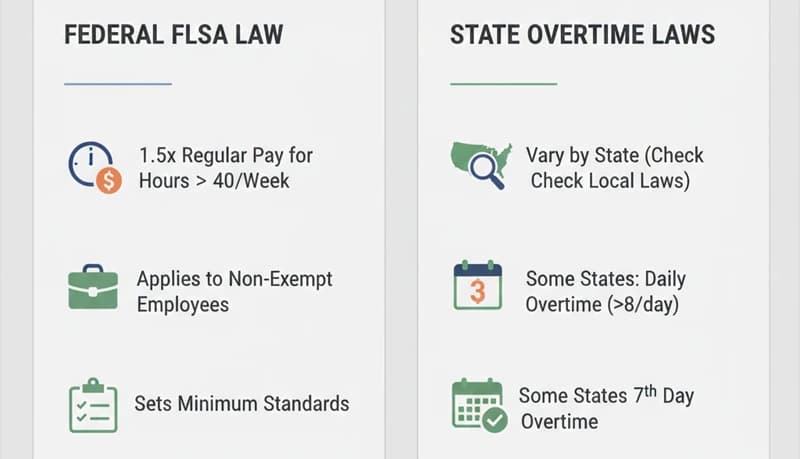
The federal Fair Labor Standards Act (FLSA) sets the baseline for overtime pay in the United States: non-exempt employees must be paid 1.5x their regular rate for hours worked beyond 40 in a workweek. Most states follow FLSA without additional requirements — but several states have stricter rules, including daily overtime thresholds, double-time provisions, and different exemption criteria.
If you have employees in multiple states, you need to follow whichever law — federal or state — provides the greater protection to the employee. Accurate employee time tracking is the foundation of overtime compliance — you cannot calculate overtime correctly without reliable hours data. This guide covers the federal standard, every state with rules that exceed it, and the compliance fundamentals that apply everywhere.
These overtime rules are separate from paid sick leave requirements and time-off rules for hourly employees.
Federal overtime rules (FLSA)
The Fair Labor Standards Act is the foundation. Every employer covered by FLSA must follow these rules unless a state law is more favorable to the employee. For a summary of the FLSA's general requirements, see the US labor law overview.
The basic rule
Non-exempt employees must receive overtime pay at 1.5x their regular rate of pay for all hours worked over 40 in a workweek. The workweek is any fixed, recurring period of 168 hours (7 consecutive 24-hour periods). It does not have to align with the calendar week, but it must be consistent.
Important: FLSA does not require overtime for working more than 8 hours in a day, working on weekends, or working on holidays. Those are state-level or contractual requirements, not federal ones.
Exempt vs. non-exempt employees
Not every employee is entitled to overtime. The FLSA exempts certain employees based on a combination of how they are paid and what work they do. To be exempt, an employee must generally meet all of the following:
- Salary basis — Paid a fixed salary that is not reduced based on the quality or quantity of work performed
- Salary level — Earns at least the minimum salary threshold (currently $844/week or $43,888/year as of July 2024)
- Duties test — Primary duties fall into one of the recognized exemption categories
Common FLSA exemption categories
| Category | Primary duties |
|---|---|
| Executive | Manages the enterprise or a department, directs the work of two or more employees, has authority to hire/fire or influence those decisions |
| Administrative | Office or non-manual work directly related to management or business operations, exercises independent judgment on significant matters |
| Professional | Work requiring advanced knowledge in a field of science or learning, or creative work requiring invention/imagination/originality |
| Computer employee | Systems analyst, programmer, software engineer, or similar role; can be paid hourly at $27.63+/hour instead of salary |
| Outside sales | Primary duty is making sales or obtaining orders away from the employer's place of business |
| Highly compensated | Total annual compensation of $132,964+ and performs at least one exempt duty |
Misclassifying employees as exempt is one of the most common FLSA violations. When in doubt, classify as non-exempt — the penalty for not paying overtime owed is far more expensive than paying overtime to someone who might technically be exempt.
FLSA record-keeping requirements
Employers must maintain the following records for every non-exempt employee:
- Full name, address, date of birth (if under 19), sex, and occupation
- Hour and day when the workweek begins
- Total hours worked each workday and each workweek
- Basis on which wages are paid (hourly rate, weekly salary, etc.)
- Regular hourly pay rate for any week in which overtime is worked
- Total daily or weekly straight-time earnings
- Total overtime compensation for the workweek
- Total wages paid each pay period
- Date of payment and pay period covered
Records must be kept for at least 3 years (payroll records) or 2 years (supporting records like time cards and schedules).
FLSA penalties
- Back pay — Employees can recover unpaid overtime for up to 2 years (3 years for willful violations)
- Liquidated damages — Equal to the amount of back pay owed (effectively doubling the liability)
- Civil penalties — Up to $2,451 per violation for repeated or willful violations
- Criminal penalties — Willful violations can result in fines up to $10,000 and imprisonment
States with overtime rules stricter than FLSA
Most states simply follow the federal 40-hour weekly overtime threshold. The states below have additional or different requirements — daily overtime, lower weekly thresholds, double-time provisions, or stricter exemption criteria.
Alaska
- Daily overtime: 1.5x after 8 hours in a workday
- Weekly overtime: 1.5x after 40 hours in a workweek
- Whichever calculation results in greater pay applies
- Exemptions follow federal standards
California
California has the most comprehensive overtime rules in the country:
- Daily overtime: 1.5x after 8 hours in a workday
- Daily double time: 2x after 12 hours in a workday
- Weekly overtime: 1.5x after 40 hours in a workweek
- 7th consecutive day: 1.5x for the first 8 hours; 2x after 8 hours on the 7th consecutive day of work in a workweek
- Exemption criteria are stricter than federal: The salary threshold is higher (2x the state minimum wage for full-time work), and exempt employees must spend more than 50% of their time on exempt duties
Colorado
- Daily overtime: 1.5x after 12 hours in a workday
- Weekly overtime: 1.5x after 40 hours in a workweek
- Whichever calculation results in greater pay applies
- Colorado's exemption salary threshold tracks above the federal minimum
Minnesota
- Weekly overtime: 1.5x after 48 hours in a workweek (not 40)
- This is less protective than FLSA for employees covered by both, so FLSA's 40-hour threshold applies to employees covered by federal law
- Minnesota's 48-hour rule is relevant primarily for employees not covered by FLSA (small employers with less than $500,000 in annual revenue and no interstate commerce)
Nevada
- Daily overtime: 1.5x after 8 hours in a workday if the employee earns less than 1.5x the state minimum wage
- Weekly overtime: 1.5x after 40 hours in a workweek
- Employees earning 1.5x or more of the minimum wage are only entitled to weekly overtime, not daily
Oregon
- Weekly overtime: 1.5x after 40 hours in a workweek
- Manufacturing daily overtime: 1.5x after 10 hours in a workday for employees in manufacturing establishments
- Oregon's exemption criteria are generally consistent with federal standards but have some state-specific nuances
Washington
- Weekly overtime: 1.5x after 40 hours in a workweek
- Washington has phased in state-specific salary thresholds for overtime exemptions that are significantly higher than the federal threshold. For large employers (51+ employees), the salary threshold is tied to the state minimum wage multiplied by a factor that increases over time.
- Agricultural workers have specific overtime protections that phase in over time
States that follow FLSA
The following states have no overtime requirements beyond the federal FLSA standard. Non-exempt employees in these states are entitled to 1.5x pay after 40 hours in a workweek, with exemptions matching federal guidelines.
Alabama, Arizona, Arkansas, Connecticut, Delaware, Florida, Georgia, Hawaii, Idaho, Illinois, Indiana, Iowa, Kansas, Kentucky, Louisiana, Maine, Maryland, Massachusetts, Michigan, Mississippi, Missouri, Montana, Nebraska, New Hampshire, New Jersey, New Mexico, New York, North Carolina, North Dakota, Ohio, Oklahoma, Pennsylvania, Rhode Island, South Carolina, South Dakota, Tennessee, Texas, Utah, Vermont, Virginia, West Virginia, Wisconsin, Wyoming
Some of these states have additional state-level labor protections (such as higher minimum wages or stricter break requirements) that interact with overtime calculations but do not change the fundamental overtime threshold or rate.
How overtime is calculated
Regular rate of pay
The "regular rate" is not always the same as the hourly rate. Under FLSA, the regular rate includes all remuneration paid to the employee, including:
- Hourly wages or salary converted to an hourly rate
- Non-discretionary bonuses and commissions
- Shift differentials
- Piece-rate earnings
The regular rate excludes discretionary bonuses, gifts, vacation/holiday pay, and employer contributions to benefit plans.
Example: An employee earns $20/hour and works 45 hours in a week. They also earned a $100 non-discretionary production bonus that week.
- Straight-time earnings: 45 hours × $20 = $900
- Add bonus: $900 + $100 = $1,000
- Regular rate: $1,000 ÷ 45 hours = $22.22/hour
- Overtime premium: 5 overtime hours × ($22.22 × 0.5) = $55.56
- Total pay: $1,000 + $55.56 = $1,055.56
What counts as "hours worked"
Under FLSA, hours worked includes all time an employee is required to be on the employer's premises, on duty, or at a prescribed workplace. This includes:
- Waiting time — If the employee is engaged to wait (required to stay at the workplace), it counts. If the employee is waiting to be engaged (free to use the time for their own purposes), it does not.
- On-call time — Counts if the employee must remain on or near the premises. Does not count if the employee is free to leave and simply carries a phone.
- Training time — Counts unless all four conditions are met: attendance is voluntary, outside regular hours, not directly related to the job, and no productive work is performed.
- Travel time — Normal commuting does not count. Travel between work sites during the day counts. Overnight travel during normal working hours counts.
- Pre/post-shift work — Putting on required equipment, booting up systems, or performing security checks counts if it is integral and indispensable to the principal work activity.
Common calculation mistakes
- Averaging hours across two workweeks — Illegal under FLSA. Each workweek stands alone. You cannot offset a 50-hour week with a 30-hour week.
- Paying a flat overtime rate — The overtime rate must be calculated based on the actual regular rate for that workweek, including any bonuses or commissions earned.
- Excluding non-discretionary bonuses from the regular rate — Production bonuses, attendance bonuses, and performance bonuses must be factored into the regular rate calculation.
- Comp time instead of overtime pay — Private-sector employers generally cannot offer compensatory time off instead of overtime pay. (Government employers can, under certain conditions.)
Employer compliance checklist
1. Classify employees correctly. Review every position classified as exempt against all three tests: salary basis, salary level, and duties. Reclassify anyone who does not clearly meet all three.
2. Track all hours worked. Use a time tracking system that captures actual start and end times, not just scheduled hours. Require employees to record all time worked, including any work performed before or after scheduled shifts.
3. Know your state rules. If you have employees in Alaska, California, Colorado, Nevada, Oregon, or Washington, apply daily overtime rules in addition to the weekly threshold. If you have remote employees in multiple states, apply each state's rules to the employees working there.
4. Calculate the regular rate correctly. Include non-discretionary bonuses, commissions, and shift differentials in the regular rate calculation for every workweek in which overtime is worked.
5. Maintain records. Keep payroll records for at least 3 years and supporting time records for at least 2 years. Ensure records are accessible for inspection.
6. Audit periodically. Review overtime patterns quarterly. Track overtime by employee — not just in aggregate — to catch classification errors, missed payments, or employees consistently working unreported hours. See our labor law compliance center for state-specific requirements, or consult an employment attorney for your specific situation.