Break Laws by State in 2026 — Rest Breaks & Meal Breaks

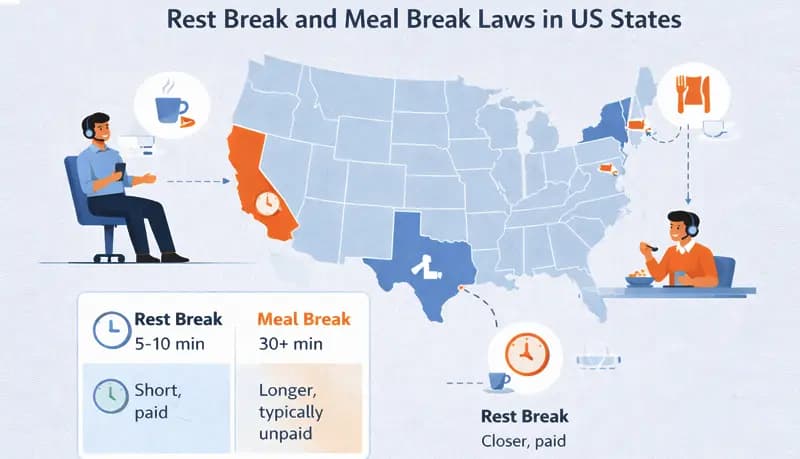
There is no federal law requiring employers to provide rest breaks or meal breaks. The FLSA has only two rules on the topic: if an employer chooses to offer short breaks (5–20 minutes), they must be paid; and meal breaks (30+ minutes) may be unpaid only if the employee is completely relieved of duties.
Beyond that, break requirements are entirely a state matter — and they vary widely. Accurate employee time tracking that records break start and end times is essential for documenting compliance, especially in states with strict break requirements. Some states mandate both paid rest breaks and unpaid meal breaks. Others require meal breaks but not rest breaks. And roughly half the states have no break requirements at all for adult employees.
This guide covers every state's requirements, organized so you can quickly find what applies to your workforce. For related regulations, see our guides on overtime pay laws, paid sick leave laws, and time-off rules for hourly employees.
Federal rules (FLSA)
The Fair Labor Standards Act does not require breaks of any kind. It only regulates how breaks are treated when an employer provides them:
Short rest breaks (5–20 minutes) — Must be counted as paid work time. An employer cannot dock pay for a 10-minute break.
Meal breaks (30+ minutes) — May be unpaid, but only if the employee is completely relieved of all duties for the entire break. If the employee must monitor a phone, stay at their workstation, or remain available to respond, the break must be paid.
Nursing mothers — Under the PUMP Act (2022), employers must provide reasonable break time and a private space (not a bathroom) for nursing employees to express breast milk for up to one year after the child's birth. This applies to FLSA-covered employees.
States with rest break and meal break requirements
The following states have laws requiring one or both types of breaks. Each entry specifies whether the requirement covers rest breaks, meal breaks, or both — and the key details.
Alaska
- Rest breaks: Not required by state law
- Meal break: 30-minute unpaid break for employees working 6+ consecutive hours
Arkansas
- Rest breaks: Not required by state law
- Meal break: Not required by state law for most employees (minors must receive breaks)
California
- Rest breaks: 10-minute paid break for every 4 hours worked (or major fraction thereof)
- Meal break: 30-minute unpaid break for shifts over 5 hours; second meal break for shifts over 10 hours
- Penalty for missed breaks: 1 additional hour of pay at the employee's regular rate for each workday a required break is not provided
- Timing: Meal break must begin before the end of the 5th hour; second meal break before the end of the 10th hour
- California's break penalties make compliance particularly important — missed breaks across a large workforce add up quickly
Colorado
- Rest breaks: 10-minute paid break for every 4 hours worked
- Meal break: 30-minute unpaid break for shifts over 5 hours
- Timing: Meal break must be provided between the end of the 3rd hour and the start of the 6th hour of work
Connecticut
- Rest breaks: Not required by state law
- Meal break: 30-minute unpaid break for employees working 7.5+ consecutive hours
- Timing: Must be given after the first 2 hours and before the last 2 hours of the shift
Delaware
- Rest breaks: Not required by state law
- Meal break: 30-minute unpaid break for employees working 7.5+ consecutive hours
- Timing: Must be given after the first 2 hours and before the last 2 hours of the shift
Hawaii
- Rest breaks: 10-minute paid break for every 4 hours worked
- Meal break: 30-minute unpaid break for employees working 5+ continuous hours
Illinois
- Rest breaks: Not separately mandated
- Meal break: 20-minute break for employees working 7.5+ continuous hours, to be given no later than 5 hours after the start of the work period
- Note: The Illinois One Day Rest in Seven Act also requires at least 24 consecutive hours of rest in every calendar week
Kentucky
- Rest breaks: 10-minute paid break for every 4 hours worked
- Meal break: Reasonable unpaid meal break between the 3rd and 5th hour of work
- Note: Kentucky is one of the few states that specifies a window for when the meal break must fall
Maine
- Rest breaks: Not separately mandated
- Meal break: 30-minute break (unpaid if employee is relieved of duties) after 6 consecutive hours of work
- Exception: Does not apply if three or fewer employees are on duty and the nature of the work allows employees to eat during work
Maryland
- Rest breaks: Not required by state law for most employees
- Meal break: Not required by state law for most employees
- Note: Maryland's Healthy Retail Employee Act requires certain retail establishments with 50+ employees to provide breaks, but there is no general statewide mandate
Massachusetts
- Rest breaks: Not required by state law
- Meal break: 30-minute unpaid break for employees working 6+ hours
Minnesota
- Rest breaks: Sufficient time to use the nearest restroom for every 4 hours worked (paid)
- Meal break: Reasonable time to eat for shifts over 8 consecutive hours
- Note: Minnesota's restroom break requirement is modest but specific — employers cannot restrict restroom access
Nebraska
- Rest breaks: Not required by state law
- Meal break: 30-minute break (off-premises allowed) for employees working in assembly plants, workshops, or mechanical establishments, required for shifts during which the meal period falls
Nevada
- Rest breaks: 10-minute paid break for every 4 hours worked (or major fraction thereof)
- Meal break: 30-minute unpaid break for employees working 8+ continuous hours
New Hampshire
- Rest breaks: Not separately mandated
- Meal break: 30-minute break after 5 consecutive hours of work
- Exception: Not required if the employer allows the employee to eat while working and the employee is paid for the time
New York
- Rest breaks: Not required by state law
- Meal break: 30-minute unpaid break for shifts covering the noon meal period (11 AM–2 PM) for employees working 6+ hours; 45-minute break for factory workers. Additional meal break requirements apply to shifts spanning other meal periods.
- Note: New York's rules are unusual — the break timing depends on when the shift falls relative to standard meal periods, not just shift length
North Dakota
- Rest breaks: Not separately mandated
- Meal break: 30-minute unpaid break after 5 consecutive hours of work
- Exception: Does not apply if the total work period is 7.5 hours or less
Oregon
- Rest breaks: 10-minute paid break for every 4 hours worked (or major fraction thereof)
- Meal break: 30-minute unpaid break for shifts over 6 hours
- Timing: Rest breaks must be taken approximately in the middle of each 4-hour segment; meal break between hours 2 and 5 of the shift
Pennsylvania
- Rest breaks: Not required by state law for adult employees
- Meal break: Not required by state law for adult employees
- Note: Pennsylvania only requires breaks for minors (under 18). There is no general adult break requirement despite common misconception.
Rhode Island
- Rest breaks: Not separately mandated
- Meal break: 20-minute unpaid break within a 6-hour shift; 30-minute unpaid break within an 8-hour shift
Tennessee
- Rest breaks: Not separately mandated
- Meal break: 30-minute unpaid break for employees scheduled to work 6+ consecutive hours
- Timing: Must be given no earlier than the employee's 3rd hour and no later than the 5th hour of scheduled work
Vermont
- Rest breaks: Not required by state law
- Meal break: Reasonable opportunity to eat and use the restroom; employers must provide employees with "reasonable opportunities" during work periods
Washington
- Rest breaks: 10-minute paid break for every 4 hours worked
- Meal break: 30-minute unpaid break for shifts over 5 hours
- Timing: Meal break must begin no later than the end of the 5th hour; rest breaks should be as close to the midpoint of each 4-hour period as possible
- Penalty: If the employer fails to provide a required break, the employee must be paid for the missed break time
West Virginia
- Rest breaks: 20-minute break for employees working 6+ consecutive hours
- Meal break: The 20-minute break serves as the meal/rest period
Wisconsin
- Rest breaks: Not required by state law
- Meal break: Not required by state law for adult employees
- Note: Wisconsin recommends but does not mandate a 30-minute meal break for shifts over 6 hours. Employers in manufacturing must provide breaks per administrative rules.
States with no break requirements for adult employees
The following states have no state-level requirement for employers to provide rest breaks or meal breaks to adult employees (employees 18 and older). Federal FLSA rules still apply — if breaks are offered, short breaks must be paid and meal breaks may be unpaid only if the employee is fully relieved of duties.
Alabama, Arizona, Florida, Georgia, Idaho, Indiana, Iowa, Kansas, Louisiana, Michigan, Mississippi, Missouri, Montana, New Jersey, New Mexico, North Carolina, Ohio, Oklahoma, South Carolina, South Dakota, Texas, Utah, Virginia, Wyoming
Many of these states do require breaks for minors (employees under 18). If you employ minors, check your state's child labor laws separately.
Paid vs. unpaid breaks
The distinction between paid and unpaid breaks matters for both labor law compliance and payroll accuracy:
Paid breaks — Short rest breaks (typically 5–20 minutes) must be counted as hours worked and included in overtime calculations. The employee does not need to be completely relieved of duties. Most state-mandated 10-minute rest breaks fall into this category.
Unpaid breaks — Meal breaks of 30+ minutes may be unpaid, but only if the employee is completely relieved of all duties. This means:
- The employee can leave the premises if they choose
- The employee is not required to monitor equipment, answer phones, or respond to customers
- The employee is not required to remain "on call" or within a certain distance of the workplace
If any of these conditions are not met, the break must be paid — regardless of what state law says about unpaid meal breaks. This is where many employers make mistakes, particularly in call centers and customer-facing roles where someone is "on break" but still expected to respond if needed.
On-duty meal breaks
Some states allow "on-duty" meal breaks when the nature of the work prevents the employee from being fully relieved. The typical requirements for a valid on-duty meal break:
- The nature of the work prevents a duty-free break (for example, a solo security guard who cannot leave their post)
- The employer and employee agree in writing to an on-duty meal break
- The employee is paid for the on-duty meal break
On-duty meal break agreements must be genuinely voluntary — the employee must be able to revoke the agreement at any time. If your operation regularly cannot provide duty-free meal breaks, that is a staffing issue, not a reason to default to on-duty meal breaks for everyone.
Compliance for multi-state employers
If you have employees in multiple states — common for businesses with remote teams or BPO operations — the break law that applies is based on where the employee works, not where the company is headquartered.
Option 1: State-specific policies. Apply each state's break requirements to employees working in that state. This is precise but requires maintaining multiple policies and training managers on each one.
Option 2: A single policy meeting the strictest standard. Adopt a break policy that meets or exceeds the most protective state requirement you operate in. For example, if you have employees in California, Washington, and Texas, you could apply California's rules (10-minute rest breaks per 4 hours, 30-minute meal breaks per 5 hours) to all employees everywhere. This is simpler to administer and eliminates the risk of applying the wrong state's rules.
Configure your time tracking system to record break start and end times. This creates the documentation you need to demonstrate compliance during an audit or in response to an employee complaint. For more on state-specific requirements, see our labor law compliance center.