What Is a Hybrid Work Schedule? Types, Benefits, and Setup

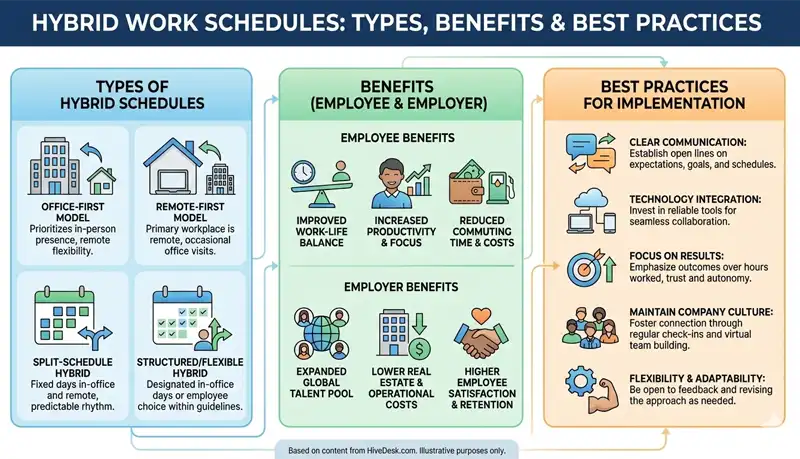
A hybrid work schedule in a call center means some agents work from an office and some work from home — either on different days, in different roles, or as permanently separate groups. Unlike office-only or fully remote operations, hybrid introduces a split that affects scheduling, supervision, quality management, and technology infrastructure. The operational question is not whether hybrid can work in a call center — it can — but which model fits your operation and what changes are needed to maintain service level, quality, and adherence when part of the workforce is not in the building. A remote work solution that provides the same visibility for at-home agents as you have on the floor is essential.
The four hybrid models for call centers
Each model creates a different set of operational trade-offs. The right choice depends on your operation's size, hours of operation, security requirements, and management capacity.
Model 1: Scheduled hybrid (fixed in-office days)
How it works: All agents work from home on some days and from the office on others. The schedule specifies which days are in-office and which are remote — typically 2–3 days in office per week.
| Aspect | Detail |
|---|---|
| Typical pattern | In-office Tuesday–Thursday, remote Monday and Friday. Or 3 days in-office, 2 remote on a rotating basis |
| Office capacity needed | 60–70% of full capacity (not every agent is in-office on the same day) |
| Supervision model | Supervisors are in-office on the same days as their teams. Remote days rely on adherence monitoring and time tracking |
Operational advantages:
- Coaching and QA sessions happen in-person on office days — more effective than remote coaching for most agents
- Training and calibration sessions are scheduled on in-office days
- Agents maintain team connections through regular in-person interaction
Operational challenges:
| Challenge | Impact | Mitigation |
|---|---|---|
| Scheduling complexity | The schedule must account for which agents are in-office vs. remote on each day. If volume requires 50 agents and only 30 are in-office, the schedule must ensure 20 remote agents are also available | Build the schedule in two layers: coverage requirement first, then in-office/remote assignment |
| Inconsistent productivity by location | Some agents perform differently at home vs. in-office. AHT or adherence may vary by work location | Track metrics by location. If an agent's home-day AHT is 20%+ higher than office-day AHT, the home environment may have distractions |
| Equipment and connectivity | Agents need a reliable home setup — computer, headset, stable internet, quiet workspace | Define minimum home workspace requirements. Test connectivity before approving remote work |
Model 2: Split team (some always in-office, some always remote)
How it works: The workforce is divided into two permanent groups. One group always works from the office. The other always works from home. Agents do not switch between the two.
| Aspect | Detail |
|---|---|
| Typical split | 40–60% in-office, 40–60% remote. Often based on tenure, performance, or role |
| Office capacity needed | Sized for the in-office group only — significant space reduction possible |
| Supervision model | Separate supervisors or supervision approaches for each group. Remote supervisors may manage exclusively remote agents |
Operational advantages:
- Each group has a consistent work environment — no daily adjustment between home and office
- Office space can be permanently reduced (not just some days of the week)
- Expands the hiring pool — remote positions attract candidates who cannot commute
Operational challenges:
| Challenge | Impact | Mitigation |
|---|---|---|
| Two-tier workforce perception | In-office agents may feel remote agents have it easier (or vice versa). Resentment builds if remote eligibility criteria are unclear | Publish clear criteria for remote eligibility (e.g., 6+ months tenure, QA score above 85%, adherence above 92%). Make it a privilege that can be earned or revoked based on performance |
| Supervision gap for remote agents | In-office supervisors naturally observe their agents — overhearing calls, noticing body language, catching issues in real time. Remote agents lose this passive oversight | Implement structured remote supervision: daily adherence check, scheduled call listening, weekly 1:1 video check-ins |
| Remote agent isolation | Remote agents miss informal learning, team dynamics, and culture building | Schedule monthly or quarterly in-person days for remote agents. Include remote agents in team meetings via video |
Model 3: Office-first with remote flexibility
How it works: The default is in-office. Agents can work from home occasionally — for specific reasons (appointment, weather, personal need) — but the expectation is that most days are in-office.
| Aspect | Detail |
|---|---|
| Typical pattern | 4–5 days in-office, 0–1 days remote per week as needed |
| Office capacity needed | Full capacity — assume all agents may be in-office on any given day |
| Supervision model | Standard in-office supervision. Remote days are the exception, not the norm |
Operational advantages:
- Simplest to manage — the operation runs as an office-based call center with occasional flexibility
- Full in-person supervision, coaching, and team management
- No home workspace requirements to validate or maintain
Operational challenges:
| Challenge | Impact | Mitigation |
|---|---|---|
| Remote days become unmanaged | If remote work is informal (agent texts supervisor: "working from home today"), there is no process for ensuring coverage, connectivity, or productivity | Create a formal remote work request process. Require advance notice (except emergencies). Limit to X days per month |
| Recruiting disadvantage | Operations offering 0–1 remote days may lose candidates to competitors offering 2–3 remote days or full remote | Be transparent in job postings. Compete on other factors (schedule quality, compensation, advancement) rather than overpromising flexibility |
Model 4: Remote-first with office available
How it works: The default is remote. The office exists for training, onboarding, team events, and agents who prefer or need an in-office environment.
| Aspect | Detail |
|---|---|
| Typical pattern | 4–5 days remote. Office visits for training, nesting, team meetings, or by agent choice |
| Office capacity needed | 20–30% of full capacity — hotdesking or shared workstations |
| Supervision model | Fully remote supervision. All coaching, QA, and management processes designed for remote delivery |
Operational advantages:
- Maximum geographic hiring flexibility — no commute requirement
- Significant office cost reduction
- Can be attractive for attrition reduction — agents who would leave due to commute or relocation can stay
Operational challenges:
| Challenge | Impact | Mitigation |
|---|---|---|
| Training effectiveness | Classroom training and nesting are less effective remotely. New agents miss side-by-side coaching and real-time support | Require in-office attendance for the full training and nesting period (3–5 weeks). Transition to remote after the agent reaches production targets |
| Quality management at scale | QA evaluations work the same (evaluators listen to recorded or live calls regardless of location). But coaching delivery is harder — no walking over to an agent's desk after hearing a call | Build a remote coaching workflow: flag the call, schedule a 15-minute video call, review the specific moment together via screen share |
| Security and compliance | Sensitive customer data (payment info, health records, account details) is accessed from agents' homes. Some clients or regulations require data to be handled in controlled environments | Implement endpoint security, VPN requirements, screen recording prohibition, clean desk policy for home workspaces. Some highly regulated accounts may require in-office only |
| Connectivity failures | An agent's home internet outage takes them offline. In an office, IT can fix issues in minutes | Require minimum internet speed (25+ Mbps). Agents must have a backup plan (mobile hotspot). Track connectivity-related downtime as a metric |
Choosing the right model
| Factor | Points toward office-heavy | Points toward remote-heavy |
|---|---|---|
| Operation maturity | New or growing operation still building processes — in-person management helps establish standards | Mature operation with documented processes, established QA, and experienced supervisors who can manage remotely |
| Agent tenure | High proportion of new agents (fewer than 6 months) who need close supervision and coaching | Experienced workforce with established habits and track records |
| Security requirements | Handles sensitive data (payment, health, financial) with strict client or regulatory requirements | Standard customer service with no heightened data sensitivity |
| Labor market | Local labor market has sufficient candidates | Local market is exhausted — need to hire from a wider geography |
| Management capacity | Supervisors are not experienced managing remote agents | Supervisors are trained and equipped for remote management |
| Attrition drivers | Attrition is driven by factors unrelated to commute (compensation, scheduling, management) | Commute or location is a significant attrition driver |
What changes operationally in a hybrid model
Regardless of which model you choose, hybrid operations require changes to four management areas.
1. Scheduling
| Change | Why | How |
|---|---|---|
| Track in-office vs. remote by agent by day | Coverage planning needs to know how many agents are physically present vs. remote | Add a location field to the schedule. In scheduled hybrid, this is predetermined. In flexible models, agents indicate location in advance |
| Ensure minimum in-office presence for supervision | If all agents on a shift choose to work remote on the same day, there is no one to supervise in-office, and in-office infrastructure is wasted | Set minimum in-office counts per shift. In scheduled hybrid, the schedule enforces this. In flexible models, set quotas |
| Schedule training and coaching on in-office days | In-person coaching is more effective. Team calibration sessions require presence | Block coaching and training slots on designated in-office days |
2. Supervision and adherence
| Change | Why | How |
|---|---|---|
| Implement time tracking for remote agents | In-office, supervisors can see who is at their desk. Remote, they cannot | Use time tracking software that records login/logout, active time, and idle time. Review adherence daily |
| Structured remote check-ins | Passive supervision (walking the floor, overhearing calls) does not exist for remote agents | Daily start-of-shift check-in (5-minute team huddle via video). Mid-shift adherence review. End-of-shift status update |
| Monitor performance by location | Identify whether remote work affects individual agent performance | Compare AHT, FCR, QA scores, and adherence on remote days vs. in-office days, by agent |
3. Quality management
| Change | Why | How |
|---|---|---|
| Remote coaching delivery | Cannot walk to an agent's desk after hearing an issue | Schedule coaching as video calls. Share the call recording or timestamp. Review the specific moment together. Use screen share for system-related coaching |
| Consistent evaluation regardless of location | QA scores should not differ based on whether the agent was in-office or remote when the call was handled | Evaluate calls blind to location. If evaluators know the agent was remote, unconscious bias may affect scores |
| Calibration sessions | Must include both in-office and remote evaluators/supervisors | Hold calibration sessions via video with the full QA team. Do not exclude remote participants |
4. Communication
| Change | Why | How |
|---|---|---|
| Urgent updates reach all agents simultaneously | In-office, a supervisor can announce a system outage or process change verbally. Remote agents miss this | Use a broadcast channel (team chat, SMS alert) for operational updates. Do not rely on email for urgent communication |
| Remote agents have equal access to information | Policy updates, schedule changes, and process documents must be accessible remotely | Centralize documentation in a system accessible from any location. If a process change is posted on a physical board in the office, it does not reach remote agents |
| Team cohesion across locations | Remote agents can feel disconnected from the team, which affects engagement and eventually attrition | Include remote agents in team meetings via video (camera on). Recognize remote agents' contributions in the same forum as in-office agents |
Remote work eligibility criteria
Not every agent should work remotely. Define objective criteria for remote eligibility so that the decision is performance-based rather than arbitrary.
| Criterion | Threshold | Rationale |
|---|---|---|
| Tenure | 3–6 months minimum | New agents need the in-person training, nesting, and close supervision that the office provides. Remote work should be earned after demonstrating competence |
| QA score | 85%+ trailing 30-day average | Agents with quality issues need closer supervision, which is easier in-office |
| Adherence | 92%+ trailing 30-day average | An agent who does not follow the schedule in the office will be harder to manage remotely |
| AHT | Within 15% of target | Agents with significantly elevated AHT may need system efficiency coaching that is easier to deliver in-person |
| Home workspace | Dedicated workspace, reliable internet (25+ Mbps), quiet environment | Verified before remote work begins. Agent self-certifies or supervisor validates via video tour |
| No active performance plan | Not currently on a performance improvement plan | Agents receiving intensive coaching need in-person support |
Remote work should be revocable. If an agent's performance declines after transitioning to remote, return them to in-office work. Make this clear from the start so it is not perceived as punitive when it happens — it is a standard condition of the arrangement.
Measuring hybrid effectiveness
After implementing a hybrid model, track whether it is achieving the intended benefits without degrading operations.
| Metric | Compare | Concern if |
|---|---|---|
| Service level | Pre-hybrid baseline | Service level declined after hybrid implementation — indicates scheduling or coverage issues |
| AHT by location | In-office days vs. remote days, same agents | Remote AHT is consistently 15%+ higher — may indicate home environment distractions or system performance issues |
| Adherence by location | In-office days vs. remote days | Remote adherence significantly lower — supervision gap needs to be addressed |
| QA scores by location | In-office vs. remote, same agents | Scores diverge by location — investigate whether the work environment or the supervision difference is the cause |
| Attrition rate | Pre-hybrid baseline | If attrition decreased, hybrid is delivering a retention benefit. If unchanged or increased, the model may not be addressing attrition drivers |
| Absence rate | Pre-hybrid baseline | Unplanned absences on remote days specifically — may indicate agents treating remote days as informal time off |
| Office space utilization | Capacity vs. actual presence | If scheduled hybrid results in the office being 30% full on designated days, office capacity can be reduced further |