Asynchronous and Synchronous Communication in Remote Teams

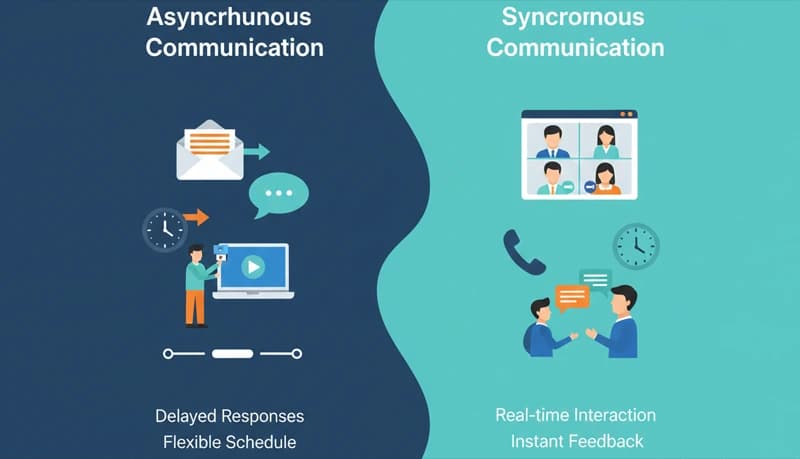
Remote and hybrid teams need both synchronous and asynchronous communication to work effectively. The challenge is knowing when to use each one — and getting the balance right.
Too many live meetings drain productivity. Too little real-time interaction leads to isolation and misalignment. This guide breaks down the differences, pros and cons, and how to build a communication approach that works for distributed teams.
What's the difference?
Synchronous communication
Synchronous communication happens in real time — both parties are present and responding to each other live. Examples include video calls, phone calls, in-person meetings, and active chat conversations.
The key characteristic: everyone is available at the same time.
Asynchronous communication
Asynchronous communication doesn't require everyone to be online simultaneously. You send a message, and the recipient reads and responds when they're available. Examples include email, recorded video messages, shared documents with comments, task assignments, and chat messages that don't expect an immediate reply.
The key characteristic: the message waits until the recipient is ready.
When to use each
Use synchronous communication for:
- Brainstorming and creative discussions — Rapid back-and-forth generates ideas faster than trading messages
- Sensitive conversations — Performance feedback, conflict resolution, and personal matters benefit from tone and body language
- Urgent decisions — When something needs to be resolved immediately
- Team building — Casual conversations and social time that build rapport and trust
- Complex topics — Discussions where questions and answers build on each other quickly
Use asynchronous communication for:
- Status updates — Daily and weekly reports don't need a meeting
- Task assignments and feedback — Written instructions are clearer and can be referenced later
- Cross-timezone collaboration — When team members can't be online at the same time
- Decisions that benefit from reflection — Giving people time to think leads to better responses
- Documentation — Anything that needs to be referenced later should be written down
Pros and cons of synchronous communication
Pros
- Immediate feedback — Questions get answered in real time
- Builds rapport — Face-to-face interaction (even virtual) strengthens relationships
- Good for complex discussions — Nuance is easier to convey in conversation than in writing
Cons
- Interrupts focus — Meetings and live chats pull people out of deep work. 71% of professionals report that frequent interruptions reduce their productivity.
- Scheduling challenges — Getting everyone online at the same time is difficult across time zones
- Information gets lost — Unless someone takes thorough notes, decisions and details from meetings are easily forgotten
- Time-consuming — Many meetings could be replaced by a well-written message
Pros and cons of asynchronous communication
Pros
- Protects focus time — People can respond when they're ready, not when they're interrupted
- Time-zone friendly — Works for teams spread across the world
- Produces better responses — People have time to think, research, and formulate complete answers
- Creates a written record — Messages, documents, and comments serve as documentation. Combining async updates with a remote work solution that tracks time and tasks gives managers full visibility without requiring constant meetings
- Reduces meeting fatigue — Fewer meetings means more time for actual work
Cons
- Slower responses — You may wait hours for an answer to a simple question
- Messages can be missed — Important updates get buried in busy inboxes
- Lack of nuance — Tone and intent are harder to convey in writing
- Requires discipline — People need to check messages regularly and respond within reasonable timeframes
Benefits of asynchronous communication for remote teams
Fewer interruptions, more focus
Good work requires focus, and focus requires uninterrupted time. In a team where messages can wait until inboxes are checked a few times a day, every team member can choose their best focus hours and do their deepest work without stopping to answer unrelated questions mid-session.
Greater autonomy
Asynchronous communication gives employees control over when they respond and how thoroughly they address each task. This increases their sense of ownership and reduces the weight of constant check-ins that can feel like micromanagement.
More inclusive
Async communication is more accessible for people in different time zones, those with varying schedules, and employees who communicate better in writing than in live conversation. It levels the playing field for team members who might struggle with the pressure of real-time meetings.
Better-quality communication
When you know someone might not read your message for hours, you tend to make it more complete. You include context, reference materials, and specific questions. The recipient, in turn, can take time to provide a thorough response. This leads to higher-quality communication than rapid-fire chat.
How to improve asynchronous communication
Provide enough context
The biggest failure in async communication is sending incomplete messages. When asking a question, include enough information for the other person to respond fully without needing to ask follow-up questions. Attach relevant documents, link to related tasks, and explain the background.
Set response expectations
Not every message needs an instant reply, but people should know when a response is expected. Include a deadline when timing matters: "Can you review this by Thursday?" removes ambiguity.
Manage notifications
Encourage your team to take control of their notification settings. Being "always online" defeats the purpose of async communication. Set norms around availability — for example, check messages three times a day rather than responding to every ping immediately.
Share availability
Use shared calendars or status indicators so team members know when colleagues are available for synchronous communication and when they're in focus mode.
Write clearly
Async communication depends on clear writing. Use short paragraphs, bullet points, and specific subject lines. State what you need and by when. The easier your message is to parse, the faster and better the response will be.
Finding the right balance
The goal isn't to eliminate synchronous communication — it's to use each type where it works best. A practical approach:
- Default to async — Make asynchronous communication the default for most work communication. This protects everyone's focus time and works across time zones.
- Schedule sync intentionally — When you do book a meeting, have an agenda and share it in advance. Keep meetings short and focused. This blends the value of live discussion with the productivity benefits of async.
- Let the team adapt — Trust your team to determine which conversations need a live call and which can be handled through messages and documents. As professionals, they'll find the right balance for their workflow.
- Use effective communication channels — Match the channel to the message. Quick questions go in chat. Detailed requests go in task management tools. Complex discussions get a meeting.
The teams that communicate best aren't the ones that talk the most — they're the ones that communicate in the right way at the right time.