A Guide to Managing Leaves for Your Hybrid Team

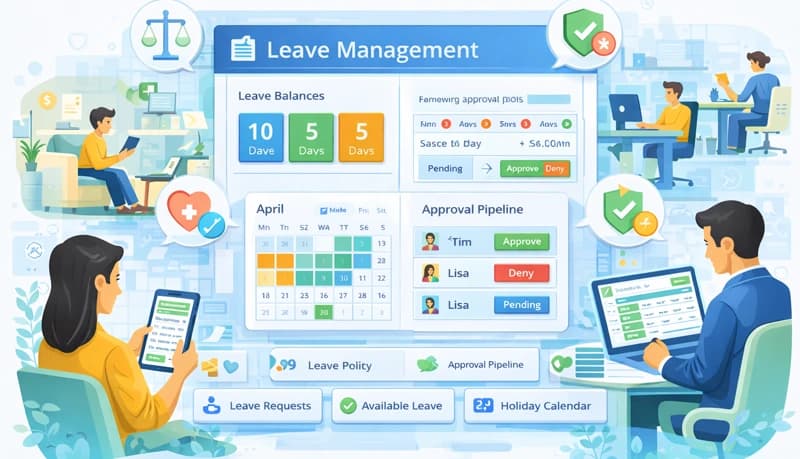
Balancing a happy team and a well-run business is hard. HR teams must give employees enough time to recharge, recover, and attend to family — while ensuring there's no workflow disruption or staffing shortage.
With hybrid and remote work now the norm, the challenge is even greater. Most leave management techniques designed for on-site teams don't work when employees are spread across locations and time zones. This guide covers how to build a leave management policy and system that works for hybrid teams.
Why leave management matters
Productivity
Well-rested employees are more productive. A good leave policy ensures people take the time off they're entitled to, which improves their well-being, engagement, and output. Proper leave management also keeps your team staffed adequately so productivity doesn't drop when people are out.
Retention and recruitment
Employees consistently rank paid time off as one of the most important benefits. Poor leave management frustrates employees and damages your employer brand, making it harder to hire and retain good people.
Fairness
Leave management helps you apply policies consistently across the organization. Without a clear system, some employees may get preferential treatment while others feel shortchanged — which hurts morale.
Compliance
Your leave policy must comply with local, state, and federal labor laws. For hybrid teams with employees in multiple countries, this means tracking different regulations for each location. Non-compliance can lead to fines and legal problems.
Reducing absenteeism
Employees who take regular, planned time off are less likely to burn out and less likely to take unplanned sick days. Good leave management is preventive, not just reactive.
Challenges specific to hybrid teams
Leave tracking
On-site teams can track attendance and leave through simple observation. Hybrid teams need a digital system. Without one, it's hard to know who's on leave, who's working remotely, and who's in the office on any given day.
Communication
Hybrid employees work at different times and in different locations. Communicating policy changes, notifying the team about who's out, and coordinating coverage requires digital tools like a vacation tracker and clear processes — not hallway conversations.
Leave requests and approvals
In-office employees can request time off by walking to their manager's desk. Remote employees need a digital process where they can apply, managers can approve, and HR can track — all in one system.
Staffing across time zones
Remote employees in different time zones create unique staffing challenges. If multiple employees in the same time zone take leave simultaneously, you could lose coverage for an entire region or shift. Managers need visibility into leave schedules across time zones to prevent gaps. A remote work solution that combines attendance tracking with time-off management helps you see the full picture in one place.
What a good leave policy should cover
Types of leave
Define each type of leave your organization offers — vacation, sick leave, personal days, parental leave, bereavement, and any other categories. Specify whether each type is paid or unpaid, and how much each employee is entitled to.
Eligibility
Clarify who qualifies for each type of leave — full-time employees, part-time employees, contractors. If policies differ between on-site and remote employees, make that explicit to prevent confusion.
Request and approval process
Document how employees request time off, how far in advance they need to submit requests, who approves them, and how they'll be notified of the decision. For hybrid teams, this process must be fully digital.
Compliance by location
If you have employees in multiple countries or states, your policy needs to account for different labor laws and regulations in each location. Update your policy whenever you hire in a new jurisdiction.
Communication
All new employees should receive the leave policy during onboarding. Policy updates should be communicated through multiple channels to reach both on-site and remote employees.
Why you need a leave management system
Managing leave with spreadsheets and email works for small on-site teams. For hybrid teams, you need a dedicated system. Here's what a good leave management system provides:
Self-service for employees
Employees can check their available balance, submit requests, and see the status of their application — without emailing HR. This is faster and more transparent for everyone.
Streamlined approvals
Managers can see their team's leave calendar, check for conflicts, and approve or deny requests from within the system. HR gets a consolidated view of the entire organization's leave.
Visibility for planning
A dashboard showing who's on leave and who's available helps managers allocate work and prevent bottlenecks. This is especially important for hybrid teams where you can't just look around the office to see who's in.
Automatic balance tracking
The system tracks leave balances automatically — no manual calculations, no spreadsheet errors. A dedicated vacation tracker updates balances immediately when leave is approved.
Multi-location support
For teams spread across countries, the system should handle different holiday calendars, leave entitlements, and regulations for each location.
Payroll accuracy
Some leave is paid, some isn't. A good system distinguishes between the two and provides accurate data for payroll, eliminating manual errors. Combined with time tracking, you get a complete picture of hours worked, paid time off taken, and compensation owed.
Compliance
The system helps you stay compliant by applying the correct leave policies based on each employee's location and employment type.
Making leave management work
The key to effective leave management in a hybrid team is treating it as a system, not an afterthought. Build a clear policy, choose a tool that handles the complexity of distributed teams, and communicate the policy consistently to everyone.
When leave is managed well, employees take the time they need without guilt, managers maintain adequate coverage, and the business runs smoothly — regardless of where people work.