Remote Work Trends 2026: What's Actually Ahead

Remote Work Trends 2026 — Quick Answer
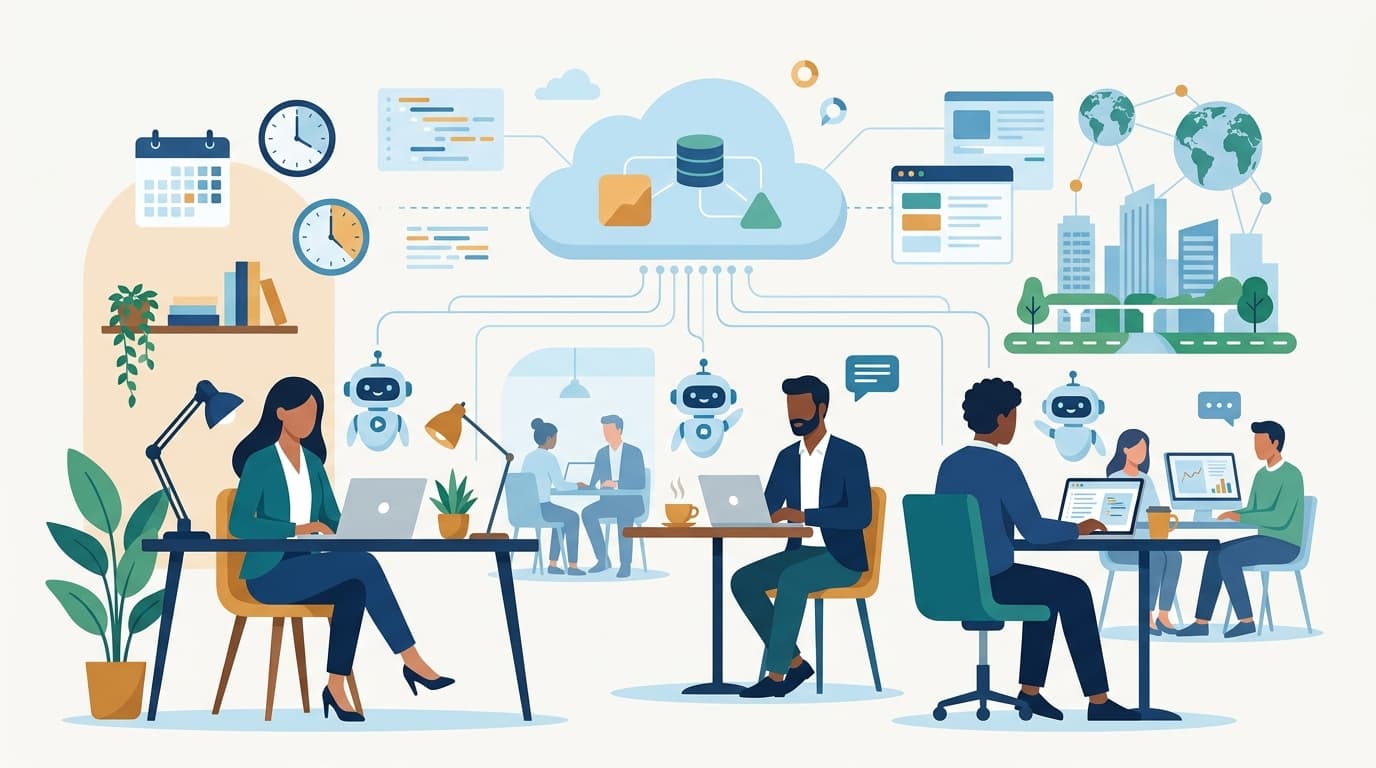
The remote work trends that matter most in 2026 are: (1) AI agents becoming genuine teammates on distributed teams, (2) async-first operating models replacing meeting-heavy remote cultures, (3) hybrid schedules stabilizing rather than reversing, (4) performance measurement shifting from activity to outcomes, (5) right-to-disconnect and distributed-work compliance going mainstream, and (6) the remote tech stack consolidating from a dozen point tools into a few integrated platforms. The common thread: remote work is no longer an experiment to defend — it's an operating model to optimize.
The return-to-office debate is over — not because one side won, but because the question stopped being interesting. Most organizations have landed where they're going to land: some fully remote, some fully on-site, and a large stable middle running hybrid schedules. The real action in 2026 isn't where people work. It's how distributed work actually operates — who (or what) is on the team, how work gets coordinated across time zones, how performance gets measured, and what the law now requires of employers with people spread across jurisdictions.
This isn't a tool roundup or a rehash of pandemic-era statistics. It's an analysis of six structural shifts in distributed work — what's driving each one, what it looks like in practice, and what team leaders should do about it this year.
1. AI Agents Join the Distributed Team
The most consequential of the remote work trends in 2026 isn't about humans at all. AI has moved past the "chatbot that drafts your email" phase and into agentic territory: software that takes a goal, breaks it into steps, executes across multiple tools, and reports back. For distributed teams, that changes the shape of the org chart.
Microsoft's Work Trend Index calls the organizations leading this shift "Frontier Firms" — companies built around human-agent teams, where managers increasingly direct the work of AI agents alongside people. The gap is already visible in sentiment: according to Microsoft's Work Trend Index, 71% of workers at these AI-forward firms say their company is thriving, compared to 37% of workers globally.
Why does this matter more for remote teams than co-located ones? Because distributed teams already run on the infrastructure agents need:
- Written context. Agents work from documents, tickets, and threads — exactly the artifacts async remote teams already produce. A meeting-driven office culture starves agents of context; a documentation-driven remote culture feeds them.
- Time-zone coverage. An agent doesn't sleep. Work handed off at the end of a workday in Manila can be triaged, summarized, and queued before the New York morning — without any human working odd hours.
- Coordination overhead. The classic tax on distributed teams is coordination: status updates, handoff notes, meeting scheduling. This is precisely the category of work agents absorb first.
What to do in 2026: Treat agent adoption as a management problem, not a procurement problem. Decide which workflows agents own end-to-end, which require human review, and how agent output gets attributed and audited. Teams that skip this governance step will rediscover it later as a quality-control crisis.
2. Async-First Becomes the Default Operating Model
For years, "remote" mostly meant "the office, recreated on Zoom" — the same meeting load, the same synchronous expectations, just with worse ergonomics. That model is losing to something better: async-first operations, where written communication is the default and real-time meetings are the exception reserved for decisions, conflict, and connection.
The shift is being driven by three forces converging at once. Global hiring keeps stretching teams across more time zones, making synchronous overlap a scarce resource. AI summarization has made written communication dramatically cheaper to consume — a 40-message thread now collapses into a three-bullet digest. And a growing body of team experience shows that meeting-heavy remote cultures burn people out without producing better decisions.
Async-first in practice looks like:
- Decisions in documents, not calls. Proposals are written, commented on across time zones, and decided with a clear owner — with a short call only if written debate stalls.
- Recorded and summarized meetings. Anyone not present gets the same information without attending.
- Defined response-time expectations. Not "always on," but explicit: routine messages within one business day, urgent channels for genuine emergencies.
The trap to avoid is treating async as an absolute. Teams that go fully async lose the relationship glue that makes hard conversations possible. The durable model is a deliberate mix — and if you're calibrating that balance, our guide to asynchronous and synchronous communication breaks down when each mode wins.
What to do in 2026: Audit your recurring meetings and convert every status-shaped meeting into a written update. Keep synchronous time for the three things it's genuinely better at: deciding, disagreeing, and bonding.
3. Hybrid Stabilizes — and Stops Being News
Every January brings predictions that hybrid work is about to collapse into full RTO. The data keeps refusing to cooperate. According to Gallup, roughly half of remote-capable U.S. employees work hybrid schedules, with the remainder split between fully remote and fully on-site — proportions that have been remarkably stable, shifting only a few percentage points quarter to quarter. Gallup also finds that six in ten remote-capable employees prefer hybrid, which means the arrangement is anchored by employee demand, not just employer policy.
High-profile RTO mandates make headlines precisely because they're exceptions. Underneath the noise, the hybrid pattern has matured in three ways:
- Anchor days over free-for-all. The dominant model is now team-coordinated: everyone in on the same two or three days, rather than individuals choosing randomly. Offices used as collaboration venues, not attendance venues.
- Hybrid as a compensation lever. Flexibility has hardened into part of the total rewards package. Employers pulling it back are effectively issuing a pay cut — and candidates price it that way.
- Policy stability. Companies have stopped re-litigating their policy every quarter. The 2026 conversation is about making the chosen model work, not choosing again.
For leaders, the challenge has shifted from policy to practice: running meetings that don't disadvantage the remote half of the room, distributing opportunity evenly, and keeping culture coherent across locations. Our toolkit on hybrid work best practices for leaders covers the operational side in depth.
What to do in 2026: Stop treating your work model as provisional. Whatever you run — remote, hybrid, on-site — invest in making it excellent rather than keeping the decision perpetually open. Ambiguity, not any particular model, is what drains teams.
4. Performance Measurement Shifts from Activity to Outcomes
The surveillance-heavy phase of remote management — keystroke counters, always-on webcams, "green dot" presenteeism — is aging badly. It never measured what mattered, it corroded trust, and increasingly it collides with privacy regulation. What's replacing it in 2026 is outcome-based measurement: defining what good output looks like, agreeing on it explicitly, and evaluating people against results rather than hours of visible activity.
This is partly an AI story too. When an AI agent can generate activity signals — messages sent, documents touched, hours logged — activity metrics lose whatever meaning they had. The only durable measure of a knowledge worker's contribution is the outcome: the shipped feature, the resolved ticket, the closed deal, the client retained.
Outcome-based management in practice:
- Explicit definitions of done. Every project and role has written success criteria, so "is this person performing?" has an objective answer.
- Time data as context, not verdict. Time tracking still matters — for client billing, capacity planning, and spotting overload before it becomes burnout — but it informs the conversation rather than replacing it. Used this way, visibility tools support trust instead of undermining it; our guide to the ethics of employee monitoring draws that line in detail.
- Shorter feedback loops. Quarterly reviews give way to lightweight weekly or biweekly check-ins against agreed outcomes.
If you're building this muscle, start with our framework for measuring employee productivity — it walks through defining output measures that survive contact with real teams.
What to do in 2026: Write down what "good" looks like for every role on your team. If you can't, that's the problem to fix before you buy any measurement tool.
5. Right-to-Disconnect and Distributed Compliance Go Mainstream
For most of the remote era, compliance was an afterthought. In 2026 it's a board-level topic, driven by two converging pressures: right-to-disconnect legislation and the multiplying obligations of employing people across jurisdictions.
The right-to-disconnect movement — laws limiting employer contact outside working hours — began with France in 2017 and has since spread to more than a dozen countries, including Portugal, whose 2021 labor code amendment carries meaningful fines for out-of-hours contact. The most significant recent expansion is Australia: according to the Fair Work Ombudsman, Australian employees gained a legal right to refuse unreasonable out-of-hours contact in August 2024, with the law extending to small-business employees in August 2025.
For distributed teams, this lands differently than it does for a single-office company. A team spanning Lisbon, Sydney, and Austin now has employees with different legal protections around the same Slack message. Add to that the established mesh of cross-border obligations — hours-of-work record-keeping, local overtime rules, tax presence, and data-privacy regimes like GDPR — and "we hired someone in another country" has become a compliance project, not just an HR form.
The practical consequences for 2026:
- Working-hours boundaries become policy, not culture. "We respect time zones" is no longer enough; teams are writing explicit contact windows and urgent-versus-routine channel rules.
- Accurate hours records matter more. Demonstrating compliance with hours and rest-period rules requires actual records of when work happened — one more reason time tracking has shifted from a billing tool to a compliance tool.
- Async-first gets a legal tailwind. An operating model built on "respond within one business day" is naturally compatible with right-to-disconnect rules. Meeting-heavy synchronous cultures are the ones that will keep tripping over them.
What to do in 2026: Map where your people actually are, list the working-time rules that apply in each jurisdiction, and encode boundaries into your communication norms before a regulator or a resignation letter does it for you.
6. The Remote Tech Stack Consolidates
The pandemic-era answer to every distributed-work problem was another app. The result, by the early 2020s, was a stack of ten to fifteen point tools per team — chat here, time tracking there, project management somewhere else, plus scheduling, documentation, whiteboarding, and video, each with its own license, login, and data silo.
In 2026, that stack is contracting. Three forces are driving consolidation:
- Budget scrutiny. Finance teams are auditing per-seat SaaS spend line by line, and overlapping tools are the first cut.
- AI needs unified data. An AI assistant is only as useful as the context it can see. Ten disconnected tools mean ten blind spots; platforms that combine time, tasks, schedules, and communication give AI (and managers) one coherent picture of the work.
- Tool fatigue is a real productivity cost. Every additional app adds context-switching for employees and administration for managers. Teams have learned that a smaller, integrated stack usually beats a larger "best-of-breed" one in practice.
The winning shape is a small core: one communication hub, one system of record for projects, and one platform for workforce operations — time, schedules, attendance, and reporting together rather than scattered. That's the philosophy behind HiveDesk's feature set, which combines time tracking, task management, scheduling, and project cost reporting in a single tool, and it's where the broader market is clearly heading.
What to do in 2026: Inventory your stack, mark the overlaps, and consolidate around tools that integrate — your budget, your employees' attention, and your future AI workflows will all thank you.
The Future of Remote Work: Three Predictions Past 2026
Where do these trends point beyond this year? Three predictions, offered as analysis rather than certainty:
Distributed becomes the unmarked case. We'll stop saying "remote team" the way we stopped saying "e-business." Tools, laws, and management norms will assume distribution by default, and co-location will be the special case that needs justification (and sometimes gets it — some work genuinely benefits from a room).
Management skill becomes the bottleneck. The technology for distributed work is largely solved; the management craft isn't. The scarce resource will be leaders who can set clear outcomes, write well, run async decision processes, and manage a blended human-agent team. Organizations will start hiring and promoting explicitly for these skills.
The talent market finishes going global. As compliance tooling matures and employer-of-record services commoditize cross-border hiring, competing for talent locally while your competitors recruit globally will look like a strategic error, not a preference. The follow-on effects — wage convergence pressure, 24-hour operating cycles, truly multinational small companies — will define the next decade of work.
For the current numbers behind these shifts, see our regularly updated remote work statistics page.
Frequently Asked Questions
Is remote work declining in 2026?
No — it has stabilized. According to Gallup, about half of remote-capable U.S. employees work hybrid, with the rest split between fully remote and fully on-site, and those proportions have held roughly steady. Individual company RTO mandates make news, but the aggregate picture is stability, not retreat.
What is the biggest remote work trend in 2026?
The integration of AI agents into distributed teams. It changes team composition, makes written/async operations more valuable (agents run on documented context), and accelerates the shift to outcome-based performance measurement, since activity metrics mean little when software can generate activity.
What should managers of remote teams prioritize this year?
Three things: write down explicit outcomes for every role, convert status meetings into async written updates, and get ahead of working-hours compliance for every jurisdiction where you employ people. Each addresses a structural shift rather than a passing fad.
The Bottom Line
The story of remote work trends in 2026 is maturation. The experiments are over; the operating model is here. AI agents are joining the roster, async-first is becoming the coordination default, hybrid has settled into stable patterns, outcomes are replacing activity as the measure of work, regulators are formalizing boundaries, and the tool sprawl is finally contracting.
None of these trends rewards waiting. The teams pulling ahead aren't the ones with the boldest work-from-anywhere policy — they're the ones doing the unglamorous work of clear outcomes, written communication, honest measurement, and a stack that fits. That work is available to every team, starting now.