How Time Tracking Builds Employee Accountability

Accountability means employees take ownership of their work — they do what they say they'll do, they're honest about how they spend their time, and they flag problems early rather than hiding them. It's one of the most important traits of a productive team, and one of the hardest to build. Without it, small dishonesty — inflated hours, buddy punching, untracked breaks — gets normalized fast.
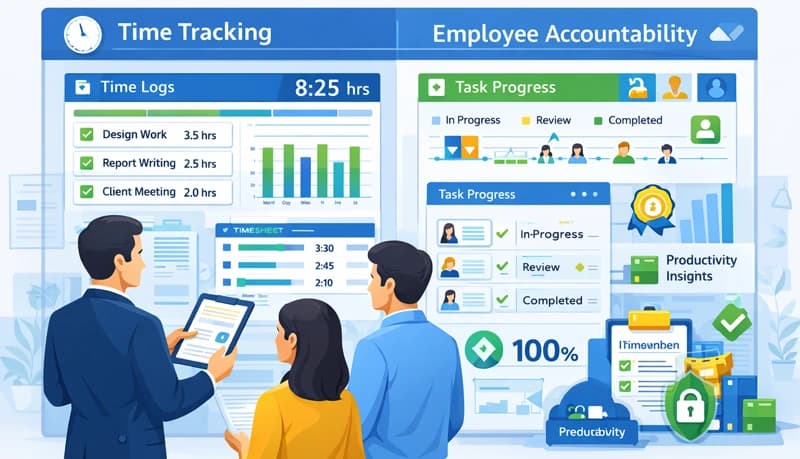
Time tracking supports accountability by making work visible. When everyone logs their hours against specific projects and tasks, there's a shared record of where effort goes. This isn't about surveillance — it's about creating transparency that helps both managers and employees do their jobs better.
How time tracking creates accountability
Work becomes visible
Without time tracking, most of what employees do is invisible to everyone except themselves. A developer might spend three hours debugging an obscure issue that no one else knows about. A project manager might spend half their day in meetings that produce nothing. A designer might be quietly carrying the workload of two people.
Time tracking makes this work visible. When effort is logged, managers can see who's doing what, employees can demonstrate their contributions, and the team has a shared understanding of where time goes. For a deeper look at the tools and metrics involved, see our guide to employee productivity tracking.
Commitments become measurable
When an employee says "I'll finish this by Friday," time tracking adds substance to that commitment. If the task is estimated at 10 hours and they've logged 8 by Thursday, everyone can see they're on track. If they've logged 2, there's an early signal that something is off — and time to address it before the deadline passes.
This isn't about catching people — it's about catching problems early. The data surfaces issues that would otherwise stay hidden until a deadline is missed.
Patterns become clear
A single day's time data tells you very little. But weeks and months of data reveal patterns that drive better decisions:
- Which tasks consistently take longer than expected?
- Who is overloaded and who has capacity?
- Where does non-productive time accumulate?
- Are certain types of work chronically underestimated?
These patterns help managers address systemic issues rather than reacting to individual incidents.
The trust problem
Time tracking only builds accountability if employees trust the system. If they see it as a surveillance tool, the result is resentment and gaming — not genuine accountability.
Signs that time tracking is eroding trust
- Employees pad their hours to look busy rather than logging accurately
- People resist the tool or "forget" to use it regularly
- Managers use time data to criticize rather than to understand
- Employees feel they need to justify every minute of their day
If you see these signs, the problem isn't the tool — it's how it's being used.
How to build trust around time tracking
Explain the purpose clearly. "We track time so we can bill clients accurately, estimate projects better, and make sure no one is overloaded" is a very different message than "We track time so we know what you're doing all day."
Track outcomes, not just hours. An employee who delivers high-quality work in 6 hours is more valuable than one who logs 8 hours of low-output activity. Make it clear that time data is one input — not the sole measure of performance.
Apply it to everyone. If managers and senior staff exempt themselves from time tracking, it sends a clear message that tracking is about control, not accountability. When leadership tracks their time too, it normalizes the practice.
Never punish honest data. If an employee logs time accurately and it reveals a problem — they spent 4 hours on something that should have taken 1 — the response should be "let's figure out why" not "why did you waste time?" Punishing honest time entries guarantees you'll get dishonest ones going forward.
Share the data back. Give employees access to their own time data and team-level summaries. When people can see how the data is used and benefit from it themselves, they're more likely to engage with the system honestly.
Accountability for remote and hybrid teams
Accountability is harder to build on remote teams because the informal signals of in-office work are absent. You can't see who's at their desk, who's in a meeting, or who left early.
Time tracking fills this gap — but it needs to be implemented thoughtfully.
Focus on output, not presence
For remote teams, tracking hours matters less than tracking what those hours produce. Tools like screenshot-based time tracking and remote employee monitoring software can provide visual proof of work without requiring constant oversight. An employee working from home who logs 6 focused hours and completes all their tasks is more accountable than one who logs 8 hours but produces little.
Combine time tracking with clear deliverables. Time data tells you how long things take; task completion tells you whether the work is getting done. Together, they give a complete accountability picture.
Account for different working patterns
Remote employees often work non-traditional hours — early mornings, late evenings, or split schedules. Time tracking should accommodate these patterns rather than penalizing them. What matters is that the work gets done and the hours are logged accurately, not that everyone works 9-to-5.
Use data for support, not suspicion
When a remote employee's time data looks unusual — fewer hours than expected, or lots of time on unplanned tasks — start with curiosity rather than accusation. They might be dealing with a personal issue, struggling with unclear requirements, or blocked by a dependency they haven't flagged. The data is a signal to check in, not a reason to assume the worst.
Accountability for managers too
Time tracking creates accountability in both directions. Employees are accountable for how they spend their time, and managers are accountable for how they manage their team's time.
Are you allocating work fairly?
Time data shows whether work is distributed evenly or whether certain employees are consistently overloaded. If one person logs 50 hours every week while others average 35, that's a management problem — not an individual performance issue.
Are your estimates realistic?
If projects routinely take 50% longer than estimated, the accountability gap isn't with the employees — it's with whoever set the estimate. Historical time data helps you set realistic expectations rather than aspirational ones.
Are meetings eating productive time?
Time tracking often reveals that a significant portion of the team's week goes to meetings, leaving insufficient time for focused work. If your team is spending 15+ hours a week in meetings, accountability starts with reducing that overhead — not asking employees to make up the difference.
Making it work in practice
Keep it simple
The less friction time tracking adds, the more consistently people will use it. Select a task, start a timer, work, stop the timer. If the process is more complicated than that, simplify it.
Set clear expectations
Define what you expect: daily time entry, project-level tracking, minimum description detail. Put it in writing during onboarding so every new hire starts with the same understanding.
Review regularly
Time data only creates accountability if someone looks at it. Review timesheets weekly. Discuss patterns monthly. Compare project estimates against actuals after every completed project. The review itself signals that the data matters.
Use data constructively
When the data reveals problems — a project running over budget, an employee struggling with a task type, a team consistently working overtime — use it as a starting point for problem-solving, not blame. Teams that see time data used to improve processes and workload balance will embrace accountability. Teams that see it used to punish will resist it.
The goal of time tracking isn't to create a culture of monitoring. It's to create a culture where work is visible, commitments are clear, problems surface early, and everyone — employees and managers alike — is accountable for doing their part.