Real-Time Agent Monitoring for Call Center Success

Imagine you're a conductor, leading a grand orchestra. Every musician plays a vital role, and a single missed note, a slightly off-key instrument, or a faltering rhythm can disrupt the entire performance. You can't wait until after the concert to address these issues; you need to identify and correct them as they happen. This, in essence, is the power of real-time agent monitoring in a call center. It's about empowering you to conduct your customer support orchestra with precision, ensuring every interaction hits the right note.
This complete guide isn't just about watching agents; it's about actively shaping the customer experience in the moment, fostering a culture of continuous improvement, and driving operational excellence through performance monitoring and data-driven decision-making.
What is Real-Time Agent Monitoring in a Call Center?
At its core, real-time agent monitoring in a call center or contact center refers to the continuous observation, analysis, and often intervention in customer interactions and agent activities as they are happening. Unlike traditional methods that rely on post-call reviews or weekly reports, real-time monitoring provides immediate insights into agent performance, customer sentiment, and operational efficiency. It's like having a live dashboard displaying the pulse of your entire customer service operation.
Think of a call center agent interacting with a frustrated customer. Without real-time monitoring, a supervisor might only discover the issue hours or even days later, after a complaint has escalated or a negative review has been posted. With real-time monitoring, that same supervisor could instantly see a spike in negative sentiment, observe the agent struggling to find information, or notice a lengthy hold time. This immediate awareness opens the door for timely intervention, whether it's providing on-the-spot guidance via escalation, or simply offering a word of encouragement.
Beyond the Traditional Scorecards: A New Paradigm
For years, call centers and contact centers have relied on scorecards, surveys, and sampled call recordings to assess performance. While these tools offer valuable insights, they are inherently retrospective. They tell you what happened, but often too late to change the outcome. Real-time monitoring, however, shifts the paradigm from reaction to proactive management.
It moves beyond simply scoring an agent's performance after the fact. Modern monitoring solutions powered by AI agents and large language models (LLMs) delve into the nuances of each interaction, analyzing customer sentiment, identifying knowledge gaps, and flagging deviations from best practices as they unfold. This allows for a dynamic and adaptive approach to agent management and customer service. Instead of waiting for a quarterly review to address recurring issues, real-time monitoring provides the data and the opportunity to make adjustments in the moment, preventing minor issues from escalating into major problems. It's about empowering supervisors to be active coaches, not just auditors.
Why Real-Time Monitoring is a Game-Changer for Call Centers
The impact of real-time monitoring extends far beyond simply catching errors. It fundamentally transforms how call centers operate, creating a ripple effect that benefits customers, agents, and the business as a whole.
Immediate Identification and Resolution of Issues
Imagine a customer is about to churn because an agent is struggling to resolve a complex billing issue. Without real-time monitoring, that customer might be lost forever. With it, a supervisor sees the interaction escalating, detects the frustration through sentiment analysis, and observes the agent fumbling with the system. This immediate visibility allows the supervisor to jump in, offer a solution, or even take over the call, turning a potentially disastrous situation into a successful resolution. It's the difference between finding a small leak and repairing it, versus discovering a flooded basement.
Proactive Coaching and Skill Development
Traditional coaching often feels like reviewing a past game film—informative, but unable to change the score. Real-time monitoring enables "live coaching." A supervisor can identify an agent struggling with a new product feature or a particularly challenging customer personality during the call. They can then send a whisper message, pop up relevant information on the agent's screen, or step in to demonstrate best practices. This immediate, contextual feedback loop is far more effective than a post-call review, leading to faster skill development and improved agent confidence. It's like having a personal trainer right there with you during your workout, correcting your form in the moment.
Enhanced Customer Experience and Satisfaction
Ultimately, everything in a call center boils down to the customer. Real-time monitoring directly impacts customer satisfaction and CSAT scores by enabling faster issue resolution, reducing wait times, and ensuring consistent service quality. When agents are supported and coached effectively through agent evaluation and real-time feedback, they provide better customer support. When supervisors can proactively intervene, they prevent negative experiences. The result is a smoother, more efficient, and more satisfying interaction for the customer, leading to increased loyalty and positive brand perception. It's about making every customer feel heard, valued, and efficiently served—elevating the entire user experience.
Improved Agent Morale and Retention
No one likes to feel like they're failing, or that they're struggling alone. Real-time monitoring, when implemented correctly, is a powerful tool for agent support. Knowing that a supervisor is there to provide immediate assistance, rather than just criticize after the fact, fosters a sense of security and confidence. Proactive coaching helps agents master their roles faster, reducing stress and improving job satisfaction. When agents feel supported, empowered, and successful, they are less likely to experience burnout and more likely to remain with the company, significantly reducing costly turnover. It turns the supervisor from a distant judge into an active ally.
Data-Driven Operational Efficiency
Beyond individual agent interactions, real-time monitoring provides a wealth of data on overall operational performance. It can identify patterns in call types, agent workflows, and system bottlenecks. Are certain call types consistently leading to longer handle times? Are agents spending too much time navigating outdated systems? This real-time data allows managers to make immediate adjustments to staffing, training modules, or even technology, optimizing resource allocation and streamlining processes. It transforms guesswork into strategic, data-informed decisions, much like a pilot constantly checking their instruments to ensure the most efficient flight path.
Key Features and Capabilities of Effective Real-Time Monitoring Platforms

To deliver on its promise, a robust real-time monitoring platform isn't just a single tool; it's an integrated suite of capabilities designed to provide end-to-end observability of call center operations.
Live Call Listening and Sentiment Analysis
This is the cornerstone. Supervisors can discreetly listen in on live calls without the customer or agent knowing, gaining unvarnished insight into the interaction. Coupled with AI-powered sentiment analysis—which uses LLMs and natural language processing to detect emotional cues in speech (tone, pitch, word choice)—supervisors can instantly gauge the customer's mood, whether they're happy, frustrated, or escalating. This immediate emotional barometer is crucial for knowing when to intervene. Modern AI agent systems can process these signals with minimal latency, delivering near-instant sentiment scores that update throughout the conversation.
Screen Monitoring and Activity Tracking
It's not just what agents say, but what they do. Screen monitoring allows supervisors to see the agent's desktop in real-time, observing which applications they're using, how efficiently they're navigating systems, and if they're following correct procedures. Activity tracking provides data on idle time, breaks, and adherence to schedules. This helps identify workflow inefficiencies, system issues, or areas where additional training on specific software is needed. Combined with agent behavior analysis, it provides a comprehensive picture of how agents interact with their monitoring tools and systems throughout the lifecycle of each customer interaction.
Alerts and Notifications for Critical Events
The system can be configured to trigger immediate alerts and notifications for specific events. This could be a sudden spike in negative customer sentiment, an agent spending too long on a call, a customer mentioning a competitor, or an agent violating a specific compliance rule. These customizable alerts ensure supervisors are immediately notified of situations requiring their attention, preventing minor issues from spiraling out of control. It's having a sophisticated alarm system for your call center—one with low enough latency that interventions happen in seconds, not minutes.
Performance Dashboards and Visualizations
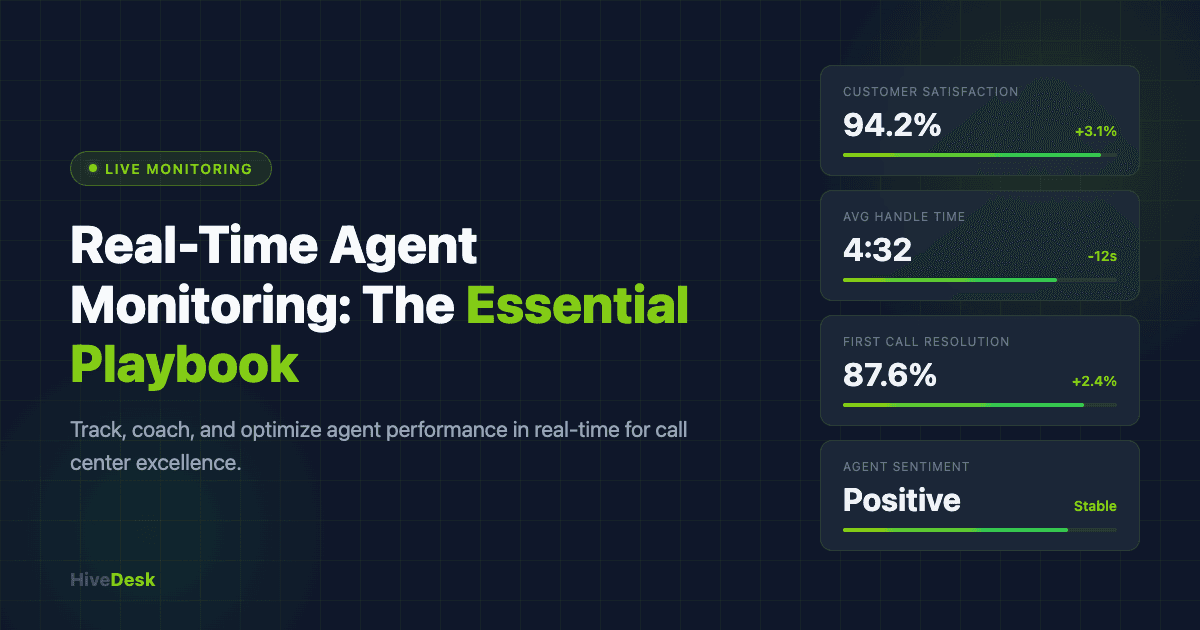
Aggregating all this real-time data into intuitive dashboards is crucial. Supervisors and managers can view key metrics and performance indicators (KPIs) like average handle time (AHT), first call resolution (FCR) rates, queue times, and agent status, all updated in real-time. Visualizations like charts and graphs make complex data easy to digest, allowing for quick identification of trends, bottlenecks, or peak activity periods. Advanced dashboards also display performance metrics like error rate, agent response quality, and automation success rates, giving you a bird's-eye view of everything happening right now.
Integration with Other Call Center Systems (CRM, WFM)
For true effectiveness, the monitoring platform must seamlessly integrate with existing call center infrastructure through well-documented APIs. This includes Customer Relationship Management (CRM) systems to provide agents with instant access to customer history and supervisors with context, as well as Workforce Management (WFM) systems to optimize scheduling and staffing based on real-time call volumes and agent availability. Many platforms offer SDKs for custom integrations, enabling API calls that pull data from multiple data sources into a unified observability layer. This interconnectedness creates a holistic view and enables more intelligent, data-driven decisions across the entire operation.
The Role of AI Agents and LLMs in Modern Monitoring
The latest generation of real-time monitoring solutions represents a quantum leap forward, powered by AI agents and large language models that bring unprecedented intelligence to call center operations.
How AI Agents Transform Monitoring
An AI agent in the monitoring context is an autonomous system that continuously analyzes conversations, detects patterns, and takes intelligent actions. Unlike simple rule-based automation, an AI agent can understand context, interpret nuance, and make sophisticated judgments about agent interactions. For example, an AI agent might recognize that an agent's response to a billing question is technically correct but lacks empathy, and surface a coaching suggestion in real-time.
Modern platforms deploy multiple AI agents working in concert—one AI agent might handle sentiment analysis while another focuses on compliance validation, and a third monitors agent behavior patterns across the entire agent system. These AI agent architectures can process thousands of simultaneous customer interactions with remarkably low latency, ensuring every conversation receives the same level of intelligent oversight. Unlike traditional AI systems that operate on rigid rules, modern AI agents adapt to new scenarios and learn from each interaction.
LLMs Powering Deeper Analysis
Large language models (LLMs) have revolutionized how monitoring platforms understand conversations. LLMs can analyze transcripts for subtle meaning, detect sarcasm, identify buying signals, and even predict customer churn risk based on conversational cues. They go far beyond keyword spotting to truly comprehend what's happening in an interaction.
LLMs also power the automation of quality assurance workflows. Instead of supervisors manually reviewing a small sample of calls, LLMs can evaluate every single interaction against quality benchmarks, flagging only those that need human attention. This AI-powered automation doesn't replace human judgment—it amplifies it, allowing supervisors to focus their coaching time where it matters most.
Observability: Bringing Software Engineering Principles to the Call Center
The concept of observability—borrowed from software engineering—is transforming how call centers understand their operations. In software, observability means having complete visibility into how a system behaves, the ability to debug issues from external outputs, and the capacity to understand complex system functions without looking at source code.
Applied to call centers, observability means going beyond surface-level metrics to understand the full picture: why an agent is struggling, what systemic issues cause repeated failures, and how different processes interact to affect outcomes. An observability framework connects data from every touchpoint—from the IVR system to the agent desktop to the CRM—creating a unified view that helps leaders debug operational problems quickly.
This observability mindset means treating your call center operations like a complex system where every component is instrumented for monitoring. Just as software engineers track latency and error rates across their applications, call center leaders can track response latency, system latency, and process latency across their operations. When the observability layer detects anomalies—like a sudden increase in handle times or a drop in resolution rates—it triggers investigation workflows that help teams identify and fix root causes rather than just treating symptoms.
Modern observability platforms pull from diverse datasets including call recordings, chat transcripts, CRM records, and agent activity logs. By aggregating these datasets into a comprehensive analytics engine, they enable the kind of deep analysis that was previously impossible. Some organizations even leverage open-source observability tools alongside commercial monitoring solutions to build custom dashboards tailored to their specific needs.
The "How-To" of Implementation: A Step-By-Step Guide

Implementing real-time monitoring isn't just about buying software; it's about a strategic organizational shift. Here's how to navigate it effectively.
1. Define Your Monitoring Objectives
Before you even look at technology, clearly articulate why you're implementing real-time performance monitoring. Is it to reduce AHT? Improve FCR? Boost customer satisfaction scores? Enhance agent training? Prevent churn? Specific, measurable objectives will guide your technology selection, metric definition, and overall strategy. Without a clear "why," you risk collecting datasets for data's sake.
2. Select the Right Technology Partner
Do your homework. Look for a platform that aligns with your defined objectives and integrates seamlessly with your existing infrastructure. Consider scalability, ease of use for supervisors, robust analytics, and vendor support. Evaluate whether the provider's AI agent capabilities are truly intelligent or merely rule-based automation. Don't be swayed by shiny features you don't need; focus on the functions and capabilities that directly address your pain points and goals. Request demos, talk to references, and ensure the platform can grow with your evolving needs.
3. Establish Clear Metrics and KPIs
Based on your objectives, identify the specific key metrics you will track in real-time. This might include sentiment scores, hold times, talk times, agent idle times, system navigation efficiency, and adherence to script or compliance guidelines. Establish a benchmark for each metric so you can measure improvement over time. Ensure these KPIs are understood by everyone—agents, supervisors, and management—and that they directly contribute to your overall goals. Don't drown in data; focus on the performance metrics that truly matter.
4. Train Your Supervisors and Agents
This step is critical. Supervisors need comprehensive training not just on how to use the monitoring tools, but how to leverage them for effective coaching and support. They must understand how to interpret real-time data, deliver constructive feedback, and intervene appropriately without micromanaging. Agents need to understand what is being monitored, why it's being monitored (to help them succeed, not punish them), and how the data will be used. Transparency is key to building trust and ensuring agent evaluation processes are seen as supportive rather than punitive.
5. Foster a Culture of Transparency and Continuous Improvement
Real-time monitoring should not be a tool for surveillance or punishment. Position it as a shared resource for growth and excellence. Explain to agents how monitoring data will be used to identify training needs, provide immediate support, and celebrate successes. Encourage open dialogue between agents and supervisors about performance insights. Frame every interaction as an opportunity for learning and refinement through a continuous feedback loop, not just a pass/fail assessment.
6. Iterate and Optimize
Deployment isn't the end; it's the beginning. Continuously monitor the effectiveness of your real-time system. Are your initial objectives being met? Are there new insights emerging? Is the technology working as expected? Gather feedback from supervisors and agents. Be prepared to adjust your metrics, refine your coaching strategies, or even tweak system configurations based on real-world usage and evolving business needs. This iterative approach ensures the system remains a valuable asset, not a static tool.
Real-Time Monitoring in Action: Use Cases and Scenarios
To truly grasp the power of real-time monitoring, let's explore some tangible use cases and scenarios.
Identifying and Addressing Agent Knowledge Gaps
Imagine a customer calls with a complex technical question about a new product feature. The real-time AI agent system, through live call listening and screen monitoring, identifies the agent frequently pausing, navigating multiple knowledge base articles, and expressing uncertainty in their tone. The system's sentiment analysis might also detect a rising level of frustration from the customer.
Real-time intervention: A supervisor receives an alert. They immediately observe the agent's struggle. Instead of waiting, the supervisor sends a "whisper message" to the agent, providing the direct link to the relevant knowledge base article or a concise instruction for resolving the issue. This allows the agent to quickly and confidently provide the correct answer, improving customer satisfaction and enhancing the agent's confidence and product knowledge in real-time. The AI agent logs this as a knowledge gap for future training validation, ensuring that even rare edge cases are documented and addressed in subsequent coaching sessions.
Preventing Customer Churn with Proactive Interventions
A customer calls to cancel their subscription. The real-time sentiment analysis flags a high level of dissatisfaction and a clear intent to churn. The agent, following standard procedure, begins to process the cancellation.
Real-time intervention: An alert is triggered for the supervisor. The supervisor quickly reviews the customer's history via CRM integration, noticing they are a long-standing, high-value customer with previous positive interactions. The supervisor then steps in, either by sending a quick message to the agent suggesting specific retention offers or by taking over the call to personally address the customer's concerns and offer a tailored solution. This proactive intervention transforms a potential churn into a saved customer.
Optimizing Resource Allocation During Peak Times
It's Monday morning, and an unexpected marketing campaign has led to a surge in call volume, overwhelming the current staffing levels. The real-time performance dashboards show long queue times, escalating average handle times, and a significant number of calls abandoned.
Real-time intervention: Managers immediately see the spike on their dashboards. Based on the real-time data, they can quickly reallocate resources — pulling agents from less busy channels (like email support), authorizing overtime for available staff, or even adjusting IVR routing to provide self-service options for simpler inquiries. This is the core of intraday management. This immediate response minimizes customer frustration and prevents a service meltdown.
Handling Edge Cases and Compliance
In a financial services call center, an agent begins to discuss sensitive customer financial information, but inadvertently omits a required legal disclaimer. The real-time AI agent, through speech analytics, identifies the missing phrase—one of those edge cases that human supervisors might easily miss when monitoring multiple calls simultaneously.
Real-time intervention: An immediate alert is sent to the supervisor. The supervisor quickly sends a pop-up reminder to the agent's screen, displaying the exact disclaimer text they need to read. The agent can then seamlessly integrate it into the conversation, ensuring regulatory compliance is met during the interaction, avoiding potential fines or legal repercussions down the line. The system logs this for agent evaluation and helps debug recurring compliance gaps across the team.
Potential Challenges and How to Overcome Them
While the benefits are clear, implementing real-time monitoring isn't without its hurdles. Understanding and addressing these challenges upfront is crucial for success.
Privacy Concerns and Building Trust
Agents naturally worry about "Big Brother" watching their every move. This fear can lead to resentment, decreased morale, and even attempts to circumvent the monitoring system.
Overcoming this: Transparency is paramount. Communicate clearly why monitoring is being implemented (to support them, improve customer experience, foster growth), what is being monitored, and how the data will be used. Emphasize that it's a coaching tool, not a disciplinary one. Involve agents in the process, perhaps by having them review their own monitored interactions for self-coaching. Ensure strict data privacy policies are in place and communicated.
Information Overload and Alert Fatigue
Real-time AI systems generate a vast amount of data. Supervisors can quickly become overwhelmed by a constant stream of alerts and metrics, leading to burnout and missed critical interventions.
Overcoming this: Smart configuration is key. Set up alerts for only truly critical events based on your defined objectives. Prioritize alerts based on severity. Use customizable dashboards that filter information, allowing supervisors to focus on what's most relevant to their team or specific issues. Train supervisors on effective data interpretation and provide tools for filtering and analyzing information efficiently. See the workforce analytics guide for how to build this analytical capability. Leveraging automation to handle routine alerts frees supervisors to focus on the agent responses and situations that truly require human judgment.
Ensuring Fairness and Preventing Micromanagement
The line between helpful coaching and stifling micromanagement can be thin. If supervisors are constantly intervening or nitpicking, agents will feel scrutinized and disempowered.
Overcoming this: Define clear guidelines for supervisor intervention. Emphasize coaching and development over constant correction. Empower agents to take ownership of their calls, intervening only when necessary to prevent significant issues or provide targeted support. Train supervisors to use data to identify patterns and underlying issues rather than focusing on individual "mistakes." The agent productivity measurement guide covers how to build coaching around data patterns. Foster a culture where agents feel comfortable asking for help, knowing monitoring is a safety net, not a trap.
Technical Integration Complexities
Connecting a new real-time monitoring platform with existing CRM, WFM, telephony, and other agent systems can be technically challenging, leading to delays and unexpected costs.
Overcoming this: Thorough planning and vetting of technology partners are essential. Choose platforms known for their integration capabilities, flexible APIs, and comprehensive SDKs that support custom API calls to your existing infrastructure. Involve your IT team early in the selection process to assess compatibility and potential hurdles. Plan for a phased rollout to identify and resolve integration issues incrementally, rather than trying a "big bang" approach.
Looking Ahead: The Future of Real-Time Monitoring
The evolution of real-time monitoring is rapid, driven by advancements in artificial intelligence and machine learning.
AI and Machine Learning Advancements
AI is already enhancing capabilities like sentiment analysis and speech analytics, making them more accurate and nuanced. In the future, AI agent technology will be able to detect even more subtle cues in conversations, identify emerging trends in customer inquiries, and even predict potential customer dissatisfaction before it fully escalates. AI agents will move beyond just identifying problems to autonomously suggesting and even implementing solutions, with increasingly lower latency between detection and action.
Predictive Analytics for Proactive Problem-Solving
Imagine an AI agent system that not only flags a problematic call but predicts which agents are most likely to struggle with a particular type of interaction based on their past performance and current emotional state. Predictive analytics will enable call centers to intervene before an issue even arises, perhaps by automatically routing a complex call to the most skilled agent or prompting an agent with relevant information based on early conversational cues. These predictions will be trained on ever-larger datasets, improving accuracy over time.
Personalized Coaching and Gamification
Future monitoring systems will move towards hyper-personalized coaching. AI agents will analyze individual agent performance data over time, identifying specific strengths and weaknesses through continuous agent evaluation, and then recommending tailored training modules or coaching exercises. Gamification elements could be introduced, turning skill development into engaging challenges with rewards, further boosting agent engagement and performance.
Is Real-Time Agent Monitoring the Right Move for Your Call Center?
If you're looking to elevate your customer experience, empower your agents, and unlock new levels of operational efficiency in your call center, then real-time agent monitoring isn't just an option—it's an imperative. It's a strategic investment that pays dividends in customer loyalty, agent retention, and bottom-line success. By embracing transparency, focusing on coaching, and leveraging powerful technology, you can transform your call center into a dynamic, responsive, and truly customer-centric operation.
The world of customer service is moving faster than ever. Are you ready to keep pace, or even set the pace? Real-time monitoring provides the visibility and agility to not just survive, but to thrive in this evolving landscape.