First Contact Resolution: The Ultimate Guide to FCR

Imagine this: your car breaks down, you call for roadside assistance, and the person on the other end not only understands your problem immediately but also dispatches the perfect solution, all in one go. You hang up, relieved, knowing your issue is resolved. That, my friend, is the essence of First Contact Resolution (FCR) in action. It's the holy grail of customer support, the moment a customer's problem is fully resolved on their very first interaction with your business, without needing to be transferred, called back, or follow up.
This guide isn't just about defining FCR; it's about giving you the roadmap to achieving it. We'll dive deep into why it matters, how to measure first call resolution effectively, what often holds companies back, and most importantly, the actionable strategies you can implement today to transform your contact center and delight your customers. Think of this as your mentor session for mastering one of the most impactful metrics in customer experience.
What Exactly is First Contact Resolution (FCR)?
At its core, First Contact Resolution is exactly what it sounds like: resolving a customer's query or issue completely during their initial interaction, regardless of the channel. Whether it's a phone call to your call center, an email, a live chat, or a social media message, the goal is to close the loop then and there.
Let's break it down further. It's not just about answering a question; it's about resolving the underlying customer needs. If a customer calls about a billing error, FCR means not just explaining the error, but correcting it, confirming the correction, and ensuring no further action is needed from the customer. If they chat about a product malfunction, FCR means diagnosing the problem, providing a solution (e.g., troubleshooting steps, replacement order), and confirming its implementation or dispatch, all within that single chat.
The magic of FCR lies in its simplicity and profound impact. It's about respecting your customer's time and demonstrating your support team's competence. In every call center environment and contact center operation, issue resolution on the first time a customer reaches out is the gold standard that separates exceptional service from merely adequate service.
Why is FCR so Important?
Why should you care so much about this one metric? Because FCR is a powerful lever that simultaneously boosts customer satisfaction, agent morale, and your bottom line. It's a win-win-win scenario.
First, let's talk about the customer. Think about your own experiences. How frustrating is it when you have to repeat your story to multiple agents, get transferred endlessly, or wait for a callback that never comes? It erodes trust and damages the customer relationship, making you feel like just another ticket number. High FCR, on the other hand, makes customers feel valued, heard, and that their time is precious. A customer whose issue is resolved quickly and efficiently is a happy customer, and happy customers are loyal customers. They become your advocates, sharing positive experiences and driving organic growth. FCR directly correlates with higher Customer Satisfaction (CSAT) and Net Promoter Score (NPS), and builds lasting customer loyalty that translates into higher customer retention rates over the long term.
Next, consider your agents. Imagine being a call center agent who constantly has to transfer calls or tell customers you'll get back to them. It's disheartening and makes you feel ineffective. When agents are empowered and equipped to resolve issues on the first contact, their job satisfaction skyrockets. They feel competent, valuable, and proud of their work. This leads to reduced agent churn, lower training costs, and a more engaged, motivated customer service team. When agents are happy, they deliver even better service, creating a virtuous cycle.
Finally, there's the impact on your business's efficiency and cost. Each repeat contact, each transfer, each follow-up, costs you money. It ties up agent resources, increases call handling times, and inflates operating costs. By resolving issues upfront, you reduce overall call volume, shorten average handle times, and free up your agents to serve more customers or tackle more complex issues. It's like unclogging a drain—everything flows much smoother and faster. Less repeat contact means fewer agents needed to handle the same number of customer inquiries, translating to significant cost savings. It's not just about saving money; it's about optimizing your entire service operation.
The Metrics Behind FCR: How Do You Measure Success?

Measuring FCR isn't just about slapping a percentage on a dashboard; it's about truly understanding the effectiveness of your resolution efforts. Like any powerful metric, its value comes from consistent, accurate tracking and analysis. Tracking FCR alongside other key performance indicators (KPIs) gives you the full picture of contact center health.
Defining Your FCR Calculation Method
This is where many companies stumble. There isn't a single, universally agreed-upon FCR formula, which can lead to confusion. The most common way to calculate your first call resolution rate is:
FCR Rate = (Number of Resolved Interactions on First Contact / Total Number of Interactions) × 100
However, the devil is in the details of how you define "resolved" and "interaction." Here are the primary methods:
Agent-Reported FCR: After an interaction, the agent marks whether they believe the issue was resolved on the first contact. This is simple to implement but can be subjective and prone to overestimation, as agents naturally want to report success.
Customer-Reported FCR (Post-Call Surveys and Post-Interaction Surveys): Immediately after an interaction, the customer receives a survey asking if their issue was resolved on the first contact. Post-call surveys are often the most accurate measure of customer perception, which is ultimately what matters most. However, survey response rates can be low, leading to a biased sample. A common question is, "Was your issue fully resolved today?"
CRM/System-Based FCR: This involves using your customer relationship management (CRM) system or contact center software to identify repeat contacts within a specific timeframe (e.g., a customer calling back about the same issue within 24-72 hours). If no subsequent contact is made, it's counted as an FCR. This method is objective but requires robust system integration and clear definitions of "same issue" and "follow-up period." It also might miss issues where the customer didn't contact you again but still had an unresolved problem.
Blended Approach: The most robust method combines elements of the above. You might use system tracking as a baseline, augment it with agent feedback, and validate it with customer surveys. This gives you a holistic view, accounting for internal perception, external reality, and system efficiency.
Mentor's Tip: Don't just pick one method and stick to it blindly. Start with what's feasible, but always strive to incorporate customer feedback. Your customers' perspective on resolution is the ultimate truth. If they don't feel resolved, it doesn't count.
What is a Good FCR Rate?
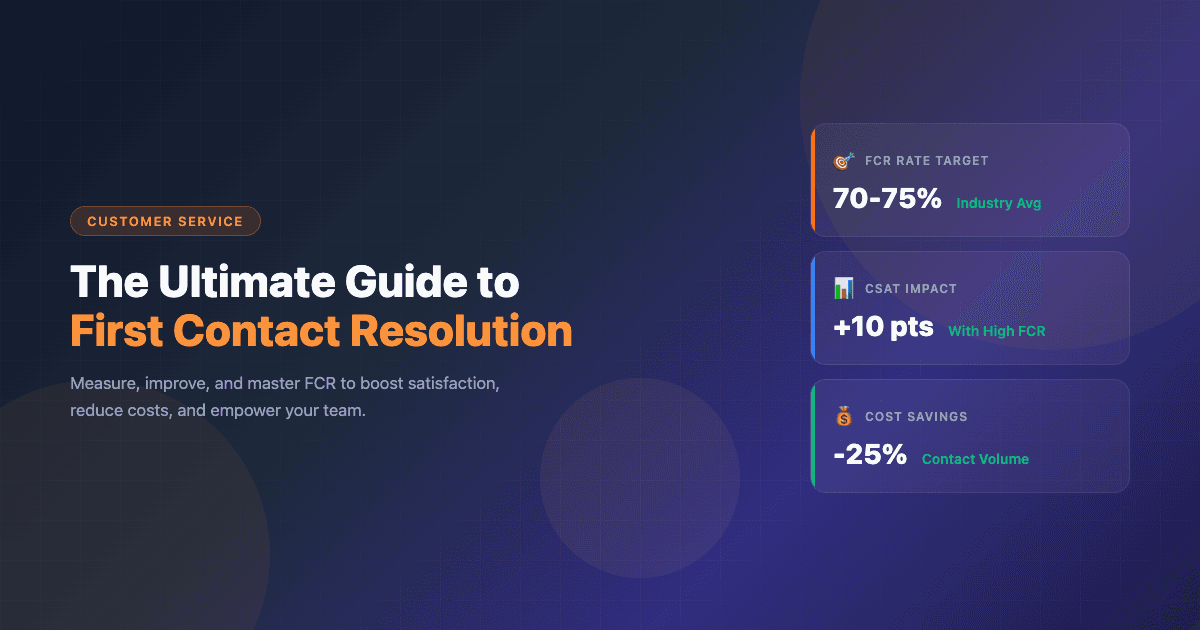
Understanding what constitutes a good FCR rate helps you set realistic targets. According to industry research from organizations like SQM Group, the industry standard benchmark for FCR typically falls between 70% and 75%. World-class call centers and contact centers often achieve FCR rates above 80%. If your FCR rate falls below 70%, there's significant room for improvement. Keep in mind that a high FCR rate doesn't mean perfection—even the best organizations deal with complex issues that legitimately require follow-up.
Key Metrics to Track Alongside FCR
FCR doesn't live in a vacuum. To truly understand its health and impact, you need to monitor it alongside other critical KPIs and customer service metrics. These metrics provide context and help diagnose issues or confirm improvements.
Customer Satisfaction (CSAT): Directly asking customers about their satisfaction after an interaction is paramount. High FCR almost always correlates with high CSAT. If your FCR is high but CSAT is low, it means you're resolving issues quickly, but perhaps not empathetically or completely.
Net Promoter Score (NPS): While a broader measure of loyalty, FCR contributes significantly to a positive overall customer experience, thus influencing NPS. Promoters are often customers who've had consistently positive, efficient interactions.
Customer Effort Score (CES): This metric measures how much effort a customer had to exert to get their issue resolved. A low CES combined with a high FCR rate indicates a truly frictionless experience—customers are getting their problems solved quickly and easily.
Average Handle Time (AHT): This measures the average time an agent spends on an interaction. While lower AHT is generally good, don't chase it at the expense of FCR. Sometimes, taking a little extra time on the first contact to fully resolve an issue prevents multiple, shorter contacts later, leading to a lower total AHT for that customer's problem.
Repeat Contact Rate and Repeat Calls: This is the inverse of FCR. If a customer contacts you multiple times—especially through repeat calls for the same issue—your FCR is low, and your repeat contact rate is high. Tracking this helps identify problematic areas or processes.
Agent Utilization and Adherence: These metrics help you understand if your agents have the capacity and focus to dedicate themselves to thorough, first-contact resolutions. Overworked agents are less likely to achieve FCR.
Transfer Rate: Frequent transfers indicate agents lack the knowledge, tools, or authority to resolve issues. A high transfer rate is a red flag for low FCR potential in any call center.
Cost Per Contact: By resolving issues on the first try, you inherently reduce the overall cost associated with serving a customer. Track this to see the financial benefits of improved FCR.
By analyzing FCR in conjunction with these metrics, you get a holistic view of your service operation's health and can pinpoint areas for improvement more effectively. Together, these key performance indicators paint a comprehensive picture of your contact center's effectiveness.
Decoding the Root Causes: Why Isn't FCR Higher?
Before you can fix something, you need to understand why it's broken. Low FCR isn't usually due to a single culprit but rather a confluence of factors, often stemming from process, people, or technology. Let's shine a light on the common obstacles that prevent companies from achieving high first call resolution in their call center and contact center operations.
Common Obstacles to Achieving High FCR
Think of your customer service system like a complex machine. When FCR is low, there's friction somewhere in the gears.
Inadequate Agent Training and Knowledge Gaps: This is perhaps the most significant hurdle. If your call center agents don't have a deep understanding of your products, services, policies, and internal processes, they simply can't resolve complex issues on the first try. They'll have to escalate, consult, or transfer. Imagine a doctor who only knows basic first aid—they can't perform surgery. Your agents need comprehensive training that goes beyond the basics, equipping them to handle a wide range of scenarios.
Lack of Empowerment and Authority: Even if agents have the knowledge, if they lack the authority to make decisions, issue refunds, adjust accounts, or waive fees, they'll hit a wall. They become information providers rather than problem solvers. This often stems from a fear of abuse or a desire for control, but it cripples FCR. Empowered agents are confident agents, and confident agents resolve issues.
Fragmented Systems and Data Silos: Picture an agent who has to jump between five different systems to find a customer's order history, billing details, and previous interaction notes. It's slow, frustrating, and prone to errors. When customer data is scattered across disparate systems, agents waste valuable time searching rather than resolving. This leads to customers repeating information and agents missing crucial context.
Inefficient Processes and Bureaucracy: Are your internal processes convoluted? Do agents need multiple approvals for simple actions? Does resolving a complex issue require a multi-step workflow that forces callbacks? Overly rigid or inefficient processes are FCR killers. They introduce unnecessary steps, delays, and friction for both the agent and the customer.
Poor Self-Service Options or Misdirection: Sometimes, the problem starts before the customer even reaches an agent. If your self-service options (FAQs, knowledge base, chatbots) are inadequate, outdated, or difficult to navigate, customers will inevitably call for issues they could have resolved themselves. Worse, if your IVR or chatbot misdirects customers to the wrong department, it's an FCR failure from the get-go.
Unclear Communication and Expectations: If the customer's initial query isn't fully understood, or if the agent provides a solution that isn't clear or complete, the customer will likely contact you again. This also applies to internal communication—if there's a disconnect between different departments, an agent might resolve an issue from their perspective, only for it to resurface due to another department's actions.
Over-Reliance on Escalation: If escalation to a specialist or supervisor becomes the default for anything beyond the most basic inquiries, your FCR will suffer. While escalations are sometimes necessary, they should be a last resort, not a first response.
Lack of Post-Interaction Follow-Up or Quality Assurance: Without a robust QA process that reviews interactions for FCR, you won't truly understand why issues aren't being resolved. Were steps missed? Was the customer truly satisfied? Without this feedback loop, the same problems will recur.
Understanding these obstacles is the first step toward dismantling them. Each point represents an opportunity for improvement, a chance to refine your operations and elevate your FCR rate.
Actionable Strategies to Skyrocket Your FCR

Now for the good stuff: how do you actually improve FCR? It's not about a single magic bullet, but a holistic approach that touches every aspect of your customer service ecosystem. Let's break down five key strategies that will empower your customer service team and optimize your processes for stellar FCR.
1. Empower Your Agents: Knowledge is Power (and Solutions)
Your agents are the front lines of your customer experience. To achieve a high FCR rate across your contact center, they need to be fully equipped, not just with scripts, but with deep understanding and the autonomy to act.
Invest in Comprehensive, Ongoing Training: Initial onboarding is just the beginning. Your training programs need to cover not only product knowledge and system navigation but also advanced troubleshooting, active listening skills, empathy, and conflict resolution. Regularly update training with new product features, policy changes, and emerging customer issues. Use role-playing scenarios to prepare agents for complex calls.
Build a Centralized, Dynamic Knowledge Base: This is your agent's lifeline. Create an intuitive, easily searchable knowledge base that houses all the information an agent might need: FAQs, troubleshooting guides, product specs, policy documents, internal process workflows, competitor comparisons, and even best practices for handling specific customer emotions. Critically, this needs to be a living document, constantly updated by a dedicated team based on new information and agent feedback. Make it accessible with just a few clicks.
Grant Authority and Autonomy: This is crucial. If an agent has to ask permission for every minor decision, FCR tanks. Establish clear guidelines for common issues (e.g., "Agents can issue a refund up to $X without manager approval" or "Agents can apply a one-time courtesy credit"). Trust your agents. When they feel trusted and empowered, they become true problem-solvers. This doesn't mean a free-for-all; it means establishing boundaries within which they can operate independently.
Provide Real-Time Support: Sometimes, an agent needs a quick answer on a complex issue. Implement a system for real-time support, such as an internal chat channel where agents can quickly get clarification from supervisors or subject matter experts without putting the customer on hold or transferring them.
2. Streamline Your Processes: Less Friction, More Resolution
Inefficient processes are like speed bumps on the road to FCR. Smooth them out, and you'll see a noticeable difference in your first call resolution rate.
Map Customer Journeys and Identify Friction Points: Don't guess where problems occur; actually map out common customer journeys for various issues. Where do customers typically get stuck? Where do they have to repeat information? What internal handoffs introduce delays? This exercise often reveals surprising bottlenecks. For example, you might discover that a specific return process requires five internal steps, each adding a day, leading to repeat contacts.
Simplify and Automate Workflows: Once you've identified friction points, look for ways to simplify. Can approval steps be reduced? Can data entry be automated? Can a multi-step process be condensed into one? For instance, if an agent needs to update customer information in three different systems, explore integrations or a master data management system to do it once.
Implement Effective Call Routing (and Chat/Email Routing): Ensure customers are directed to the right agent with the right skills from the very first contact. This ties directly into your workforce management and scheduling practices. Use intelligent routing based on the customer's query (often identified via IVR choices, chatbot interactions, or email keywords) and their history. Don't let a sales query end up with a technical support agent.
Establish Clear Escalation Paths (and Minimize Them): While the goal is FCR, some issues will require escalation. Make sure the escalation process is crystal clear, efficient, and leads to a resolution, not another transfer. More importantly, analyze why issues are escalating and address the root causes to reduce their frequency.
3. Leverage Technology Wisely: Tools, Not Crutches
Technology isn't a silver bullet, but when used strategically, it can be a powerful accelerator for FCR in any call center or contact center.
Implement a Robust CRM System: A 360-degree view of the customer is non-negotiable for FCR. Your CRM should consolidate all customer interactions, purchase history, preferences, and previous issue details in one accessible place. This allows agents to quickly understand context without asking repetitive questions, enabling them to dive straight into problem-solving. Building stronger customer relationships starts with having the right data at your fingertips.
Utilize AI-Powered Self-Service: Intelligent chatbots and comprehensive knowledge bases can handle simple, repetitive queries, freeing up agents for more complex issues. A good chatbot can answer FAQs, provide troubleshooting steps, and even guide customers to the right self-service articles. This shifts lower-tier support away from live agents, enabling them to focus on the issues that truly require human intervention and can be resolved on the first contact.
Desktop Automation and Integrations: Automate routine tasks for agents, such as pulling up customer records based on caller ID, pre-filling forms, or generating follow-up emails. Integrate your various systems (CRM, ticketing, billing, knowledge base) so agents don't have to switch between screens or manually copy-paste information. Every second saved searching for data is a second gained for resolving the issue.
Analytics and Reporting Tools: Invest in tools that provide granular data on FCR, repeat contacts, transfer rates, and specific issue types. Use this data — as part of your broader workforce analytics practice — to identify trends, pinpoint recurring problems, and measure the effectiveness of your FCR initiatives. For example, if you see a spike in repeat contacts for a specific product, you know where to focus your training or knowledge base updates.
4. Listen Intently: The Voice of the Customer and Agent
You can't improve what you don't understand. Active listening to both your customers and your agents provides invaluable insights.
Implement Post-Interaction Surveys: As discussed in the metrics section, surveys are critical for gauging customer-reported FCR. Ask directly: "Was your issue fully resolved today?" and "Did you have to contact us multiple times for this issue?" Analyze the feedback to understand why issues weren't resolved.
Analyze Call Recordings and Chat Transcripts: Regularly review a sample of interactions, especially those that didn't result in FCR. What went wrong? Was the agent missing information? Was the process too complex? Was the customer's initial intent misunderstood? This is invaluable for identifying training gaps and process breakdowns. A structured QA program makes this systematic rather than ad hoc.
Create Agent Feedback Loops: Your agents are in the trenches; they know what works and what doesn't. Establish channels for them to provide feedback on processes, tools, training gaps, and customer pain points. Hold regular team meetings dedicated to discussing FCR challenges and brainstorming solutions. They often have the most practical ideas for improvement. For example, an agent might suggest a new knowledge base article for a recurring niche issue.
Root Cause Analysis: For every significant FCR failure, conduct a root cause analysis. Don't just fix the symptom; understand the underlying problem. Was it a policy, a system error, an agent training gap, or a product defect?
5. Foster a Culture of Resolution: Make it a Priority
FCR shouldn't just be a metric; it should be a mindset that permeates your entire customer service organization.
Communicate the "Why": Explain to your agents why FCR is so important—for customer satisfaction, for their own job satisfaction, and for the business's success. When they understand the impact, they'll be more invested.
Lead by Example: Managers and team leads need to model a resolution-oriented approach. They should be supportive, coaching agents on how to resolve rather than just process.
Recognize and Reward FCR Success: Celebrate agents who consistently achieve high FCR. This reinforces the desired behavior and motivates others. Recognition can be monetary, public acknowledgment, or even offering opportunities for more advanced training or responsibilities. Tracking agent performance on FCR helps identify your top performers and uncover coaching opportunities.
Align Incentives: Consider incorporating FCR as a component of agent performance reviews and incentives, but be careful not to make it the only metric. Balancing it with CSAT ensures agents aren't rushing resolutions.
Break Down Silos Between Departments: Many FCR failures occur because different departments aren't aligned. Foster cross-functional collaboration. For instance, if an agent needs information from the shipping department to resolve a customer's missing package inquiry, ensure there's a seamless way to get that information quickly.
Implementing these strategies requires dedication and continuous effort. It's not a one-time fix but an ongoing commitment to improvement.
Real-World Examples: FCR in Action
Let's look at how companies have successfully implemented FCR strategies and the tangible benefits they reaped. These aren't just theoretical ideas; they're proven approaches.
Example 1: Improving FCR with Self-Service and Agent Empowerment
Online retailers often struggle with escalating contact volumes and declining FCR for common issues like order status, returns, and basic troubleshooting. When call center agents are overwhelmed with repetitive questions, they have less time for complex issues, which further lowers FCR.
Effective strategies for this scenario include:
Self-Service Tools: Deploying chatbots or self-service portals trained on knowledge base content, order management data, and FAQs can handle common queries such as real-time order tracking, return processes, and basic troubleshooting.
Seamless Hand-off to Agents: When self-service tools can't resolve an issue, a smooth, context-rich hand-off to a live agent is critical. The agent should receive the full interaction history and any data already collected, so the customer doesn't have to repeat themselves.
Agent Empowerment: For issues that require human attention, agents benefit from enhanced tools and authority, including direct access to relevant systems, a broader range of resolution options, and increased decision-making authority.
Continuous Improvement: Regularly analyzing interactions and agent feedback helps identify gaps in self-service capabilities and areas where agents need more empowerment.
Example 2: Reducing Escalations Through Specialist Roles
B2B software companies often face persistent FCR challenges. Their contact center agents may be knowledgeable but frequently need to escalate issues to tier-2 support or developers, leading to long resolution times and frustrated customers.
Effective strategies for this scenario include:
Specialist Roles: Instead of distinct support tiers, creating a "Resolution Specialist" role with intensive, specialized training in deeper technical troubleshooting can reduce the need for escalation.
Knowledge Base Enrichment: Augmenting the existing knowledge base with direct contributions from engineering and product teams—including troubleshooting steps for common issues, workarounds for known bugs, and clear instructions for advanced configurations—empowers frontline agents.
Expanded System Access: Granting specialists elevated access to customer accounts and product logs allows them to diagnose and fix issues without relying solely on backend teams.
Dedicated Communication Channels: Real-time channels connecting specialists directly with product managers and senior developers enable immediate consultation on critical issues, preventing transfers or prolonged holds.
Agent-Driven Process Improvement: Regular forums where agents present challenging cases, discuss common blockers, and propose improvements help teams continuously improve FCR.
These approaches illustrate that FCR improvement is a strategic imperative that yields positive outcomes when approached thoughtfully.
The Future of FCR: What's Next?
FCR isn't a static metric; it's constantly evolving, driven by advancements in technology and changing customer expectations. Looking ahead, here's what's on the horizon:
Hyper-Personalized AI-Driven Self-Service: Expect AI to become even more sophisticated, moving beyond basic FAQs to truly understand complex customer queries and proactively offer personalized solutions based on individual customer data, past interactions, and current context. Think of AI that can guide a user through a multi-step setup process specific to their device and plan, rather than just providing a generic manual.
Proactive Resolution: The ultimate FCR is resolving an issue before the customer even knows they have one. Predictive analytics will become key, allowing companies to identify potential problems (e.g., a service outage affecting specific customers, a delivery delay) and proactively communicate solutions or updates, often through automated channels.
Integrated Omnichannel Experiences: The lines between channels will continue to blur. FCR will mean a seamless resolution journey across voice, chat, email, social media, and self-service, with context effortlessly flowing between them. A customer starting a query on a chatbot might seamlessly transition to a video call with an agent, who has all the prior context at their fingertips.
Emotional AI and Empathy-Driven Resolution: AI will likely evolve to better understand customer sentiment and emotional states, allowing for more empathetic responses and tailoring resolution strategies based on the customer's frustration level. This means not just solving the problem, but solving it in a way that truly delights the customer.
Augmented Agent Intelligence: Agents won't be replaced, but rather augmented by AI. This could include real-time sentiment analysis during calls, suggestions for the next best action, or even automatically drafting responses. This empowers agents to achieve FCR faster and more effectively by providing instant access to relevant information and reducing cognitive load.
Focus on Outcome-Based FCR: The emphasis will shift from simply "resolving the interaction" to "resolving the customer's underlying need and achieving their desired outcome." This requires a deeper understanding of customer intent and ensuring that the solution provided truly addresses their long-term goal, not just the immediate symptom.
The future of FCR is exciting, promising even greater efficiency and customer delight. It will require companies to continually adapt, invest in smart technology, and most importantly, keep the customer at the very center of their strategy.
Ready to Transform Your Customer Service with FCR?
You've now got the map, the compass, and a deep understanding of the terrain. Improving First Contact Resolution isn't just about tweaking a single metric; it's about fundamentally rethinking how you serve your customers and empower your team. It's a journey that requires commitment, investment, and a relentless focus on the customer.
By systematically addressing agent training, streamlining processes, leveraging technology wisely, and, crucially, listening to both your customers and your agents, you can unlock significant gains. You'll not only see your FCR numbers climb but also experience a ripple effect of higher customer satisfaction, more engaged employees, and a more efficient, profitable operation. FCR connects directly to every other contact center metric — improving it lifts the entire call center operation.
Start small, pick one or two areas from this guide that resonate most with your current challenges, and begin implementing change. Measure your progress, learn from your experiments, and iterate. The path to FCR mastery is continuous, but the rewards are profound. Your customers will thank you, and your business will thrive. Now, go forth and resolve!