

Overtime Calculator
Calculate overtime pay for hourly and salaried employees. Supports federal FLSA weekly overtime (1.5x) and California daily overtime with double-time (2x) rates.
Calculate Overtime Pay →Calculate overtime based on total weekly hours exceeding the threshold (default 40 hours under FLSA).
Regular Hours
40
$1,000.00
Overtime Hours (1.5x)
5
$187.50
Total Gross Pay
$1,187.50
45 total hours at $25.00/hr
5 overtime hours at $37.50/hr (1.5x rate)
Tracking overtime by hand? HiveDesk logs hours automatically and flags overtime so payroll stays accurate.
Track it automatically →What Is Overtime Work?
Overtime work is defined as any hours worked beyond the standard working hours. Generally, the standard working hours are 40 hours per week, though this may vary depending on the job and the state. Overtime is paid at a higher rate than the regular rate, to compensate for the extra hours worked.
For any business, managing employee overtime is one of the most important and challenging tasks. Keeping track of the amount of hours worked, allocating overtime pay, and ensuring compliance with labor regulations can be overwhelming.
An overtime calculator takes all the guesswork out of managing overtime, allowing employers and HR managers to quickly and accurately calculate overtime pay. The ability to quickly calculate overtime pay is essential for any business looking to stay compliant with labor regulations and maximize the efficiency of their payroll.
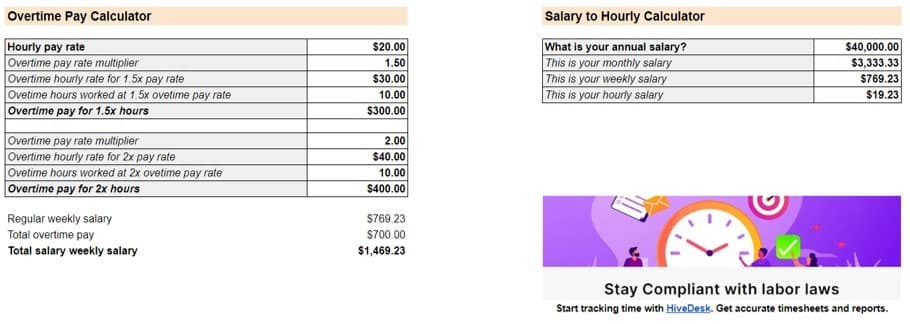
Overtime Pay Spreadsheet Template
Need to calculate overtime for multiple employees? Our Google Sheets template supports both 1.5x and 2x pay rates. Copy it to your Google Drive and use it for your entire team.
Overtime Pay Rules in the USA
The US overtime pay rule states that all workers must be paid time-and-a-half for any hours worked over 40 in one workweek. This means that any non-exempt employee who works more than 40 hours in one week must be compensated at 1.5 times their regular rate of pay.
Employers must also pay overtime to part-time employees, seasonal employees, and temporary employees, so long as they fall under the non-exempt category and work more than 40 hours within the one-week period.
FLSA Overtime Formula
Regular Pay = Regular Hours (up to 40) x Hourly Rate
Overtime Pay = Overtime Hours x (Hourly Rate x 1.5)
Total Gross Pay = Regular Pay + Overtime Pay
Example: An employee earning $20/hr who works 48 hours earns $800 regular pay (40 x $20) + $240 overtime pay (8 x $30) = $1,040 total.
Calculating Overtime for Hourly vs Salaried Employees
Non-Salaried (Hourly) Employees
To calculate overtime pay for hourly employees, first determine the employee's regular rate of pay by dividing total earnings by total hours worked during the pay period. Then pay 1.5 times this rate for any hours over 40 during a workweek.
Employers must also ensure they are paying the correct minimum wage, as overtime pay cannot be below the applicable minimum wage. It is important to keep accurate records of employee hours to ensure compliance with the Fair Labor Standards Act.
Salaried Employees
Generally, salaried employees are exempt from overtime pay. However, there are situations where a salaried employee may be entitled to overtime — particularly if they earn below the FLSA salary threshold or do not perform exempt job duties.
To calculate overtime for eligible salaried employees, first determine the hourly rate by dividing the weekly salary by 40. Then apply the 1.5x overtime rate for hours worked over 40 in a workweek.
California Overtime Rules
California requires employers to pay at least 1.5 times the regular rate of pay for any hours worked beyond 8 in a day or 40 in a week. This applies to all non-exempt employees, regardless of the type of industry or occupation.
The overtime pay rate is double the employee's regular rate of pay for all hours worked in excess of 12 in any workday and for all hours worked in excess of 8 on the seventh consecutive day of work in a workweek.
| Hours Worked | Pay Rate |
|---|---|
| Up to 8 hours/day (or 40/week) | Regular rate (1x) |
| Over 8 hours/day (up to 12) | 1.5x regular rate |
| Over 12 hours/day | 2x regular rate (double-time) |
| Over 40 hours/week | 1.5x regular rate |
| 7th consecutive day (first 8 hrs) | 1.5x regular rate |
| 7th consecutive day (over 8 hrs) | 2x regular rate |
Who Is Eligible for Overtime Pay?
Under the Fair Labor Standards Act, most employees are eligible for overtime pay if they work more than 40 hours in a single workweek. Exceptions apply to employees who are exempt due to their job duties or salaried workers classified as “exempt.”
Non-Exempt (Eligible for OT)
- Hourly employees
- Salaried employees below the salary threshold
- Workers without executive, administrative, or professional duties
Exempt (Not Eligible for OT)
- Salaried employees above the threshold
- Executive, administrative, or professional roles
- Outside sales and certain computer professionals
Track Overtime Automatically with HiveDesk
Manual overtime tracking leads to errors, compliance risk, and payroll disputes. HiveDesk tracks overtime automatically by recording all employee hours in real time and generating accurate timesheets.
- Automatic time tracking across desktop, mobile, and browser
- Real-time overtime hour tracking and alerts
- Accurate timesheets with manager approval workflow
- Attendance and shift schedule adherence tracking
- Export data for payroll processing
All for $5/user/month with every feature included. Start a free 14-day trial— no credit card required.
Frequently Asked Questions
Common questions about overtime pay calculations and compliance.
Under the Fair Labor Standards Act, non-exempt employees must be paid 1.5 times their regular hourly rate for all hours worked over 40 in a workweek. The regular rate is calculated by dividing total earnings by total hours worked during the pay period.
California requires employers to pay 1.5 times the regular rate for hours worked beyond 8 in a day or 40 in a week. Double-time (2x the regular rate) applies for hours worked in excess of 12 in any workday and for hours worked beyond 8 on the seventh consecutive day of work in a workweek.
Employees classified as exempt under the FLSA are not entitled to overtime. This typically includes executive, administrative, professional, outside sales, and certain computer-related positions. Exemption requires meeting both a minimum salary threshold and specific job duty requirements.
It depends on their classification. Salaried employees who earn below the FLSA salary threshold or who do not perform exempt job duties (executive, administrative, professional) are still entitled to overtime pay. Being paid a salary alone does not make an employee exempt.
No. Under the FLSA, employers must pay overtime for all hours worked over 40 per week, regardless of whether the overtime was authorized in advance. Employers can discipline employees for working unauthorized overtime, but they still must pay for the hours worked.
Federal (FLSA) overtime is calculated on a weekly basis only. Some states like California and Alaska also calculate overtime on a daily basis. When federal and state laws differ, the rule that is more favorable to the employee applies. Always check your specific state labor laws.
When an employee works at different pay rates during the same workweek, overtime is calculated using the weighted average of all rates. The weighted average is total straight-time pay divided by total hours worked. Overtime is then paid at 1.5 times this blended rate.
Time tracking software like HiveDesk automatically records all hours worked, flags when employees approach or exceed overtime thresholds, and generates accurate timesheets. This reduces compliance risk from manual tracking errors and ensures overtime is calculated and paid correctly every pay period.
Related Resources
Overtime Tracker
Automatically track and manage employee overtime hours.
Interactive Overtime Calculator
Web-based calculator with federal and California rules.
FLSA Overtime Compliance Guide
Complete guide to federal overtime rules and exemptions.
US State Overtime Pay Laws
State-by-state overtime pay rules and regulations.
Overtime Policy Template
Downloadable overtime policy template for your business.
Hourly Rate Calculator
Convert annual salary to hourly rate and back.
Ready to Get Started?
Join teams worldwide who trust HiveDesk for workforce management, time tracking, and employee monitoring. $5/user/month, all features included.