Minimum Wage by State in 2026 — All 50 States + Federal

Minimum Wage by State — Quick Answer
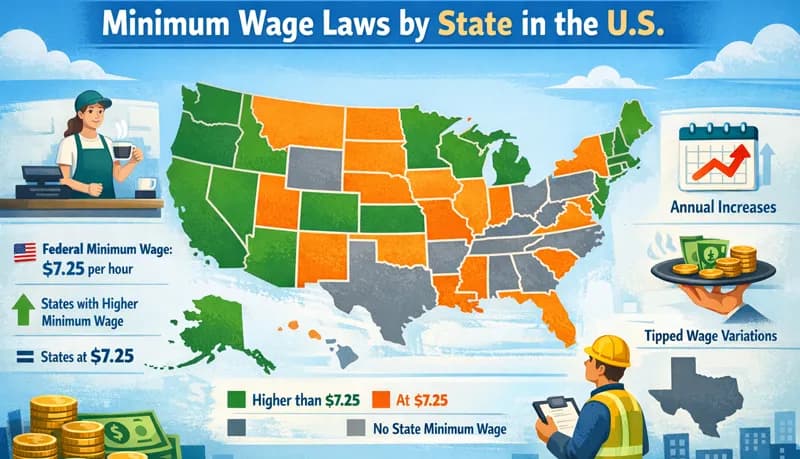
The federal minimum wage is $7.25 per hour (unchanged since 2009). As of 2026, 30 states plus Washington D.C. have minimum wages above the federal rate. When state and federal rates differ, employers must pay whichever is higher. The highest state minimum wages are in Washington ($16.66/hr), California ($16.50/hr), and New York ($16.50/hr in New York City). Five states — Alabama, Louisiana, Mississippi, South Carolina, and Tennessee — have no state minimum wage law and default to the federal rate.
When federal and state minimum wage rates differ, the employer must pay the higher of the two. This is the fundamental rule, and it applies in every situation — if your state's minimum wage is $15.00 and the federal minimum is $7.25, you pay $15.00. If your state has no minimum wage law or sets a rate below federal, you pay the federal rate.
For call centers and BPOs with employees across multiple states, this means tracking different rates in every state where agents work. Automated time tracking software helps ensure every hour is recorded at the correct rate. A remote workforce spread across 10 states may be subject to 10 different minimum wage rates — and some states have local minimums that go higher still.
Federal minimum wage
The FLSA baseline
The Fair Labor Standards Act (FLSA) sets the federal minimum wage at $7.25 per hour, a rate that has been unchanged since July 2009. The FLSA applies to employers with annual gross sales of $500,000 or more, or to employees engaged in interstate commerce — which covers virtually all call center and BPO operations.
Tipped employees under federal law
The FLSA allows employers to pay a reduced cash wage of $2.13 per hour to tipped employees, provided that the employee's tips bring their total hourly earnings to at least $7.25. This is called a "tip credit." If tips do not bring the employee's total earnings to the minimum wage, the employer must make up the difference.
A tipped employee under the FLSA is one who regularly receives more than $30 per month in tips. Call center agents generally are not tipped employees, but this matters for BPOs that handle reservation lines, concierge services, or other roles where tips may be involved.
Youth minimum wage
The FLSA permits employers to pay $4.25 per hour to employees under 20 years old during their first 90 consecutive calendar days of employment. After 90 days, or when the employee turns 20, the regular minimum wage applies.
Penalties
Employers who violate the FLSA's minimum wage requirements face:
- Back pay for the full amount of underpayment
- Liquidated damages equal to the back pay amount (effectively doubling the liability)
- Civil penalties up to $2,451 per violation (adjusted annually for inflation)
- Criminal penalties for willful violations — fines up to $10,000 and imprisonment for repeat offenders
State minimum wage rates
The following table lists minimum wage rates by state. Many states adjust rates annually based on inflation (CPI indexing) — rates shown are approximate and employers should verify current rates with their state's department of labor.
States above the federal minimum
| State | Minimum wage | Tipped minimum | Tip credit allowed | Notes |
|---|---|---|---|---|
| Alaska | $11.73 | $11.73 | No | CPI-indexed annually |
| Arizona | $14.35 | $11.35 | Yes ($3.00 credit) | CPI-indexed |
| Arkansas | $11.00 | $2.63 | Yes | |
| California | $16.00 | $16.00 | No | No tip credit; some cities higher |
| Colorado | $14.42 | $11.40 | Yes ($3.02 credit) | CPI-indexed |
| Connecticut | $16.35 | $6.38 | Yes | |
| Delaware | $13.25 | $2.23 | Yes | |
| Florida | $13.00 | $9.98 | Yes ($3.02 credit) | Increasing $1/year to $15 by 2026 |
| Hawaii | $14.00 | $12.75 | Yes ($1.25 credit) | |
| Illinois | $14.00 | $8.40 | Yes | |
| Maine | $14.15 | $7.08 | Yes (50% of minimum) | CPI-indexed |
| Maryland | $15.00 | $3.63 | Yes | |
| Massachusetts | $15.00 | $6.75 | Yes | |
| Michigan | $10.56 | $3.84 | Yes | Restored Earned Sick Time Act may affect rate schedule |
| Minnesota | $11.13 | $11.13 | No | Large employer rate; small employer $9.08; CPI-indexed |
| Missouri | $13.75 | $6.88 | Yes (50% of minimum) | Increasing to $15 by 2026 |
| Montana | $10.55 | $10.55 | No | For businesses with gross sales over $110K; CPI-indexed |
| Nebraska | $13.50 | $2.13 | Yes | Increasing to $15 by 2026 |
| Nevada | $12.00 | $12.00 | No | Single rate since 2024 (previously had two-tier system) |
| New Jersey | $15.49 | $5.26 | Yes | CPI-indexed; seasonal/small employers may have lower rate |
| New Mexico | $12.00 | $3.00 | Yes | |
| New York | $15.00–$16.00 | Varies by region | Yes | NYC and some counties higher; statewide increasing |
| Ohio | $10.45 | $5.25 | Yes | CPI-indexed; employers with gross receipts under $394K may pay federal |
| Oregon | $14.70 (standard) | $14.70 | No | Portland metro: $15.95; non-urban: $13.70; CPI-indexed |
| Rhode Island | $14.00 | $3.89 | Yes | |
| South Dakota | $11.20 | $5.60 | Yes (50% of minimum) | CPI-indexed |
| Vermont | $13.67 | $6.84 | Yes (50% of minimum) | CPI-indexed |
| Virginia | $12.41 | $2.13 | Yes | |
| Washington | $16.66 | $16.66 | No | Highest statewide rate; CPI-indexed; Seattle higher |
| Washington DC | $17.50 | $10.00 | Yes | CPI-indexed |
| West Virginia | $8.75 | $2.62 | Yes | Applies to employers with 6+ employees |
States at the federal minimum ($7.25)
These states either match the federal rate or have no state minimum wage law. The federal FLSA rate of $7.25 per hour applies:
| Category | States |
|---|---|
| No state minimum wage law | Alabama, Louisiana, Mississippi, South Carolina, Tennessee |
| State rate set below federal (federal rate applies) | Georgia ($5.15), Wyoming ($5.15) |
| State rate equals federal | Idaho, Indiana, Iowa, Kansas, Kentucky, New Hampshire, North Carolina, North Dakota, Oklahoma, Pennsylvania, Texas, Utah, Wisconsin |
States with no tip credit
In most states, employers can take a "tip credit" — paying tipped employees a lower cash wage and counting tips toward the minimum wage. However, seven states prohibit tip credits entirely, meaning tipped employees must be paid the full state minimum wage before tips:
Alaska, California, Minnesota, Montana, Nevada, Oregon, Washington
This is relevant for BPOs that handle hospitality, travel, or food service call center work where agents may occasionally receive tips from customers.
Local minimum wages
Many cities and counties set minimum wages higher than their state's rate. These local rates apply to all employees working within the jurisdiction — including remote workers if the employer is located there.
| Jurisdiction | Minimum wage (approximate) | Notes |
|---|---|---|
| Seattle, WA | $20.76 | Large employers (500+ employees) |
| SeaTac, WA | $19.71 | Hospitality/transportation workers |
| San Francisco, CA | $18.67 | CPI-indexed |
| San Jose, CA | $17.55 | CPI-indexed |
| Los Angeles, CA | $16.78 | Matches CA rate + CPI |
| New York City | $16.00 | All employers |
| Denver, CO | $18.29 | CPI-indexed |
| Portland, OR | $15.95 | Oregon's Portland metro rate |
| Minneapolis, MN | $15.57 | Large employers |
| Chicago, IL | $16.20 | Large employers (21+ employees) |
| Flagstaff, AZ | $17.40 | CPI-indexed |
This is not exhaustive — dozens of cities have their own minimums. Employers must check local ordinances for every jurisdiction where employees work.
Scheduled increases
Several states have enacted legislation that automatically increases the minimum wage on a fixed schedule or by CPI indexing:
Fixed schedule increases:
- Florida — $1.00 per year increase until $15.00 in September 2026
- Missouri — increasing to $15.00 by January 2026
- Nebraska — increasing to $15.00 by 2026
CPI-indexed annual adjustments (rate adjusts automatically each January based on consumer price index): Alaska, Arizona, California (starting 2025), Colorado, Maine, Minnesota, Missouri (after reaching $15), Montana, Nevada, New Jersey, Ohio, Oregon, South Dakota, Vermont, Washington
CPI-indexed states can see rates increase every year without legislative action. Employers must check updated rates each January and adjust payroll accordingly.
Compliance for multi-state employers
Which rate applies
For employees who work in a single state, the rule is straightforward: pay the higher of the federal or state minimum wage (and local, if applicable).
For BPOs and call centers with remote agents, the rate is generally determined by where the work is performed — not where the employer is headquartered. An agent working from home in Washington ($16.66/hour) for a call center headquartered in Texas ($7.25/hour) must be paid the Washington rate.
Common compliance mistakes
Applying the headquarters rate to all employees. A call center in Kentucky paying $7.25/hour to remote agents in California ($16.00) is violating California law. Each employee must be paid according to the laws of the state (and city) where they work.
Missing local minimum wages. An employer correctly paying Colorado's $14.42 rate to an agent in Denver is still non-compliant — Denver's minimum is $18.29. Local rates are easy to overlook, especially in states where dozens of cities have their own minimums.
Not updating rates on January 1. States with CPI-indexed rates announce new rates in the fall, effective January 1. If payroll is not updated, every paycheck in January is a violation. Build an annual rate review into your payroll calendar, and use timesheet software to verify that updated rates are applied correctly across all locations.
Ignoring the tip credit obligation to make up the difference. In states that allow tip credits, employers must track whether tips actually bring total earnings to the minimum wage — for every pay period. If they do not, the employer must make up the shortfall. Simply paying the tipped minimum and assuming tips cover the rest is not compliant.
Not accounting for training time. Paid training hours count as hours worked and must be compensated at minimum wage (or more). A call center that runs a 4-week paid training program must pay trainees at least the applicable minimum wage for all training hours, including classroom time.
Payroll impact
The cost difference between states is substantial. For a 100-agent operation paid at minimum wage:
| State rate | Hourly cost (100 agents) | Annual labor cost (wages only, 2,080 hrs/agent) |
|---|---|---|
| $7.25 (federal) | $725/hr | $1,508,000 |
| $12.00 | $1,200/hr | $2,496,000 |
| $15.00 | $1,500/hr | $3,120,000 |
| $16.66 (Washington) | $1,666/hr | $3,465,280 |
The difference between operating in a $7.25 state and a $16.66 state is $1.96 million per year in wages alone for 100 agents — before benefits, payroll taxes, and overhead. This is why site location decisions in BPO scaling are heavily influenced by local wage rates.