Managing Workplace Conflicts — Resolving Disputes Early

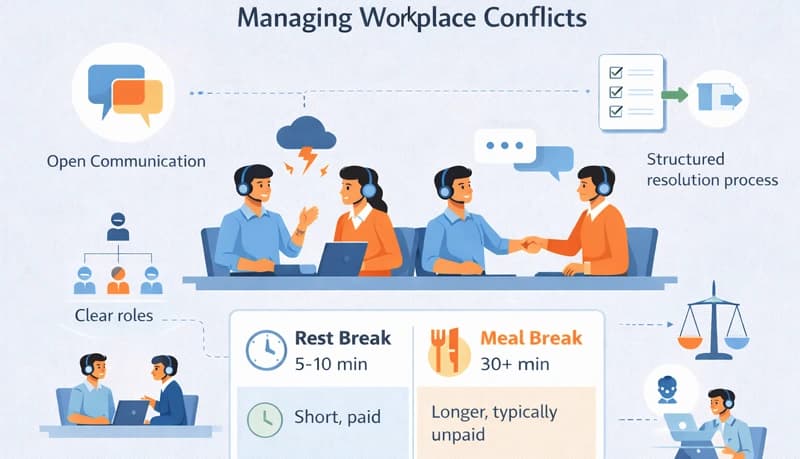
Most workplace conflicts are not personality clashes. They are the result of unclear expectations, poorly defined roles, uneven workload distribution, or broken communication. When two people disagree about who owns a task, when someone feels they are doing more than their share, or when a decision gets made without the right people in the room — that is a structural problem, not a personal one.
The instinct to label conflicts as "personality issues" is counterproductive because it makes the problem seem unsolvable. You cannot change someone's personality. But you can clarify who owns what, fix a process that creates friction, or address a workload imbalance. Tools like a call center management solution with clear task assignments and time tracking reduce the ambiguity that breeds conflict in the first place. Most conflicts dissolve once the underlying cause is resolved.
Why conflicts escalate
Conflicts rarely start as major disputes. They start as small frustrations that go unaddressed:
- Someone's work is repeatedly overwritten or ignored in a review
- A team member consistently misses deadlines, creating pressure on everyone else
- Two people have different interpretations of a decision that was never formally documented
- Someone feels excluded from meetings where decisions about their work are made
- Workloads shift unevenly and the people absorbing extra work feel unrecognized
These irritations accumulate. By the time someone raises a conflict formally, weeks or months of frustration have hardened into resentment. At that point, it is harder to resolve because the original cause is buried under layers of emotional weight.
The single most effective thing a manager can do is address friction early — when it is still a small misunderstanding rather than an entrenched grievance.
Common sources of workplace conflict
Unclear roles and responsibilities
When two people think they own the same decision, or when nobody owns it, conflict is inevitable. This is especially common in growing teams where roles evolve faster than documentation, or in remote teams where informal boundaries are harder to observe.
Fix it: Write down who is responsible for what. Not in vague terms — specify who makes the final call on specific types of decisions. When a new project starts, clarify ownership explicitly rather than assuming everyone knows.
Uneven workload distribution
Few things create resentment faster than watching a colleague coast while you are overwhelmed. This often happens not because anyone is deliberately shirking, but because workload is invisible — managers do not know how much each person is actually doing.
Fix it: Make workload visible. Use task tracking and time tracking data to understand who is carrying what. Redistribute proactively rather than waiting for someone to complain.
Poor communication about decisions
Conflict frequently stems from decisions that were communicated poorly or not at all. Someone learns about a change through a side conversation. A deadline moves without notification. A priority shifts and half the team does not know.
Fix it: Decisions should be documented and communicated to everyone they affect. Use a consistent channel (a shared document, a project update, a team standup) so people know where to look for decisions and do not have to rely on hallway conversations.
Competing priorities
When people work on multiple projects or serve multiple stakeholders, they inevitably face situations where demands conflict. Without clear priority frameworks, they make their best guess — and that guess often conflicts with what someone else expects.
Fix it: Establish explicit priority order for competing demands. When conflicts arise, escalate priority decisions to a single owner who can arbitrate rather than leaving individuals to navigate competing requests on their own.
Interpersonal friction
Sometimes the issue genuinely is that two people do not communicate well with each other. Different working styles, communication preferences, or approaches to feedback can create real friction — even when neither person is doing anything wrong.
Fix it: This is the one category where structural fixes alone may not work. Address it directly with both parties, focusing on specific behaviors rather than personality traits. "When you send one-word replies to detailed questions, it comes across as dismissive" is addressable. "You two just have different personalities" is not.
How to handle a conflict conversation
When you need to address a conflict directly, the structure of the conversation matters. Most managers either avoid these conversations entirely or handle them badly by taking sides prematurely.
Step 1: Talk to each person separately first
Before bringing people together, understand each person's perspective individually. Ask:
- What specifically is the problem from your point of view?
- When did this start?
- What have you already tried to resolve it?
- What outcome would you consider fair?
Listen without judging or problem-solving in the moment. Your goal is to understand both sides fully before intervening.
Step 2: Identify the structural cause
After hearing both sides, look for the structural issue underneath the interpersonal complaint. In most cases, you will find one of the sources listed above — unclear ownership, uneven workload, a communication gap, or competing priorities.
Step 3: Bring both parties together (if appropriate)
Not every conflict requires a face-to-face conversation. If the issue is a process problem, you can fix it without a joint meeting. But when the conflict involves how two people interact, bringing them together is usually necessary.
When facilitating:
- State the problem as you understand it (neutrally, without attributing blame)
- Let each person share their perspective without interruption
- Focus on the specific situation and behaviors, not character judgments
- Identify what each person needs going forward
- Agree on concrete next steps — not vague commitments like "communicate better," but specific actions like "tag the other person on the ticket before reassigning it"
Step 4: Follow up
Check in with both parties within a week. Ask whether the agreed-upon changes are working. If the situation has not improved, escalate the structural fix — change the process, adjust reporting lines, or involve HR.
Most managers skip this step, which is why the same conflicts resurface repeatedly.
Conflicts in remote and hybrid teams
Remote work adds specific dynamics that increase conflict risk:
Tone misinterpretation. Written messages lack vocal tone and body language. A blunt Slack message that would be fine in person can read as hostile in text. People develop negative narratives about each other based on communication style rather than intent.
Visibility imbalance. In hybrid teams, people in the office have more casual access to managers and decision-makers. Remote workers may feel left out of conversations or passed over for opportunities — not because of deliberate exclusion, but because proximity creates advantages.
Timezone friction. When teams span time zones, people in later zones often feel like decisions are made before their day starts. This creates a power imbalance that breeds resentment over time.
Reduced informal interaction. In-person teams resolve minor friction through casual conversation — a quick clarification at someone's desk, a comment over coffee. Remote teams lack these low-effort conflict resolution moments, so small misunderstandings persist longer.
What helps:
- Default to video for difficult conversations — do not handle conflict over chat or email
- Over-communicate decisions and the reasoning behind them, especially when they affect remote team members who were not in the room
- Rotate meeting times for global teams so the same timezone does not always bear the inconvenience
- Create explicit norms around response times and communication channels so people do not interpret a delayed response as disrespect
When to involve HR
Not every conflict needs HR involvement. Most should be resolved between the individuals involved, with manager support if needed. But some situations require formal intervention:
- Harassment or discrimination — Any conflict that involves protected characteristics (race, gender, age, disability, etc.) must go to HR immediately, regardless of perceived severity
- Retaliation — If someone reports a problem and then experiences negative consequences, that is an HR matter
- Repeated unresolved conflicts — If the same conflict keeps resurfacing despite managerial intervention, HR should assess whether there is a deeper issue
- Policy violations — If the conflict involves breaking company rules or policies
- Threats or intimidation — Any behavior that makes someone feel physically or psychologically unsafe
Document conflicts from the beginning — dates, what was discussed, what was agreed, what happened afterward. If a situation eventually requires formal action, having a documented history is far more useful than relying on memory.
What not to do
Do not ignore it. Hoping a conflict will resolve itself rarely works. Unaddressed conflicts get worse, not better, and they spread — other team members get pulled in, take sides, and the problem multiplies.
Do not take sides prematurely. Even if one person's account sounds more reasonable, you are hearing only one perspective. Reserve judgment until you understand both sides.
Do not mandate that people "just get along." This is not actionable. People need specific, concrete changes — not vague directives about teamwork.
Do not punish both parties equally. If one person is clearly in the wrong, treating both parties the same feels deeply unfair to the person who raised a legitimate concern. It also discourages people from raising issues in the future.
Do not use team-building activities as conflict resolution. A team outing does not fix unclear role definitions, unfair workload distribution, or broken communication processes. Address the root cause directly.