Tax Withholding for Employers — Federal and State Reference

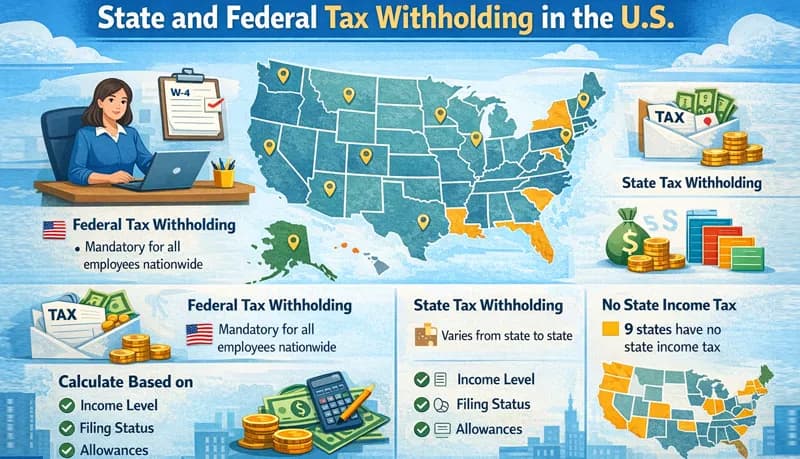
Employers are legally required to withhold taxes from employee wages and remit them to the appropriate government agencies. This applies to federal income tax, Social Security and Medicare (FICA), and — in most states — state income tax. Getting it wrong results in penalties, interest, and personal liability for responsible individuals within the company.
For call centers and BPOs with large hourly workforces, withholding compliance is operationally significant. High turnover means constant onboarding of new employees, each requiring correct W-4 processing. Remote work arrangements create multi-state withholding obligations. And the volume of payroll transactions — hundreds of employees paid weekly or biweekly — means that deposit schedule errors compound quickly. Reliable employee time tracking is the first step — accurate hours data feeds every downstream payroll and withholding calculation.
Federal tax withholding
What employers must withhold
Every employer paying wages to employees must withhold three categories of federal tax:
| Tax | Rate | Wage base (2024) | Employer match |
|---|---|---|---|
| Federal income tax | Varies by W-4 and wages | No limit | No |
| Social Security (OASDI) | 6.2% | $168,600 | Yes — 6.2% |
| Medicare | 1.45% | No limit | Yes — 1.45% |
| Additional Medicare | 0.9% on wages over $200,000 | N/A | No |
Federal income tax withholding is calculated using the employee's Form W-4, their filing status, and the IRS withholding tables (Publication 15-T). The 2020 W-4 redesign eliminated withholding allowances — employees now report filing status, multiple jobs, dependents, and additional withholding amounts.
FICA taxes (Social Security + Medicare) are split equally between employer and employee. The employer withholds the employee's share and pays the matching employer share. Total FICA cost per employee is 15.3% of wages up to the Social Security wage base, then 2.9% (Medicare only) above it.
Deposit schedules
The IRS assigns employers to one of two deposit schedules based on total tax liability reported on Form 941 during a lookback period:
| Schedule | Threshold | Deposit deadline |
|---|---|---|
| Monthly | $50,000 or less in lookback period | 15th of the following month |
| Semi-weekly | More than $50,000 in lookback period | Wednesday or Friday following payday (depends on pay date) |
| Next-day | $100,000+ accumulated on any day | Next business day |
New employers default to the monthly schedule. Deposits are made electronically through the Electronic Federal Tax Payment System (EFTPS).
Reporting requirements
| Form | What it reports | Deadline |
|---|---|---|
| Form 941 | Quarterly wages, tips, withholding, and FICA | Last day of the month following the quarter |
| Form W-2 | Annual wages and withholding per employee | January 31 (to employees and SSA) |
| Form W-3 | Summary transmittal of all W-2s | January 31 (to SSA) |
| Form 940 | Annual federal unemployment tax (FUTA) | January 31 |
Penalties for non-compliance
| Violation | Penalty |
|---|---|
| Late deposit (1–5 days) | 2% of unpaid tax |
| Late deposit (6–15 days) | 5% |
| Late deposit (16+ days) | 10% |
| Late deposit (10+ days after first IRS notice) | 15% |
| Failure to file Form 941 | 5% per month, up to 25% |
| Trust fund recovery penalty | 100% of unpaid withholding — assessed personally against responsible individuals |
The trust fund recovery penalty (IRC Section 6672) is the most serious risk. Officers, directors, and payroll managers who are responsible for collecting and remitting withholding taxes can be held personally liable for the full amount — even if the business is a corporation or LLC. This liability survives bankruptcy.
State income tax withholding
States with no income tax
Nine states do not impose a state income tax on wages. Employers in these states have no state withholding obligation:
Alaska, Florida, Nevada, New Hampshire, South Dakota, Tennessee, Texas, Washington, Wyoming
New Hampshire and Tennessee historically taxed interest and dividend income but not wages — New Hampshire's tax on interest and dividends was fully phased out as of January 1, 2025. Tennessee's was eliminated in 2021. Neither state has ever required wage withholding.
Employers in these states still must comply with all federal withholding requirements and may have other state payroll taxes (unemployment insurance, disability insurance, paid family leave) that require registration and deposits.
How state withholding works
The remaining 41 states (plus the District of Columbia) require employers to withhold state income tax from employee wages. The process follows the same general pattern in every state:
- Employee completes a state withholding form (equivalent of the federal W-4) indicating filing status, exemptions, and any additional withholding
- Employer calculates withholding using the state's published withholding tables or formulas, applied to the employee's wages
- Employer deposits withheld taxes on a schedule determined by the total amount withheld (monthly, quarterly, or more frequently for large employers)
- Employer files periodic returns (quarterly or monthly) reporting wages paid and taxes withheld
- Employer files an annual reconciliation summarizing the year's withholding and transmitting state copies of W-2s
State withholding forms
Most states have their own withholding form that employees must complete. Some states accept the federal W-4 in lieu of a state form.
| State | Withholding form | Notes |
|---|---|---|
| Alabama | Form A-4 | |
| Arizona | Form A-4 | Employee selects a withholding percentage |
| Arkansas | Form AR4EC | |
| California | Form DE 4 | Required — does not accept federal W-4 |
| Colorado | Form DR 0004 | |
| Connecticut | Form CT-W4 | |
| Delaware | Accepts federal W-4 | |
| Georgia | Form G-4 | |
| Hawaii | Form HW-4 | |
| Idaho | Form ID W-4 | |
| Illinois | Form IL-W-4 | Flat rate state — 4.95% |
| Indiana | Form WH-4 | Flat rate state — 3.05% plus county tax |
| Iowa | Form IA W-4 | |
| Kansas | Form K-4 | |
| Kentucky | Form K-4 | Flat rate state — 4.0% |
| Louisiana | Form L-4 | |
| Maine | Form W-4ME | |
| Maryland | Form MW507 | County tax also applies |
| Massachusetts | Form M-4 | Flat rate state — 5.0% (plus 4% surtax on income over $1M) |
| Michigan | Form MI-W4 | Flat rate state — 4.25% plus local city tax in some jurisdictions |
| Minnesota | Form W-4MN | |
| Mississippi | Form 89-350 | |
| Missouri | Form MO W-4 | |
| Montana | Form MW-4 | |
| Nebraska | Form W-4N | |
| New Jersey | Form NJ-W4 | |
| New Mexico | Accepts federal W-4 | |
| New York | Form IT-2104 | NYC residents have additional city tax |
| North Carolina | Form NC-4 | Flat rate state — 4.5% |
| North Dakota | Accepts federal W-4 | |
| Ohio | Form IT 4 | Municipal income tax also applies in many cities |
| Oklahoma | Form OK-W-4 | |
| Oregon | Form OR-W-4 | No sales tax — income tax rates are higher |
| Pennsylvania | Form PA-W4 | Flat rate state — 3.07% plus local earned income tax |
| Rhode Island | Form RI W-4 | |
| South Carolina | Form SC W-4 | |
| Utah | Form TC-40W | |
| Vermont | Form W-4VT | |
| Virginia | Form VA-4 | |
| West Virginia | Form WV/IT-104 | |
| Wisconsin | Form WT-4 | |
| District of Columbia | Form D-4 |
States with flat income tax rates
Several states use a flat income tax rate rather than graduated brackets, which simplifies withholding calculation:
| State | Flat rate (2024) |
|---|---|
| Colorado | 4.4% |
| Illinois | 4.95% |
| Indiana | 3.05% (plus county tax) |
| Kentucky | 4.0% |
| Massachusetts | 5.0% (plus 4% surtax over $1M) |
| Michigan | 4.25% |
| New Hampshire | No wage tax |
| North Carolina | 4.5% |
| Pennsylvania | 3.07% |
| Utah | 4.65% |
States with local income taxes
Some states have city, county, or school district income taxes that employers must also withhold — adding a layer of complexity beyond state withholding:
| State | Local tax type | Scope |
|---|---|---|
| Indiana | County tax | All 92 counties — rates vary (0.5%–3.38%) |
| Kentucky | Local occupational tax | Many cities and counties |
| Maryland | County tax | All 23 counties + Baltimore City (2.25%–3.2%) |
| Michigan | City income tax | 24 cities including Detroit (2.4% residents, 1.2% non-residents) |
| New York | NYC tax + Yonkers | NYC: 3.078%–3.876%. Yonkers: surcharge on state tax |
| Ohio | Municipal income tax | Most cities — typically 1%–3%. The Regional Income Tax Agency (RITA) and CCA handle collection for many municipalities |
| Oregon | Transit taxes | Portland Metro, Lane County transit payroll taxes |
| Pennsylvania | Local earned income tax | Over 2,500 jurisdictions — rates up to 3.07% combined |
Ohio and Pennsylvania are particularly complex. A call center in Ohio may need to withhold for the state, the employee's resident city, and the work-location city — with credits between jurisdictions. Pennsylvania has thousands of local tax jurisdictions, each with its own rate and collector.
Multi-state withholding
When multi-state withholding applies
Multi-state withholding obligations arise when:
- An employee lives in one state and works in another
- An employee works remotely from a different state than the employer's location
- An employee travels and works in multiple states
- A BPO or call center has agents working from home across multiple states
For call centers with remote agents, this is increasingly the default scenario rather than the exception.
Reciprocity agreements
Some states have reciprocity agreements that simplify multi-state situations. When an employee lives in one state and works in another state that has a reciprocity agreement with the home state, the employer only withholds for the employee's state of residence.
Common reciprocity pairs include: Virginia–DC–Maryland, Illinois–Iowa–Kentucky–Michigan–Wisconsin, Indiana–neighboring states, Pennsylvania–several neighboring states, and New Jersey–Pennsylvania.
Without a reciprocity agreement, the employer generally must withhold for the state where the work is performed. The employee then claims a credit on their resident state return for taxes paid to the work state.
The convenience-of-the-employer rule
New York, Connecticut, Delaware, Nebraska, and Pennsylvania apply variations of a "convenience of the employer" rule. Under this doctrine, if a remote employee works from home in another state for their own convenience (rather than because the employer requires it), the employer's state may still claim the right to tax those wages. This can result in employees being taxed by both states, with limited credit relief.
This is particularly relevant for call centers that hire remote agents — an agent working from home in New Jersey for a New York-based call center may owe New York tax on wages earned while working remotely, even though the work was performed in New Jersey.
Registration requirements
An employer with even one employee working in a state typically must register with that state's tax authority for withholding purposes. This means obtaining a state withholding tax account, filing periodic returns, and depositing withheld taxes — even if only one employee works there.
For a BPO that hires remote agents in 15 states, that means registration and ongoing filing obligations in 15 states. Each has its own forms, schedules, and filing requirements.
Employer setup and ongoing obligations
New employer checklist
| Step | Details |
|---|---|
| Obtain EIN | Apply via IRS Form SS-4 or online at IRS.gov |
| Register with EFTPS | Required for federal tax deposits |
| Register with state tax authority | Each state where you have employees |
| Collect Form W-4 | From every employee at hire |
| Collect state withholding form | From every employee (if state requires its own form) |
| Set up payroll system | Configure federal and state withholding tables |
| Determine deposit schedule | Monthly or semi-weekly based on lookback period |
Common mistakes
Misclassifying employees as independent contractors. If a worker should be classified as an employee, the employer is liable for all unpaid withholding taxes — federal, state, and FICA — plus penalties. The IRS and state agencies actively audit for misclassification, particularly in industries with large hourly workforces.
Using outdated withholding tables. States update their withholding tables annually. Using the prior year's tables results in incorrect withholding. Most payroll providers update automatically, but employers who calculate manually must download updated tables each year.
Missing state registration when hiring remote workers. Hiring a remote agent in a new state triggers a registration obligation. If you do not register and begin withholding, you accumulate liability for all periods during which withholding should have occurred — plus penalties and interest. Check registration requirements before the employee's first day of work, not after.
Ignoring local tax obligations. Employers focused on federal and state compliance sometimes overlook local withholding requirements. In Ohio, Pennsylvania, Indiana, and Maryland, failing to withhold local taxes creates separate liability from state taxes. The employee's residence and work location both matter.
Not updating W-4s when employees request changes. Employees can submit a new W-4 at any time. Employers must implement the change no later than the start of the first payroll period ending 30 or more days after the new W-4 is submitted. Delayed implementation means incorrect withholding.
Failing to withhold from supplemental wages correctly. Bonuses, commissions, and overtime pay may be subject to different withholding rates. The IRS allows employers to withhold supplemental wages at a flat 22% rate (37% for amounts over $1 million), or to aggregate them with regular wages. States have their own supplemental wage rules.
Resources
For federal withholding reference:
- IRS Publication 15 (Circular E) — Employer's Tax Guide: covers federal withholding methods, deposit schedules, and reporting requirements
- IRS Publication 15-T — Federal income tax withholding tables and computational procedures
- Form W-4 instructions — Employee withholding certificate guidance
For state-specific withholding tables, forms, and deposit schedules, check the tax or revenue department website for each state where you have employees. Most payroll providers (setting up direct deposit and withholding together) handle the table updates and deposit scheduling automatically, but the employer remains legally responsible for accuracy.