1st, 2nd, and 3rd Shift Hours Explained: Times, Pay, and Who Works Them

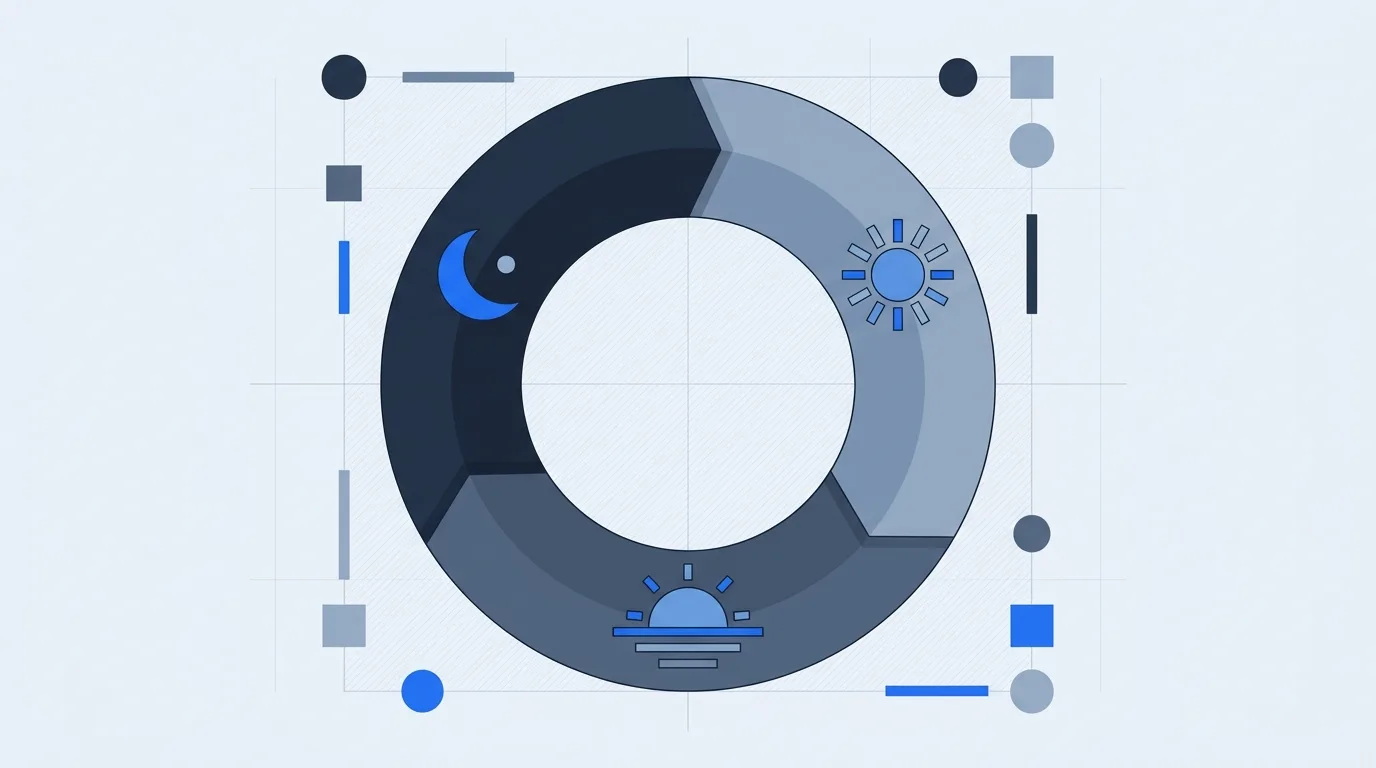
First shift usually runs from about 7 AM to 3 PM, second shift from about 3 PM to 11 PM, and third shift from about 11 PM to 7 AM. Those three eight-hour blocks cover a full 24-hour day, which is why the numbering exists at all. The exact times vary by employer and industry. A hospital's first shift might start at 6:30 AM, a warehouse's at 5 AM, and a contact center's second shift might not begin until 4 PM.
This guide explains what each shift is, who typically works it, how the hours differ across industries, and how the three shifts interact with pay, overtime, and rotation schedules. If you are trying to work out your own hours for a specific shift, the time card calculator handles shifts that cross midnight.
- The three shifts split the day into roughly 7 AM to 3 PM (first), 3 PM to 11 PM (second), and 11 PM to 7 AM (third), with a half-hour overlap or unpaid lunch depending on the employer
- First shift is the day shift, second shift is also called the swing or evening shift, and third shift is also called the night or graveyard shift
- Second and third shifts often pay a differential on top of base pay, but no federal law requires one
- A shift that crosses midnight is normally assigned to the workday on which it starts for payroll purposes, though the employer's written workweek rule controls
- 12-hour operations usually collapse the three shifts into two, a day shift and a night shift, and rotate crews through them
First, Second, and Third Shift at a Glance
The table below shows the typical windows for each shift. The 12-hour examples apply to operations that use two shifts a day instead of three.
| Shift | Common names | Typical hours | 8-hour example | 12-hour example |
|---|---|---|---|---|
| 1st shift | Day shift, morning shift, AM shift | Early morning to mid-afternoon | 7:00 AM to 3:30 PM with a 30-minute lunch | 7:00 AM to 7:00 PM |
| 2nd shift | Swing shift, evening shift, afternoon shift, PM shift | Mid-afternoon to late night | 3:00 PM to 11:30 PM with a 30-minute lunch | Not used; 12-hour sites run day and night only |
| 3rd shift | Night shift, graveyard shift, overnight shift | Late night to early morning | 11:00 PM to 7:30 AM with a 30-minute lunch | 7:00 PM to 7:00 AM |
The 30-minute overlap you see in the 8-hour examples is not an accident. Most operations either pay an extra half hour for a handover or schedule an unpaid meal break inside the shift so that eight paid hours plus the break equals eight and a half hours on site. Either way, the incoming crew is on the floor before the outgoing crew leaves.
Typical Shift Hours by Industry
Different industries anchor the day differently. The starting point is driven by when demand begins, not by the clock.
| Industry | 1st shift | 2nd shift | 3rd shift | Notes |
|---|---|---|---|---|
| Manufacturing | 6:00 AM to 2:00 PM | 2:00 PM to 10:00 PM | 10:00 PM to 6:00 AM | Earlier start so the line is running before the office opens |
| Healthcare (hospitals) | 7:00 AM to 3:30 PM | 3:00 PM to 11:30 PM | 11:00 PM to 7:30 AM | Many nursing units now use 7 AM to 7 PM and 7 PM to 7 AM 12-hour shifts |
| Contact centers and BPO | 8:00 AM to 4:30 PM | 4:00 PM to 12:30 AM | 12:00 AM to 8:30 AM | Hours follow the customer's time zone; offshore teams work "night" locally to cover a US day |
| Warehousing and logistics | 5:00 AM to 1:30 PM | 1:00 PM to 9:30 PM | 9:00 PM to 5:30 AM | Shifts are timed around inbound and outbound truck schedules |
| Hospitality (hotels) | 7:00 AM to 3:00 PM | 3:00 PM to 11:00 PM | 11:00 PM to 7:00 AM | Front desk usually runs exactly three 8-hour shifts |
| Security | 6:00 AM to 2:00 PM | 2:00 PM to 10:00 PM | 10:00 PM to 6:00 AM | Often 12-hour posts, 6 to 6, at smaller sites |
Two things to notice. First, the labels are relative: a "second shift" in a warehouse can start at 1 PM while a contact center's does not start until 4 PM. Second, in offshore BPO operations the shift names often refer to the client's clock, not the local one. A team in Manila working 9 PM to 6 AM local time to cover US East Coast business hours is usually called the "day shift" for that account.
First Shift: The Day Shift
First shift is the standard daytime block. It typically starts between 5 AM and 9 AM and ends between 1 PM and 5 PM.
Who works it. The largest share of the workforce. In an operation that runs three shifts, first shift usually has the most staff because supervisors, support functions, vendors, and management are all on site during the day.
Advantages. Normal sleep schedule, evenings and nights free, the most face time with managers, and the fewest handover problems because the day team can catch up with both the night crew leaving and the evening crew arriving.
Disadvantages. First shift rarely carries a differential, so it is often the lowest-paid shift per hour. Early starts in manufacturing and logistics, 5 or 6 AM, can be harder on sleep than people expect. Commutes fall in peak traffic.
Second Shift: The Swing or Evening Shift
Second shift covers the afternoon and evening. It typically starts between 2 PM and 4 PM and ends between 10 PM and midnight. It is called the swing shift because it swings between the day and the night.
Who works it. Students, parents who share childcare with a partner on first shift, people who prefer late mornings, and in contact centers, agents covering West Coast or evening customer demand. Second shift is also common for restaurant, retail, and hospitality roles that follow customer traffic.
Advantages. Mornings are free for appointments, school, or a second commitment. The shift usually carries a modest differential. Traffic is lighter at both ends. Supervision is thinner in the evening, which some employees prefer.
Disadvantages. Evenings, dinner, and most social life happen while you are at work. Ending at 11 PM or midnight with a commute means a late bedtime, and the schedule can be isolating for people whose household runs on a day schedule.
Third Shift: The Night or Graveyard Shift
Third shift is the overnight block. It typically starts between 10 PM and midnight and ends between 6 AM and 8 AM. It is also called the night shift or the graveyard shift.
Who works it. Hospital nurses and technicians, security officers, manufacturing and warehouse crews, hotel night auditors, emergency services, and BPO agents covering the other side of the world. Some employees choose it for the differential; others take it because it is the shift with openings.
Advantages. Third shift usually carries the highest differential. Daytime is free for errands, classes, and childcare handoffs. The floor is quieter, with fewer meetings and interruptions, and many people find they get more done.
Disadvantages. Sleeping during the day is harder for most people, and the disruption to circadian rhythm is the main reason turnover on nights tends to be higher. Access to daytime services, from banks to doctors, competes with sleep. Handovers to first shift happen at the end of a long night when fatigue is highest.
Shift Differential Pay for Second and Third Shift
A shift differential is extra pay for working a less desirable shift. It is usually expressed as a percentage of base pay or a flat amount per hour, and it is paid on top of the base rate for every hour on the qualifying shift. Third shift typically earns more than second, and weekend versions of either shift may earn more again.
Federal law does not require a shift differential. Under the Fair Labor Standards Act (FLSA), an employer only has to pay the applicable minimum wage and overtime. Differentials are set by employer policy or by a union contract. Where a differential is paid, though, it must be included in the regular rate of pay when calculating overtime, which is a common payroll mistake.
Our guide to shift differential pay covers how to set rates, how the differential flows into overtime, and how to write the policy.
Overtime When a Shift Crosses Midnight
Second and third shifts create a bookkeeping question that first shift never does: which day does the shift belong to?
The FLSA measures overtime per workweek, a fixed and recurring period of seven consecutive 24-hour periods that the employer defines in writing. It does not care which calendar day a shift lands on. What matters is that every hour is counted once, in the workweek in which it was worked. Most payroll systems handle a midnight-crossing shift in one of two ways:
- Assign the whole shift to the day it starts. An 11 PM Sunday to 7 AM Monday shift counts as Sunday. This is the most common approach and the easiest to explain to employees.
- Split the shift at midnight. One hour is credited to Sunday and seven to Monday. This is used when the workweek boundary falls inside the shift and the employer wants strict accuracy at the week change.
Either approach is acceptable as long as it is applied consistently and no hours are dropped or double-counted at the workweek boundary. If the workweek starts at 12:00 AM Sunday and a third-shift employee works Saturday 11 PM to Sunday 7 AM, the employer has to decide in writing whether that shift belongs to the old week or the new one, because it changes whether the employee crosses 40 hours. Our guide to overtime pay laws in the US covers the federal rule and the states that add daily overtime.
Daily overtime states
California, Alaska, Nevada, and Colorado have daily overtime thresholds in addition to the federal weekly rule. For a 12-hour night shift in those states, the daily rule usually triggers before the weekly one does. Check the state rule before setting up 12-hour shifts.
How the Three Shifts Fit into Rotation Schedules
An operation that runs 24 hours has to staff all three shifts every day, including weekends. There are two basic ways to do that.
Fixed shifts. Each employee is permanently assigned to first, second, or third shift. This is the simplest model, it lets people build a stable routine, and it is common in contact centers and hospitals. The disadvantage is that third shift becomes hard to staff, because nobody rotates off it.
Rotating shifts. Crews cycle through the shifts on a schedule. The DuPont schedule rotates four crews through 12-hour days and nights over a four-week cycle. The 2-2-3 schedule, sometimes called the Panama schedule, does the same with a 14-day pattern of two on, two off, three on. Eight-hour rotations move crews forward from first to second to third shift, usually weekly, because rotating forward is easier on sleep than rotating backward.
The choice affects everything from overtime cost to turnover. Our complete guide to shift rotation patterns compares the common patterns, and the shift schedule generator builds a rotation for any crew size and pattern.
Compressed alternatives exist for operations that do not need round-the-clock coverage. A 4-10 schedule gives employees four 10-hour days and a three-day weekend, and a 9/80 schedule gives every other Friday off.
Scheduling Tips for Managers Running Three Shifts
Build the handover into the schedule. Thirty minutes of paid overlap, or a written handover log, prevents the information loss that happens when one crew walks out as the next walks in. In contact centers, that means open tickets and escalations; in manufacturing, it means line status and safety issues.
Protect the shift boundaries. Asking a third-shift employee to stay two hours into first shift because someone called in is the fastest way to create overtime and fatigue problems at the same time. Keep a float pool or an on-call list instead.
Rotate forward, not backward. If crews rotate, move them from days to evenings to nights. Moving from nights back to days in one step is the hardest transition.
Watch consecutive night shifts. Most operations cap night shifts at four to six in a row before a break. Fatigue-related errors rise sharply past that point, and the schedule should be designed around the cap rather than relying on supervisors to catch it.
Post schedules early and keep them stable. Predictable schedules matter more to second- and third-shift employees, whose lives are already arranged around unusual hours. Some cities and states have predictive scheduling laws that require advance notice for hourly workers; check the rules where you operate.
Track coverage by shift, not just by headcount. A team of 30 agents does not mean 10 per shift once leave, training, and shrinkage are removed. Our call center shift scheduling template with break times plans coverage by interval, and the employee shift scheduling fundamentals guide covers the basics.
Tracking Hours Across Three Shifts
Three shifts mean three sets of clock-in and clock-out times, shifts that cross midnight, differentials that depend on the shift, and overtime that depends on the workweek. Doing that on paper time cards is where errors creep in.
HiveDesk tracks time automatically across desktop, mobile, and browser apps, so a shift that starts at 11 PM and ends at 7 AM is recorded as one shift on the correct day. Timesheets are generated from the tracked hours and routed for approval, attendance is visible by shift in real time, and leave is managed in the same system so coverage gaps show up before the shift starts. It costs $5 per user per month with every feature included.
Track Every Shift Automatically
HiveDesk records clock-in and clock-out times across all three shifts, handles overnight shifts correctly, and builds timesheets for approval. $5/user/month, 14-day free trial, no credit card required.
Frequently Asked Questions
What are 2nd shift hours?
Second shift typically runs from about 3 PM to 11 PM, though many employers use 2 PM to 10 PM or 4 PM to midnight. It covers the afternoon and evening, between the day shift and the night shift, and is also called the swing shift or evening shift.
What are 3rd shift hours?
Third shift typically runs from about 11 PM to 7 AM. Manufacturing sites often use 10 PM to 6 AM and some hospitals use 11 PM to 7:30 AM with a half-hour overlap. It is the overnight shift, also called the night shift or graveyard shift.
What are 1st shift hours?
First shift typically runs from about 7 AM to 3 PM. Warehouses and factories often start earlier, at 5 or 6 AM, while offices and contact centers may start at 8 or 9 AM. It is the standard day shift.
Is third shift the same as the graveyard shift?
Yes. Graveyard shift, night shift, overnight shift, and third shift all describe the same block of hours, roughly 11 PM to 7 AM. The term used depends on the industry and the region.
Is second shift the same as the swing shift?
Usually. Swing shift most often means the afternoon-to-evening second shift. In some workplaces, though, a swing shift means a rotating schedule in which an employee alternates between day and night shifts. Check which meaning your employer uses.
Which shift pays the most?
Third shift usually pays the most because it typically carries the largest shift differential. Second shift often carries a smaller differential, and first shift usually carries none. Federal law does not require any differential, so the amounts are set by employer policy or union contract.
How does overtime work on a shift that crosses midnight?
Overtime under the FLSA is calculated per workweek, not per calendar day. Most employers assign a midnight-crossing shift to the day it started. What matters legally is that every hour is counted once in the workweek in which it was worked and that the employer's written workweek rule is applied consistently.
How do 12-hour shifts map to first, second, and third shift?
They do not map directly. Operations on 12-hour shifts run a day shift, often 7 AM to 7 PM, and a night shift, 7 PM to 7 AM, and rotate crews through them. The second shift effectively disappears, with its hours split between the day and night crews.