BPO KPIs — The 15 Metrics Every Outsourcer Must Track

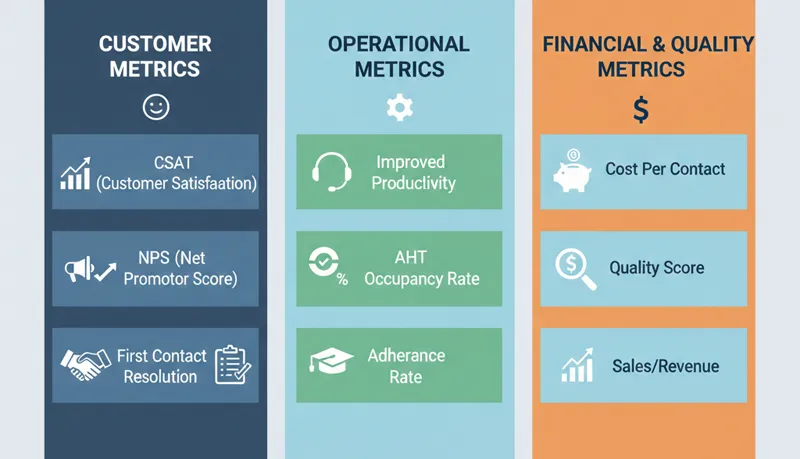
BPOs track the same operational metrics as in-house call centers — service level, FCR, AHT, CSAT, quality scores, occupancy, adherence, retention, and cost per call. Those metrics measure how well the operation runs. This guide does not repeat them.
What makes BPO KPI tracking different is the multi-client, multi-site, contract-driven nature of the business. A BPO must track not just whether calls are handled well, but whether each client account is profitable, whether contractual SLAs are being met, whether agents are being utilized across accounts efficiently, and whether growth is financially sustainable. These commercial and operational metrics sit on top of the standard call center KPIs and determine whether the BPO succeeds as a business — not just as an operation.
Account-level metrics
Account profitability
The most important metric a BPO can track is profitability by client account. A BPO can have excellent operational metrics — high quality, good FCR, strong retention — and still lose money if its accounts are priced wrong or its costs are allocated incorrectly.
How to calculate:
Account profit = account revenue − (agent hours × loaded hourly cost) − account-specific overhead
Account margin = (account profit ÷ account revenue) × 100
What to include in account-specific overhead:
- Dedicated team leads or supervisors
- Account-specific software licenses or tools
- Training costs for account-specific content
- QA resources dedicated to the account
- Travel for client visits
| Margin range | Interpretation | Action |
|---|---|---|
| 15%+ | Healthy — account is generating good returns | Protect and grow |
| 10–15% | Adequate — sustainable but limited room for error | Monitor cost trends |
| 5–10% | Marginal — one cost increase or volume drop pushes it negative | Investigate cost drivers, consider rate renegotiation |
| Below 5% | Unprofitable or near-breakeven | Renegotiate pricing, restructure delivery, or consider exiting |
Frequency: Monthly. Quarterly is too late — an account that was profitable in January can be losing money by March due to wage increases, turnover spikes, or volume changes.
Common mistake: Using a blended loaded cost across all sites to calculate account profitability. If an account uses agents at both your onshore site ($33/hr loaded) and offshore site ($11/hr loaded), the blended number masks the true cost of each site's contribution. Calculate using the actual loaded cost at each site.
SLA compliance by account
Every BPO client contract includes service level agreements — performance thresholds the BPO is contractually obligated to meet. Missing SLAs can trigger financial penalties, credit obligations, or contract termination clauses.
Common SLA metrics:
| SLA metric | Typical contractual target | Measurement |
|---|---|---|
| Service level | 80% of calls answered in 20–30 seconds | ACD system, measured in 15-minute or 30-minute intervals |
| Average speed of answer | Under 30 seconds | ACD system |
| Abandonment rate | Below 3–5% | ACD system (excluding calls abandoned within 5 seconds) |
| Quality score | 85%+ monthly average | QA evaluation program |
| CSAT | 4.0+ on 5-point scale | Post-call survey |
| FCR | 70–80%+ | Repeat contact tracking |
| Schedule adherence | 90%+ | WFM system |
What to track:
- Current period performance vs. SLA — are you meeting the threshold right now?
- Trend — are you trending toward or away from the SLA? A metric at 81% today that was 85% three months ago is a problem even though it currently passes.
- SLA misses by interval — center-wide daily SLA may pass, but if you are missing SLA during specific hours (6–8 PM, for example), the client will notice even if the daily average meets target.
- Financial exposure — what is the penalty for missing each SLA? Some SLAs carry credits or holdbacks that directly reduce revenue. Quantify the financial risk of near-misses.
Revenue per agent hour
How to calculate: Account revenue ÷ total agent hours billed to the account
This metric shows how much revenue each hour of agent work generates for a specific account. Compare it across accounts to identify which clients generate the highest revenue per unit of labor — and whether those high-revenue accounts are also high-margin or are offset by higher costs.
Why it matters: Revenue per agent hour, combined with loaded cost per hour, gives you margin per agent hour — the most granular profitability metric available. An account generating $28/hr in revenue with a loaded cost of $25/hr has a $3/hr margin. At 2,000 agent hours per month, that is $6,000 in profit — thin but viable. If loaded cost increases by $1.50 due to turnover or wage inflation, the account is barely breaking even.
Utilization and efficiency metrics
Billable utilization
In a BPO, not all agent time is billable to a client. Training, meetings, system downtime, and bench time (when agents are between account assignments) are typically non-billable. Billable utilization measures how much of your paid agent time generates revenue.
How to calculate: (Billable hours ÷ total paid hours) × 100. Accurate billable hours require reliable time tracking software that records hours by client account automatically.
Target: 85–90%. Below 80% means you have a significant amount of paid time that is not generating revenue — likely due to excessive training, high turnover (new hires in non-billable onboarding), or agents sitting on the bench between assignments.
| Billable utilization | Interpretation |
|---|---|
| 90%+ | Excellent — very little non-billable time |
| 85–90% | Good — typical for a well-run BPO |
| 80–85% | Acceptable — investigate sources of non-billable time |
| Below 80% | Problem — significant revenue leakage |
Sources of non-billable time to monitor:
- New hire training — high turnover increases the proportion of time spent in training. At 40% turnover, a significant percentage of your workforce is always in non-billable ramp-up.
- Bench time — agents waiting for assignment after an account ends or reduces volume. Track bench days per agent per quarter.
- Account transitions — time spent retraining agents for a new account is non-billable. Frequent transitions drive utilization down.
- Internal meetings and administrative time — necessary but should be managed tightly.
Cross-account scheduling efficiency
BPOs that cross-train agents on multiple accounts can shift agents between accounts based on volume fluctuations — reducing both overtime on busy accounts and idle time on quiet ones. This flexibility is one of a BPO's structural advantages over a single-client operation.
What to track:
- Percentage of agents cross-trained on 2+ accounts. Target: 20–30% of your workforce.
- Cross-account shift frequency — how often agents are actually moved between accounts in a given week. If agents are cross-trained but never moved, the investment in training is not producing returns.
- Quality delta — does quality drop when an agent works a secondary account versus their primary? If it does, the cross-training needs to be deeper or the agent needs more time on the secondary account to maintain proficiency.
Shrinkage by account
Shrinkage — the percentage of paid time when agents are not available for productive work — should be tracked by account, not just center-wide. Different accounts have different shrinkage profiles:
- An account with complex products requires more training time (higher shrinkage)
- An account with high turnover has more new hires in onboarding (higher shrinkage)
- An account with rigid compliance requirements requires more compliance training (higher shrinkage)
If you use a single shrinkage assumption across all accounts in your staffing model, you will overstaff some accounts and understaff others.
Client relationship metrics
Client retention rate
How to calculate: (Clients at end of period − new clients acquired) ÷ clients at start of period × 100
Losing a client is the most expensive event in a BPO's operations. Every departure means agents to reassign or separate, training materials and processes that become obsolete, and revenue that disappears immediately while costs decline gradually (severance, bench time, facility underutilization).
Target: 90%+ annual client retention. A BPO losing more than one in ten clients per year has either a service delivery problem, a pricing problem, or a client selection problem.
Client concentration
How to calculate: Largest client's revenue ÷ total BPO revenue × 100
This is a risk metric, not a performance metric. See our BPO scaling guide for the full discussion, but the key threshold: no single client should represent more than 25–30% of total revenue. Above that, you have an existential dependency.
What to track alongside concentration:
- Contract renewal dates for top 3 clients — know when you are at risk
- Client satisfaction trends (QBR scores, NPS, escalation frequency) for concentrated clients
- Pipeline of new business that would reduce concentration if won
Contract renewal rate
How to calculate: (Contracts renewed ÷ contracts up for renewal) × 100
Different from client retention — a client who renews at a lower rate or reduced scope represents a partial loss even though they are technically retained. Track both the renewal rate and the revenue change at renewal (expansion, flat, or contraction).
Multi-site performance metrics
Site-level comparison
For BPOs operating across multiple sites, tracking the same metrics at each site and comparing them reveals operational quality differences that center-wide averages hide.
Track by site:
| Metric | Why site-level tracking matters |
|---|---|
| Quality scores | Ensures QA standards are consistent across locations |
| AHT by call type | Identifies efficiency differences between sites handling the same work |
| Agent retention | High turnover at one site signals local management or working condition problems |
| Training pass rate | Low pass rates at one site suggest training quality or hiring quality issues |
| Schedule adherence | Adherence problems concentrated at one site indicate management or cultural differences |
| Loaded cost per hour | Ensures site cost assumptions in pricing models are still accurate |
Cross-site calibration: Run the same QA evaluations across sites monthly. If the Manila site scores 88% and the Louisville site scores 82% on the same call types, either Manila is performing better (learn from them) or the sites are scoring differently (calibrate evaluators).
Site cost efficiency
How to calculate: Total site operating cost ÷ total billable hours produced at the site
This gives you a true cost per billable hour at each location, capturing not just agent wages but management overhead, facilities, training, and turnover costs. Compare across sites to validate whether your offshore or nearshore sites are actually delivering the cost savings they were opened to achieve — after accounting for the management and coordination overhead they create.
The BPO dashboard
Not every metric needs to be reviewed at the same cadence. Real-time dashboards let you monitor daily metrics without waiting for manual reports. Structure your reporting by frequency:
Daily (real-time)
- Service level by account (interval-level)
- Abandonment rate by account
- Agent occupancy
- Schedule adherence
- Active agent count vs. required by account
Weekly
- Quality scores (as evaluations are completed)
- AHT trends by account and agent
- Billable utilization
- Attendance and no-call no-show incidents
- Overtime hours by account
Monthly
- Account-level profitability
- SLA compliance (formal reporting to clients)
- FCR and CSAT trends
- Agent retention by account, site, and tenure
- Shrinkage analysis
- Cross-account scheduling efficiency
- Cost per call by account
Quarterly
- Client retention and contract status
- Client concentration analysis
- Site-level performance comparison
- Loaded cost recalculation (wages, benefits, turnover costs may have changed)
- Revenue per agent hour trends
- Bench time analysis
- Pipeline and diversification progress
The metrics that should trigger immediate action when they miss targets: SLA compliance (contractual risk), account margin dropping below 5% (financial risk), and client concentration exceeding 30% (existential risk). Everything else can be addressed through the regular review cadence.