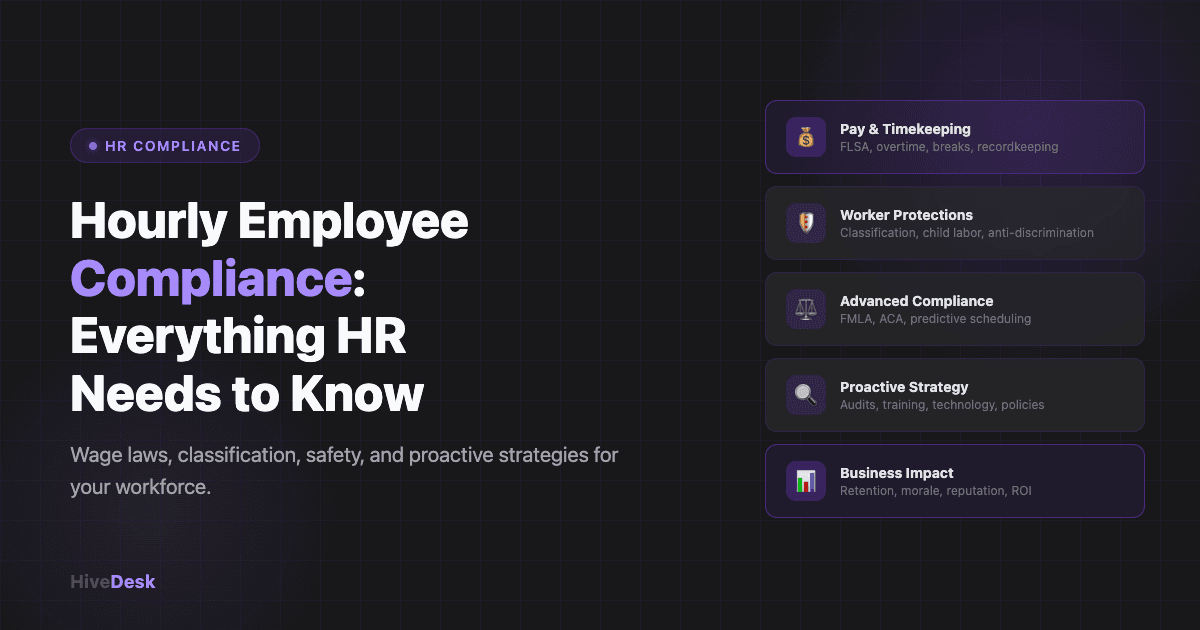
Hourly Employee Compliance: Everything HR Needs to Know

As HR professionals, we often juggle a myriad of responsibilities, from recruiting top talent to fostering a positive company culture. But for businesses that rely heavily on hourly workers, one area stands paramount: HR compliance. It's not just a box to check; it's the very foundation of a fair, legally sound, and ultimately, successful operation.
The Bedrock of Your Business: Why Hourly Employee Compliance Matters More Than You Think
Imagine your business as a magnificent structure. The products you sell, the services you offer, the brand you build – these are the gleaming floors and impressive facade. But beneath it all, supporting every single beam and brick, is the bedrock of HR compliance. And for hourly employees, this bedrock needs to be meticulously laid and constantly maintained.
Why does it matter so profoundly? Because a single misstep in hourly compliance can send tremors through your entire organization. A class-action lawsuit for unpaid wages can cripple a thriving business. A Department of Labor (DOL) investigation can cause lasting reputational damage. And beyond the legal and financial ramifications, there's a deeper, more human cost.
It's Not Just About Avoiding Fines, It's About Building Trust
Think about it: who are your hourly employees? They're the frontline staff, the customer service representatives, the production line workers, the delivery drivers. They are the face of your company, the engine that keeps it running. When they feel respected, fairly compensated, and protected by clear, consistent HR policies — including proper scheduling and time tracking — they become your most ardent advocates.
Conversely, when they suspect wage theft, experience inconsistent scheduling, or feel their basic employee rights are being overlooked, trust erodes. This isn't just about a disgruntled employee; it's about a tarnished reputation, low morale, high turnover, and ultimately, a struggling business. HR compliance, therefore, isn't just a legal necessity; it's a strategic imperative for building a loyal, engaged workforce and a resilient company culture. It's about demonstrating, through your actions, that you value your people.
The Core Pillars of Hourly Employee Compliance: A Legal Landscape Overview
Navigating the legal landscape for hourly employees can feel like charting a course through a complex archipelago. There are broad, federal mandates, and then countless smaller islands of state and local regulations, each with its unique topography. Understanding the full scope of applicable employment laws is the first step for any HR team committed to getting it right.
Fair Labor Standards Act (FLSA): Your North Star
The Fair Labor Standards Act (FLSA) is your undeniable North Star. Enacted in 1938, this federal law establishes fundamental protections for most private and public sector employees. It dictates the federal minimum wage, overtime pay, recordkeeping, and child labor standards. If you do nothing else, understanding the FLSA is non-negotiable. It's the baseline from which all other HR compliance efforts flow. Any misapplication of its rules, especially regarding overtime or proper classification of non-exempt employees, can lead to significant penalties.
State and Local Laws: The Nuances You Can't Ignore
While the FLSA provides the federal framework, state and local employment laws often add layers of additional requirements – and sometimes, more generous protections. Think of it like this: the FLSA sets the minimum floor, but states and cities can build higher ceilings.
For instance, many states have minimum wages higher than the federal rate. Some have specific requirements for meal and rest breaks that differ from federal guidelines. Others have enacted paid sick leave laws, predictive scheduling ordinances, or unique wage laws around final paychecks. Operating in multiple jurisdictions means HR teams must be intimately familiar with all applicable laws. What's perfectly compliant in one city could be a glaring violation just a few miles away. This complexity underscores the need for vigilant, localized HR compliance efforts.
I. The Foundation: Accurate Pay and Timekeeping

At the heart of hourly employee compliance lies accurate pay and timekeeping. It's where the rubber meets the road, directly impacting your employees' livelihoods and your company's financial integrity.
A. Defining "Work Time": Beyond the Obvious
This seems straightforward, right? Employees clock in, they work, they clock out. But the legal definition of "work time" extends far beyond just active production. Imagine a retail employee who needs to put on a uniform before their shift officially starts, or an administrative assistant who must log into a series of applications before they can begin their tasks. Is that pre-shift activity compensable? Often, yes.
Work time includes all time an employee is "suffered or permitted to work," which means even if you didn't explicitly ask them to, if you know they're performing work-related tasks, you must pay them. This also applies to things like mandatory training, travel between work sites, and even short breaks (usually 5-20 minutes). If an employee is required to remain on premises or "on call" for a significant period, even if not actively working, that time may also be compensable. It's crucial to analyze these "gray areas" carefully to avoid inadvertently underpaying.
B. Overtime Calculations: The 40-Hour Rule and Beyond
The FLSA generally requires overtime pay at 1.5 times a non-exempt employee's regular rate of pay for all hours worked over 40 in a workweek. Sounds simple enough, but the "regular rate of pay" is where many employers stumble. It's not just their hourly wage. It includes most forms of compensation, such as non-discretionary bonuses, shift differentials, and certain commissions.
Let's say an employee earns $15/hour but also receives a $100 production bonus in a week where they worked 50 hours. Their "regular rate" isn't just $15. You'd need to add the bonus to their straight-time earnings ($15 x 50 hours = $750) then divide by the total hours worked (50 hours), resulting in a regular rate of $17/hour. Their overtime rate would then be $17 x 1.5 = $25.50/hour for the 10 overtime hours. Overlooking bonuses or other payments in the regular rate calculation is a common and costly mistake. Furthermore, remember that some states have daily overtime rules (e.g., California), requiring overtime after 8 hours in a day, not just 40 in a week.
C. Meal and Rest Breaks: A Legal Necessity, Not a Courtesy
While federal law doesn't mandate meal or rest breaks for adults, it does require that if breaks of 20 minutes or less are provided, they must be paid. Longer meal periods (typically 30 minutes or more) where an employee is completely relieved of duties are generally unpaid. However, this is one of the biggest areas where state laws diverge. Many states, like California, New York, and Oregon, have very specific requirements for paid rest breaks and unpaid meal breaks, including when they must be taken (e.g., after a certain number of hours worked) and what happens if they are interrupted or missed. Failure to provide legally mandated breaks, or allowing employees to work "off the clock" during breaks, can lead to significant penalties and class-action lawsuits.
D. Record-Keeping: Your Best Defense
Accurate, detailed record-keeping isn't just a good practice; it's your absolute best defense in any wage and hour dispute. The FLSA requires employers to keep accurate records of employee names, addresses, occupations, pay rates, hours worked each day and workweek, total daily or weekly straight-time earnings, total overtime earnings, deductions, and total wages paid each pay period. Properly safeguarding employee information within these records is equally important from a privacy standpoint.
Think of your timekeeping records as a digital diary of your employees' work lives. If an employee claims unpaid wages or overtime, these records are the primary evidence. Inaccurate or missing records will almost always be interpreted against the employer. Embrace modern, reliable timekeeping systems that create immutable, timestamped entries, reducing disputes and providing a clear audit trail.
II. Beyond the Paycheck: Protecting Your Hourly Workforce
While pay and timekeeping are fundamental, HR compliance extends to protecting the dignity, safety, and proper classification of your hourly workforce.
A. Employee Classification: Employee vs. Independent Contractor
Misclassifying an employee as an independent contractor is one of the costliest mistakes an employer can make. The allure of avoiding payroll taxes, employee benefits, and overtime obligations can be strong, but the legal repercussions for misclassification are severe, involving back taxes, penalties, and lost wages.
The distinction often hinges on the level of control you exert over the worker. Does your company dictate when, where, and how the work is performed? Do you provide the tools and equipment? Is the worker an integral part of your business operations? If the answer to these questions is largely "yes," they are likely an employee, regardless of what label you put on them. Various tests (IRS 20-factor test, ABC test in states like California) exist, but the core principle is consistent: substance over form. When in doubt, err on the side of classification as an employee, or seek expert legal counsel.
B. Child Labor Laws: Protecting Your Youngest Employees
Hiring minors comes with a stringent set of rules designed to protect their education, health, and well-being. The FLSA sets federal standards, prohibiting employment of children under 14 in most non-agricultural jobs, limiting hours for 14- and 15-year-olds, and restricting hazardous occupations for those under 18. For a detailed breakdown, see the child labor laws guide.
However, state child labor laws often impose additional, sometimes more restrictive, requirements regarding permissible work hours, occupations, and required work permits. For example, some states prohibit minors from working past a certain hour on school nights, or from working during school hours without specific waivers. Diligent HR teams must know these rules, obtain proper permits, and ensure strict adherence to avoid fines, legal action, and negative publicity.
C. Anti-Discrimination and Harassment: A Zero-Tolerance Policy
Hourly workers, like all employees, are protected by federal anti-discrimination laws such as Title VII of the Civil Rights Act, the Americans with Disabilities Act (ADA), and the Age Discrimination in Employment Act (ADEA), which prohibit discrimination based on race, color, religion, sex (including sexual orientation and gender identity), national origin, disability, or age. The Equal Employment Opportunity Commission (EEOC) enforces these protections, and many states and localities extend them to other characteristics, such as marital status, veteran status, or genetic information. Additionally, the Equal Pay Act requires that men and women in the same workplace receive equal pay for substantially equal work.
A zero-tolerance policy against discrimination and harassment is not just a legal requirement; it's a moral imperative. This means providing regular, comprehensive compliance training for all employees, especially managers, on what constitutes harassment and discrimination, and establishing clear, accessible reporting mechanisms. Under the ADA, employers must also provide reasonable accommodations for qualified employees with disabilities, unless doing so would cause undue hardship. Prompt investigation and appropriate corrective action for every complaint are critical, regardless of the position of the individuals involved. A single unaddressed incident can quickly spiral into a toxic work environment and costly litigation.
D. Workplace Safety: A Moral and Legal Imperative (OSHA)
The Occupational Safety and Health Administration (OSHA), which enforces the Occupational Safety and Health Act, requires employers to provide a workplace free from recognized hazards that are causing or are likely to cause death or serious physical harm to employees. For hourly workers, who often operate in physically demanding or potentially hazardous environments, this is particularly critical.
This means providing appropriate personal protective equipment (PPE), ensuring machinery is properly guarded, training employees on safe work practices, and maintaining a clean and safe work environment. Beyond the initial setup, human resources plays a crucial role in fostering a safety culture, encouraging incident reporting without fear of reprisal, and ensuring regular safety audits and updates. A safe workplace protects your employees, reduces workers' compensation costs, and avoids costly OSHA citations.
III. Navigating the Nuances: Advanced Compliance Considerations
As you master the fundamentals, other, more specialized HR compliance areas will demand your attention, especially as legislative trends evolve.
A. Leave Laws: FMLA, State-Specific Paid Sick Leave, and More
The Family and Medical Leave Act (FMLA) grants eligible employees up to 12 weeks of unpaid, job-protected leave for specific family and medical reasons. While FMLA applies to employers with 50 or more employees, many states have their own family and medical leave laws that may cover smaller employers or offer broader protections.
Beyond FMLA, a significant trend is the rise of state and local paid sick leave laws. These laws typically require employers to allow employees to accrue and use paid time off for their own illness, the illness of a family member, or other designated reasons. Each jurisdiction has its own rules on accrual rates, caps, carryover, and acceptable reasons for use. Mismanaging these diverse leave entitlements can be a minefield, leading to employee grievances and legal challenges. HR teams must meticulously track eligibility, accrual, and usage across all applicable laws.
B. Healthcare and Benefits Compliance: ACA and Beyond
For employers with 50 or more full-time equivalent employees, the Affordable Care Act (ACA) requires offering health insurance that meets minimum essential coverage standards. Understanding ACA compliance is critical, as penalties for non-compliance can be substantial. HR teams need to accurately track employee hours to determine full-time status and eligibility for healthcare benefits.
Beyond the ACA, employers should also be aware of other employee benefits obligations, including COBRA continuation coverage and any state-specific healthcare mandates. These compliance challenges require careful attention to detail and robust tracking systems.
C. Wage Garnishment and Deductions: Following the Rules
Wage garnishment involves withholding an employee's earnings for the payment of a debt, usually under a court order. This can include child support, student loans, or tax levies. Employers are legally obligated to comply with valid garnishment orders. However, there are federal limits on how much can be garnished from an employee's disposable earnings, and state laws can impose even stricter limits or different priorities for multiple garnishments.
Similarly, deductions from an employee's pay, even for things like uniform costs, cash register shortages, or damaged equipment, are highly regulated. Federal law generally prohibits deductions that bring an employee's pay below minimum wage, and many states have specific rules about what deductions are permissible and whether employee consent is required. Incorrectly handling garnishments or making unauthorized deductions can result in legal challenges and fines.
D. Predictive Scheduling Laws: The Growing Trend
Predictive scheduling, or "fair workweek" laws, are a relatively new but growing trend, particularly in large cities and progressive states. These laws aim to provide hourly workers, especially in retail, food service, and hospitality, with more predictable work schedules and stable incomes.
Typically, they require employers to provide advance notice of schedules (e.g., 14 days), pay "predictability pay" for last-minute changes or canceled shifts, and offer additional hours to existing part-time employees before hiring new staff. These laws often come with strict record-keeping requirements and significant penalties for non-compliance. If your business operates in an area with predictive scheduling laws, understanding and implementing compliant scheduling practices is crucial to avoid costly violations and maintain employee satisfaction.
IV. Proactive Compliance: How HR Can Lead the Charge

HR compliance isn't about playing defense; it's about leading the offense. Your HR team is uniquely positioned to champion a culture of proactive compliance, transforming potential liabilities into operational strengths. Use this section as the foundation for your own HR compliance checklist.
A. Robust Policies and Procedures: Your Blueprint for Success
Think of your HR policies and procedures as the architectural blueprints for your compliance framework. They must be clear, comprehensive, and accessible. This includes a detailed employee handbook covering topics like timekeeping, overtime, break policies, anti-harassment, and workplace safety. But it's not enough to simply have them; they must be regularly reviewed and updated to reflect changes in federal, state, and local laws.
More importantly, these policies need to be communicated effectively to all employees, perhaps requiring signed acknowledgments. A well-crafted policy that no one understands or follows is as good as no policy at all. A thorough HR compliance checklist should include a schedule for periodic policy reviews and employee acknowledgment tracking.
B. Training Your Team: Managers Are Your Front Line
Your managers are the crucial link between HR and your hourly workforce. They are the ones approving timesheets, scheduling shifts, addressing breaks, and responding to initial employee complaints. If they don't understand the compliance rules, your best policies will fail.
Invest in regular, mandatory compliance training for all managers on wage and hour laws, anti-discrimination, and specific company policies. Use real-world examples and interactive discussions to ensure comprehension. Empower them with the knowledge and resources to make compliant decisions and escalate complex issues to HR appropriately. Their understanding is your first line of defense against compliance breaches. Ensure that onboarding programs for new hires also include thorough compliance orientation, so every employee understands their rights and responsibilities from day one.
C. Technology as Your Ally: Timekeeping Systems and HRIS
In today's complex regulatory environment, manual processes are a recipe for disaster. Embrace technology as your most powerful ally. Modern timekeeping systems with biometric authentication, geo-fencing, or robust clock-in/out features can significantly reduce "buddy punching" and ensure accurate work time capture. Real-time tracking capabilities give managers and HR teams instant visibility into hours worked, helping prevent overtime surprises.
Integrated HR Information Systems (HRIS) can help track leave accruals, manage employee data, automate payroll calculations (including complex overtime scenarios), and even generate compliance reports. These systems streamline HR compliance workflows and reduce the risk of human error. Investing in the right technology isn't just an expense; it's an investment in efficiency, accuracy, and risk mitigation.
D. Regular Audits and Reviews: Catching Compliance Issues Before They Escalate
HR compliance isn't a "set it and forget it" task. It requires continuous vigilance. Conduct regular audits of your payroll, timekeeping records, classification decisions, and policy adherence. Review sample timesheets, check overtime calculations, and ensure meal/rest breaks are being taken and properly recorded.
Consider engaging an external expert periodically to conduct an independent compliance audit. This fresh perspective can uncover compliance risks or areas where your practices might unintentionally deviate from legal requirements. Catching and correcting compliance issues internally is far less costly and damaging than facing an external audit or, worse, a lawsuit. Regular performance reviews also provide an opportunity to reinforce compliance expectations and identify any gaps in understanding among your team.
The Ripple Effect: Investing in HR Compliance Pays Dividends
Hourly employee compliance can seem like a daunting mountain of regulations. But viewing it as merely an obligation misses the profound opportunity it presents. When you invest in robust HR compliance, you're not just avoiding fines; you're building a healthier, more ethical, and ultimately more profitable business.
Think of the ripple effect:
Reduced Legal Risk: Fewer lawsuits, investigations, and penalties.
Improved Employee Morale: Employees who feel valued and fairly treated are more engaged, productive, and loyal.
Better Retention: A fair workplace environment reduces the costs associated with constant recruitment and training.
Enhanced Reputation: A company known for treating its employees well attracts top talent and earns customer trust.
Operational Efficiency: Clear policies and reliable technology streamline HR workflows and reduce administrative burdens.
In essence, strict hourly employee HR compliance isn't just "HR's job"; it's a strategic business advantage. By diligently implementing these best practices, HR leaders can transform compliance from a necessary evil into a powerful driver of organizational success and a testament to your company's commitment to its most valuable asset: its people.