BPO Client Billing: Improving Accuracy and Profitability

The BPO industry thrives on efficiency and cost-effectiveness. Yet for many BPO providers, the very foundation of their financial health — client billing — harbors hidden inefficiencies that erode profitability and strain client relationships. This guide walks you through actionable strategies to transform your billing operations, ensuring every hour, every service, and every value-add is accurately captured and billed.
Understanding Your Current Billing Landscape
Before you can improve, you need to understand where you stand.
"Accurate" billing means precisely reflecting the services delivered, resources consumed, and value created — all in strict accordance with the contract. If a client requests a detailed breakdown, you should be able to provide it without hesitation.
"Profitable" billing means revenue from your services consistently exceeds the direct and indirect costs of delivery, while contributing to your desired margins. Every minute spent on a client task has an associated cost — agent salaries, infrastructure, software, management overhead. If your billing doesn't capture these effectively, you're leaving money on the table.
Where Are You Losing Money?
Most BPO providers believe their billing is "good enough." But "good enough" is the enemy of profitability.
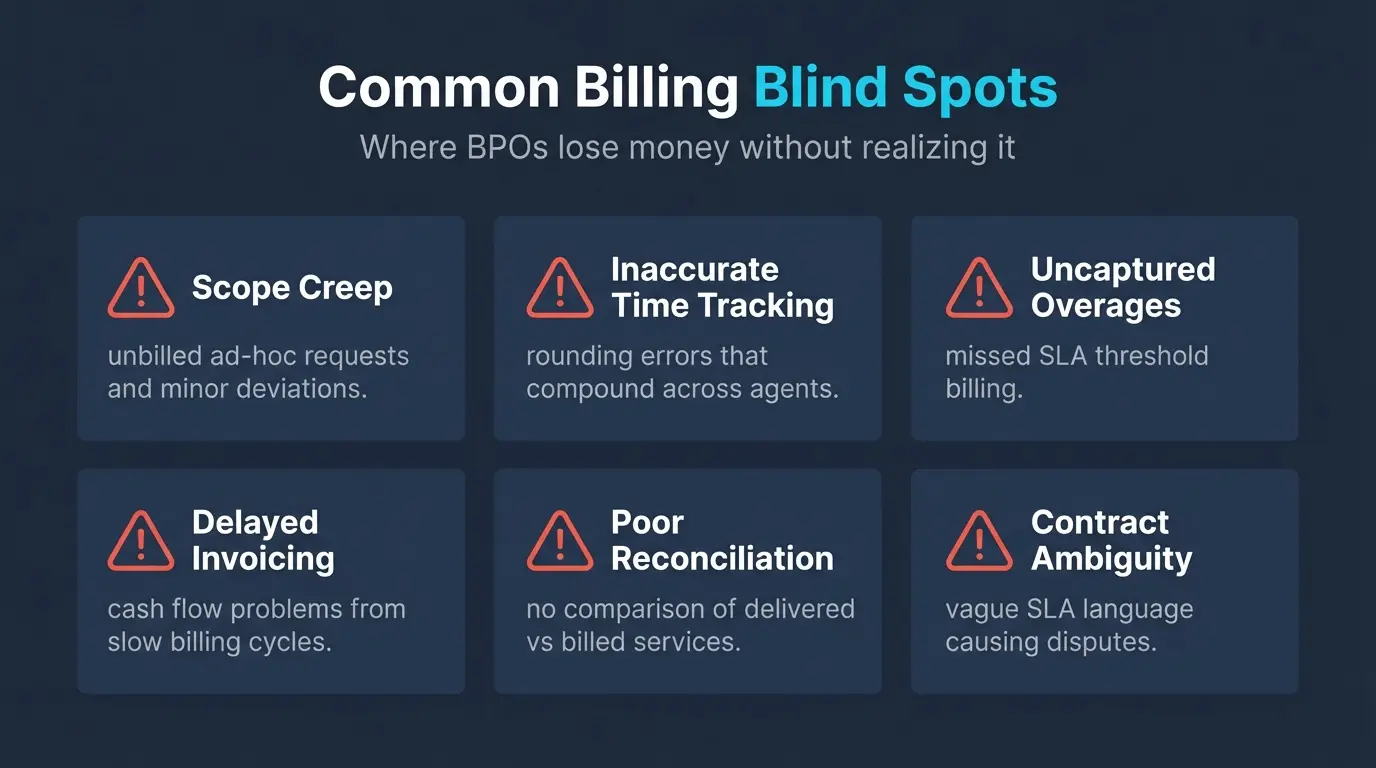
Scope Creep: Ad-hoc client requests and minor SOW deviations fulfilled without documentation or billing adjustment. Each "small favor" adds up to significant unbilled effort.
Inaccurate Time Tracking: Manual errors, time estimation instead of actual tracking, or rounding down. Switching to automated time tracking eliminates this category of leakage entirely. Two minutes per task, multiplied across hundreds of tasks and agents, becomes substantial revenue leakage.
Uncaptured Overage Charges: When clients exceed SLA thresholds for volume or error rates, are you consistently applying agreed-upon overage charges?
Delayed Billing: The longer an invoice sits, the harder it is to collect. Delays create cash flow problems and complicate financial reporting.
Poor Reconciliation: Failing to regularly compare actual service delivery data against billed services — like never reconciling your bank statement.
Contract Ambiguity: Vague SLA language leads to disputes and forces you to absorb costs that should have been billed.
To uncover your blind spots, trace a few randomly selected invoices back to the raw data — time logs, task completion reports, volume metrics. Where do the numbers diverge?
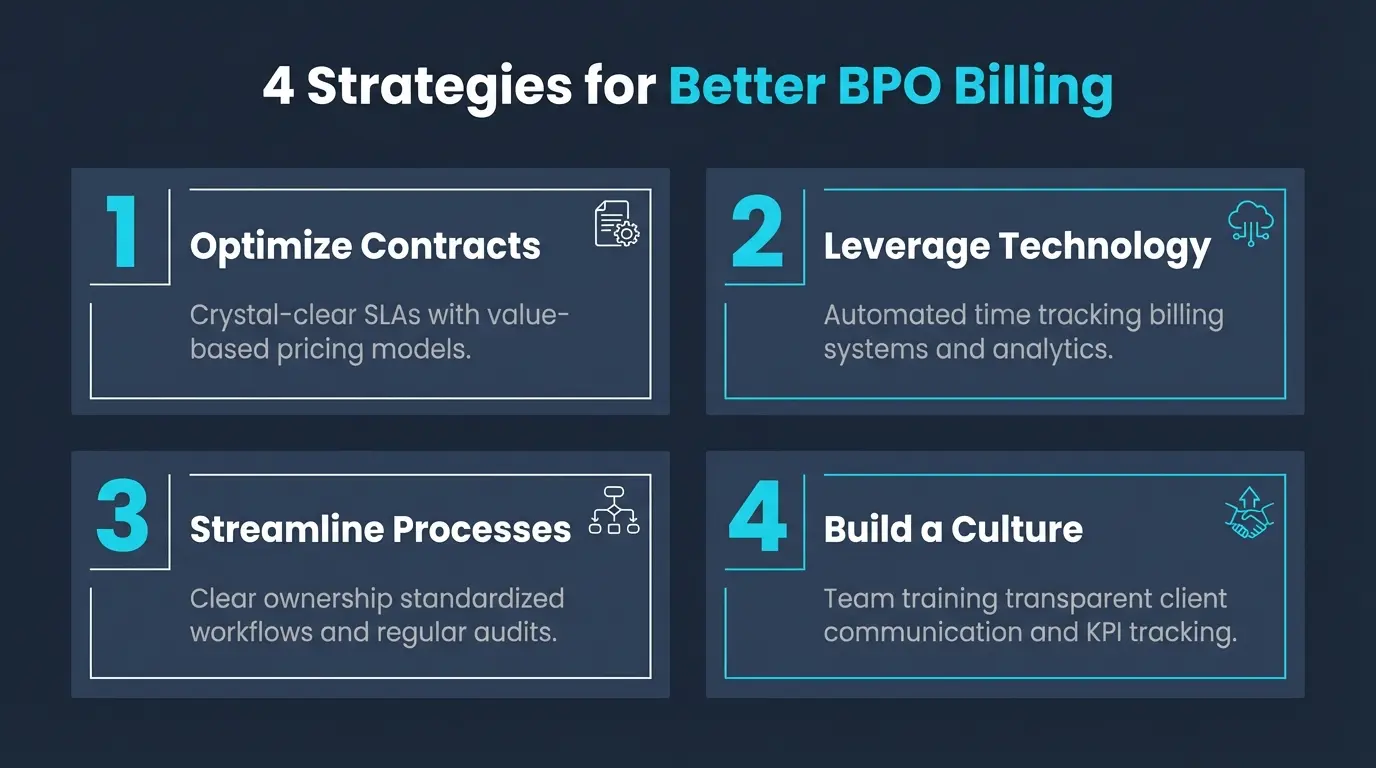
Strategy 1: Optimize Your SLAs and Contracts
Your contract is the blueprint for your billing. A flawed blueprint guarantees a flawed structure.
Write Crystal-Clear SLAs
Every metric, deliverable, and performance threshold must be explicitly defined. Avoid vague terms like "timely" or "reasonable effort." Use quantifiable language:
- "Response time for critical incidents: 15 minutes, 24/7"
- "Average handle time for Tier 1 calls: 180 seconds"
- "Error rate for data entry: less than 0.5%"
- "Volume processed per agent per day: 200 transactions"
Each metric should have a corresponding billing implication. What happens when volume exceeds 200 transactions? Is there a premium for exceeding expectations?
Move Beyond Cost-Plus Pricing
Cost-plus pricing (calculate costs, add a percentage) often fails to capture the true value you deliver. Consider:
- Per-Outcome Pricing: Billing based on completed units (per qualified lead, per resolved ticket)
- Tiered Pricing: Different rates for different service or performance levels
- Gain-Sharing: A percentage of savings or revenue you generate for the client
- Hybrid Models: Base FTE rate plus performance-based bonuses
The conversation shifts from "how much per hour?" to "how much value do we deliver?"
Formalize Change Order Management
Any deviation from the SOW — no matter how small — must trigger a formal change request with: a clear description, resource/timeline/cost impact, proposed billing adjustment, and client sign-off before implementation.
Strategy 2: Leverage Technology for Billing Accuracy
Manual processes breed errors. Technology is your greatest ally.
Implement Purpose-Built Billing Systems
Stop using spreadsheets for complex billing. A proper billing system should:
- Integrate with time tracking and project management tools
- Support complex billing models (FTE-based, transaction-based, hybrid, performance-based)
- Automate invoice generation on pre-defined schedules
- Provide granular reporting of billed services and costs
- Handle multi-currency and multi-region billing
Automate Data Capture
The less human intervention between raw data and your invoice, the higher your accuracy:
- Automated time tracking — tools that track agent time integrated with task management
- Volume tracking — CRM or ticketing systems that automatically count transactions
- Performance metrics — systems that track SLA adherence directly feeding your billing platform
- Automated reconciliation — software that compares data sources and flags discrepancies
Use Analytics Proactively
Billing data is a goldmine of insights:
- Profitability trends — which clients, services, or agents are most profitable?
- Anomaly detection — spot sudden dips or spikes that indicate data capture issues
- Revenue forecasting — use historical data to predict future revenue
- SLA compliance monitoring — track real-time performance against contractual obligations
Strategy 3: Streamline Internal Billing Processes
Define Clear Ownership
Map your entire billing cycle — from service delivery to payment — and assign clear ownership:
- Service Delivery Managers: Capture service data, manage change orders, ensure SLA adherence
- Finance/Billing Team: Invoice generation, dispute resolution, payment processing
- Account Managers: Client communication, contract interpretation, billing queries
- QA/Audit Team: Periodic accuracy checks and process compliance
Standardize Everything
Document every step: onboarding new clients into the billing system, capturing service data, generating invoices, handling disputes, processing change orders. Standardization reduces variations, minimizes errors, and makes training new staff easier.
Conduct Regular Audits
- Pre-invoice audits: Sample-check invoices against raw data before sending
- Post-billing reconciliation: Monthly or quarterly, reconcile billed revenue against delivery reports and costs
- Process audits: Periodically review billing processes for efficiency improvements
- Third-party audits: External assessment every few years for unbiased evaluation
Strategy 4: Build a Culture of Billing Excellence
Train Your Team
Billing accuracy starts at the front lines. Train all employees on accurate time tracking, data capture, and billing procedures. Educate operational leaders on the financial impact of scope creep and uncaptured services.
Communicate Transparently with Clients
- Provide regular, transparent reports on service delivery metrics
- Schedule billing review meetings with client stakeholders
- Maintain a clear, accessible dispute resolution process
- Educate clients on how they're being billed
Track Billing KPIs
| KPI | Target | Why It Matters |
|---|---|---|
| Billing Accuracy Rate | 99%+ | Invoices sent without disputes |
| Days Sales Outstanding (DSO) | As low as possible | Speed of payment collection |
| Unbilled Revenue | Minimal | Services delivered but not yet invoiced |
| Billing Dispute Rate | Below 2% | Client satisfaction with billing |
| Change Order Capture Rate | 100% | Scope changes formally documented and billed |
| Profit Margin by Client | Varies | Granular profitability tracking |
How HiveDesk Supports BPO Billing Accuracy
The foundation of accurate BPO billing is accurate time data. If you can't prove how many hours your agents worked on a client's account, every invoice is vulnerable to disputes.
HiveDesk provides the time tracking infrastructure that feeds your billing process:
- Automatic time tracking — agents check in and time is tracked continuously, eliminating manual estimation
- Project and task tracking — connect every hour to a specific client, project, or task
- Activity monitoring with periodic screenshots — proof of work for client-facing accountability
- Timesheet generation — auto-generated from tracked time for approval and billing
- Client billing reports — export time data by client for accurate invoicing
- Real-time dashboards — see who's working on what, right now
All at $5/user/month. Start a 14-day free trial — no credit card required.
Looking Ahead: Future Billing Challenges
AI for anomaly detection — algorithms that flag unusual time logs or billing patterns before they become disputes.
Blockchain for immutable contracts — transparent, tamper-proof records of service delivery and payments. Smart contracts that automatically trigger payments when SLA conditions are met.
Evolving regulations — data privacy laws (GDPR, CCPA) will continue to affect how you collect, store, and process billing data across international borders.
Build a resilient, adaptable billing system today and you're not just improving accuracy — you're future-proofing your BPO operation.
Accurate Time Data Is the Foundation of Accurate Billing
HiveDesk tracks agent time automatically by client and project — giving you the proof of work you need for dispute-free invoicing. $5/user/month, all features included.