Supplemental Benefits in Call Centers — Reducing Attrition

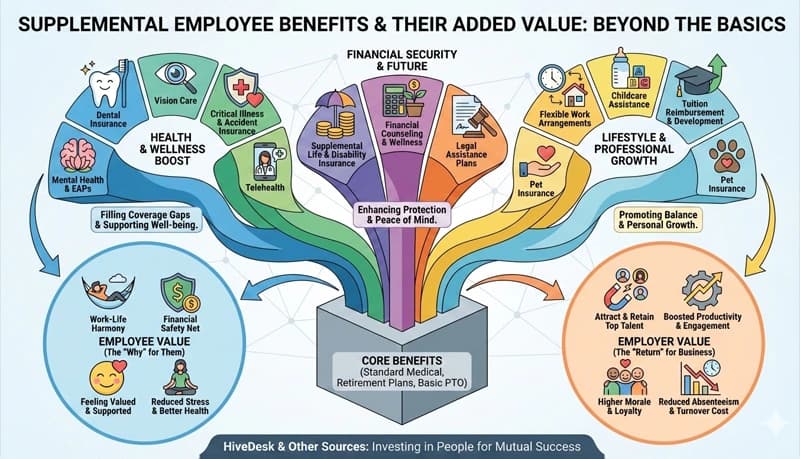
Supplemental benefits are anything an employer offers beyond base wages and legally required benefits (Social Security, unemployment insurance, workers' compensation). In a call center, where attrition rates typically run 30–60% annually and the cost of replacing an agent is $5,000–$7,000, the question is not whether to offer benefits — it is which benefits deliver enough retention or productivity value to justify their cost.
The challenge for call center and BPO operations is that the workforce is predominantly hourly, often entry-level, and price-sensitive. Benefits that appeal to salaried professionals (stock options, sabbaticals, conference budgets) have little impact on an hourly agent deciding whether to stay or leave. What matters to this workforce is more immediate: health coverage they can afford, schedule flexibility, financial stability, and a path to advancement. Using a call center management solution with flexible scheduling features directly addresses one of the top retention drivers.
Benefits that reduce attrition
These benefits directly address the reasons agents cite for leaving. They are not perks — they are operational investments that reduce the cost of turnover.
Health insurance
| Detail | Typical structure |
|---|---|
| What to offer | Medical, dental, and vision coverage. For hourly workers, the employer contribution percentage matters more than the plan design |
| Eligibility threshold | Full-time (30+ hours/week). Some operations extend to agents working 25+ hours to retain part-time staff |
| Typical employer contribution | 50–80% of individual premium. Family coverage contribution varies more widely |
| Waiting period | 30–90 days. Shorter waiting periods reduce early attrition — agents who need coverage will leave for an employer that provides it sooner |
Why it reduces attrition: Health insurance is the single most valued benefit for hourly workers. An agent earning $15/hour who cannot afford individual market insurance will leave for a $14.50/hour job that offers employer-sponsored coverage. The benefit is not just a perk — it is a retention anchor.
Cost-benefit math: Employer cost for individual coverage is typically $300–$500/month per agent. The cost of replacing one agent who leaves because of no insurance is $5,000–$7,000. If offering health insurance prevents even 2–3 departures per year in a 50-agent operation, it pays for itself through avoided replacement costs.
Paid time off (beyond legal minimums)
| Detail | Typical structure |
|---|---|
| What to offer | PTO bank (combined vacation + sick) or separate vacation and sick leave allocations |
| Starting accrual | 5–10 days per year for new hires, increasing with tenure (10–15 days at 2 years, 15–20 at 5 years) |
| Accrual vs. front-loaded | Accrual (earned per pay period) is more common and lower risk. Front-loaded (full allocation on hire date or anniversary) is simpler but creates liability if the agent leaves early |
Why it reduces attrition: Agents who feel they cannot take time off without financial penalty will burn out and leave. PTO also creates a tenure-based retention mechanism — agents accumulate more PTO as they stay longer, making it progressively more costly (in lost PTO) to leave.
Scheduling consideration: Every PTO day is an absence from the schedule. The staffing calculation must include PTO usage in the shrinkage assumption. If agents receive 10 PTO days per year, that adds approximately 4% to annual shrinkage.
Schedule flexibility
| Detail | Typical structure |
|---|---|
| Shift bidding | Agents bid on preferred shifts based on seniority or performance. Higher-performing or more tenured agents get first choice |
| Shift swaps | Agents can trade shifts with peers (with supervisor approval) without manager-initiated schedule changes |
| Hybrid/remote options | Agents meeting performance criteria can work from home some or all days |
| Compressed schedules | 4×10 or 3×12 options where available, giving agents more days off per week |
Why it reduces attrition: Schedule dissatisfaction is one of the top 3 reasons agents leave call centers. An agent who cannot attend their child's school events, work around a second job, or avoid a difficult commute will leave regardless of pay. Schedule flexibility costs nothing in direct benefit expense — it requires scheduling process changes but no incremental spending.
Career advancement paths
| Detail | Typical structure |
|---|---|
| Defined progression | Agent → Senior Agent → Team Lead → Supervisor → Operations Manager. Each level has clear criteria (tenure, performance, skills) |
| Internal posting | Supervisory and support roles (QA analyst, trainer, WFM analyst) are posted internally first before external recruiting |
| Timeline | Agent to team lead in 12–18 months for strong performers. Team lead to supervisor in 12–24 months |
Why it reduces attrition: Agents who see no path beyond their current role will leave when they are ready for more. The agents most likely to leave for advancement are the top performers — the ones you can least afford to lose. A visible career path converts "I need to leave to grow" into "I can grow here."
Cost: Minimal direct cost. Requires management time to define the path, communicate it, and follow through on internal promotions. The cost of not offering advancement is losing your best agents to competitors who do.
Benefits that improve quality of life but have lower attrition impact
These benefits are valued by employees but are less likely to be the deciding factor in whether an agent stays or leaves.
| Benefit | What it provides | Attrition impact | When to offer |
|---|---|---|---|
| Dental and vision insurance | Coverage for dental and vision care, often with low employer cost | Moderate — valued but rarely the reason someone stays or leaves | Include if you offer medical. The incremental cost is low ($30–$60/month per agent) and the perceived value is high |
| Employee assistance program (EAP) | Free confidential counseling, legal advice, financial guidance — typically 3–6 sessions per year | Low direct attrition impact, but can help agents through personal crises that would otherwise cause attendance problems or resignation | Offer at all operations. Cost is typically $1–$3 per employee per month — negligible |
| Wellness programs | Gym membership discounts, health screenings, wellness challenges | Low — appreciated but does not drive retention decisions | Offer when the core benefits (health, PTO, schedule flexibility) are already in place |
| Tuition reimbursement | Employer pays part or all of tuition for job-related education | Low for retention (agents pursuing degrees often plan to leave the call center for a different career) but can be used strategically with tenure requirements (must stay 12 months after reimbursement or repay) | Consider for operations that want to develop internal talent for management roles |
| Commuter benefits | Pre-tax transit passes, parking subsidies, or mileage reimbursement | Moderate in high-cost-of-commute areas. Low where most agents drive short distances | Offer in urban locations where commute cost is a meaningful percentage of agent pay |
| Meal subsidies or break room amenities | Free or subsidized meals, quality break room, coffee and snacks | Low attrition impact but improves daily experience | Low cost, easy to implement. Better break facilities can reduce ACW-as-break-time behavior by giving agents a reason to take their actual break |
Benefits that do not work in call centers
| Benefit | Why it does not work |
|---|---|
| Unlimited PTO | Designed for salaried professionals who self-manage their time. In a call center, every absence is a coverage gap. Agents cannot take time off whenever they want — it must be scheduled around volume. "Unlimited" sounds good but functionally means "request-based with approval" — which is what standard PTO already is |
| Remote work for all agents | Not every agent qualifies for remote work based on performance, tenure, or security requirements. Offering it as a universal benefit creates expectations that cannot be met |
| Stock options or equity | Hourly call center agents need immediate financial value, not long-term equity that vests over 4 years. Stock options are meaningful for salaried managers, not for an agent earning $15/hour who may not stay 12 months |
| Sabbatical programs | Designed for tenured professionals. In a call center where median tenure is 12–18 months, a sabbatical program at 5 years benefits almost no one and signals a disconnect between the benefit design and the actual workforce |
| Pet insurance as a standalone offering | Fine as part of a voluntary benefits menu. Not a substitute for the core benefits that drive retention |
How to evaluate whether a benefit is worth offering
Every benefit has a cost (direct expense + administrative burden) and a value (retention impact + recruiting advantage + productivity effect). The evaluation framework:
| Question | How to answer |
|---|---|
| Does it address a top attrition driver? | Review exit interview data. If agents cite "no health insurance," "schedule inflexibility," or "no growth opportunities" as reasons for leaving, benefits addressing those drivers will have the highest impact |
| What does it cost per agent per year? | Calculate the fully loaded cost: employer premium contribution, administrative cost, and any lost productivity (e.g., PTO days are paid non-productive time) |
| How many departures would it need to prevent to break even? | Cost of the benefit across all agents ÷ cost per departure ($5,000–$7,000). If health insurance costs $200,000/year for 50 agents and each departure costs $6,000, the benefit breaks even if it prevents 33 departures. If your attrition would drop from 50% to 40% (25 departures to 20), that saves 5 × $6,000 = $30,000 — which does not cover the full cost but is part of the return |
| Does it create a recruiting advantage? | If competing employers in your market do not offer the benefit, it differentiates your job posting. If all competitors offer it, not offering it is a disadvantage |
| Can it be structured to reward tenure? | Benefits that increase with tenure (more PTO at year 2, higher employer contribution at year 3, shift bidding priority based on seniority) create an increasing cost-of-leaving that compounds over time |
Structuring a benefits package by operation size
The benefits you can offer depend on scale. A 20-agent operation cannot negotiate group health rates the same way a 500-agent operation can.
| Operation size | Core benefits (offer these first) | Add when financially viable | Low priority |
|---|---|---|---|
| Fewer than 30 agents | Competitive hourly pay, schedule flexibility, defined career path, EAP | Health insurance (explore small group plans or SHOP marketplace), PTO above minimums | Tuition reimbursement, wellness programs, commuter benefits |
| 30–100 agents | Health insurance (medical + dental + vision), PTO (10+ days), schedule flexibility, career path, EAP | Hybrid/remote options for qualifying agents, shift bidding, referral bonuses | Tuition reimbursement, wellness challenges |
| 100–300 agents | All of the above + short-term disability, life insurance, 401(k) with modest match | Tuition reimbursement with tenure requirement, wellness programs, commuter benefits | Sabbaticals, stock options |
| 300+ agents | Comprehensive package competitive with regional employers. Benefits become a strategic differentiator in recruiting | Tiered benefits by tenure (increasing PTO, increasing employer health contribution), internal mobility programs across sites | Boutique perks that do not scale |
Benefits and BPO contract economics
In a BPO, benefits are part of the fully loaded labor cost that determines contract pricing and profitability.
| Consideration | Impact |
|---|---|
| Benefits load | Benefits typically add 20–35% on top of base wages. A $15/hour agent with full benefits costs $18–$20/hour fully loaded. This must be factored into per-agent or per-call pricing |
| Client expectations | Some BPO clients specify minimum benefit requirements in the SLA or contract — particularly for dedicated teams where agent quality and retention directly affect the client's brand |
| Attrition cost allocation | High attrition driven by poor benefits is a cost the BPO bears — recruiting, training, and productivity ramp costs come out of the BPO's margin, not the client's invoice. Investing in benefits that reduce attrition directly improves margin |
| Competitive positioning | BPOs competing for the same labor pool differentiate partly on benefits. The BPO offering health insurance at 30 days will attract better candidates than the one with a 90-day waiting period |
What to do first
If your operation currently offers minimal benefits beyond base pay:
- Survey departing agents. Review the last 6 months of exit data. Identify the top 3 reasons agents leave. If benefits-related reasons (insurance, PTO, schedule) appear, those are your priorities
- Calculate your current attrition cost. Monthly departures × $5,000–$7,000 per departure. This is the budget that better benefits can offset
- Start with schedule flexibility. It costs nothing in direct expense and addresses one of the most common attrition drivers. Implement shift bidding, shift swaps, and clear schedule publication timelines
- Add health insurance next if you do not already offer it. It is the highest-impact supplemental benefit for hourly workers and the largest differentiator in recruiting
- Structure benefits to reward tenure. Every benefit should have a tenure component — more PTO at year 2, remote eligibility at 6 months, shift bidding priority by seniority. This makes each month of tenure more valuable to the agent