What Is BPO? Complete Guide to Business Process Outsourcing

Business Process Outsourcing (BPO) is when a company contracts out specific business processes to a third-party service provider. Think of it as bringing in specialists to handle functions that aren't your core expertise — so you can focus on what truly differentiates your business.
In the business landscape of 2026, understanding BPO isn't just about knowing a buzzword. It's about grasping a fundamental strategic lever that can drive growth, foster innovation, and unlock efficiencies across your organization.
What Is BPO? The Basics
At its heart, BPO is about delegation. A company contracts an external provider to handle an entire business process — not just a single task, but a repeatable sequence of activities. This could be managing customer service inquiries, processing payroll, handling IT support, or running complex data analytics.
The "why" goes beyond just offloading work. Businesses engage in BPO to enhance operational efficiency, reduce costs, access specialized skills, and free up internal resources to focus on their unique value proposition.
BPO Has Evolved Beyond Call Centers
If your mind jumps to crowded call centers when you hear "BPO," you're thinking of the 1990s model. The BPO landscape has matured dramatically. Today, BPO encompasses highly specialized, knowledge-intensive processes: financial analysis, legal process outsourcing, R&D, digital marketing, and sophisticated IT infrastructure management.
BPO is no longer just about cost arbitrage — it's about value creation and competitive advantage.
Why Businesses Turn to BPO
Cost Efficiency
Cost reduction remains a primary driver, but it's more nuanced than just "cheaper labor":
- Reduced overhead — no investment in office space, equipment, or utilities for the outsourced function
- Minimized training expenses — the BPO provider already has trained staff
- Operational optimization — BPO providers specialize in these processes, achieving higher efficiency and fewer errors
- Variable cost model — pay for what you use rather than maintaining full-time staff regardless of workload
Focus on Core Competencies
Non-core functions divert valuable internal resources from strategic work. By outsourcing payroll, IT support, or customer service, you liberate your team to pour energy into innovation and the activities that differentiate you in the market.
Access to Specialized Expertise
BPO providers house teams of specialists — seasoned accountants, multilingual customer service reps, data scientists — whose sole focus is mastering those outsourced processes. You get world-class expertise without the burden of hiring and managing it directly. Effective BPO workforce management ensures these specialists are scheduled, coached, and performing at their best.
Scalability
BPO offers flexibility to scale services up or down based on business cycles. A rapidly growing startup can handle a massive influx of customer inquiries without building and dismantling internal teams.
Innovation
Reputable BPO providers invest heavily in new technologies — AI, automation, advanced analytics — and bring fresh perspectives to your operations, often identifying inefficiencies that internal teams miss.
Types of BPO
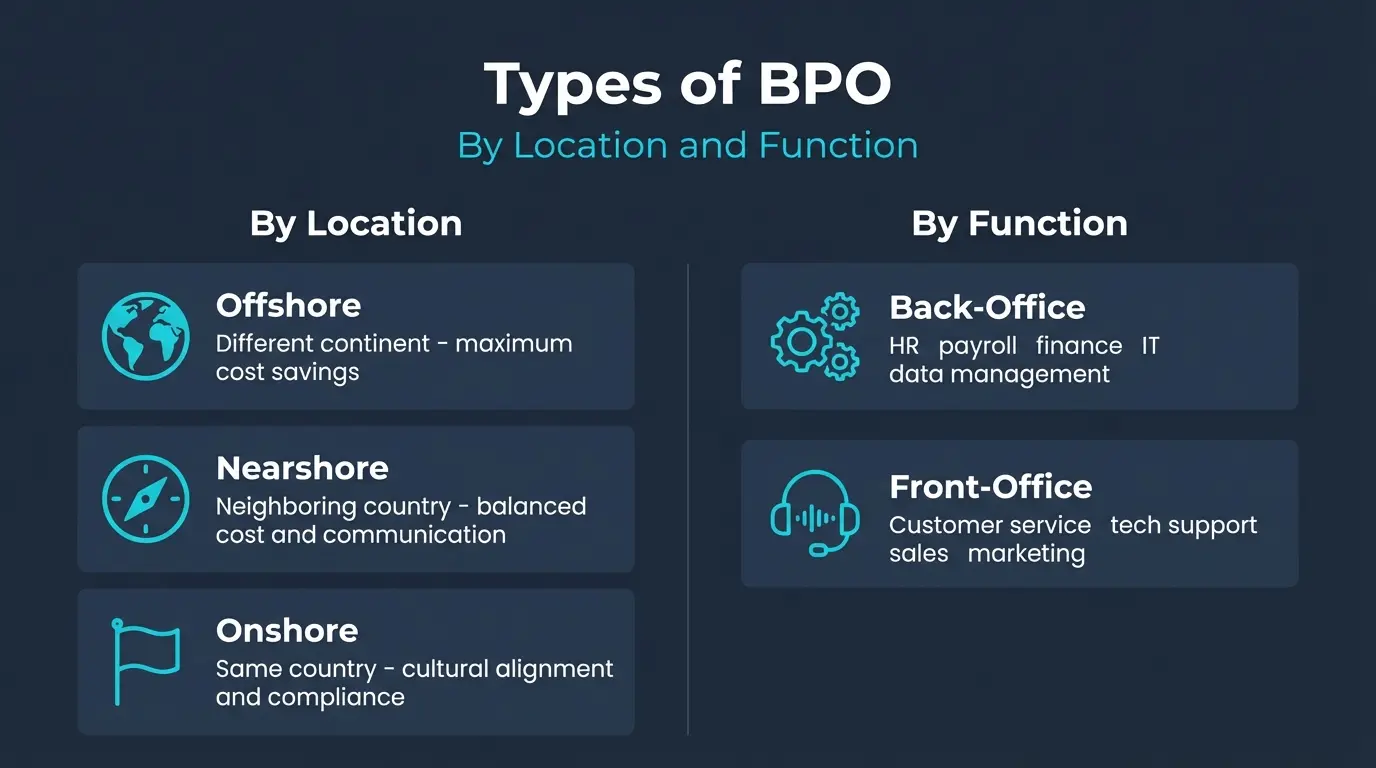
By Location
Offshore BPO: Contracting to a provider in a distant country (different continent). Primary drivers: significant cost savings and access to large talent pools. Example: US company outsourcing customer service to the Philippines or India.
Nearshore BPO: Outsourcing to a neighboring country or similar time zone. Balances cost savings with closer cultural alignment and easier communication. Example: US company outsourcing to Mexico or Canada.
Onshore BPO (Domestic): Outsourcing within the same country. Benefits: complete cultural alignment, no language barriers, same legal framework. Example: New York firm outsourcing accounting to a California provider.
By Function
Back-Office: Internal functions not client-facing but crucial for operations:
- Human Resources — payroll, benefits, recruitment
- Finance & Accounting — AP/AR, tax, financial reporting
- IT — help desk, application development, network management
- Data Management — data entry, processing, analytics
Front-Office: Customer-facing functions:
- Customer Service — call centers, email, chat, social media support
- Technical Support — troubleshooting, product support
- Sales & Marketing — telemarketing, lead generation, digital marketing
Industries Using BPO
BPO spans virtually every industry: IT, telecommunications, healthcare, financial services, retail/e-commerce, manufacturing, legal, and government. It's a versatile tool for any organization looking to optimize operations.
How BPO Works: The 6-Step Process
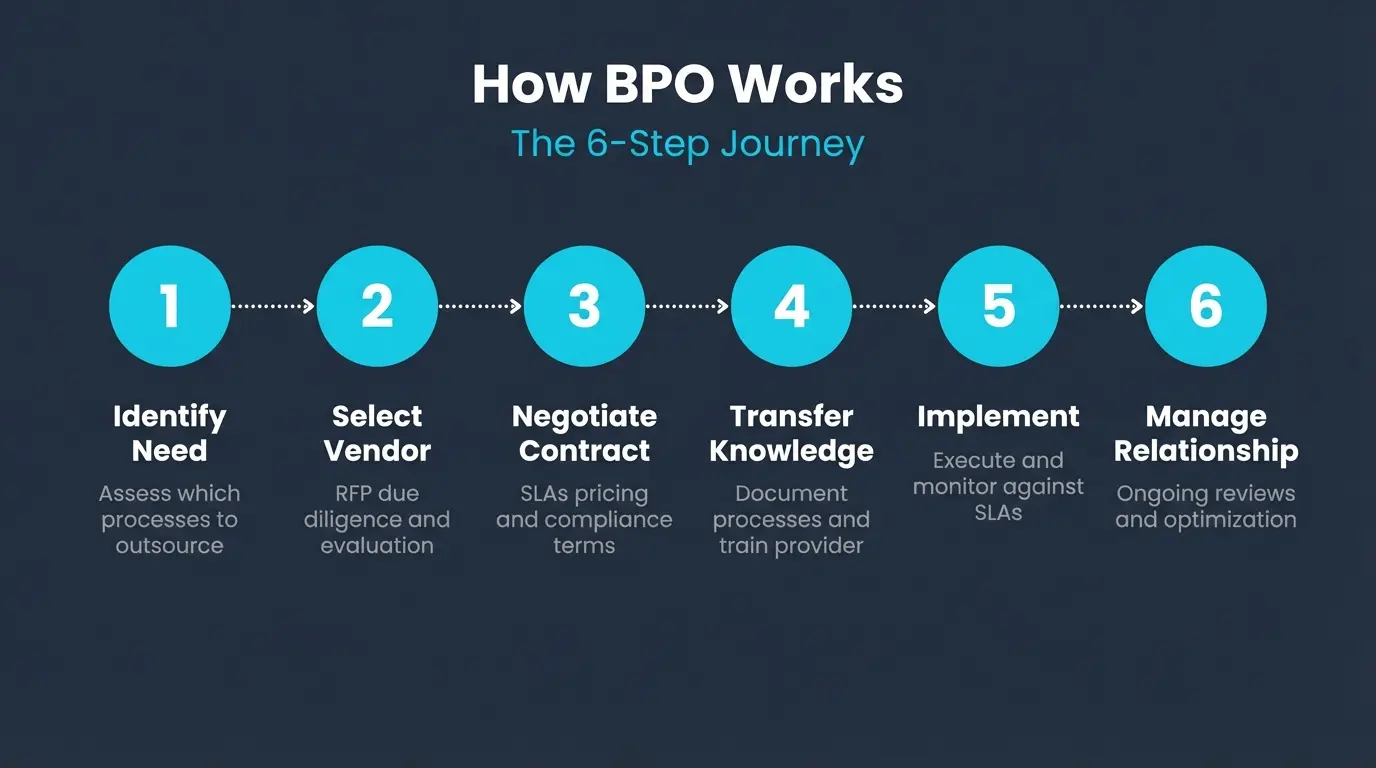
1. Identify the Need
Assess your operations critically. Which processes are inefficient, costly, or draining internal resources? Which functions lack specialized expertise? Document challenges and quantify them.
2. Select a Vendor
Define requirements (scope, SLAs, security, cultural fit), send RFPs, and conduct thorough due diligence — credentials, experience, financial stability, technology infrastructure, and client references.
3. Negotiate the Contract
The contract is the backbone of the BPO relationship. It must cover: scope of services, SLAs with quantifiable metrics, pricing model, data security and confidentiality, intellectual property, compliance requirements, and an exit strategy.
4. Transfer Knowledge
The internal team documents all procedures, policies, and systems, then trains the BPO provider's team. This phase requires significant collaboration to ensure the external team fully understands your processes and culture.
5. Implement and Monitor
The BPO provider begins executing. This requires continuous monitoring — regular performance reviews against SLAs, quality checks, and feedback loops. Issues must be addressed promptly.
6. Manage the Relationship
Ongoing partnership management: scheduled meetings, performance reports, strategic planning for how the outsourced function can evolve, and a clear process for resolving disputes.
The Pros and Cons
Benefits
- Significant cost savings through labor arbitrage and economies of scale
- Enhanced efficiency from specialized, optimized processes
- Access to global talent and advanced technologies
- Increased focus on core business and strategic initiatives
- Greater flexibility to scale with demand
- Reduced operational risk with robust disaster recovery
Challenges
- Loss of control over quality and day-to-day operations
- Communication challenges across time zones and cultures
- Data security risks when sharing sensitive information with third parties
- Quality control issues if not managed with clear SLAs
- Vendor lock-in making it costly to switch providers
- Employee morale impact if internal staff perceive BPO as a job threat
Understanding both sides allows you to implement mitigation strategies and choose the right partner. For a deeper dive into when outsourcing makes strategic sense and how to structure it, see our strategic outsourcing complete guide.
BPO Trends for 2026
Intelligent Automation: RPA, AI, and ML are transforming BPO. Routine tasks are increasingly automated, shifting BPO from processing to intelligently managing work with human oversight for complex decisions.
Value-Added Services: Clients expect strategic partners, not just task processors. BPO providers are acting as consultants, offering domain expertise and innovation partnerships.
Enhanced Data Security: Stricter regulations (GDPR, CCPA) mean BPO providers face greater scrutiny. Robust cybersecurity frameworks, specialized compliance teams, and transparent data practices are non-negotiable.
Cultural Alignment: As relationships deepen, cultural fit becomes critical. The best partnerships go beyond contractual obligations to genuine collaboration with shared values.
How HiveDesk Supports BPO Operations
For BPO companies managing remote and distributed teams, HiveDesk provides the operational infrastructure to track and manage your workforce:
- Automatic time tracking — agents check in and time is tracked continuously
- Activity monitoring with periodic screenshots — full transparency for clients and managers
- Real-time dashboards — see who's working, on what, right now
- Attendance management — clock-ins, breaks, and absences
- Employee scheduling — shift management for multi-shift operations
- Client billing — track time by client for accurate invoicing and profitability
All at $5/user/month — purpose-built for the BPO industry. Start a 14-day free trial.
Is BPO Right for Your Business?
Consider BPO when:
- You're facing cost pressures and need to optimize operational expenses
- Internal teams are overwhelmed by non-core tasks
- You lack in-house expertise for a specific function
- You need to scale rapidly or manage fluctuating demand
- You want access to cutting-edge technology without upfront capital expenditure
Before committing, define which functions are truly core (and must stay in-house), set measurable success criteria, assess data security requirements, and evaluate the impact on internal employees.
The "best" BPO arrangement is one where both parties — the client and the provider — benefit from the partnership and grow together.
Managing a BPO Team? Track Time and Performance Automatically
HiveDesk gives BPO managers automatic time tracking, activity monitoring, and real-time dashboards for remote and distributed teams. $5/user/month, all features included.