Strategic Outsourcing: A Complete Guide for Enterprises

Strategic outsourcing isn't about offloading tasks to the cheapest provider. It's the deliberate, long-term partnering with external providers to manage specific business functions — with the explicit goal of enhancing your overall business strategy, not just trimming costs.
In 2026, every decision about resources, talent, and operations carries immense weight. Understanding when and how to outsource strategically is the difference between enterprises that thrive and those that merely survive.
Strategic vs. Tactical Outsourcing
The distinction matters. Most outsourcing failures happen because companies apply a tactical approach to what should be a strategic decision.
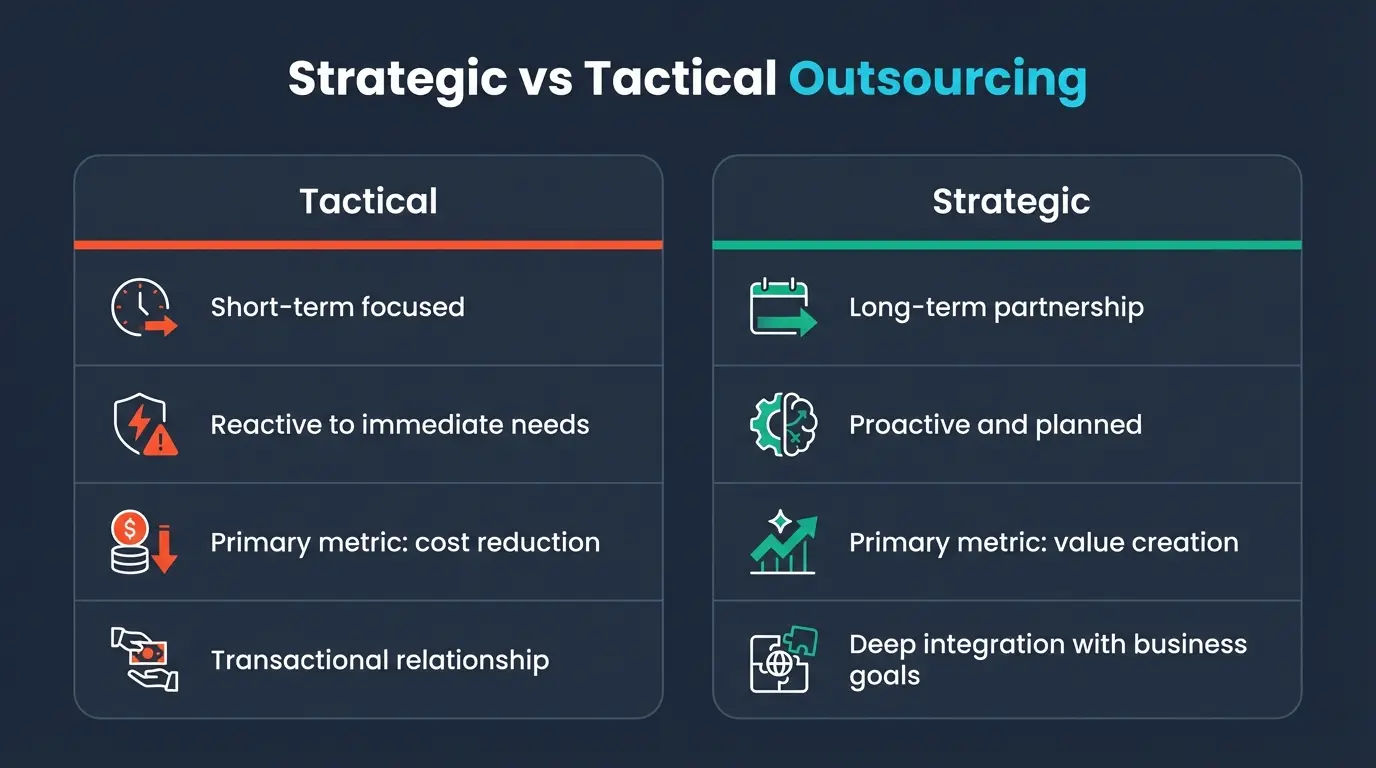
Tactical outsourcing is reactive and short-term. It's driven by immediate needs — a budget constraint, a temporary capacity gap, a one-off project. The relationship is transactional, and the primary metric is cost reduction or task completion.
Strategic outsourcing is proactive, long-term, and deeply integrated with business objectives. It's about building enduring partnerships that contribute to your market position, innovation pipeline, and operational excellence. The focus shifts from reducing costs to creating value.
A software company that tactically outsources a small module when the team is swamped is solving a capacity problem. The same company strategically partnering with a specialized AI firm to co-create a breakthrough feature is gaining a competitive advantage. The distinction is everything.
Why Strategic Outsourcing Matters Now
Focus on Core Competencies
Every enterprise has a unique set of skills that define its competitive edge. Non-core functions — IT support, HR administration, customer service — can divert valuable resources from the activities that truly differentiate you.
Strategic outsourcing frees your in-house team to concentrate on what makes you special. Your top engineers spend less time patching servers and more time innovating your next product.
Access Global Talent and Expertise
No single company can possess all necessary expertise. Strategic outsourcing provides a direct conduit to specialized knowledge, cutting-edge technologies, and diverse perspectives. Need blockchain integration? Partner with a distributed ledger specialist. Need advanced AI? Collaborate with a data science firm. They become an extension of your innovation ecosystem.
Mitigate Risk
By partnering with specialized providers, you transfer certain operational risks to entities best equipped to manage them. A cloud provider handles infrastructure, uptime, and security. A logistics partner absorbs shipping and warehousing complexity. This diversifies your operational base and builds resilience.
Scale Efficiently
Strategic outsourcing converts fixed costs (salaries, infrastructure, training) into variable costs. You pay for what you use, allowing operations to expand or contract with market fluctuations without making long-term, high-cost commitments. When combined with remote work, the benefits multiply — as we discuss in why remote workers are a win for everyone.
The 6-Step Implementation Blueprint
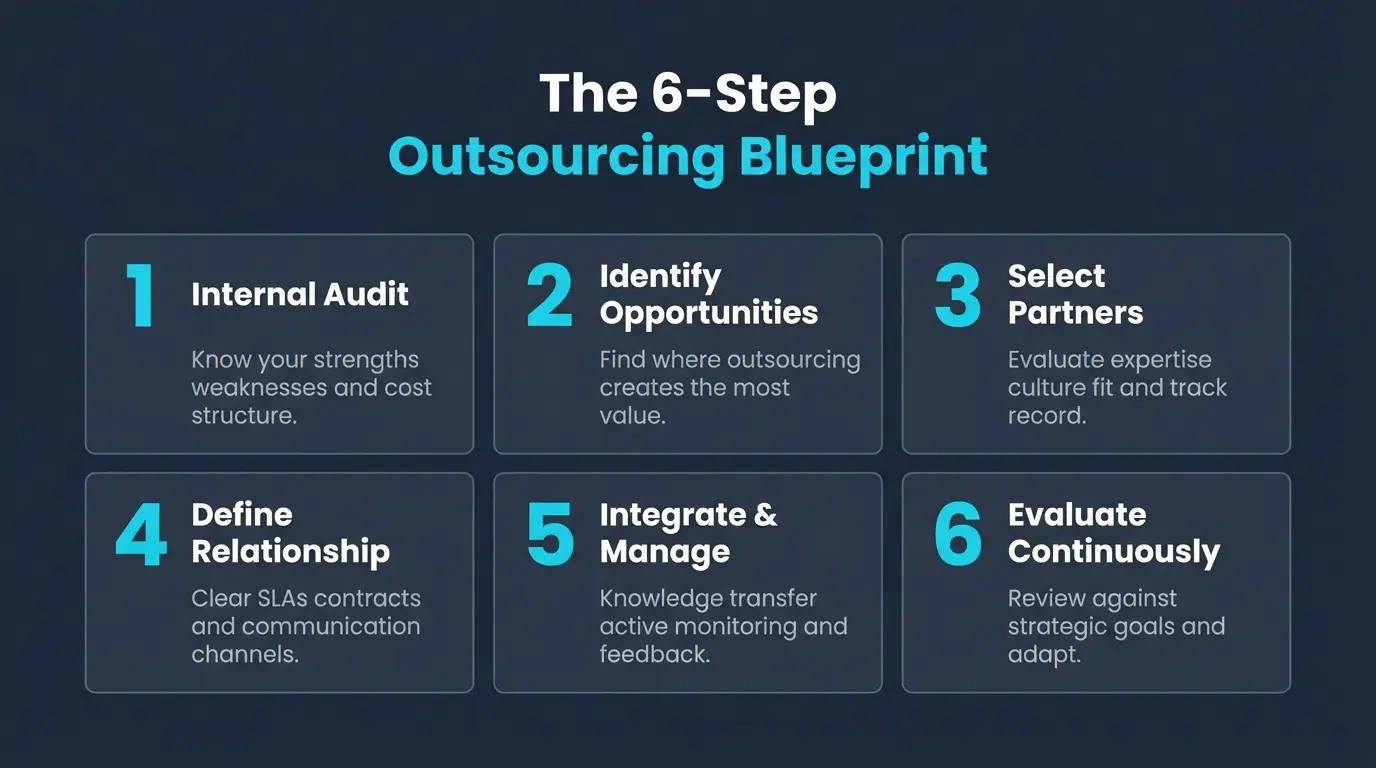
Step 1: Internal Audit
Before looking outward, look inward. Which functions are truly core to your competitive advantage? Where are you struggling — inefficiency, high costs, lack of expertise? Be honest about your current state.
Step 2: Identify Opportunities
Pinpoint where outsourcing creates the most value. This isn't just about cost savings — can outsourcing enhance quality, accelerate innovation, improve customer experience, or free up capital? Map each opportunity to specific KPIs.
Step 3: Select Partners
Your outsourcing partner isn't a vendor — they're an extension of your enterprise. Don't choose solely on price. Evaluate:
- Cultural alignment and shared values
- Proven track record with similar engagements
- Deep industry expertise
- Robust data security protocols
- Scalability and growth capacity
- References from comparable clients
Step 4: Define the Relationship
Ambiguity is the enemy. Clearly define scope of work, performance metrics through SLAs, reporting structures, communication channels, escalation procedures, intellectual property ownership, and exit strategy. The contract should reflect this clarity.
Step 5: Integrate and Manage
Establish dedicated liaison teams, integrate project management systems, and ensure smooth knowledge transfer. Active management is key — monitor performance against SLAs, provide feedback, and address issues proactively.
Step 6: Evaluate Continuously
Periodically review the partnership against your current strategic goals. Is it still delivering expected value? Are there opportunities to optimize or expand? Don't be afraid to renegotiate terms or transition to a new partner if the arrangement no longer aligns with your evolving strategy.
Common Pitfalls and How to Avoid Them
Poor Communication
The biggest failure point isn't usually capability — it's communication. Establish clear protocols from day one: regular meetings, detailed reporting, open feedback channels, and dedicated contacts on both sides.
Wrong Partner Selection
Choosing on price alone is building on a shaky foundation. Invest heavily in due diligence. Look beyond marketing materials — insist on concrete evidence of capability, reference checks, and cultural alignment.
Loss of Control
The key is balance. Define clear boundaries, establish robust performance monitoring, and maintain oversight through regular reviews. Empower your partner to do their best work, but retain strategic steering.
Cultural Mismatch
When outsourcing globally, different work ethics, communication styles, and approaches to problem-solving can create friction. Invest in cultural awareness training and choose partners who demonstrate understanding of your company culture.
Real-World Examples
Tech Company + Software Development Partner
A global tech company outsourced non-core software development and QA to a specialist firm in Eastern Europe. The goal wasn't cost-cutting alone — it was speed and niche expertise. Their in-house senior engineers focused solely on core R&D and product architecture. The result: faster time-to-market, reduced technical debt, and a more focused, innovative internal team.
Manufacturer + Logistics Partner
A manufacturing company with complex global supply chains partnered with a third-party logistics provider. The 3PL brought world-class technology, a vast network, and expertise in international trade regulations. The manufacturer reinvested saved capital into product innovation and production capacity. Their supply chain became more resilient, efficient, and cost-effective.
How HiveDesk Supports Outsourced Teams
Whether you're an enterprise outsourcing functions to a BPO partner, or a BPO provider managing outsourced teams, HiveDesk provides the operational visibility both sides need:
- Automatic time tracking — know exactly how many hours your outsourced team is working
- Activity monitoring with periodic screenshots — transparent proof of work
- Real-time dashboards — see who's working, on what, right now
- Project and task tracking — connect hours to specific deliverables
- Timesheet management — auto-generated timesheets for billing and payroll
- Client billing — track time by client for accurate invoicing
All at $5/user/month. Start a 14-day free trial.
Is Strategic Outsourcing Right for You?
For most enterprises in 2026, the answer is yes — provided it's approached strategically, not tactically. It demands clear vision, diligent execution, and a commitment to genuine partnership.
For a financial perspective on when outsourcing makes sense for growing companies, see our global expansion costs CFO guide.
Shift your mindset from cost-cutting to value creation.
Know your core — identify what must stay in-house versus what can be partnered.
Partner wisely — treat selection as seriously as hiring a senior executive.
Communicate relentlessly — clarity is the cornerstone of success.
Manage actively — partnerships require ongoing nurture and evaluation.
By embracing strategic outsourcing, you're not just delegating tasks. You're orchestrating a network of specialized talents — internal and external — to create a more agile, innovative, and resilient enterprise.
Managing an Outsourced Team? Get Real-Time Visibility
HiveDesk gives you automatic time tracking, activity monitoring, and real-time dashboards for your outsourced and remote teams. $5/user/month, all features included.