Best Workforce Management Software for Contact Centers

The contact center landscape is a dynamic battlefield where customer expectations are constantly rising and operational efficiency is the ultimate weapon. In this environment, effective workforce management isn't just an advantage — it's the bedrock of success.
Without robust WFM, you're guessing at staffing levels, struggling with agent burnout, missing service level agreements (SLAs), and disappointing your customers. Great WFM transforms this guesswork into data-driven strategy, turning potential chaos into operational efficiency.
Why Workforce Management Matters for Contact Centers
The days of contact centers being mere cost centers are long gone. Today, they are customer experience hubs, brand ambassadors, and revenue generators. This evolution is driven by the rise of omnichannel communication, the demand for personalized service, and the increasing complexity of customer inquiries.
Contact centers are under immense pressure to deliver consistent, high-quality service across multiple channels, often with fewer resources. The employee experience is also paramount — engaged and empowered agents are more productive and less likely to churn. Workforce management software steps in as the strategic partner to navigate these complexities.
What WFM Software Actually Does
At its core, WFM software optimizes the productivity and efficiency of your contact center agents. It encompasses several critical functions:
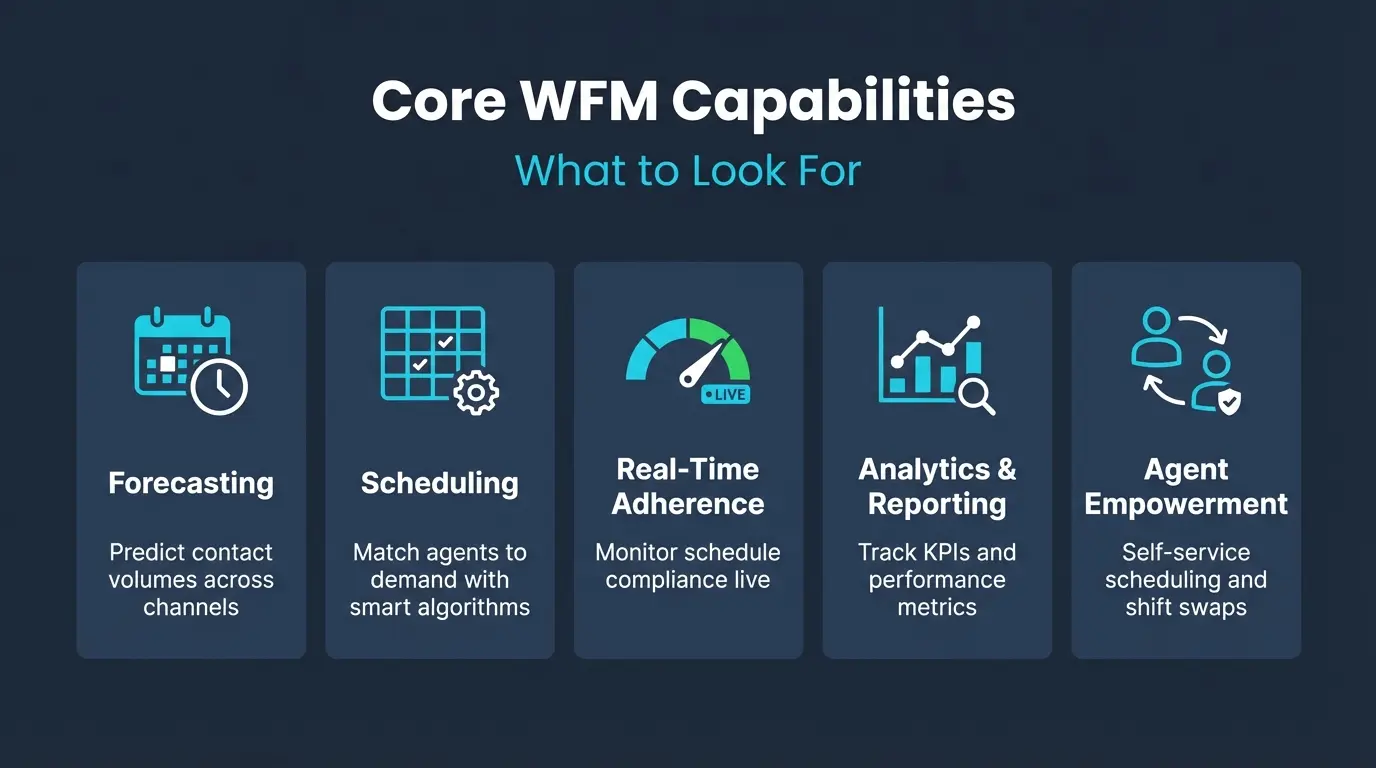
Forecasting: Predicting future contact volume across all channels (calls, chats, emails, social media) using sophisticated algorithms and historical data.
Scheduling: Crafting optimal schedules that match the right number of agents with forecasted demand, considering agent skills, preferences, and labor laws.
Real-Time Adherence: Monitoring agent activity in real-time to ensure schedule compliance, identifying deviations, and making on-the-fly adjustments to maintain service levels.
Reporting & Analytics: Deep insights into performance metrics, agent productivity, service levels, and operational costs through intuitive dashboards.
Agent Empowerment: Self-service scheduling, shift swaps, shift bidding, and performance dashboards that give agents more control and transparency.
In essence, WFM software ensures you have the right number of rightly skilled agents available at the right time — all while balancing costs and agent well-being.
How We Chose the Best
Our methodology focused on identifying solutions that consistently deliver value across a spectrum of needs:
- Core Features: Sophistication of forecasting engines, scheduling flexibility, and real-time intraday management capabilities
- Scalability & Integrations: Ability to grow from dozens to thousands of agents, with seamless integrations to CRM, ACD, and UC platforms
- User Experience: Intuitive interfaces for both administrators and agents, with strong training resources
- Value for Money: Total cost of ownership balanced against efficiency gains, service level improvements, and agent retention
- Innovation: Commitment to evolving with AI, machine learning, and cloud-native architecture
The 8 Best WFM Platforms for Contact Centers
1. NICE Workforce Management
NICE is an industry titan with a WFM offering renowned for its deep functionality in complex, large-scale environments.
Key Strengths:
- Enterprise-grade scalability for thousands of agents across multiple sites
- Highly sophisticated forecasting algorithms with patented engine
- Powerful intraday management for real-time adjustments
- Comprehensive WFO suite (Quality Management, Performance Management, Interaction Analytics)
- Excellent compliance and labor law adherence capabilities
Considerations: Complex implementation, higher price point, potentially overwhelming for smaller operations.
Best For: Large, complex contact centers with thousands of agents, diverse skill sets, and stringent compliance requirements.
2. Verint Workforce Management
Verint is a powerhouse in the WFO space, excelling in balancing robust functionality with a focus on agent experience.
Key Strengths:
- Deep forecasting models leveraging AI and machine learning
- Strong agent-centric features (self-service shift swaps, vacation requests, performance visibility)
- Seamless integration with its comprehensive WFO suite
- Advanced intraday automation capabilities
- Deep industry expertise in contact center operations
Considerations: Extensive feature set can present a learning curve; enterprise pricing.
Best For: Mid-to-large contact centers seeking comprehensive, agent-centric WFM with powerful forecasting and seamless WFO integration.
3. Calabrio ONE Workforce Management
Calabrio ONE is a unified suite lauded for its intuitive interface and emphasis on usability alongside powerful features.
Key Strengths:
- Intuitive design that significantly reduces learning curves
- Predictive analytics and AI for more accurate multi-channel forecasting
- Integrated with Quality Management, Analytics, and Customer Feedback
- Strong agent empowerment with mobile app access and gamification
- Flexible and adaptable for quick response to changing demands
Considerations: Ultra-large global enterprises may find NICE or Verint slightly deeper in niche scenarios.
Best For: Mid-to-large contact centers prioritizing intuitive UX, predictive analytics, and a unified platform approach to WFO.
4. Genesys Cloud CX Workforce Engagement Management
Genesys WEM is an integral part of the Genesys Cloud CX platform, benefiting from tight integration and cloud-native architecture.
Key Strengths:
- Cloud-native with rapid deployment, automatic updates, and inherent scalability
- Unified agent and supervisor experience within the core CCaaS platform
- AI-powered forecasting with dynamic scheduling adjustments
- Comprehensive engagement tools (Quality Management, Performance Management, Speech Analytics)
- Strong agent experience focus with empowerment portals and gamification
Considerations: Greatest value within the Genesys ecosystem; some niche features still maturing.
Best For: Contact centers already using or considering Genesys Cloud CX for their core CCaaS platform.
5. Alvaria Workforce Engagement Management
Formed from the merger of Aspect Software and Noble Systems, Alvaria brings decades of contact center expertise to a mature WFM solution.
Key Strengths:
- Battle-tested for highly complex multi-site, multi-skill, multi-channel environments
- Sophisticated forecasting engines with intricate business rule support
- Strong real-time performance management and intraday management
- Comprehensive WEM suite integrating WFM, QM, and Performance Management
- Flexible deployment (cloud, on-premises, or hybrid)
Considerations: Interface may feel less modern than newer solutions; complex implementation for large deployments.
Best For: Large, established contact centers with intricate operational requirements seeking a proven, robust WFM solution.
6. Five9 Workforce Optimization
Five9's WFO suite complements its core CCaaS offering with seamless data flow and a unified experience.
Key Strengths:
- Native integration with Five9 CCaaS for a truly unified platform
- Cloud-first design with continuous updates and scalability
- AI-powered forecasting and scheduling with handle time predictions
- Strong real-time monitoring and intraday adjustments
- Agent self-service scheduling and mobile access
Considerations: Best value within the Five9 ecosystem; some specialized WFM features may be deeper in dedicated solutions.
Best For: Existing Five9 customers or organizations seeking a unified, cloud-native contact center solution with built-in WFM.
7. Playvox Workforce Engagement
Playvox approaches WFM with a strong focus on agent engagement, weaving gamification, coaching, and performance management directly into the workflow.
Key Strengths:
- Agent engagement at its core with gamification and coaching integration
- Clean, modern UI that simplifies WFM tasks and reduces training time
- Solid forecasting and intelligent scheduling
- Seamless quality management and coaching tools
- Quick time to value with faster implementation than enterprise suites
Considerations: Extremely large centers with highly unique business rules may need deeper enterprise features.
Best For: Mid-sized contact centers prioritizing agent engagement, reducing churn, and modernizing WFM with an intuitive experience.
8. injixo WFM
injixo is a cloud-native WFM platform designed for mid-market contact centers, offering enterprise-grade features with simplicity and quick implementation.
Key Strengths:
- Cloud-native from the ground up with modern, intuitive interface
- Highly accurate forecasting using machine learning across multiple channels
- Intelligent scheduling that balances service levels, skills, and preferences
- Strong intraday management with real-time visibility
- Enterprise-grade features at a more accessible price point
Considerations: Highly bespoke legacy systems may require custom integration work.
Best For: Mid-to-large contact centers needing powerful, accurate WFM without the complexity or cost of traditional enterprise systems.
How to Choose the Right WFM Software
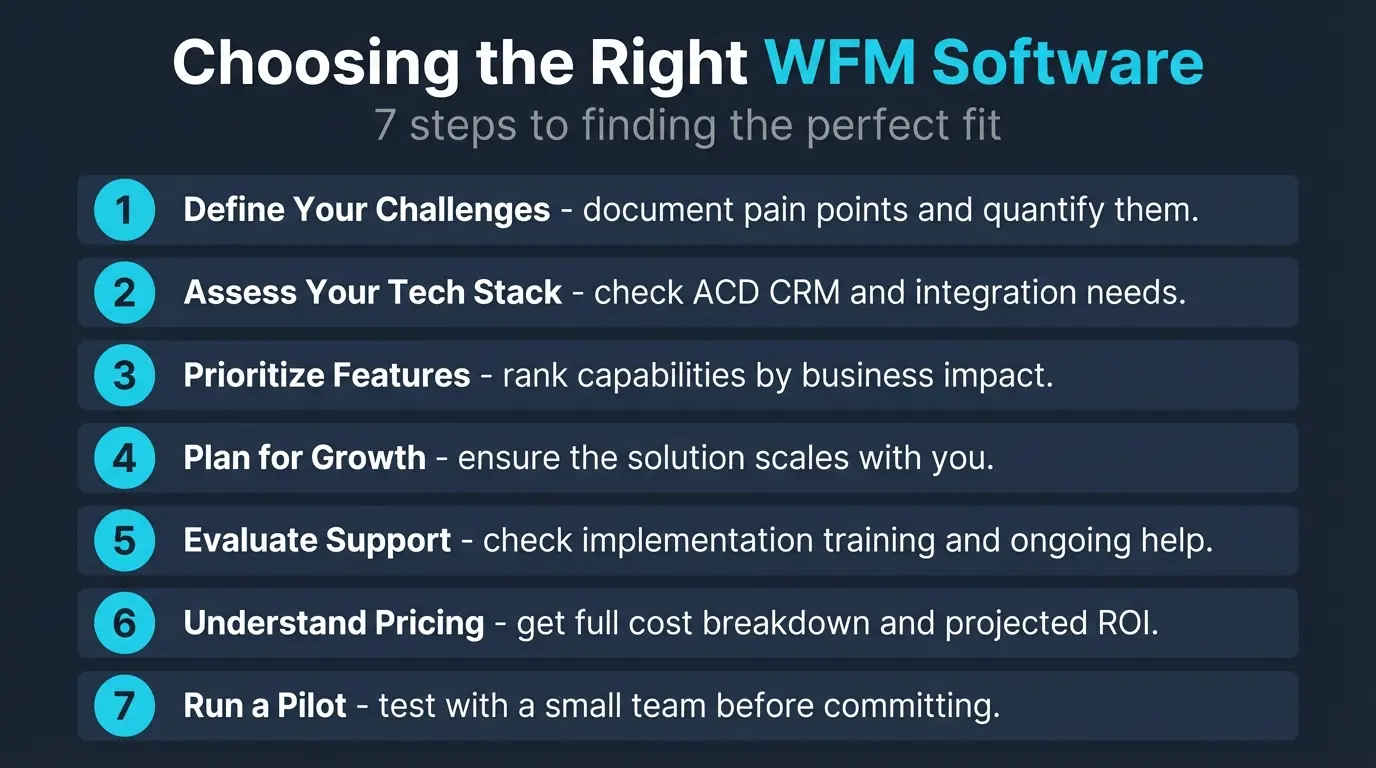
1. Define Your Challenges
Document your current pain points. Are you missing SLAs? Overspending on overtime? Struggling with agent attrition? Quantify these challenges and envision what success looks like.
2. Assess Your Tech Stack
What ACD/CCaaS, CRM, and HR systems are you using? Your WFM solution needs to integrate seamlessly. Understand the API capabilities and ask vendors about pre-built connectors.
3. Prioritize Features by Impact
Rank WFM capabilities based on your specific needs. If agent retention is your top concern, self-service scheduling and gamification may matter more than the most advanced forecasting model.
4. Plan for Growth
Don't just buy for today. Can the solution handle 50% or 100% growth in agent headcount? Can it accommodate new channels as they emerge?
5. Evaluate Vendor Support
Inquire about implementation support, ongoing technical assistance, and training resources. Read customer reviews about their support experience.
6. Understand Total Cost
Get a clear breakdown of all costs — licensing, implementation, training, and professional services. Then build a projected ROI around overtime savings, service level improvements, and reduced agent churn.
7. Run a Pilot
Schedule demos with your top 2-3 choices. If available, leverage free trials to test with a small team. Gather feedback from both WFM administrators and agents.
How HiveDesk Fits In
While enterprise WFM platforms like NICE and Verint are designed for large-scale forecasting and scheduling optimization, many small to mid-size contact centers need a simpler starting point — accurate time tracking, employee scheduling, attendance management, and real-time visibility into agent activity.
That's where HiveDesk fits. As a contact center workforce management solution, it provides the foundational capabilities that smaller operations need:
- Automatic time tracking across desktop, mobile, and browser
- Employee scheduling with shift management
- Attendance tracking with clock-in/clock-out and break monitoring
- Activity monitoring with periodic screenshots
- Real-time dashboards showing who's working and what they're doing
- Project and task tracking to connect hours to deliverables
All at $5/user/month — a fraction of the cost of enterprise WFM platforms. Start a 14-day free trial to see if it's the right fit for your team. If you're evaluating options specifically for smaller teams, see our guide to time tracking software for small businesses and our roundup of the best employee time clock apps.
Best WFM Software for Small and Mid-Size Teams
Not every team needs enterprise forecasting. If the platforms above are more than your operation requires, these tools cover the core workforce management workflow — time tracking, scheduling, and attendance — at SMB prices:
- HiveDesk ($5/user/month) — time tracking with screenshots, shift scheduling, attendance, leave management, and invoicing in a single plan with no tiers. Built for contact centers, BPOs, and desk-based remote teams.
- Hubstaff ($5–$10/user/month) — adds GPS tracking and geofencing for teams with field or mobile workers, plus 40+ integrations including payroll.
- Deputy (from $5/user/month per module) — scheduling with labor compliance: break tracking, fair-workweek tools, and demand-based auto-scheduling.
- Connecteam ($29–$99/month base) — scheduling plus communication, training, and digital forms for deskless teams.
- When I Work (from $2.50/user/month) — simple shift scheduling with swapping, availability, and team messaging for retail and hospitality.
Frequently Asked Questions
What is workforce management software?
Workforce management (WFM) software helps organizations manage employee time, schedules, attendance, and productivity. Core features include time tracking, employee scheduling, attendance tracking, leave management, and reporting. Enterprise contact-center WFM adds volume forecasting, real-time adherence, and intraday management; SMB tools add monitoring (screenshots, activity tracking) and invoicing.
What is the best workforce management software for call centers?
For enterprise call centers that need forecasting and real-time adherence, NICE, Verint, and Calabrio lead the category. For small to mid-size call centers, HiveDesk covers agent monitoring with screenshots, shift scheduling, attendance tracking, and real-time dashboards at $5/user/month.
What is the cheapest workforce management software?
HiveDesk at $5/user/month includes time tracking, monitoring, scheduling, attendance, leave management, and invoicing — the most complete WFM feature set at the lowest per-user cost. When I Work starts lower at $2.50/user/month but covers scheduling only.
What is the best workforce management software for small business?
HiveDesk at $5/user/month offers the best value for small businesses that need the full workflow in one plan. When I Work is a good fit for simple shift scheduling, and Clockify works if you only need free basic time tracking.
Maximizing Your WFM Investment
Purchasing software is just the first step. To truly unlock its potential:
Data Accuracy is Paramount. The algorithms rely on accurate historical data — contact volumes, average handle times, absenteeism, seasonal trends. Regularly audit your data sources.
Embrace Automation, But Keep the Human Touch. Leverage automation for routine tasks, but empower your WFM team to use judgment for nuanced decisions, especially in intraday management.
Continuous Improvement. WFM is not set-it-and-forget-it. Regularly review forecasts against actuals, analyze scheduling efficiency, and gather feedback from agents and supervisors. Treat it as an ongoing optimization journey.
Start With the Basics — Time Tracking, Scheduling, and Attendance
HiveDesk gives small to mid-size contact centers the workforce management foundation they need — time tracking, scheduling, attendance, and real-time dashboards. $5/user/month, all features included.