

Creating a Better Onboarding Process for Call Center Agents

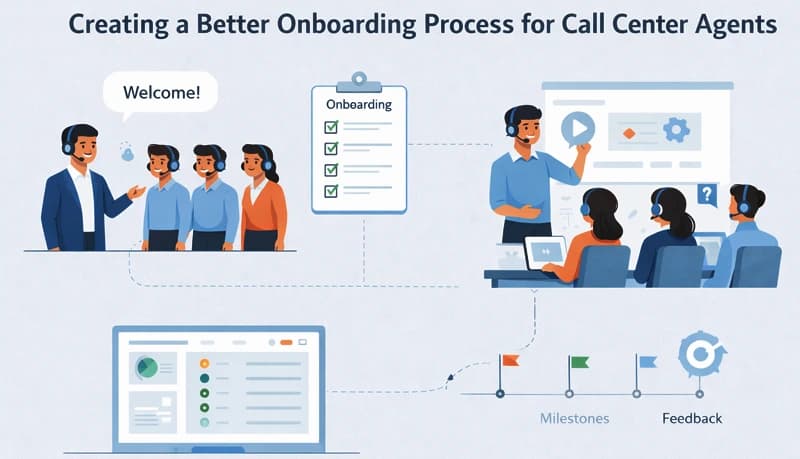
The first 90 days determine whether a new call center agent stays or leaves. Industry turnover data consistently shows that a disproportionate share of call center attrition happens within the first 3 months — agents who survive the 90-day mark are significantly more likely to stay a year or more.
Poor onboarding is often the reason. New agents get dropped into live calls before they are ready, receive inconsistent training depending on which trainer is available, or spend their first week filling out forms while their motivation fades. By the time they hit the floor, they feel overwhelmed, unsupported, and already thinking about leaving.
A good onboarding process is not about making the first day pleasant — it is about systematically building the skills, confidence, and habits that turn a new hire into a productive agent who wants to stay. Every day of the onboarding period should have a clear purpose and measurable outcome.
The cost of getting onboarding wrong
Before redesigning your onboarding, quantify what bad onboarding costs. This makes the business case for investing time and resources.
Turnover cost per early departure. An agent who leaves within 90 days generates the full cost of turnover — recruiting, training, lost productivity — with almost zero return. If your all-in turnover cost is $5,000–$8,000 per agent and 25% of new hires leave within 90 days, a class of 20 new hires loses 5 agents at a cost of $25,000–$40,000 before they even reach full productivity.
Extended time to proficiency. An agent who is not properly trained takes longer to reach target handle times and quality scores. During the ramp-up period, they handle fewer calls per hour, generate more repeat contacts, and require more supervisor support. Each extra week of ramp-up costs the equivalent of the productivity gap multiplied by the agent's loaded hourly rate.
Quality impact. Undertrained agents create bad customer experiences that damage client relationships — particularly in BPO operations where SLAs and quality scores directly affect revenue.
Onboarding structure: week by week
A call center onboarding program typically runs 4–8 weeks depending on the complexity of the accounts and the skills required. Here is a framework you can adapt.
Before day one
The period between offer acceptance and the first day matters. Agents who hear nothing for two weeks after accepting an offer start to disengage — or accept another job.
What to do:
- Send a welcome email within 24 hours of offer acceptance with start date, location, dress code, parking, and what to bring
- Complete as much HR paperwork as possible electronically before day one (tax forms, direct deposit, policy acknowledgments)
- Set up system accounts, badges, and equipment in advance so nothing delays their first day
- Assign them to a training class and send the schedule so they know what to expect
The goal is that when the agent walks in on day one, they feel expected and prepared — not confused and waiting around.
Week 1: Foundations
Focus: Company orientation, systems access, and foundational knowledge.
| Day | Content | Outcome |
|---|---|---|
| 1 | Company overview, team introductions, workspace setup, systems login | Agent can access all required systems |
| 2–3 | Product/service overview for assigned accounts, customer personas, common contact reasons | Agent understands what the business does and why customers call |
| 4–5 | Phone system training, CRM navigation, knowledge base orientation, call flow walkthrough | Agent can navigate all tools needed to handle a call |
Do not put new agents on live calls during week 1. The temptation to get them "productive" immediately is strong, especially when the floor is understaffed. Resist it. An unprepared agent on a live call learns bad habits, damages customer experience, and becomes discouraged.
Weeks 2–3: Skill building
Focus: Call handling skills, practice scenarios, and supervised practice.
- Call listening — New agents listen to recorded calls (both good and bad) and discuss what happened and why. Start with simple calls and progress to complex ones.
- Role play — Agents practice handling calls with trainers or peers playing the customer role. Cover the top 10–15 call types that account for 80% of volume.
- Simulated calls — If your systems support it, run simulated calls through the actual phone and CRM systems so agents practice the full workflow, not just the conversation.
- Knowledge assessment — Test product knowledge and process knowledge before moving to live calls. Set a passing threshold — agents who are not ready should receive additional practice, not be pushed to the floor early.
Weeks 3–4: Nesting
Nesting is the bridge between training and independent work. Agents take live calls with immediate access to support — a trainer or experienced agent sitting nearby who can help in real time.
How to structure nesting:
- Day 1 of nesting: Agent handles calls with a trainer listening to every call and providing immediate feedback after each one
- Days 2–3: Trainer monitors intermittently (every other call), agent handles most calls independently but can flag the trainer for help
- Days 4–5: Agent works mostly independently with trainer available for escalations only
- End of nesting: Agent meets minimum quality and handle time thresholds to graduate to independent work
Nesting ratios: One trainer or mentor for every 4–6 nesting agents. Higher ratios mean agents do not get enough feedback, and the nesting period loses its value.
Weeks 5–8: Supported independence
The agent is on the floor handling calls independently, but with elevated support:
- Daily check-ins with a supervisor or team lead for the first two weeks on the floor (15 minutes, focused on specific questions or challenges)
- Reduced targets — Set handle time and quality targets at 80% of full performance for weeks 5–6, ramping to 90% in weeks 7–8, and 100% after week 8
- Priority coaching — QA should review new agent calls at a higher rate (every 3rd or 4th call instead of the standard monthly sample) and deliver feedback within 24 hours
- Buddy assignment — Pair each new agent with an experienced agent on the same shift who can answer quick questions without escalating to a supervisor
What to train and how
Product and process knowledge
The biggest mistake in call center training is teaching agents everything about every product. New agents do not need encyclopedic knowledge — they need to handle the most common call types confidently and know where to find answers for everything else.
Prioritize by volume. Identify the top 10 call types that represent 70–80% of volume. Train those thoroughly. For less common scenarios, teach agents how to use the knowledge base effectively rather than memorizing every edge case.
Use job aids. One-page reference guides for common processes (how to process a refund, how to transfer to a specialist, how to escalate a complaint) reduce reliance on memorization and give new agents a safety net during early calls.
Soft skills
Call handling skills separate competent agents from excellent ones:
- Opening and closing — A consistent, professional opening and closing creates a good impression even when the call content is routine
- Active listening — Identifying the customer's actual need (which is not always what they initially say) reduces handle time and repeat contacts
- De-escalation — Techniques for handling frustrated or angry customers without escalating the situation. Practice these through role play — they cannot be learned from a slide deck.
- When to escalate — Clear criteria for what the agent should handle and what should go to a supervisor or specialist. Agents who are uncertain about escalation either escalate too much (wasting supervisor time) or too little (causing customer complaints).
Systems and tools
Agents need to be fast with the tools, not just familiar with them. Train tool usage in the context of actual call workflows, not as standalone system demos:
- Practice navigating the CRM while talking through a simulated call
- Time agents on common tasks (pulling up an account, entering a note, initiating a transfer) and set proficiency benchmarks
- Show keyboard shortcuts and efficiency tips that experienced agents use
Measuring onboarding effectiveness
Track these metrics for every training class to assess whether your onboarding is working:
| Metric | When to measure | What it tells you |
|---|---|---|
| Training completion rate | End of training | Did all agents make it through? High dropout suggests training is too long, too difficult, or new hires were poorly screened |
| Nesting pass rate | End of nesting | Can agents meet minimum standards on live calls? Low pass rates suggest training gaps |
| 30-day attrition | 30 days post-hire | Are agents leaving early? High 30-day attrition points to onboarding or job expectation problems |
| 90-day attrition | 90 days post-hire | The most important retention metric. Compare across training classes and time periods |
| Time to proficiency | Ongoing | How many weeks until a new agent hits 90% of experienced agent performance? |
| Quality scores (first 60 days) | Weekly | Are new agents meeting quality standards? Consistent low scores suggest training gaps |
| New agent AHT trend | Weekly | Handle time should decrease each week as agents gain proficiency. Flat or increasing AHT signals a problem |
Compare metrics across training classes. If Class A had 10% attrition and Class B had 30%, investigate what was different — different trainer, different account, different time of year, different recruiting source.
Common onboarding mistakes
Compressing training to get agents on the floor faster. This always backfires. An agent who starts live calls two weeks early will underperform for months longer than an agent who completed full training. The math never works in favor of cutting training short.
One-size-fits-all training. Agents with prior call center experience and agents with no customer service background should not go through identical training. Assess incoming skill levels and adjust pace accordingly — experienced agents can skip the basics and focus on account-specific content.
No structured nesting period. Going straight from classroom training to independent calls is the single most stressful moment in a new agent's experience. Nesting provides the bridge. Skipping it to save trainer time is a false economy.
Training the product but not the tools. An agent who knows the product inside and out but fumbles with the CRM for 30 seconds between every screen will have terrible handle times and feel incompetent despite knowing the answers.
No feedback during the first weeks on the floor. Once agents leave training, they often enter a feedback vacuum — QA reviews happen monthly, supervisor check-ins are sporadic, and the agent has no idea if they are doing well or poorly. Provide frequent, specific feedback during the first 30 days on the floor.
Treating onboarding as an HR process instead of an operations process. HR handles compliance paperwork. Operations should own the onboarding experience, training content, nesting structure, and ramp-up monitoring. The people closest to the work should design how new agents learn to do it.
