How Call Center Scheduling Is Changing — Key Shifts Ahead

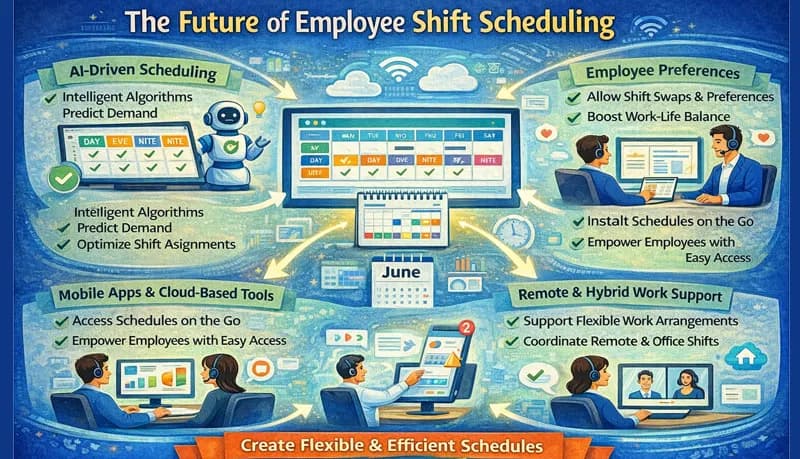
Call center scheduling has operated on the same basic model for decades: forecast call volume, calculate required staff per interval, build fixed shifts, assign agents, manage exceptions. The mechanics of building a weekly schedule have not changed fundamentally.
What is changing is the environment around scheduling — the legal requirements, the workforce composition, the expectations of hourly workers, and the operational complexity of multi-site, multi-channel, remote-first operations. These changes are not speculative future trends. They are happening now, and call centers that do not adapt their scheduling practices to account for them will face increasing compliance risk, hiring difficulty, and attrition.
Predictive scheduling laws are expanding
What they require
Predictive scheduling (also called "fair workweek") laws require employers to provide work schedules in advance and compensate employees for last-minute changes. These laws directly affect how call centers can build and modify schedules.
| Jurisdiction | Advance notice required | Penalty for late changes | Scope |
|---|---|---|---|
| Oregon | 14 days | 1 hour of pay per change within 14 days; time-and-a-half for shifts added within 10 days | Employers with 500+ employees (including retail, food service, hospitality) |
| New York City | 14 days (fast food); 72 hours (retail) | $10–$75 premium per change depending on notice given | Fast food and retail workers |
| San Francisco | 14 days | 1–4 hours of premium pay depending on change type | Retail and chain restaurant employers with 20+ employees in SF and 40+ worldwide |
| Chicago | 14 days | 1 hour of pay for each change within 14 days | Employers with 100+ employees in covered industries |
| Seattle | 14 days | 1 hour of pay per change; half-time pay for subtracted hours | Retail and food service employers with 500+ employees worldwide |
| Philadelphia | 14 days | 1 hour of premium pay for changes within 14 days | Retail, food service, hospitality employers with 250+ employees and 30+ locations |
| Los Angeles | 14 days | Predictability pay for changes within 14 days | Retail employers with 300+ employees globally |
What this means for call centers
Most existing predictive scheduling laws target retail, food service, and hospitality — industries with large hourly workforces and a history of unstable scheduling. Call centers are not yet explicitly covered in most jurisdictions. But the direction is clear: these laws are expanding to more cities and states, and some jurisdictions are broadening coverage to all hourly workers regardless of industry.
What to prepare for:
- Build schedules 14 days in advance using workforce scheduling software as standard practice, even where not yet legally required. This is already a scheduling best practice that reduces no-shows and attrition. Making it standard now avoids a scramble when legislation arrives.
- Document all schedule changes and the reason for each. If premium pay for changes becomes mandatory, you need records of when changes were made, why, and whether they were employer-initiated or employee-requested.
- Reduce reliance on last-minute schedule changes. Operations that routinely change schedules within 7 days will face significant premium pay costs under predictive scheduling laws. Better forecasting and overtime management reduce the need for last-minute changes.
Remote workforces create multi-jurisdiction complexity
The scheduling challenge
Before 2020, most call center agents worked from a centralized site. The scheduling constraints were local: one set of labor laws, one time zone, one commute pattern affecting shift preferences. Remote and hybrid workforces have changed this.
A BPO with remote agents across 10 states now faces:
- Different overtime rules. Some states calculate daily overtime (California: over 8 hours in a day), while most calculate weekly only (over 40 hours in a week). The same schedule can trigger overtime in one state and not another.
- Different minimum wage rates. A shift differential that is meaningful in a $7.25/hour state is negligible in a $16.66/hour state.
- Different break requirements. Some states mandate paid rest breaks at specific intervals; others do not. The schedule must accommodate the most restrictive requirements for agents in those states.
- Different leave laws. Paid sick leave accrual rates, parental leave duration, and carryover rules vary by state. Time-off management in the scheduling system must reflect each agent's state.
- Time zone distribution. Agents in Pacific time have a different relationship to an 8 AM–4 PM shift than agents in Eastern time. A schedule built around Eastern time may ask Pacific agents to start at 5 AM local time.
What to prepare for
- Scheduling software that supports per-employee rules. Tools that apply a single set of overtime, break, and minimum wage rules to all employees will create compliance errors in a multi-state workforce.
- Time zone-aware scheduling. Display schedules in each agent's local time, not headquarters time. Confusion about shift start times is one of the most common sources of adherence failures in distributed teams.
- State-specific break scheduling. If you have agents in California (10-minute paid break every 4 hours, 30-minute meal break by the 5th hour), your break staggering rules must enforce these minimums for those agents specifically.
Agent expectations are shifting
What has changed
The labor market for hourly workers has tightened, and worker expectations around schedule quality have increased. What was tolerated a decade ago — late schedule posting, mandatory overtime every week, zero input on shift preferences — now drives attrition to competitors who offer better scheduling practices.
| Old expectation | Current expectation | Impact on scheduling |
|---|---|---|
| "Take whatever shift you're assigned" | Agents expect some input on preferred shifts and days off | Shift bidding or preference-based assignment |
| Schedule posted a few days before | 2-week advance notice expected (and increasingly required by law) | Forecasting and schedule building must happen earlier |
| Mandatory overtime is part of the job | Agents will leave for employers who control overtime | Better staffing to reduce reliance on mandatory OT |
| No ability to swap shifts | Self-service shift swaps expected | Swap workflow with coverage validation |
| Schedule changes communicated verbally | Mobile-accessible schedules expected | Digital scheduling tools with push notifications |
| Same rigid schedule indefinitely | Some flexibility for life events (school schedule, childcare changes) | Periodic rebid or accommodation process |
This is not about offering unlimited flexibility — call centers still need coverage at specific times. It is about providing scheduling practices that treat agents as adults who have lives outside of work. The operations that do this retain agents longer and spend less on recruiting and training replacements.
What to prepare for
- Shift bidding as standard practice. Seniority-based bidding is the most common fair system — transparent, understood by agents, and rewards tenure (which reinforces retention).
- Self-service shift swaps. Agents should be able to initiate swaps with qualified colleagues without needing supervisor involvement for every transaction. The supervisor's role shifts from approving every swap to setting rules the system enforces automatically.
- Schedule stability as a retention tool. In exit interviews, schedule-related issues consistently rank among the top 3 reasons agents leave. Operations that invest in schedule quality — consistent patterns, advance notice, fair distribution of undesirable shifts — reduce attrition without spending more on wages.
Intraday management is becoming essential
The gap between schedule and reality
Even a well-built schedule diverges from reality within the first hour of the day. Agents call in sick. Call volume runs 15% above forecast. A training session runs long. The question is not whether the schedule will hold — it will not — but how quickly and effectively the operation adjusts.
Traditional call centers rely on supervisors to make intraday adjustments manually: calling in off-duty agents, extending shifts, canceling training sessions, moving breaks. This works at small scale but breaks down as the operation grows.
What intraday management looks like
| Trigger | Response | Who acts |
|---|---|---|
| 2 agents call in sick on the morning shift | Offer voluntary overtime to afternoon-shift agents willing to start early | Supervisor or WFM analyst |
| Call volume running 20% above forecast by 10 AM | Move non-essential activities (coaching, team meetings) to a lower-volume day | Operations manager |
| Service level dropping below target in a specific interval | Extend breaks into the next interval to keep agents on phones longer during the gap | Supervisor (with agent communication) |
| Volume dropping unexpectedly | Approve early releases for agents who want to leave, or pull forward training sessions | WFM analyst |
| BPO with one account over-volume and another under-volume | Shift cross-trained agents between accounts | Operations manager |
The goal is a structured decision framework — not ad hoc reactions. When the trigger occurs, the response is predefined: who makes the decision, what options are available, and what the escalation path is if the first response is insufficient.
What to prepare for
- Defined intraday response protocols. Document the triggers, responses, and decision owners. When a supervisor sees service level dropping at 10:30 AM, they should know exactly what levers they can pull without waiting for approval.
- Real-time visibility into schedule vs. actual. Supervisors need to see, at a glance, how many agents are on the phones right now compared to how many should be. Discovering a coverage gap at the end of the day — when overtime has already been incurred and service level has already missed — is too late.
- Cross-training for scheduling flexibility. BPOs that cross-train 20–30% of agents on multiple accounts have a structural advantage in intraday management: they can move agents between accounts based on real-time volume rather than being locked into account-specific schedules that cannot flex.
The fundamentals still matter most
The changes described above are real and important, but they build on top of scheduling fundamentals that many operations have not yet mastered:
- Matching coverage to volume patterns, not distributing agents equally across shifts
- Staggering breaks to maintain service level during peak intervals
- Building a 5–8% absence buffer into scheduled headcount
- Tracking schedule adherence and acting on chronic deviations
- Measuring overtime as a scheduling failure, not a normal operating condition
- Choosing scheduling tools that fit call center operations, not generic shift scheduling
An operation that masters these fundamentals will outperform one that adopts every new scheduling technology but ignores the basics. Get the foundations right first — our free shift schedule generator can help you build and test different shift patterns before committing. Then layer on the adaptations that the changing regulatory, workforce, and operational environment requires.