

Break Management in Contact Centers — How Breaks Affect Coverage, How to Schedule Them, and What to Do When They Go Wrong

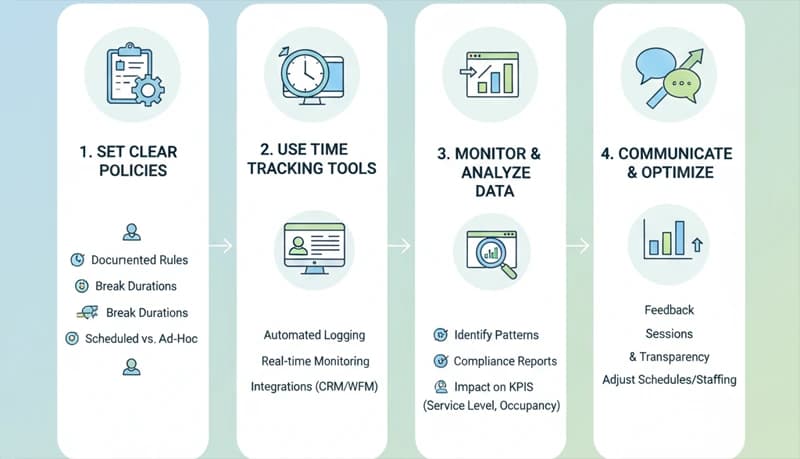
In a contact center, every agent on break is an agent not on the phones. A 15-minute break for one agent in a 20-agent shift is a 5% reduction in coverage for 15 minutes. If 4 agents take their break at the same time, coverage drops by 20% — and service level drops with it. This is why break management in a contact center is not an HR topic. It is an operational coverage problem that must be solved in the schedule.
Breaks must happen — agents need rest to maintain call quality, and state law may require them. The question is not whether to give breaks but how to schedule them so that coverage is maintained, compliance is met, and agents actually get the rest they need.
Break types and their coverage impact
| Break type | Duration | Paid or unpaid | Coverage impact | Shrinkage contribution |
|---|---|---|---|---|
| Paid rest break | 10–15 minutes | Paid (required by FLSA for breaks under 20 minutes) | Agent off phones for 10–15 minutes. Manageable if staggered | Typically 5–7% of paid time (two 15-minute breaks in an 8-hour shift) |
| Meal break (30 min) | 30 minutes | Unpaid (if agent is completely relieved of duties) | Agent off phones for 30 minutes. Significant if multiple agents take lunch simultaneously | Not counted in paid shrinkage if unpaid, but reduces on-phone headcount during the meal window |
| Meal break (60 min) | 60 minutes | Unpaid | Agent off phones for a full hour. Creates a large coverage gap unless the shift is designed to absorb it | Higher coverage impact than 30-minute meals. Less common in contact centers because of the scheduling difficulty |
| Unscheduled break | Varies (2–10 minutes) | Paid (bathroom, water, brief personal need) | Small per occurrence. Adds up if frequent or extended | Typically 1–3% of paid time in aggregate. Higher than 3% indicates an adherence problem |
How breaks affect the staffing calculation
Breaks are a component of shrinkage. The staffing model uses a shrinkage percentage to calculate how many agents to schedule above the on-phone requirement. If the model assumes 28% shrinkage and break time actually accounts for 10% of that, the break schedule must deliver that 10% — no more, no less.
What happens when breaks exceed the assumption:
If agents take 12% of their paid time on breaks but the model assumes 10%, the operation is effectively understaffed by 2 percentage points during break periods. In a 50-agent shift, that is 1 agent short — and if break time clusters instead of spreading evenly, the shortage during break intervals is worse.
How to schedule breaks
The stagger principle
The core rule: no more than 10–15% of scheduled agents should be on break at any time. This means breaks must be staggered across intervals, not given to groups simultaneously.
Worked example — 20-agent shift, 8:00–5:00:
Each agent gets two 15-minute paid breaks and one 30-minute unpaid lunch.
| Break | Groups | Timing | Agents on break | Agents on phones |
|---|---|---|---|---|
| Morning break | Group 1 (5 agents) | 9:30–9:45 | 5 | 15 |
| Group 2 (5 agents) | 9:45–10:00 | 5 | 15 | |
| Group 3 (5 agents) | 10:00–10:15 | 5 | 15 | |
| Group 4 (5 agents) | 10:15–10:30 | 5 | 15 | |
| Lunch | Group 1 (5 agents) | 11:30–12:00 | 5 | 15 |
| Group 2 (5 agents) | 12:00–12:30 | 5 | 15 | |
| Group 3 (5 agents) | 12:30–1:00 | 5 | 15 | |
| Group 4 (5 agents) | 1:00–1:30 | 5 | 15 | |
| Afternoon break | Group 1 (5 agents) | 2:30–2:45 | 5 | 15 |
| Group 2 (5 agents) | 2:45–3:00 | 5 | 15 | |
| Group 3 (5 agents) | 3:00–3:15 | 5 | 15 | |
| Group 4 (5 agents) | 3:15–3:30 | 5 | 15 |
At every point during the break window, 15 of 20 agents are on phones — a 25% reduction, which is manageable if the staffing model accounted for it. If all 20 agents took lunch from 12:00–12:30, the operation would have 0 agents for 30 minutes.
Break placement rules
| Rule | Rationale |
|---|---|
| Do not place breaks during peak intervals | If 9:00–10:00 is the highest-volume period, no breaks should be scheduled during it. Place morning breaks at 10:00+ (after the peak) or before 9:00 (before the peak) |
| Place lunches during the natural volume dip | Most business-hours operations see a dip from 11:30–1:30. This is the natural window for lunch breaks — the reduction in agents coincides with the reduction in volume |
| Place afternoon breaks between peaks | If there is a secondary afternoon peak (1:00–2:30), schedule afternoon breaks at 2:30+ after the peak subsides |
| Coordinate across shifts | If Shift A and Shift B overlap from 10:00–4:00, do not schedule both shifts' morning breaks at the same time. Interleave them so total on-break agents across both shifts stays within the 10–15% threshold |
| Account for ACW | An agent finishing a call at 9:29 with 3 minutes of ACW will not be available for their 9:30 break until 9:32. Build 2–3 minutes of buffer into break start times |
Compliance requirements
State break laws constrain when and how breaks can be scheduled. The key requirements that affect contact center scheduling:
| Requirement | States (examples) | Scheduling impact |
|---|---|---|
| 10-minute paid rest break per 4 hours | California, Colorado, Washington, Oregon, Nevada, Minnesota | Must schedule a break within each 4-hour block. Cannot skip the break even if call volume is high |
| 30-minute meal break by the 5th hour | California | Lunch must start before the agent completes 5 hours of work. An 8:00 start means lunch no later than 12:30 start. Violations result in 1 hour of premium pay per missed break |
| 30-minute meal break for 6+ hour shifts | New York, Connecticut, Delaware, others | Meal break required during shifts longer than 6 hours. Timing varies by state |
| Meal break must be duty-free | Federal (FLSA) | If the break is unpaid, the agent must be completely relieved of duties. If an agent is required to monitor a queue or stay at their desk during lunch, the break is not duty-free and must be paid |
| Break waiver for short shifts | California (6-hour shifts, mutual consent) | Agents on 6-hour shifts can waive the meal break by mutual agreement. Does not apply to 8-hour shifts |
| Documentation of meal breaks | California, Oregon, Washington | Must document actual meal break start and end times. Auto-deducting a standard 30 minutes without recording actual times is a compliance risk |
Multi-state operations: If agents work in different states (or remotely from different states), the break policy must apply the rules of the agent's work location. An agent working from home in California is subject to California break rules even if the call center is based in Texas (which has no break requirements).
Tracking break compliance
Breaks must be tracked — not just scheduled — because scheduled breaks and actual breaks often differ.
What to track
| Data point | Source | Why it matters |
|---|---|---|
| Actual break start time | Time tracking or WFM system | Compare to scheduled start. Late starts (agent returned late from previous break or was on a call) push breaks into coverage windows |
| Actual break end time | Time tracking or WFM | Compare to scheduled end. Extended breaks are the most common adherence issue in contact centers |
| Break duration | Calculated from start and end | Did the agent take the full break? Did they exceed it? |
| Break type | WFM or agent status codes | Was this a scheduled 15-minute break, a lunch, or an unscheduled break? The system must distinguish types for compliance tracking and shrinkage calculation |
| Missed breaks | WFM (scheduled break with no corresponding off-phone status) | Did a scheduled break not happen? In states requiring breaks, a missed break is a compliance violation |
The daily break report
Supervisors should review break data daily — not weekly or at end of pay period.
| Check | What to look for | Action if found |
|---|---|---|
| Extended breaks | Any break that exceeded scheduled duration by more than 5 minutes | Address same-day with the agent. Pattern of extended breaks = coaching conversation. Single occurrence = note and move on |
| Missed breaks | Agents who did not take a scheduled break | If the break was skipped due to high call volume, the break must be rescheduled — not skipped. In states with mandatory breaks, a missed break is an immediate compliance issue |
| Break clustering | Multiple agents on break simultaneously despite staggered scheduling | If 6 agents were on break at 10:15 but only 4 were scheduled for that time, 2 agents took unscheduled breaks. Coverage was 30% below plan for that interval |
| Late returns | Agents who returned from break more than 3 minutes after scheduled end | 3 minutes late from a 15-minute break is a 20% extension. Address as an adherence issue |
Break problems and their cost
Problem 1: Extended breaks
| What happens | Agents consistently return 3–5 minutes late from 15-minute breaks. A 15-minute break becomes 18–20 minutes |
|---|---|
| Frequency | Common — typically 15–25% of agents extend breaks by 3+ minutes on any given day |
| Coverage cost | If 4 of 20 agents extend breaks by 5 minutes each, the operation loses 20 agent-minutes of coverage per break cycle × 3 break cycles/day = 60 agent-minutes/day. Over a year: 60 × 250 working days = 15,000 agent-minutes = 250 hours of lost coverage |
| Financial cost | 250 hours × $15/hour = $3,750/year in lost productive time for a single 20-agent shift. In a 100-agent operation with the same pattern: approximately $18,750/year |
| Fix | Track break duration daily. Address patterns with individual agents. If the problem is widespread, investigate the cause — agents may be extending breaks because occupancy is too high and breaks are their only recovery time |
Problem 2: Break clustering
| What happens | Agents take breaks at the same time despite a staggered schedule. Common when agents are friends and want to break together, or when the schedule is published but not enforced |
|---|---|
| Coverage cost | Instead of 15 of 20 agents on phones during the break window, the operation drops to 12 or 10 — a 40–50% reduction instead of the planned 25% |
| Service level impact | A 20-agent operation at 80/20 service level needs approximately 16 agents on phones during moderate volume. If 8 agents are on break simultaneously (clustering), service level drops to 50–60% for that interval |
| Fix | Enforce the staggered schedule. The WFM system or supervisor manages break slots — agents go on break when their slot starts, not when their friend's slot starts. If agents resist, explain the coverage math |
Problem 3: Skipped breaks during high volume
| What happens | Volume spikes or unplanned absences create pressure. Supervisors ask agents to defer or skip breaks to maintain coverage |
|---|---|
| Compliance risk | In states with mandatory break laws (California, Colorado, Washington, others), skipping a required break is a violation regardless of business need. In California, each missed meal break results in 1 hour of premium pay to the agent |
| Quality risk | Agents who work 4+ hours without a break experience fatigue that degrades call quality. AHT increases, empathy decreases, and error rates rise |
| Fix | Breaks cannot be routinely skipped for coverage. If volume is consistently too high for the scheduled agents to take breaks, the operation is understaffed — the staffing model needs more agents, not fewer breaks. For genuine one-time spikes, defer the break by 15–30 minutes but do not eliminate it |
Problem 4: Agents using ACW as a break substitute
| What happens | Agents extend after-call work to get a few seconds of recovery between calls because occupancy is so high they have no other downtime |
|---|---|
| How to detect | ACW averages 90+ seconds when the documentation requirement takes 45 seconds. ACW is longer during high-volume intervals and shorter during low-volume intervals (agents do not need the buffer when calls are less frequent) |
| Root cause | Occupancy is too high. Agents have no time between calls to recover, so they create their own recovery time by staying in ACW |
| Fix | Reducing ACW without addressing occupancy will force agents to find another coping mechanism (extended breaks, increased absences). The fix is reducing occupancy to a sustainable range (80–85%) by adding agents or reducing volume |
Problem 5: Auto-deducted breaks that were not taken
| What happens | The timesheet system auto-deducts 30 minutes for lunch regardless of whether the agent actually took the break |
|---|---|
| Compliance risk | If the agent worked through lunch, the auto-deduction creates an underpayment. The agent was not paid for 30 minutes of work. This is a wage violation |
| Financial risk | Systematic auto-deduction without verification creates liability across all agents. If audited, back-pay for missed breaks can apply to every affected agent for up to 3 years (federal) or longer (state-dependent) |
| Fix | Track actual break start and end times. Never auto-deduct. If the system shows an agent did not take a break, the supervisor investigates — was it a choice, a volume issue, or a tracking error? |
Break management for remote agents
Remote and hybrid agents have the same break requirements as in-office agents, but enforcement and verification differ.
| In-office | Remote equivalent |
|---|---|
| Supervisor sees agents leave and return from break | Time tracking records break start/end times. Agent status in ACD changes to "break" and back to "available" |
| Break room provides a physical signal that the agent is on break | Agent's ACD status is the signal. If the agent is in "break" status for 23 minutes on a 15-minute break, the system flags it |
| Supervisor can visually confirm agents returned on time | WFM adherence report shows break end time vs. scheduled end time. Supervisor reviews adherence daily |
| Clock on the wall keeps break timing consistent | Break start is triggered by the schedule, not by the agent's wall clock. The system notifies the agent when their break starts and ends |
The risk with remote agents: Without physical supervision, remote agents may take longer unscheduled breaks, start scheduled breaks early, or return late. The solution is not surveillance — it is the same adherence tracking used for all agents, applied consistently. If remote agents have worse break adherence than in-office agents, investigate whether the remote work eligibility criteria include adherence standards.
BPO break management
BPO operations have additional break management considerations.
| Consideration | What it means |
|---|---|
| Per-client coverage during breaks | If 3 of 10 dedicated Client A agents are on break simultaneously, Client A's coverage drops by 30% — even if the overall operation has adequate coverage. Break staggering must be done per client account, not just per shift |
| SLA impact by account | A break-driven coverage dip on a high-SLA account has different consequences than on a lower-SLA account. Prioritize break placement on accounts with the tightest SLA targets |
| Multi-state compliance | A BPO with agents in California, Texas, and New York must apply California break rules to California agents, and New York rules to New York agents — even if all agents are on the same client account |
| Cross-trained agents | When a cross-trained agent goes on break, coverage drops on every account they serve. Break scheduling for cross-trained agents should consider which account needs them most during the break window |
| Client reporting | Some clients require visibility into break-related coverage dips. If the SLA report shows a service level miss at 12:15, and the cause was 4 of 8 dedicated agents on lunch simultaneously, the BPO needs to explain the cause and prevent recurrence |
