

Intraday Management in Call Centers — The Triggers, the Responses, and Who Makes the Call

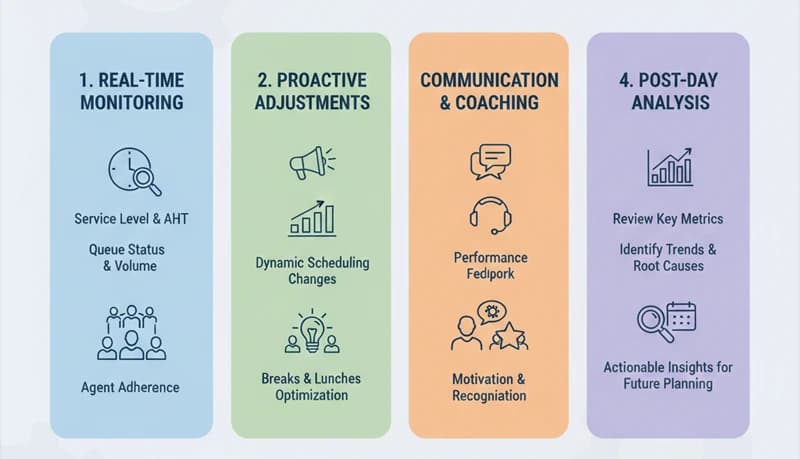
The schedule is the plan. Intraday management is what happens when reality deviates from the plan — which it does every day. Agents call in sick. Volume runs above or below forecast. A training session runs long. A system outage takes agents offline. The question is not whether deviations will happen but whether the operation has a structured response or whether supervisors improvise under pressure.
In most call centers, intraday management is informal. The supervisor notices the queue building, asks someone to skip their break, maybe calls an off-duty agent. This works at small scale. It breaks down at 50+ agents because the supervisor cannot hold the entire picture — who is on break, who is approaching overtime, which agents are cross-trained for which accounts, what the forecast says about the next 2 hours — in their head.
Structured intraday management defines the triggers that require action, the response options for each trigger, and who has the authority to execute each response. When it works, the operation adjusts within 15–30 minutes of a deviation rather than discovering the damage at the end of the day.
What the supervisor needs to see in real time
Before any response is possible, the supervisor needs visibility into four things simultaneously:
| Information | What it shows | Where it comes from |
|---|---|---|
| Agents logged in vs. scheduled | How many agents are actually on the phones compared to how many should be | Time tracking or WFM system compared against the schedule |
| Current service level | Whether calls are being answered within the target threshold (e.g., 80% within 20 seconds) | ACD real-time display |
| Queue depth and longest wait | How many callers are waiting and how long the longest has been waiting | ACD real-time display |
| Agent states | Who is on a call, who is in after-call work, who is available, who is on break, who is in a non-phone activity | ACD agent status or WFM real-time adherence |
If the supervisor cannot see all four of these at a glance, they are managing blind. They will not know there is a problem until it has been affecting service level for 30+ minutes.
The trigger-response framework
Intraday management is most effective when it is structured as a set of predefined triggers and responses rather than ad hoc decisions. Each trigger has a threshold, a set of response options, and a decision owner.
Trigger 1: Unplanned absences
Threshold: Any shift that drops below the minimum required agent count due to unplanned absences.
When to detect: Within 30 minutes of shift start. If 3 agents are scheduled to start at 8:00 AM and have not logged in by 8:15, the supervisor should be acting — not waiting to see if they show up.
| Agents absent | Response options | Decision owner |
|---|---|---|
| 1 agent (within absence buffer) | No action needed — the buffer handles it | Supervisor (acknowledge, no action) |
| 2 agents (at buffer limit) | Defer non-essential activities (coaching, team meeting) to keep agents on phones. Shift breaks to lower-volume intervals | Supervisor |
| 3+ agents (beyond buffer) | Offer voluntary overtime to off-shift agents. Consider canceling training. Extend current-shift agents by 1–2 hours (voluntary first, mandatory only if necessary) | Supervisor with ops manager approval for mandatory OT |
Trigger 2: Volume above forecast
Threshold: Actual volume running 15%+ above forecast for 2 consecutive intervals (1 hour).
A single interval above forecast may be normal variability. Two consecutive intervals suggest the day will run high. Waiting for a third interval costs another 30 minutes of degraded service.
| Volume above forecast | Response options | Decision owner |
|---|---|---|
| 15–25% above | Defer non-essential activities. Shift breaks to later intervals. Extend after-call work limits (if agents are spending excessive time in ACW) | Supervisor |
| 25–40% above | All of the above, plus offer voluntary overtime for the next shift. Cancel or shorten training sessions. Ask available back-office staff to take overflow calls (if cross-trained) | Supervisor + ops manager |
| 40%+ above | Emergency response — call in off-duty agents, activate on-call pool, cancel all non-essential activities, notify client (BPO) of potential SLA impact | Ops manager |
Trigger 3: Volume below forecast
Threshold: Actual volume running 20%+ below forecast for 2 consecutive intervals.
Overstaffing is less urgent than understaffing but still costs money — agents sitting idle are paid but not productive.
| Volume below forecast | Response options | Decision owner |
|---|---|---|
| 20–30% below | Offer voluntary time off (VTO) to agents who want to leave early. Pull forward training or coaching sessions | Supervisor |
| 30%+ below | Approve additional VTO. Move scheduled training from a future high-volume day to today. Conduct QA evaluations or coaching sessions with available agents | Supervisor |
Important: VTO should always be voluntary. Sending agents home without their agreement — especially hourly agents who need the hours — creates resentment and may violate predictive scheduling laws in some jurisdictions.
Trigger 4: Service level dropping
Threshold: Service level drops below target for 2 consecutive intervals without an obvious cause (volume spike, mass absence).
Sometimes service level drops even when staffing looks adequate. The causes are subtler:
| Possible cause | How to identify | Response |
|---|---|---|
| Too many agents on break simultaneously | Net available agents (logged in minus on break) is below requirement | Stagger remaining breaks — recall agents from break early if legally permissible, or shift upcoming breaks to later |
| Adherence slippage | Agents in wrong states — showing "available" but not taking calls, or in extended after-call work | Supervisor contacts non-adherent agents individually |
| AHT spike on a specific call type | AHT is running 20%+ above normal | Check if a new issue is driving longer calls (system problem, billing error, product defect). If so, create a quick reference for agents to handle it faster |
| System performance issue | Application load times are slow, adding hold time to every call | Escalate to IT. Notify agents to set expectations with callers about delays |
Trigger 5: BPO account imbalance
Threshold: One client account is running above-forecast volume while another is running below forecast, and the above-forecast account is missing SLA.
This trigger is specific to BPOs with multiple client accounts.
| Condition | Response | Decision owner |
|---|---|---|
| Cross-trained agents available on the below-forecast account | Move cross-trained agents to the above-forecast account for the duration of the imbalance | Supervisor or WFM analyst |
| No cross-trained agents available | Offer VTO on the below-forecast account. Offer VOT to off-shift agents trained on the above-forecast account | Ops manager |
| Imbalance persists across multiple days | Review whether the forecast for both accounts needs recalibration. Consider whether additional cross-training is needed | Ops manager + WFM |
Decision authority matrix
A common intraday management failure is unclear authority — the supervisor knows what should happen but is not sure whether they can authorize it without approval. While the supervisor waits for the ops manager to respond to a message, service level continues to degrade.
Define in advance who can authorize each intraday action:
| Action | Supervisor can authorize? | Requires ops manager? |
|---|---|---|
| Shift breaks to different intervals | Yes | No |
| Defer coaching or team meetings | Yes | No |
| Offer VTO (voluntary time off) | Yes, within daily limit | If total VTO exceeds daily limit |
| Offer VOT (voluntary overtime) | Yes | No |
| Cancel training sessions | Yes, for sessions they control | Yes, for cross-team or organization-wide training |
| Authorize mandatory overtime | No | Yes |
| Move agents between accounts (BPO) | Yes, for cross-trained agents | Yes, if moving agents with limited cross-training |
| Escalate to client about SLA risk (BPO) | No | Yes |
When the authority is defined in advance, the supervisor acts immediately instead of escalating and waiting.
The intraday management cadence
Structure intraday management as a series of check-ins rather than continuous monitoring. Continuous real-time monitoring sounds ideal but is impractical — the supervisor has other responsibilities (coaching, escalation handling, administrative tasks).
| Check-in | Time | Duration | What to review |
|---|---|---|---|
| Shift start | Within 15 min of shift start | 5 min | Who is logged in vs. scheduled? Any absences to address? |
| Mid-morning | 10:00–10:30 AM | 5 min | Service level for first 2 hours. Volume vs. forecast. Adherence. Any emerging issues? |
| Pre-lunch | 11:30 AM | 5 min | Break staggering on track? Any agents approaching overtime threshold? |
| Post-lunch | 1:30 PM | 5 min | Service level for the day so far. Afternoon volume tracking to forecast? |
| Mid-afternoon | 3:00–3:30 PM | 5 min | Overtime status — anyone who will hit 40 hours if they finish the shift? Late-shift handoff — is the evening shift fully staffed? |
| End of day | Last hour of shift | 10 min | Day summary — service level, adherence, deviations from plan. Notes for tomorrow's supervisor |
Between check-ins, the supervisor monitors passively — they can see the real-time display but are not actively analyzing it unless an alert triggers.
Logging intraday actions
Every intraday deviation and response should be logged — not in elaborate detail, but enough to answer "what happened and what did we do about it" during the weekly review.
| Field | Example |
|---|---|
| Date and time | March 13, 10:15 AM |
| Trigger | Volume 22% above forecast for 10:00–10:30 and 10:30–11:00 intervals |
| Service level impact | SL dropped to 68% (target 80%) during 10:00–10:30 |
| Action taken | Deferred 10:30 AM coaching session (4 agents returned to phones). Shifted 3 agent breaks from 11:00 to 11:30 |
| Result | SL recovered to 79% by 11:00 |
| Follow-up needed | Check forecast for Thursday — same pattern likely if volume trend continues |
This log serves two purposes: it creates accountability for intraday decisions, and it provides data for improving the forecast and schedule. If the same trigger (volume above forecast on Tuesday mornings) recurs for 3 consecutive weeks, the problem is not intraday — it is a forecasting problem that needs a structural fix.
What intraday management cannot fix
Intraday management is tactical — it addresses today's deviations from today's plan. It cannot fix structural problems:
| Structural problem | Intraday symptom | The real fix |
|---|---|---|
| Not enough agents hired | Overtime every day, VTO never offered, service level chronically below target | Hire more agents |
| Schedule does not match volume curve | Same intervals miss SL every day despite adequate total headcount | Rebuild the schedule with volume-matched shifts |
| Forecast consistently wrong | Supervisor makes the same intraday adjustments every day | Fix the forecast so the schedule accounts for the actual pattern |
| Chronic high attrition | Absences and staffing gaps every week as agents leave | Address retention — the turnover is the problem, not the daily coverage |
| Shrinkage underestimated | Fewer agents available than planned, every shift, every day | Recalculate shrinkage from actual data and reschedule |
If the supervisor is making the same intraday adjustments 4–5 days per week, the problem has moved from intraday management to workforce planning. Recurring intraday problems should be escalated to the planning process — not absorbed as the new normal.
