Absenteeism in Call Centers — Causes, Costs, and Solutions

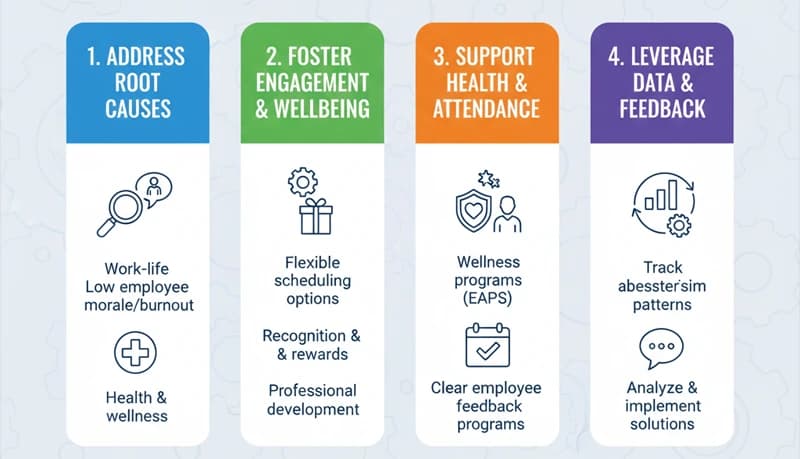
Unplanned absenteeism in call centers typically runs 5–8% on any given day. In a 100-agent operation, that means 5–8 agents are absent every day who were expected to be there. Each absence either goes unfilled — and service level drops — or gets filled by overtime at 1.5x the regular rate.
A 5% absence rate does not sound alarming until you calculate the cost. For a 100-agent operation at $15/hour average wage, 5% unplanned absenteeism means roughly 5 agents × 8 hours × 260 working days = 10,400 hours of lost coverage per year. If half of those are covered by overtime, the annual cost is approximately $78,000 in overtime pay alone — not counting the service level impact, the burnout on agents who cover the gaps, and the management time spent scrambling for coverage.
The question is not whether you will have absenteeism — you will. The question is whether the rate is manageable (built into your schedule as a buffer) or whether it is a symptom of deeper operational problems that need to be addressed.
Measuring absenteeism correctly
The basic calculation
Absence rate (%) = (Unplanned absent days / Total scheduled days) × 100
What counts as an unplanned absence:
- Sick calls (agent calls in and does not work)
- No-call no-shows (agent does not show up or call)
- Late arrivals beyond tolerance that result in missed partial shifts
- Leaving early without approval
What does not count:
- Approved PTO/vacation (this is planned absence — it should be in the schedule already)
- FMLA leave
- Jury duty
- Bereavement leave
- Workers' compensation absences
- Any other legally protected leave
Mixing planned absences (PTO) with unplanned absences (sick calls) in the same metric produces a number that is useless for diagnosis. A high absence rate that includes 4% PTO and 3% sick calls tells a different story than one that is 2% PTO and 5% sick calls. Track them separately.
What the rate tells you
| Unplanned absence rate | What it means | Action |
|---|---|---|
| Fewer than 4% | Low — within normal range for healthy operations | Build a 4–5% buffer into schedules and maintain current practices |
| 4–6% | Typical — manageable with proper scheduling buffers | Build a 6–7% buffer, monitor for upward trend |
| 6–8% | Elevated — likely a mix of individual and systemic causes | Investigate patterns (see diagnosis section below) |
| Above 8% | Problematic — systemic issue affecting the operation | Systemic investigation required — the schedule cannot buffer this away |
Track the pattern, not just the rate
The overall absence rate is a starting point. The diagnostic value is in the patterns:
| Pattern to track | How to track it | What it reveals |
|---|---|---|
| By day of week | Absence rate per day, trailing 8 weeks | Monday/Friday spikes suggest extended weekends. Mid-week spikes suggest fatigue or scheduling problems on specific shifts |
| By shift | Absence rate per shift (early, mid, late) | Higher absence on a specific shift suggests that shift has a problem — bad supervisor, undesirable hours, high occupancy |
| By tenure | Absence rate for 0–90 day agents vs. 90+ day agents | High absence in new agents suggests onboarding or job-fit issues |
| By individual | Absences per agent, rolling 12 months | Identifies chronic absentees vs. agents with one-time events |
| By season | Monthly rate over 12 months | Cold/flu season spikes are normal. Persistent summer spikes may indicate disengagement |
| Adjacent to days off | Absences on days immediately before or after scheduled days off | Pattern of extending scheduled days off suggests engagement issues |
Individual vs. systemic absenteeism
The most important diagnostic question is whether the absenteeism is concentrated in a few individuals or spread across the team.
Individual absenteeism
What it looks like: 5–10 agents account for 40–60% of all unplanned absences. The rest of the team has a normal absence rate.
Common causes:
- Chronic health condition (may require ADA accommodation)
- Personal situation (childcare, transportation, second job conflicts)
- Disengagement — agent has checked out but has not quit yet
- Substance abuse
- Knowingly exploiting a weak attendance policy
The right response: Address individually. For health or personal situations, explore whether accommodation or schedule adjustment can help. For disengagement or attendance exploitation, apply progressive discipline — verbal counseling, written warnings, and termination if the pattern continues.
The wrong response: Implementing team-wide policies that punish everyone for the behavior of a few. Mandatory overtime for the entire team because 3 agents call in sick regularly punishes the reliable agents and accelerates their attrition.
Systemic absenteeism
What it looks like: The absence rate is high across the entire team. No small group accounts for a disproportionate share. New agents and tenured agents both call in at elevated rates.
Common causes:
| Systemic cause | How to identify | What to fix |
|---|---|---|
| Occupancy too high (above 85% sustained) | Check occupancy by shift — agents are burned out from back-to-back calls with no recovery time | Add staff to bring occupancy to 75–85% |
| Mandatory overtime every week | Check overtime hours by week — agents see no end to extended hours | Fix the staffing gap that makes overtime necessary |
| Unfair scheduling | Check whether weekend/evening distribution is equitable. Agents who feel the schedule is unfair disengage | Implement shift bidding or rotation for undesirable shifts |
| Poor supervision | Check whether absence rates vary significantly by supervisor — one team at 10% while others are at 4% | Coach or replace the supervisor, not the agents |
| Low pay relative to market | Check whether you are losing agents to competitors offering more — agents who are looking elsewhere call in more | Adjust compensation or address non-monetary retention levers |
| No attendance accountability | No attendance policy or existing policy not enforced | Implement and enforce progressive discipline consistently |
| Schedule published late | Agents cannot plan their lives around the schedule — conflicts arise, agents call in | Publish schedules 2+ weeks ahead |
The wrong response: Treating systemic absenteeism as an individual discipline problem. If 25% of your agents are calling in at elevated rates, the problem is not 25% bad employees — it is something about the operation that is driving the behavior.
Interventions that reduce absenteeism
Fix the working conditions first
Before any incentive or discipline program, check whether the operation is creating conditions that drive absences:
- Is occupancy chronically above 85%? Agents who are on calls back-to-back for 7.5 hours call in sick because they are exhausted.
- Is the schedule posted less than 1 week ahead? Agents who cannot plan their lives around their schedule will have more conflicts.
- Are breaks staggered properly? Agents who go 4+ hours without a break are more fatigued and more likely to call in the next day.
- Is mandatory overtime a regular occurrence? Agents who work 45–50 hours every week without a choice will use sick calls to reclaim their time.
If any of these are true, fixing them will reduce absenteeism more than any incentive program. You cannot incentivize people into wanting to show up for a job that burns them out.
Attendance policy with progressive discipline
A clear attendance policy that is applied consistently is the baseline. The policy should define:
- What counts as an unplanned absence
- How absences accumulate (point system or occurrence system)
- What the progressive discipline steps are (verbal counseling → written warning → final warning → termination)
- What absences are excluded from the count (FMLA, ADA, etc.)
- How the accumulation resets (rolling 12 months)
The policy only works if it is enforced consistently across all agents and all supervisors. Inconsistent enforcement — one supervisor ignoring absences while another writes up every instance — creates resentment and legal risk.
Schedule quality
Schedule-related interventions reduce absenteeism by removing the conditions that drive it:
| Intervention | Why it works |
|---|---|
| Publish schedules 2 weeks ahead | Agents have time to arrange coverage for personal conflicts instead of calling in |
| Allow shift swaps | An agent who can trade a shift they cannot work avoids the absence entirely |
| Offer shift bidding by seniority | Agents who chose their schedule are less likely to skip it |
| Stagger shifts with multiple start times | Agents can select shifts that fit their transportation or childcare needs |
| Build absence buffers into the schedule | Absences still occur but they do not cause service level misses or mandatory overtime for the remaining agents |
Accurate tracking
You cannot manage what you do not track. An attendance tracker that records clock-in/clock-out times against the published schedule provides:
- Accurate absence data without relying on supervisor observation
- Late arrival tracking (was the agent 5 minutes late or 25 minutes late?)
- Pattern detection (same agent, same day of week, every 2 weeks)
- Data for attendance write-ups that is objective and defensible
Manual attendance tracking — where the supervisor notes who is absent based on a headcount — is inconsistent. Different supervisors have different thresholds for what they report, and the data is unreliable for identifying patterns or supporting discipline.
Return-to-work conversations
A brief conversation when an agent returns from an unplanned absence serves two purposes: it shows the agent that their absence was noticed and it provides information about whether an accommodation or schedule adjustment might prevent future absences.
The conversation is not punitive — it is informational:
- "We missed you yesterday — is everything okay?"
- "Is there anything about your schedule that is making it difficult to get here?"
- "I want to make sure you know about [the EAP/leave options/schedule flexibility] available to you."
Return-to-work conversations reduce absence rates because they remove the anonymity of calling in. An agent who knows they will have a face-to-face conversation when they return is less likely to call in for a non-genuine reason.
What does not reduce absenteeism
Attendance bonuses alone. Perfect attendance bonuses sound appealing but have limited effect. They reward agents who would show up anyway and do not change the behavior of chronic absentees. An agent who calls in sick 8 times per year and loses a $200 annual attendance bonus is paying $25 per absence for a day off — a trade many agents will take. If you offer an attendance incentive, tie it to a shorter period (monthly, not annual) so the reward feels more achievable.
Threats without follow-through. An attendance policy that threatens termination at 6 occurrences but never actually terminates anyone at 6 occurrences is not a policy — it is a suggestion. Agents learn quickly whether the policy is enforced or not.
Surveillance as a substitute for management. Installing cameras, tracking bathroom breaks, or monitoring every minute of an agent's day does not reduce absenteeism — it increases it. Agents who feel surveilled and distrusted disengage faster than agents who feel managed and supported.
Ignoring the data. Tracking absenteeism without acting on what the data shows is the most common failure. If the data shows that one shift has twice the absence rate of other shifts, that is a finding that requires investigation — not just a line item in a monthly report.
The cost-benefit of reducing absenteeism
Every percentage point reduction in unplanned absence rate produces measurable savings:
For a 100-agent operation at $15/hour average wage:
| Metric | At 8% absence rate | At 5% absence rate | Savings |
|---|---|---|---|
| Unplanned absent hours/year | 16,640 | 10,400 | 6,240 hours |
| Overtime hours to cover (estimated 50% coverage) | 8,320 | 5,200 | 3,120 hours |
| Overtime cost ($22.50/hour) | $187,200 | $117,000 | $70,200 |
| Service level impact | Frequent misses, customer complaints | Manageable with schedule buffers | Fewer misses |
| Supervisor time managing coverage | 5+ hours/week | 2 hours/week | 150+ hours/year |
A 3-percentage-point reduction in absence rate — from 8% to 5% — saves approximately $70,000 per year in overtime alone for a 100-agent operation. The interventions that produce this reduction (better scheduling, attendance policy enforcement, return-to-work conversations, accurate attendance tracking) cost a fraction of that amount.
Related glossary entries: tardiness, no call no show, presenteeism, and shrinkage, absenteeism, and leave of absence.