Shrinkage in Contact Centers — Understanding and Fixing It

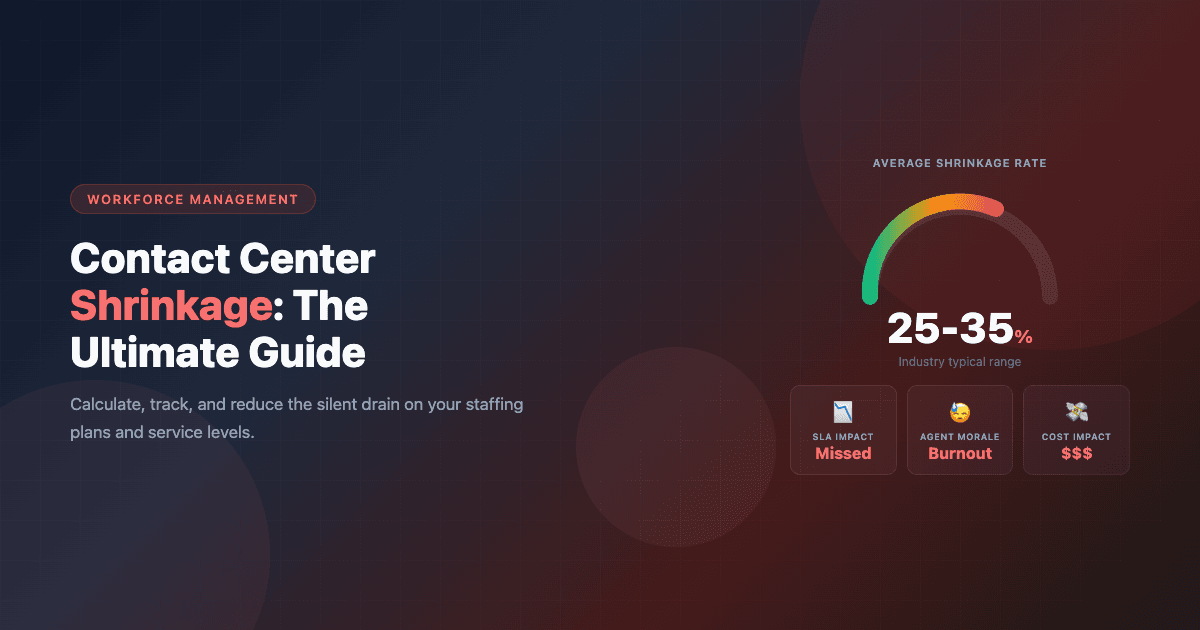
The Silent Drain: Why Shrinkage is a Contact Center's Biggest Headache
Imagine you've meticulously planned a dinner party for ten guests, bought enough food, set out ten plates. But when dinner time arrives, only seven show up, and two of the remaining three are constantly running to the kitchen for snacks, or calling friends, leaving the table unattended. That's a simplified picture of call center shrinkage in action. It's the silent drain, the unseen force that eats away at your carefully constructed staffing plans, leaving you understaffed and scrambling.
Shrinkage isn't just an inconvenient number; it's the insidious factor that can derail your service levels, overwork your agents, and ultimately chip away at your bottom line. It's the difference between the staff you schedule and the staff who are actually available to take incoming calls or respond to customer support inquiries. Understanding it, calculating it, and most importantly, reducing it, is paramount for any contact center leader striving for customer satisfaction and agent well-being.
Unmasking Shrinkage: What Exactly Are We Talking About?
At its core, contact center shrinkage refers to the percentage of paid time that call center agents are not available to handle customer interactions. It's often misunderstood as merely "agents not working," but it's far more nuanced. Think of it as all the legitimate (and sometimes illegitimate) reasons an agent isn't logged in and ready to serve customers during their scheduled time. Call center shrinkage is a necessary evil to some extent, but its management determines success.
Let's say you've scheduled 100 agent hours for a particular shift. If, due to various factors, only 80 of those hours are spent actively handling customer calls, you're experiencing 20% shrinkage. That 20% isn't just lost time; it translates directly into missed service level targets, longer wait times, and frustrated customers.
Beyond the Obvious: What Contributes to Shrinkage?
Shrinkage isn't a single monolithic problem; it's a composite of many different elements, some within your control, others less so. It's like a mosaic, with each tile representing a different reason an agent might not be available.
Consider the agent who needs to take an approved vacation day. That's planned shrinkage—a planned absence that's a necessary part of agent well-being. Then there's the agent who calls in sick unexpectedly—that's unplanned shrinkage driven by an unplanned absence. Both contribute to shrinkage, but they require very different management approaches. And it goes deeper. What about the team meeting? The one-on-one coaching session with a supervisor? The mandatory training on a new product? The five-minute bathroom break? The coffee refill? Even the few minutes spent logging into systems at the start of a shift or dealing with technical issues can add up. After-call work—the time agents spend documenting interactions and updating records after a customer conversation—is another significant contributor that's often underestimated.
Beyond these common occurrences, there are often less visible contributors. Think about system downtime, where agents are literally waiting for technology to catch up. Or agents who are stuck on a particularly complex interaction, requiring extensive research or escalation, thus becoming unavailable for the next call. Each of these elements, both scheduled and unscheduled, voluntary and involuntary, directly impacts your overall shrinkage figure. The amount of time lost to these factors during working hours can be staggering when tallied up. Recognizing these diverse components is the first step toward effective management.
The Math Behind the Mystery: How to Calculate Call Center Shrinkage Accurately

Calculating call center shrinkage isn't about complex algorithms or advanced data science, though sophisticated WFM tools can certainly help with the shrinkage calculation. It's about understanding a straightforward ratio that provides profound insight into your operational efficiency.
The Shrinkage Formula: A Simple Equation, a Powerful Insight
The basic shrinkage formula for calculating shrinkage is deceptively simple:
Shrinkage Percentage = (Total Unavailable Time / Total Paid Time) × 100
Let's break that down. "Total Paid Time" refers to all the hours your agents are paid to be at work or otherwise on the clock, including their scheduled breaks, training time, etc. "Total Unavailable Time" encompasses all the reasons agents are not actively handling customer interactions during their paid time.
For example, if your contact center has 50 agents, and each works an 8-hour shift, your Total Paid Time for the day is 400 hours (50 agents × 8 hours). Now, let's say that across all those agents, they spent a combined 60 hours on breaks, team meetings, training, and unplanned absences.
Shrinkage = (60 hours / 400 hours) × 100 = 15%
This 15% tells you that for every 100 hours you pay your agents, only 85 hours are truly available for customer interactions. That's a powerful insight, immediately highlighting where your staffing plans might be falling short. Understanding the number of agents you actually need means accounting for this gap between scheduled and productive time.
The Nuance of Real-World Scenarios
While the formula is simple, applying it in the real world requires a keen eye for detail. You'll need to accurately categorize and track all non-productive time. This means having robust time-tracking systems and clear definitions for different shrinkage categories.
Consider the difference between internal and external shrinkage. Internal shrinkage refers to non-productive time that occurs while an agent is physically at work (breaks, meetings, training, system issues). External shrinkage relates to time agents are not present at all (vacation, sick days, FMLA). Often, these are calculated separately and then combined for an overall call center shrinkage rate, allowing for more targeted interventions. Understanding your shrinkage rate for each category is critical for pinpointing where to focus improvement efforts.
Furthermore, shrinkage isn't static. It can fluctuate by day of the week, time of day, or even seasonally. A Tuesday morning might have higher meeting-related shrinkage than a Saturday afternoon. Therefore, for truly actionable insights, you'll want to calculate call center shrinkage for different periods (daily, weekly, monthly) and segment it by specific categories to pinpoint the biggest contributors. Leveraging historical data from previous periods helps you identify trends and set realistic benchmarks. This nuanced approach moves you beyond a single number to understanding the why behind your shrinkage.
The Cost of Inaction: Why You Can't Afford to Ignore Shrinkage
Ignoring call center shrinkage is akin to running a business with a leaky bucket—no matter how much you pour in, you'll always come up short. The consequences of unmanaged shrinkage ripple through every facet of your contact center, impacting service quality, people, and profits.
Impact on Service Level Agreements (SLAs)
Your Service Level Agreement (SLA) is the promise you make to your customers: "We'll answer 80% of calls within 20 seconds," for example. When shrinkage is high, you simply don't have enough agents available to meet this promise.
Imagine a busy lunch rush. You've planned for 50 agents, but due to unexpected sick calls and a mandatory system update, only 40 are actually logged in. This 20% shrinkage directly translates to longer wait times, increased abandonment rates, and a failure to meet your SLA. Customers get frustrated, which damages the overall customer experience and can lead to negative reviews, lost business, and a damaged brand reputation. The direct link between call center shrinkage and customer satisfaction is undeniable.
The Ripple Effect on Agent Morale and Retention
When your contact center operates with high shrinkage, the remaining agents bear the brunt of the workload. They face back-to-back calls, extended shifts, and the pressure of angry customers. This constant stress is a fast track to burnout.
Overworked agents become disengaged agents. Their morale plummets, leading to higher rates of absenteeism (feeding the shrinkage beast further!) and ultimately, higher agent turnover. Replacing agents is incredibly expensive—recruitment, onboarding, training—making retention a critical goal. Uncontrolled shrinkage creates a vicious cycle: high shrinkage leads to overworked agents, which leads to burnout and turnover, which further exacerbates shrinkage. Maintaining appropriate staffing levels is the key to breaking this cycle.
Bottom Line Blues: Financial Ramifications
Every percentage point of shrinkage carries a direct financial cost. You are paying agents for time they are not actively serving customers. This means you're effectively paying for a resource you're not utilizing to its full potential.
Consider the example from before: 15% shrinkage means 15% of your labor budget isn't contributing directly to customer interactions. Over a year, for a large contact center, this can amount to hundreds of thousands or even millions of dollars in wasted wages. Beyond that, there's the cost of lost business due to poor customer service, the expenses associated with high agent turnover, and potential penalties for failing to meet contractual SLAs. Shrinkage isn't just an operational metric; it's a profit killer.
Battling the Beast: Proven Strategies to Reduce Shrinkage

Reducing call center shrinkage isn't about magically eliminating all non-productive time—some of it is necessary for a healthy workforce. Instead, it's about optimizing, controlling, and strategically planning for it. Think of it as optimizing your engine, not just draining the fuel tank. Call center managers play a pivotal role in implementing these strategies effectively.
1. Empowering Your Agents: Training and Development
A well-trained agent is a more efficient agent, reducing shrinkage from various angles. If agents are confident and competent, they spend less time researching, escalating calls, or being "stuck" on complex issues. This directly improves agent productivity and lowers handle times, reducing the need for supervisory intervention (another form of shrinkage).
Investing in continuous training, skill-building workshops, and clear knowledge bases empowers agents to resolve issues quickly and accurately. This not only benefits customers but also frees up agents for the next interaction sooner. Moreover, offering growth opportunities through development can boost morale and reduce turnover, which are significant contributors to shrinkage.
2. Scheduling Smarter, Not Harder: Workforce Management Optimization
Workforce management is your primary weapon against shrinkage. It's not just about filling seats; it's about strategically placing the right people with the right skills at the right time. Advanced workforce management software uses sophisticated algorithms to forecast demand and schedule agents, factoring in known shrinkage components like breaks, meetings, and planned time off.
The key is to leverage WFM to schedule non-productive activities during forecasted lulls in call volume. For example, scheduling team meetings or training sessions during historically quieter periods minimizes their impact on service levels. Dynamic scheduling, which allows for real-time adjustments based on actual call volumes and agent availability, is another powerful tool to keep the shrinkage rate under control. Modern call center software with built-in WFM capabilities makes this process significantly easier.
3. The Human Touch: Boosting Engagement and Retention
High agent turnover is a massive contributor to shrinkage, as onboarding new agents creates a temporary gap in productive capacity. A positive work environment that fosters engagement and promotes agent retention is therefore a direct shrinkage reduction strategy.
Focus on creating a supportive culture. Provide regular, constructive feedback, recognize achievements, and ensure agents feel valued. Offer competitive compensation and benefits, clear career paths, and opportunities for advancement. Engaged agents are less likely to call out sick, more likely to be punctual, and more invested in their role, all of which directly combat shrinkage. Happy agents stay; unhappy agents leave, creating a new shrinkage problem.
4. Tech to the Rescue: Leveraging Automation and AI
Technology can significantly reduce shrinkage by offloading routine tasks and empowering agents. Think about intelligent chatbots handling frequently asked questions, or self-service portals deflecting calls that would otherwise go to an agent. This reduces overall contact volume, meaning fewer agents are needed to meet service levels at any given time.
Furthermore, AI-powered tools can assist agents in real-time, providing instant access to information, suggesting responses, or even automating post-call wrap-up tasks. This reduces Average Handle Time (AHT) and frees agents to take more calls. By streamlining workflows and reducing cognitive load, technology ensures agents spend more of their paid time on high-value interactions and improves overall agent performance.
5. Culture as a Cornerstone: Fostering a Positive Work Environment
While related to engagement, culture deserves its own spotlight. A strong, positive culture permeates every aspect of the contact center and acts as a preventative measure against many forms of shrinkage. When agents feel connected, respected, and part of a team, they are less likely to engage in behaviors that contribute to shrinkage, such as excessive unscheduled breaks or calling in sick for minor ailments.
Leaders must model positive behavior, promote transparency, and encourage open communication. Create a culture where agents feel comfortable raising concerns, where teamwork is celebrated, and where the focus is on mutual support rather than punitive measures. A healthy culture organically reduces absenteeism and improves adherence, directly shrinking shrinkage.
6. Proactive Planning: Anticipating the Unexpected
Not all shrinkage is controllable, but much of it can be anticipated and planned for. This involves scenario planning and building contingency into your staffing models. For example, understanding seasonal peaks and valleys in call volume allows you to plan for higher (or lower) staffing needs, including potential temporary staff or overtime.
Similarly, having a clear policy and process for managing planned absences (vacations, planned training) and even unplanned absences (sick leave) is crucial. By forecasting these events and building them into your WFM schedules, you reduce their impact on real-time agent availability. Proactive planning transforms potential crises into manageable events.
When Every Minute Counts: Addressing Specific Shrinkage Contributors
To truly master shrinkage, you need to go beyond the broad strategies and tackle the specific culprits head-on. Every minute counts, and optimizing these key areas can yield significant results.
Taming the Time-Off Dragon: Managing Absences Effectively
Absences, both planned and unplanned, are major shrinkage drivers. For planned time off (vacations, parental leave), your WFM system should be your best friend. Implement a clear, fair process for requesting and approving leave, ensuring it's balanced against forecasted demand. Encourage agents to submit requests well in advance.
For unplanned absences—including sick days and unexpected emergencies—focus on creating a supportive yet accountable environment. Promote well-being initiatives to reduce illness, but also have clear attendance policies and consequences for excessive or unexcused absences. Investigate patterns of absenteeism to identify underlying issues, like burnout or a toxic team environment, which can then be addressed.
Beyond the Break Room: Optimizing Schedule Adherence
Schedule adherence—how well agents stick to their assigned schedules, including start times, end times, and scheduled breaks—is often a silent killer of productivity. Poor adherence is one of the most common drivers of call center shrinkage. Agents taking longer breaks than allotted, logging in late, or wrapping up calls early all contribute to shrinkage.
Implement real-time monitoring tools and provide immediate, constructive feedback to agents who deviate from their schedules. Coach them on the importance of adherence and its impact on service levels. Make sure break schedules are fair and that agents feel they have sufficient scheduled time to recharge. Sometimes, non-adherence is a symptom of dissatisfaction or disengagement, so addressing those root causes is key.
Training That Sticks: Making Learning Efficient and Engaging
Training is essential, but if not managed efficiently, it can be a significant shrinkage factor. Lengthy, poorly delivered training sessions remove agents from the queue for extended periods without proportional benefit.
Focus on micro-learning modules, blended learning approaches (online and in-person), and just-in-time training. Ensure training is highly relevant, engaging, and leads to immediate application of knowledge. Schedule training during off-peak hours whenever possible. Track the effectiveness of training—if agents aren't retaining information, then the shrinkage associated with that training is wasted.
Tech Troubles: Streamlining Systems and Reducing Downtime
System downtime, slow applications, or persistent technical glitches can sideline agents, rendering them unavailable even when they're at their desks. This is a frustrating form of involuntary shrinkage.
Prioritize IT support and system reliability. Regularly audit agent workstations for performance issues. Implement robust monitoring tools to quickly identify and resolve system outages. Ensure agents have the necessary tools and training to troubleshoot minor technical issues themselves, reducing the need for IT intervention. A smooth technological environment means agents spend more time serving customers and less time waiting for systems.
Measuring Success: How to Track Your Shrinkage Reduction Efforts
Reducing shrinkage isn't a one-time project; it's an ongoing commitment. To ensure your efforts are paying off, you need to continuously monitor and measure your progress.
Key Performance Indicators (KPIs) to Monitor
Beyond the overall shrinkage percentage, dig deeper into specific KPIs:
Shrinkage by Category: Track how much time is spent on planned vs. unplanned absence, training, meetings, breaks, system issues, etc. This helps you identify the largest contributors and target your efforts.
Schedule Adherence Rate: Monitor individual and team adherence rates. Are agents consistently logging in on time, taking breaks as scheduled, and staying on the line?
Absenteeism Rates: Track sick leave, unplanned absences, and tardiness. Look for trends and patterns.
Agent Turnover Rate: A high turnover rate is a flashing red light for underlying shrinkage issues.
Service Level and AHT: While not direct shrinkage KPIs, these are crucial indicators of shrinkage's impact. If shrinkage goes down, your service levels should improve, and AHT might stabilize or decrease.
Regular Review and Adjustment
Just like a skilled pilot constantly checks their instruments and adjusts course, you need to regularly review your shrinkage data. Set up weekly or monthly reports that break down shrinkage by category, team, and individual.
Discuss these findings with your WFM team, supervisors, and even agents themselves. What's working? What isn't? Are there new patterns emerging? Use these insights to refine your strategies, update policies, and continuously optimize your operations. Don't be afraid to experiment with new approaches and then measure their impact.
The Continuous Journey: Shrinkage as an Ongoing Challenge
Call center shrinkage is not a monster you conquer once and for all. It's more like a river—constantly flowing, changing its course, and requiring continuous navigation. Workforce dynamics shift, technology evolves, and agents' needs change. Therefore, managing shrinkage is an ongoing process of monitoring, adapting, and optimizing.
The goal isn't necessarily to achieve zero shrinkage, which is unrealistic and unhealthy. Instead, it's about achieving a healthy shrinkage rate that balances operational efficiency with agent well-being. A contact center that successfully manages shrinkage is one that understands its components, plans for its inevitability, and proactively implements strategies to keep it within sustainable bounds. This continuous attention ensures a healthy, productive, and customer-centric operation that delivers an outstanding customer experience.
Key Takeaways for a Healthier Contact Center
Shrinkage is more than just absent agents; it's all paid time not spent actively serving customers. Understand its diverse components.
Accurate calculation is the first step. Use the formula: (Total Unavailable Time / Total Paid Time) × 100, and segment your data for deeper insights.
Ignoring shrinkage is costly. It directly impacts SLAs, agent morale, retention, and your financial bottom line.
Combat shrinkage with a multi-faceted approach: empower agents through training, optimize WFM, boost engagement, leverage technology, build a positive culture, and plan proactively.
Tackle specific contributors: manage absences, enforce adherence, optimize training, and ensure system reliability.
Measure everything. Track key KPIs and regularly review your efforts to adapt and improve.
Shrinkage management is a continuous journey, not a destination. Embrace ongoing optimization for a resilient and effective contact center.
By embracing these principles, you can transform shrinkage from a silent drain into a manageable metric, paving the way for a more efficient, engaged, and ultimately, more successful contact center.